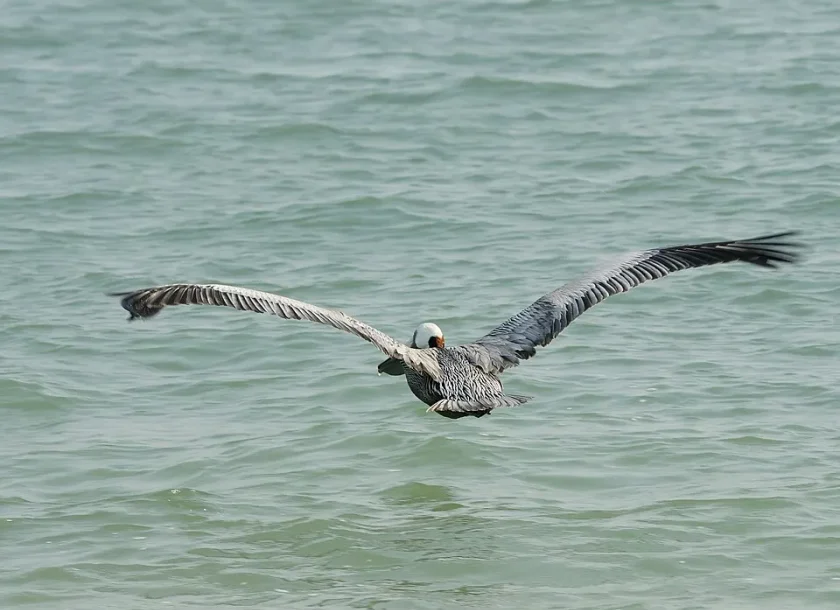
At first glance, a wetland may look like nothing more than shallow water surrounded by tall grasses. Look closer, however, and you might discover a heron hunting fish, a muskrat swimming between reeds, or a turtle basking on a fallen log.
Wetlands are among the world’s most productive ecosystems. They provide food, shelter, breeding grounds, and resting places for a remarkable variety of wildlife.
Beavers, river otters, herons, ducks, alligators, frogs, and dragonflies are some of the best-known animals that live in wetlands. Each has developed unique adaptations for surviving in environments where land and water meet.
Here are 15 fascinating wetland animals, with a particular focus on species found in North America, including their habitats, diets, and distinguishing features.
15 Wetland Animals: Quick Comparison
| Animal | Animal Group | Main Wetland Habitat | Diet |
|---|---|---|---|
| North American Beaver | Mammal | Beaver ponds and swamps | Bark and plants |
| Muskrat | Mammal | Freshwater marshes | Aquatic plants |
| North American River Otter | Mammal | Marshes and rivers | Fish and crustaceans |
| American Mink | Mammal | Marshes and stream banks | Small animals |
| Great Blue Heron | Bird | Marshes and estuaries | Fish and frogs |
| Great Egret | Bird | Marshes and coastal wetlands | Fish and small aquatic animals |
| Mallard | Bird | Ponds and marshes | Plants and invertebrates |
| Wood Duck | Bird | Wooded swamps | Seeds and insects |
| Red-winged Blackbird | Bird | Cattail marshes | Seeds and insects |
| American Alligator | Reptile | Swamps and freshwater marshes | Fish and other animals |
| Painted Turtle | Reptile | Shallow freshwater wetlands | Plants and invertebrates |
| Common Snapping Turtle | Reptile | Marshes and muddy ponds | Plants and aquatic animals |
| American Bullfrog | Amphibian | Permanent freshwater wetlands | Insects and small animals |
| Common Green Darner | Insect | Ponds and marshes | Other insects |
| Atlantic Blue Crab | Crustacean | Salt marshes and estuaries | Shellfish and other organisms |
1. North American Beaver
ALT: North American beaver photographed in Ontario, Canada.
Photo: Vissi Power | Source: Wikimedia Commons | License: CC BY-SA 3.0 | Changes: None if original used.
Scientific name: Castor canadensis
Habitat: Freshwater wetlands, streams, ponds, and wooded swamps.
Diet: Bark, leaves, twigs, and aquatic vegetation.
The North American beaver does more than simply live in wetlands. It can create them.
By building dams across streams with branches, mud, and other natural materials, beavers slow the movement of water. This can flood surrounding areas and create ponds that provide habitats for fish, frogs, water birds, and insects.
Beavers have waterproof fur, large webbed hind feet, and broad, flattened tails that help them move through aquatic environments.
They also build lodges with protected entrances, often located beneath the water’s surface.
Because of their ability to transform landscapes, beavers are often described as ecosystem engineers.
How to recognize it: Look for a large brown rodent with a broad, paddle-shaped tail and a powerful body.
Discover other remarkable wildlife architects in our guide to animals that build their own homes.
2. Muskrat
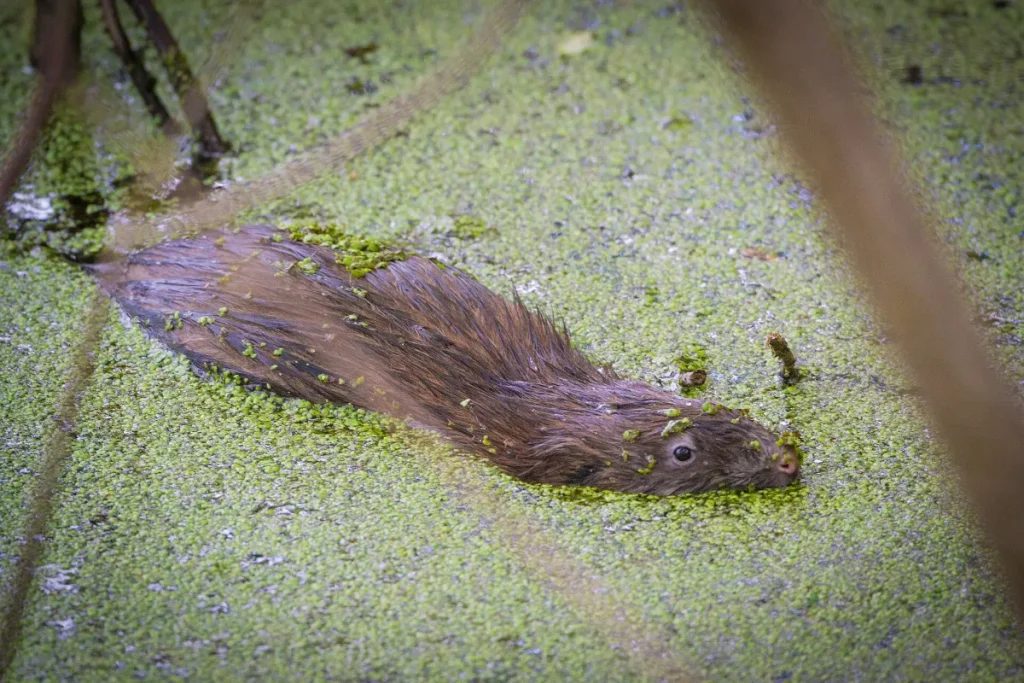
ALT: Muskrat in its natural wetland habitat in Ohio.
Photo: Andrew C | Source: Wikimedia Commons | License: CC BY 2.0 | Changes: None if original used.
Scientific name: Ondatra zibethicus
Habitat: Freshwater marshes, ponds, canals, and slow-moving waterways.
Diet: Cattails, aquatic plants, roots, and occasionally small aquatic animals.
Muskrats are medium-sized rodents commonly associated with freshwater marshes.
Their dense fur helps protect them from cold water, while their partially webbed hind feet and flattened tails assist with swimming.
Muskrats frequently construct shelters using cattails, reeds, and other aquatic vegetation. They may also dig burrows into muddy banks.
Their feeding activities can create openings within dense stands of wetland plants, changing the structure of the marsh and influencing other wildlife.
Although muskrats are frequently mistaken for beavers, they are considerably smaller and have much narrower tails.
How to recognize it: Look for a rounded brown body, small ears, and a long, narrow tail flattened from side to side.
If you discover a dome-shaped structure in a marsh, our beaver lodge vs. muskrat lodge comparison can help you identify its builder.
Freshwater ponds support a remarkable variety of wildlife, from frogs and turtles to fish and aquatic insects. Many of these animals also occur in freshwater wetlands, especially where shallow water and dense vegetation provide food and shelter. Discover more in our guide to 10 animals that live in freshwater ponds.
3. North American River Otter
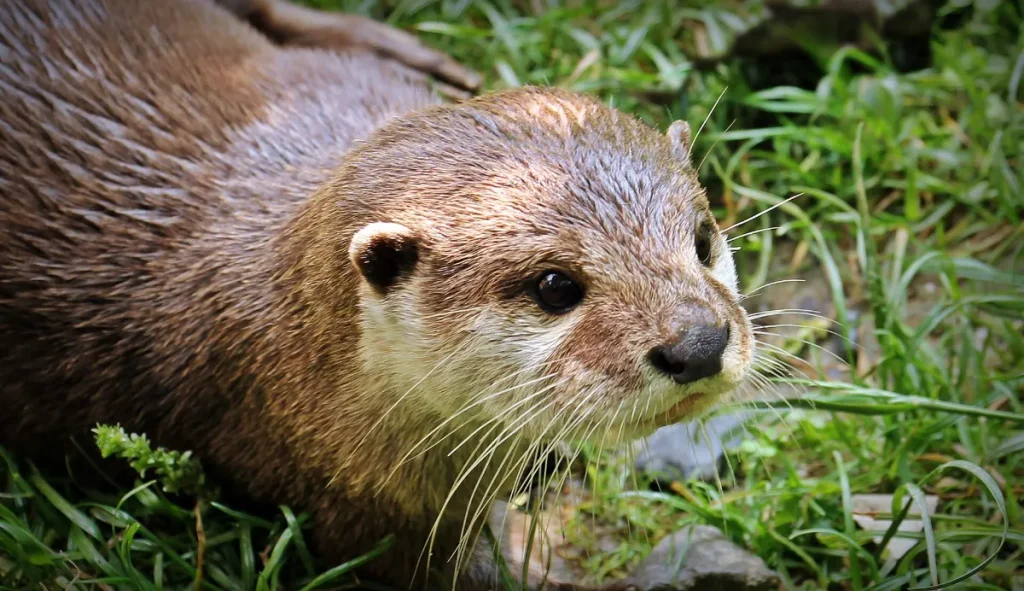
ALT: North American river otter with dense brown fur and prominent whiskers.
Photo: pixel2013 | Source: Wikimedia Commons | License: CC0 1.0 | Changes: None if original used.
Scientific name: Lontra canadensis
Habitat: Rivers, marshes, lakes, swamps, and coastal wetlands.
Diet: Fish, crayfish, frogs, and other aquatic animals.
The North American river otter is an agile aquatic predator that moves easily between land and water.
Its streamlined body, webbed feet, muscular tail, and insulating fur make it an excellent swimmer.
River otters use their sensitive whiskers to help detect prey, including in water where visibility is limited.
They frequently hunt fish and crayfish along riverbanks, submerged vegetation, and shallow wetland channels.
River otters are also known for their playful behavior. They may slide down muddy banks or snowy slopes and chase one another through the water.
Unlike sea otters, North American river otters regularly travel over land and inhabit a variety of freshwater and coastal environments.
How to recognize it: A long, streamlined body, rounded head, prominent whiskers, and thick, tapering tail.
4. American Mink
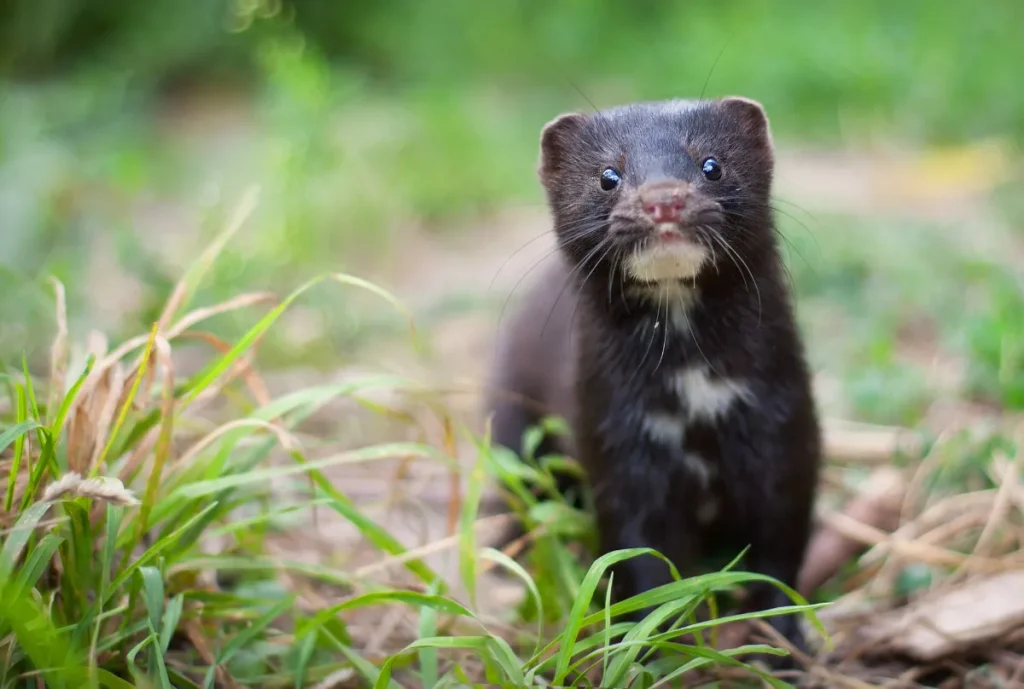
ALT: American mink showing its elongated body and dark brown fur.
Photo: Ryzhkov Sergey | Source: Wikimedia Commons | License: CC BY-SA 4.0 | Changes: None if original used.
Scientific name: Neogale vison (also known as Neovison vison)
Habitat: Marshes, riverbanks, wooded wetlands, and lakeshores.
Diet: Fish, frogs, small mammals, birds, and crustaceans.
The American mink is a slender carnivore that frequently hunts along the edges of wetlands.
Its elongated body allows it to investigate narrow spaces between rocks, vegetation, and animal burrows.
Unlike beavers and muskrats, which mainly eat plants, mink are predators. They search for frogs, fish, rodents, and other small animals both on land and in water.
American mink have dense fur and are capable swimmers, although they spend considerable time exploring shorelines.
They are generally solitary and can be difficult to observe because they often move through dense vegetation.
How to recognize it: Look for a long, dark brown body, short legs, small rounded ears, and sometimes a white patch on the chin.
Mink can resemble other members of the weasel family. Learn how to distinguish them in our mink vs. weasel identification guide.
5. Great Blue Heron

ALT: Great blue heron showing its long legs, curved neck, and pointed bill.
Photo: Mwanner | Source: Wikimedia Commons | License: CC BY-SA 3.0 | Changes: None if original used.
Scientific name: Ardea herodias
Habitat: Freshwater marshes, lakeshores, swamps, estuaries, and coastal wetlands.
Diet: Fish, frogs, crustaceans, insects, and small vertebrates.
The great blue heron is one of the most recognizable wetland birds in North America.
Its long legs allow it to wade through shallow water, while its elongated neck and pointed bill help it capture prey.
A hunting heron may remain almost motionless for several minutes before suddenly striking at a passing fish.
Although fish are an important part of its diet, the great blue heron also eats frogs, crayfish, and occasionally small mammals.
Its slow, deliberate movements allow it to approach prey without creating excessive disturbances in the water.
How to recognize it: Look for a tall blue-gray bird with long legs, a dark stripe above the eye, and a distinctive S-shaped neck.
When flying, it typically holds its neck folded backward, unlike cranes, which usually fly with their necks extended.
6. Great Egret

ALT: Great egret standing near the water with white plumage and a long neck.
Photo: Herbertkikoy | Source: Wikimedia Commons | License: CC BY-SA 4.0 | Changes: None if original used.
Scientific name: Ardea alba
Habitat: Freshwater marshes, swamps, estuaries, and tidal wetlands.
Diet: Fish, frogs, insects, and other small aquatic animals.
The great egret is a large white wading bird found across many parts of the world.
Like other herons, it uses its long legs to move through shallow water and its sharp bill to capture prey.
Great egrets often hunt by standing still or walking slowly through wetland areas where small fish gather.
Their white plumage makes them particularly noticeable against dark vegetation and muddy shorelines.
During the breeding season, adults develop delicate ornamental plumes along their backs.
How to recognize it: Look for a tall, entirely white heron with long dark legs and a long, typically yellow bill.
In North America, the great egret can be distinguished from the smaller snowy egret by its larger size and generally yellow bill. Snowy egrets typically have black bills and conspicuous yellow feet.
7. Mallard
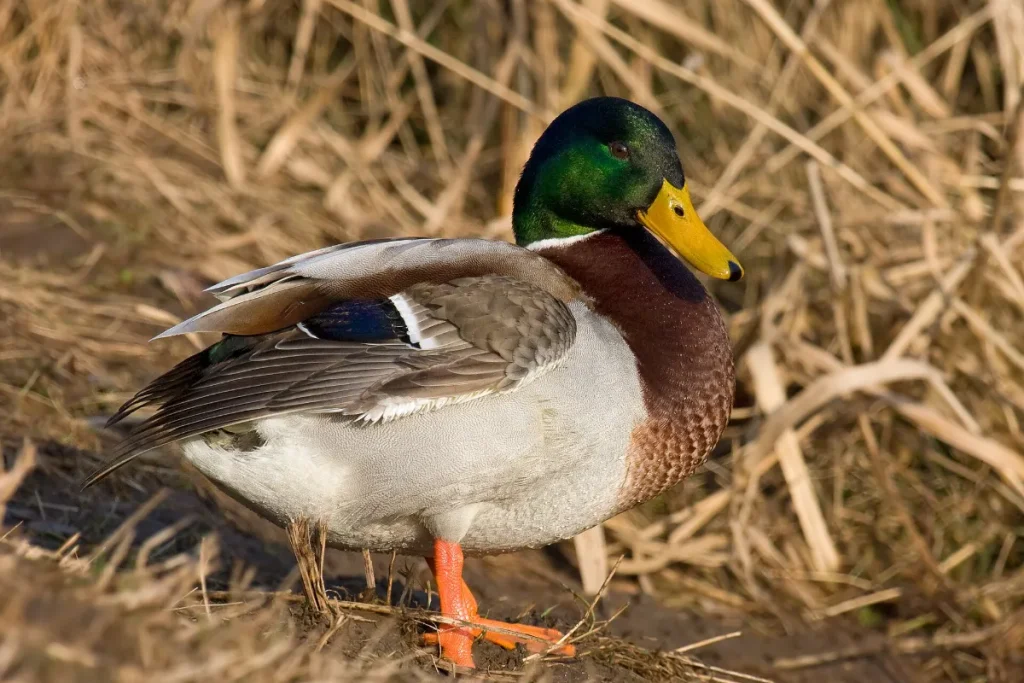
ALT: Male mallard duck with a green head and yellow bill.
Photo: Andreas Trepte | Source: Wikimedia Commons | License: CC BY-SA 2.5 | Changes: None if original used.
Scientific name: Anas platyrhynchos
Habitat: Freshwater marshes, ponds, lakes, rivers, and flooded fields.
Diet: Aquatic vegetation, seeds, insects, and other small invertebrates.
The mallard is one of the world’s most familiar ducks and can be found in both natural wetlands and urban ponds.
Mallards are dabbling ducks, meaning they often feed near the water’s surface rather than diving deeply.
They may tip their bodies forward, leaving their tails pointing upward while reaching underwater vegetation.
Their webbed feet provide efficient propulsion, while their feathers help protect them from water and cold temperatures.
Male mallards are particularly recognizable during the breeding season because of their glossy green heads and white neck rings. Females have mottled brown plumage that provides effective camouflage when nesting.
How to recognize it: Breeding males have green heads and yellow bills, while females are predominantly brown. Both sexes typically have a blue-violet wing patch bordered by white.
Some mallards migrate when temperatures fall, while others remain in areas with accessible food and open water.
Read more in our article about where ducks go in winter.
8. Wood Duck
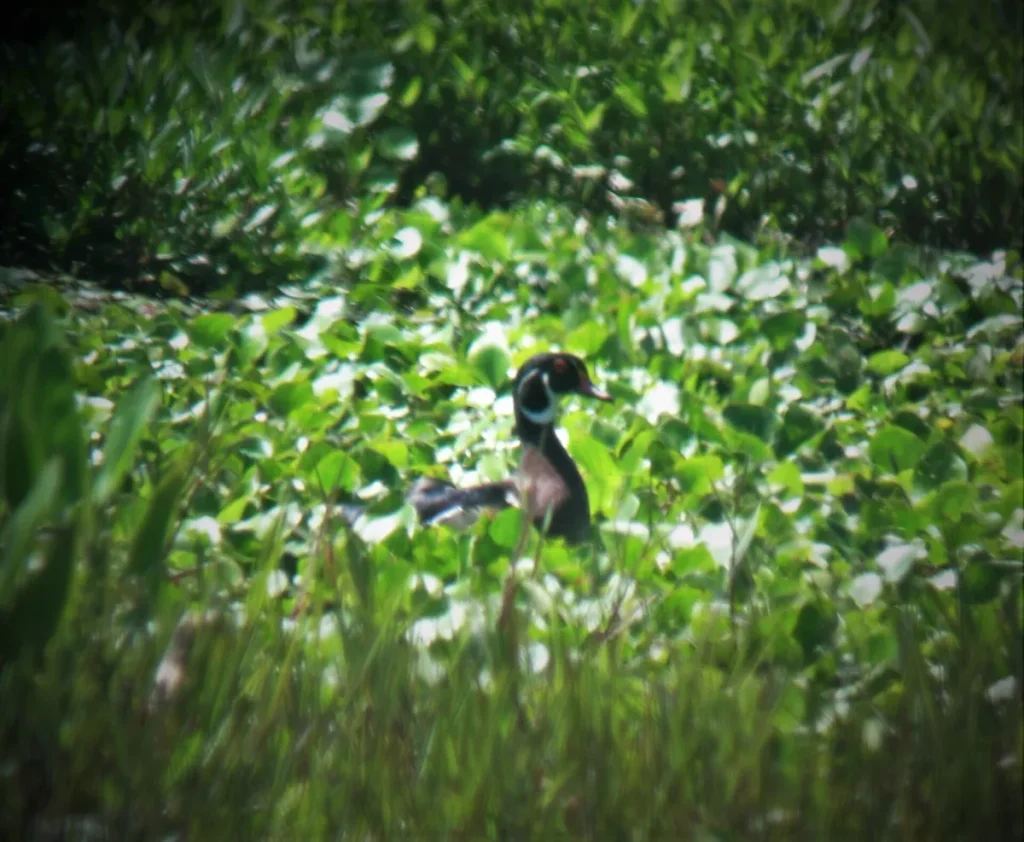
ALT: Male North American wood duck with colorful plumage and distinctive facial markings.
Photo: gailhampshire | Source: Wikimedia Commons | License: CC BY 2.0 | Changes: None if original used.
Scientific name: Aix sponsa
Habitat: Wooded swamps, forest ponds, flooded woodlands, and slow-moving waterways.
Diet: Seeds, acorns, aquatic plants, insects, and other invertebrates.
The wood duck is among the most colorful water birds in North America.
Unlike many ducks that nest on the ground, wood ducks typically nest inside tree cavities near water. They can also use appropriately designed artificial nest boxes.
Soon after hatching, ducklings leave the nest by jumping to the ground or water below. Their mother then leads them toward suitable feeding areas.
Wooded wetlands are particularly valuable to this species because they provide nesting trees, shelter, and feeding opportunities in the same environment.
How to recognize it: Breeding males have iridescent green and purple head feathers, red eyes, distinctive white facial stripes, and a chestnut-colored breast.
Females are less colorful and usually have a noticeable white eye-ring.
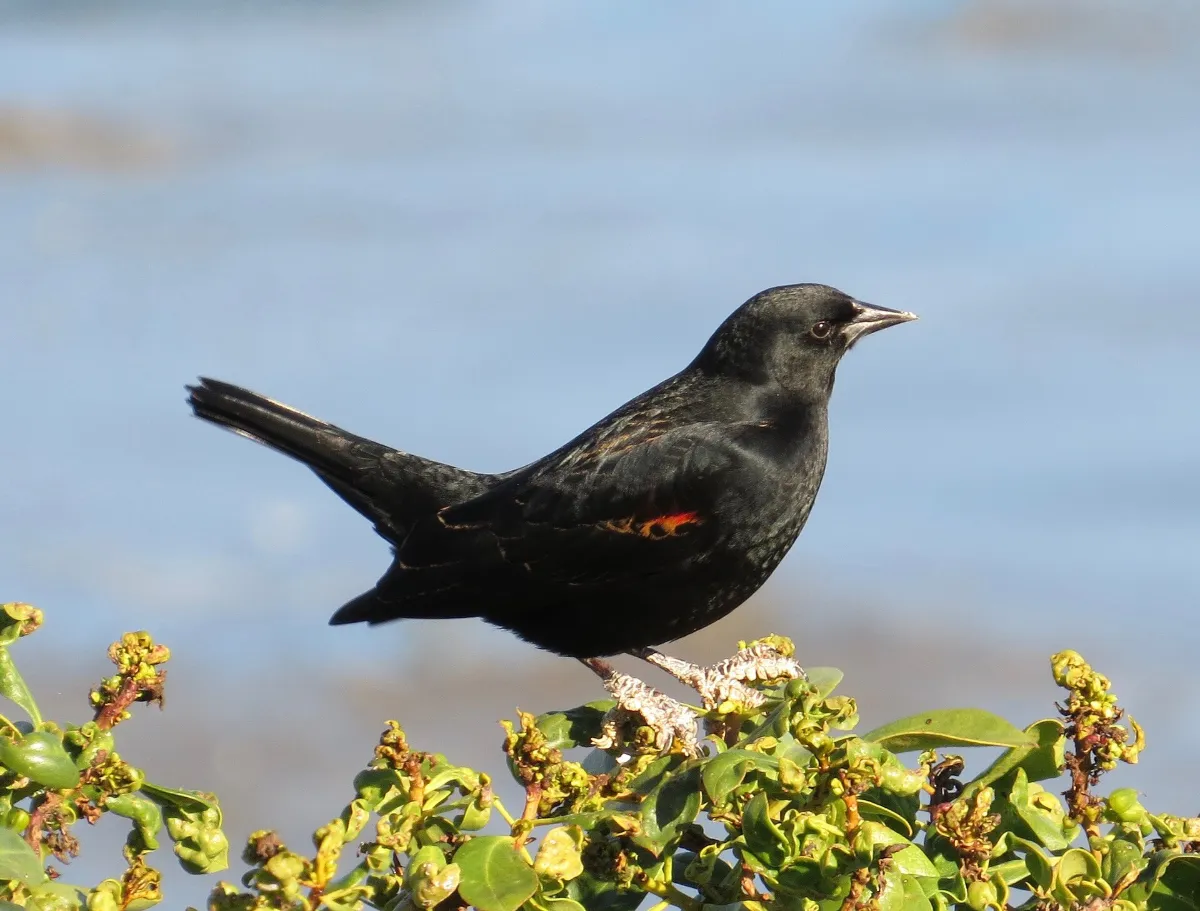
9. Red-winged Blackbird
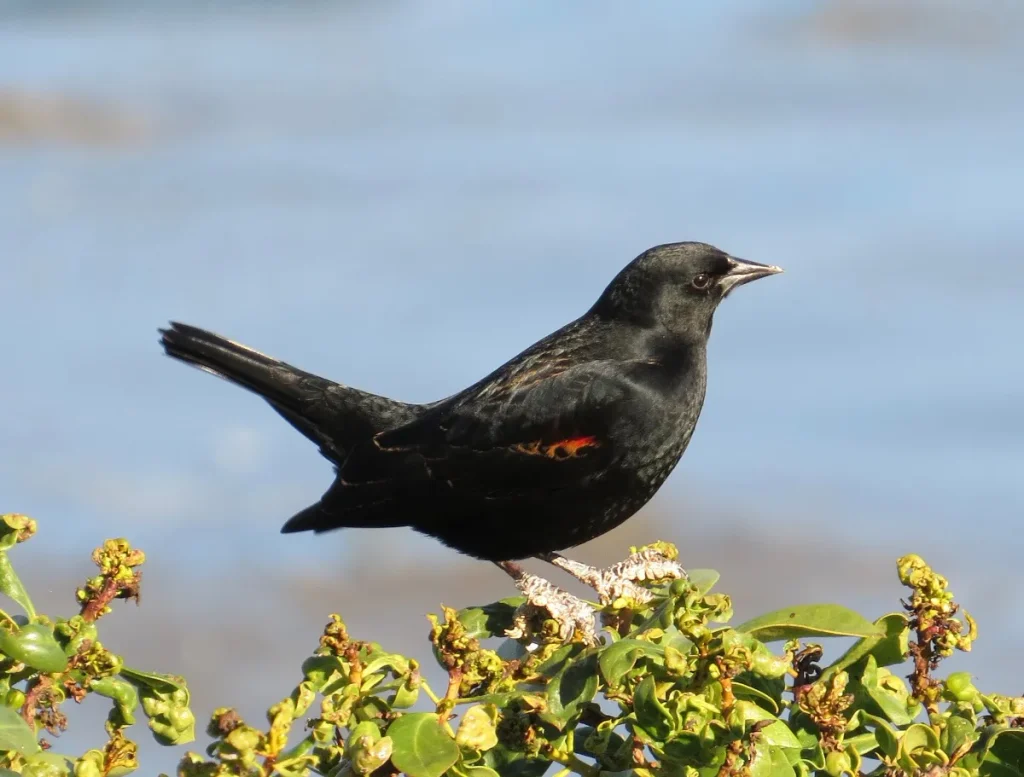
ALT: Male red-winged blackbird showing its distinctive shoulder markings.
Photo: Kaaren Perry | Source: Wikimedia Commons | License: CC BY 2.0 | Changes: None if original used.
Scientific name: Agelaius phoeniceus
Habitat: Cattail marshes, reed beds, wet meadows, and other open habitats.
Diet: Seeds, grains, insects, and other small invertebrates.
The red-winged blackbird is a familiar sight around North American marshes.
Male birds frequently perch on tall cattails or reeds, where they sing and display their colorful shoulder patches.
Dense wetland vegetation provides nesting locations and protection from some predators.
Females construct cup-shaped nests among vegetation and have streaked brown plumage that is much less conspicuous than the male’s black feathers.
Red-winged blackbirds eat a variety of seeds and insects, changing their diet according to seasonal food availability.
How to recognize it: Adult males are mostly black with distinctive red and yellow shoulder patches. Females are brown and heavily streaked.
Despite its name, the red-winged blackbird does not have entirely red wings.
10. American Alligator
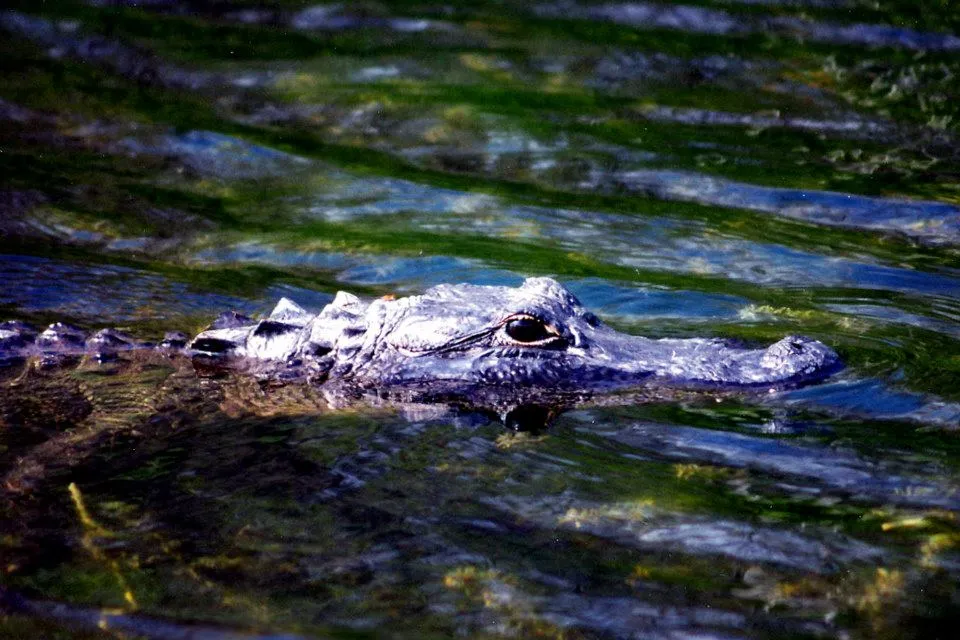
ALT: American alligator in its natural Florida habitat.
Photo: American Lotus | Source: Wikimedia Commons | License: CC BY-SA 4.0 | Changes: None if original used.
Scientific name: Alligator mississippiensis
Habitat: Freshwater swamps, marshes, lakes, and slow-moving rivers in the southeastern United States.
Diet: Fish, turtles, birds, mammals, and other animals.
The American alligator is one of the largest predators found in North American freshwater wetlands.
Its eyes and nostrils are positioned near the top of its head, allowing it to observe its surroundings and breathe while most of its body remains submerged.
A powerful tail helps propel the alligator through water, while its heavily armored skin provides protection.
Alligators also influence their surrounding environment. In some wetlands, they create depressions known as alligator holes that can retain water during dry periods and provide refuge for other animals.
This makes the American alligator an important part of ecosystems such as the Florida Everglades.
How to recognize it: Look for a broad, rounded snout, a large armored body, and a muscular tail.
Never approach, feed, or attempt to handle a wild alligator. Observe it from a safe distance and follow local wildlife regulations.
11. Painted Turtle
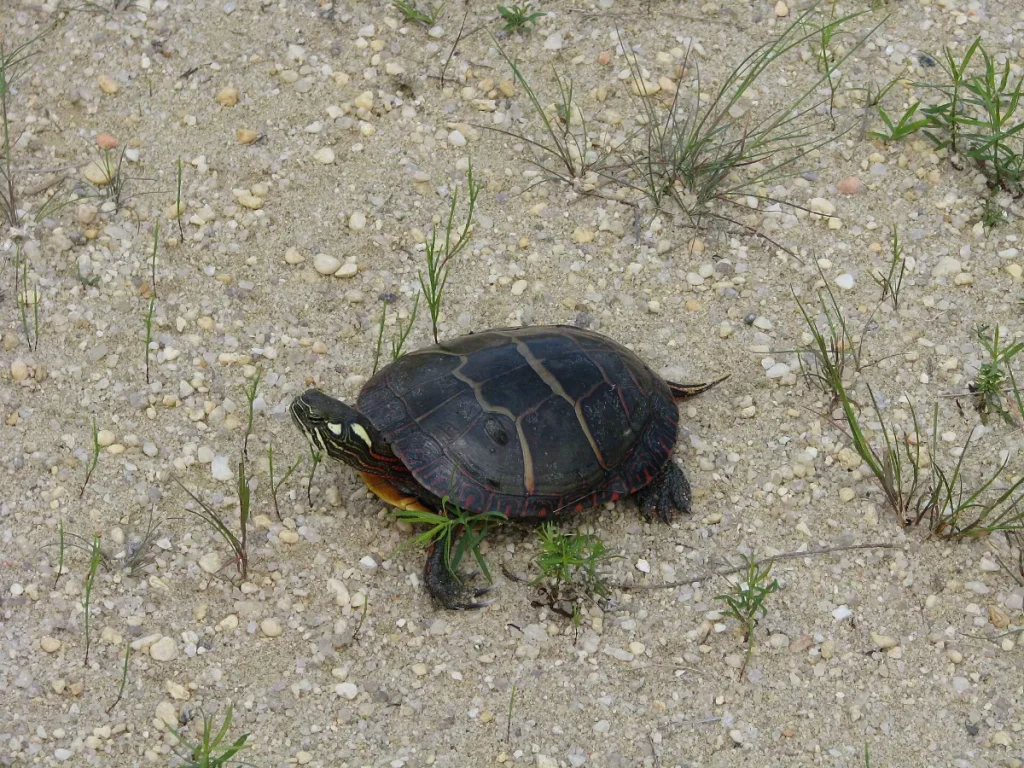
ALT: Painted turtle displaying colorful markings on its head and shell.
Photo: Hornbaker Chelsi / U.S. Fish and Wildlife Service | Source: Wikimedia Commons | License: Public Domain | Changes: None if original used.
Scientific name: Chrysemys picta
Habitat: Shallow ponds, marshes, slow-moving streams, and freshwater wetlands.
Diet: Aquatic plants, algae, insects, and other small aquatic organisms.
The painted turtle is one of the most widespread freshwater turtles in North America.
Its relatively smooth shell and colorful markings make it an attractive and recognizable wetland reptile.
Painted turtles often gather on fallen logs, rocks, or other exposed surfaces to bask in sunlight. Basking helps them regulate their body temperature.
When disturbed, they frequently slide into the water and disappear beneath the surface.
During winter in colder regions, painted turtles can remain inactive underwater for extended periods, supported by remarkable physiological adaptations.
How to recognize it: Look for a relatively flat, smooth shell and red, orange, or yellow markings on the head, neck, and edges of the shell.
12. Common Snapping Turtle
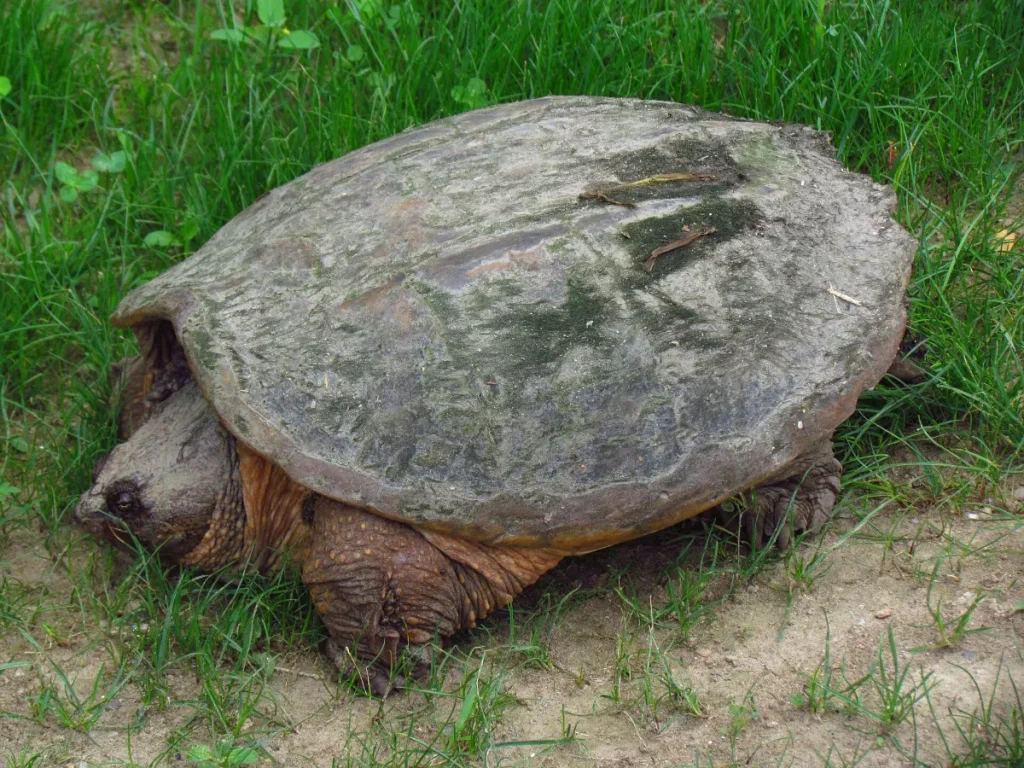
ALT: Common snapping turtle photographed near the Rideau River in Ontario.
Photo: D. Gordon E. Robertson | Source: Wikimedia Commons | License: CC BY-SA 3.0 | Changes: None if original used.
Scientific name: Chelydra serpentina
Habitat: Marshes, muddy ponds, slow-moving rivers, and freshwater swamps.
Diet: Aquatic plants, fish, insects, amphibians, carrion, and other animals.
The common snapping turtle is a large freshwater reptile that spends much of its time in water.
Its long neck, strong jaws, and relatively small lower shell distinguish it from many other freshwater turtles.
Snapping turtles often rest among submerged vegetation or muddy sediments, where their appearance helps them remain inconspicuous.
They consume both plant and animal material and may also feed on carrion.
Although snapping turtles can defend themselves vigorously when threatened on land, they generally prefer to avoid encounters with people.
How to recognize it: Look for a large head, a strong hooked beak, a long tail with raised scales, and a heavy shell.
Never attempt to pick up a snapping turtle. Its long neck allows it to bite surprisingly far behind its head.
13. American Bullfrog

ALT: American bullfrog photographed beside the Des Moines River in Iowa.
Photo: Jim417 | Source: Wikimedia Commons | License: CC BY-SA 4.0 | Changes: None if original used.
Scientific name: Lithobates catesbeianus (also known as Rana catesbeiana)
Habitat: Permanent ponds, freshwater marshes, lakes, and slow-moving waterways.
Diet: Insects, small fish, crayfish, and other small animals.
The American bullfrog is a large amphibian commonly found around permanent freshwater wetlands.
Its powerful hind legs allow it to leap into water when threatened, while its green and brown coloration helps it blend into surrounding vegetation.
Bullfrogs are opportunistic predators. They frequently wait near the water’s edge before capturing insects or other animals that come within reach.
Their tadpoles develop in water, which makes suitable aquatic habitats essential for reproduction.
Male bullfrogs produce deep, resonant calls that can be heard across ponds and marshes during the breeding season.
How to recognize it: Look for a large greenish or brown frog with a prominent circular eardrum behind each eye.
Unlike some frogs that breed in temporary pools, bullfrogs generally favor longer-lasting bodies of water.
Discover how amphibians survive colder temperatures in our guide to where frogs go in winter.
14. Common Green Darner

ALT: Male common green darner dragonfly photographed in a Texas wildlife refuge.
Photo: William L. Farr | Source: Wikimedia Commons | License: CC BY-SA 4.0 | Changes: None if original used.
Scientific name: Anax junius
Habitat: Ponds, marshes, lakes, and other freshwater environments.
Diet: Insects and other small prey.
The common green darner is a large dragonfly frequently seen flying above wetland vegetation and open water.
Although adult dragonflies spend much of their time in the air, their early development takes place underwater.
Dragonfly larvae are aquatic predators that feed on smaller organisms. After completing their underwater development, they emerge and transform into winged adults.
Adult green darners capture insects during flight, including mosquitoes and other flying insects.
Some populations undertake seasonal migrations, making this dragonfly an especially interesting example of an insect that connects aquatic and terrestrial environments.
How to recognize it: Look for a large dragonfly with a bright green thorax, transparent wings, and an elongated abdomen. Mature males typically have a blue abdomen.
15. Atlantic Blue Crab

ALT: Male Atlantic blue crab photographed in southern Louisiana.
Photo: Karkinos19 | Source: Wikimedia Commons | License: CC BY-SA 4.0 | Changes: None if original used.
Scientific name: Callinectes sapidus
Habitat: Estuaries, tidal creeks, salt marshes, and coastal waters.
Diet: Mollusks, small fish, worms, other crustaceans, and plant material.
Not all wetlands contain freshwater. Coastal wetlands are also home to a wide variety of specialized animals.
The Atlantic blue crab is an excellent example of a species associated with estuaries, where freshwater from rivers mixes with seawater.
Its last pair of legs is flattened into paddle-like structures, making it an effective swimmer.
Salt marsh creeks and other shallow estuarine habitats provide important feeding and nursery areas during parts of the blue crab’s life cycle.
Blue crabs are both predators and scavengers, contributing to the movement of energy through coastal food webs.
How to recognize it: Look for a broad shell with pointed sides, colorful claws, and flattened swimming legs.
Coastal wetlands support many other crustaceans, including species adapted to mangrove forests. Discover more in our guide to mangrove crabs.
Coastal wetlands are not the only habitats shaped by the movement of seawater. Rocky shorelines also support remarkable wildlife adapted to changing tides, powerful waves, and periods of exposure to air. Explore our guide to 12 animals that live in the intertidal zone to discover these fascinating coastal species.
What Are Wetlands?
Wetlands are areas where water covers the ground or saturates the soil for long enough to influence the plants, animals, and ecological processes found there.
Some wetlands remain flooded throughout the year, while others become wet only during particular seasons.
They are not simply lakes or rivers. Many wetlands contain shallow water, waterlogged soil, specialized plants, and a mixture of aquatic and terrestrial habitats.
This variety creates opportunities for animals with very different survival strategies.
Different Types of Wetlands and Their Animals
Wetlands can differ significantly depending on their water source, vegetation, salinity, and geographical location.
| Wetland Type | Main Characteristics | Examples of Animals |
|---|---|---|
| Freshwater Marsh | Shallow water with grasses, reeds, and cattails | Muskrats, mallards, frogs |
| Swamp | Wetland dominated by trees or shrubs | Wood ducks, alligators, beavers |
| Bog | Peat-forming wetland, typically acidic and nutrient-poor | Certain dragonflies, amphibians, and specialist birds |
| Fen | Peat-forming wetland influenced by mineral-rich water | Frogs, insects, and wetland birds |
| Salt Marsh | Coastal wetland regularly influenced by tides | Blue crabs, egrets, and shorebirds |
| Mangrove Wetland | Coastal habitat dominated by salt-tolerant trees | Crabs, mudskippers, and various water birds |
An animal that thrives in a freshwater marsh may be unable to survive in a salty coastal wetland.
Others, including several species of herons and river otters, can use both freshwater and coastal environments.
Mangrove forests are particularly fascinating because their exposed roots provide shelter for numerous specialized species. Explore our guide to animals that live in mangroves to learn more.
Salt marshes are a special type of coastal wetland where animals must survive changing tides and saline water. Discover how fiddler crabs, diamondback terrapins, marsh sparrows, and other species adapt in our guide to 10 animals that live in salt marshes.
How Do Animals Adapt to Wetland Habitats?
Animals that live in wetlands have developed a remarkable range of adaptations for finding food, moving through water, avoiding predators, and reproducing successfully.
Webbed Feet
Ducks, beavers, and river otters use webbed feet to move efficiently through water.
The increased surface area allows them to push against water with greater effectiveness.
Waterproof Feathers and Water-Resistant Fur
Many water birds have feathers that help resist water penetration, while aquatic mammals possess dense fur that assists with insulation.
These features help animals maintain body temperature in wet and sometimes cold environments.
Long Legs and Specialized Bills
Herons and egrets have long legs that allow them to wade into relatively shallow water without fully submerging their bodies.
Their pointed bills are well suited to capturing aquatic prey.
Camouflage
Frogs, turtles, and some wetland birds possess colors or patterns that help them blend into vegetation, muddy sediments, or surrounding water.
Camouflage can help predators approach prey and prey animals avoid detection.
Aquatic Life Cycles
Dragonflies and amphibians often depend on water during important stages of their development.
Even when their adult forms spend considerable time on land or in the air, suitable aquatic habitats remain essential for reproduction.
What Does a Wetland Food Chain Look Like?
Wetlands contain complex food webs connecting plants, microscopic organisms, insects, fish, amphibians, birds, and mammals.
A simplified freshwater wetland food chain might look like this:
Algae → Aquatic insect larva → Small fish → Great blue heron
Another possible food chain is:
Aquatic plants → Muskrat → American mink
These examples illustrate how energy moves between organisms.
However, real wetland food webs are much more complicated because most animals consume several different types of food and may serve as prey for multiple predators.
Decomposers, including bacteria and fungi, also play an important role by breaking down dead organic matter and recycling nutrients.
How to Identify Common Wetland Animals
You do not always need to see an animal clearly to determine which species may be nearby.
Its movements, tracks, shelters, and feeding signs can provide valuable clues.
| What You Notice | Possible Animal |
|---|---|
| Freshly cut branches and a dam across a stream | Beaver |
| A small dome-shaped mound made from reeds | Muskrat |
| A long, streamlined mammal swimming with a tapering tail | River otter |
| A tall gray bird standing motionless in shallow water | Great blue heron |
| A tall white bird searching for fish | Great egret or another white heron |
| A dark bird displaying colorful shoulder patches | Red-winged blackbird |
| Turtles basking on floating logs | Painted turtle or another freshwater turtle |
| Deep, resonant frog calls during warm evenings | American bullfrog |
| Large insects patrolling above the water | Dragonflies |
These are useful starting points rather than definitive identification rules. Local species, geography, season, and additional physical characteristics should also be considered.
For the best wildlife observation experience, visit established trails or boardwalks, move quietly, and use binoculars.
Avoid disturbing nests, entering sensitive marsh vegetation, or feeding wild animals.
Why Are Wetlands Important for Wildlife?
Wetlands provide much more than a source of drinking water.
They support wildlife by offering:
- Breeding grounds for amphibians and aquatic insects.
- Nesting habitats for water birds.
- Feeding areas for fish, reptiles, and mammals.
- Nursery habitats for numerous coastal fish and crustaceans.
- Resting places for migratory birds.
- Shelter during unfavorable environmental conditions.
Wetlands also help regulate water movement, store floodwater, trap sediments, and improve water quality.
When wetlands are drained, polluted, or fragmented, the effects can extend far beyond the animals that live directly within them.
Protecting wetlands helps maintain the ecological connections between rivers, forests, coastal environments, and surrounding landscapes.
Frequently Asked Questions
What animals live in wetlands?
Wetland animals include beavers, muskrats, river otters, mink, ducks, herons, alligators, turtles, frogs, dragonflies, fish, and numerous aquatic invertebrates.
The species present depend on the type of wetland and its geographical location.
What mammals live in wetlands?
Common North American wetland mammals include beavers, muskrats, river otters, and American mink.
Other mammals, such as raccoons and deer, may regularly visit wetlands for food, water, or shelter.
What animals live in freshwater marshes?
Freshwater marshes commonly support muskrats, mallards, herons, red-winged blackbirds, frogs, turtles, fish, and dragonflies.
Dense aquatic vegetation provides many of these animals with food and protection.
What animals live in saltwater wetlands?
Salt marshes and other coastal wetlands support crabs, shrimp, fish, shorebirds, egrets, and various marine invertebrates.
Many of these animals are adapted to changing salinity and tidal water levels.
Are all wetlands freshwater?
No. Wetlands can contain freshwater, saltwater, or brackish water.
Brackish water contains a mixture of freshwater and seawater and is commonly found in estuaries.
What is the difference between a marsh and a swamp?
Marshes are generally dominated by grasses, reeds, and other non-woody plants.
Swamps are typically dominated by trees or woody shrubs.
Both can support diverse wildlife populations.
What is the largest animal found in North American wetlands?
The American alligator is among the largest resident predators in freshwater wetlands of the southeastern United States.
Large mammals such as moose may also use wetlands, particularly in northern regions.
Do wetland animals hibernate in winter?
Some wetland animals become inactive during colder months, while others continue searching for food.
Certain turtles and frogs spend winter in protected aquatic or terrestrial locations. Beavers remain active, and many migratory birds travel to warmer regions or areas with accessible open water.
Final Thoughts
Wetlands are dynamic ecosystems where land and water meet, creating habitats for an extraordinary range of animals.
From beavers engineering entire ponds to dragonflies developing beneath the water’s surface, each species contributes to the complex relationships that keep these environments functioning.
The next time you visit a marsh, swamp, or coastal wetland, spend a few minutes observing the water’s edge.
What appears to be a quiet landscape may actually be filled with wildlife, hidden movements, and fascinating survival strategies.
Related Articles
- 8 Mangrove Animals and Where They Live
- Animals That Build Their Own Homes
- Beaver Lodge vs. Muskrat Lodge
- Animals That Look Like Beavers
- Animals That Live in Caves
References and Further Reading
- U.S. Environmental Protection Agency – Classification and Types of Wetlands
- U.S. Environmental Protection Agency – Wetlands
- U.S. Fish and Wildlife Service – Essential Wetland Habitats
- U.S. Fish and Wildlife Service – Watching Out for Wetlands
- Penn State Extension – Managing Your Restored Wetland
- Smithsonian’s National Zoo – North American River Otter
- Cornell Lab of Ornithology – Great Blue Heron Identification