Salt marshes may look like quiet stretches of grass and muddy water, but they are home to an extraordinary variety of wildlife. Beneath the tall coastal grasses, fiddler crabs dig burrows, small fish move through tidal creeks, and secretive birds search for food.
Unlike freshwater marshes, salt marshes are regularly influenced by seawater. Their animals must cope with changing tides, salty water, soft mud, and occasional flooding.
Saltmarsh sparrows, clapper rails, diamondback terrapins, fiddler crabs, mummichogs, and marsh periwinkles are among the fascinating animals that live in these coastal environments.
Some species depend heavily on salt marshes for their entire life cycles, while others use the habitat for nesting, feeding, or shelter.
Here are 10 remarkable salt marsh animals found along the Atlantic and Gulf coasts of North America, including their identification features, diets, adaptations, and roles in the ecosystem.
10 Salt Marsh Animals: Quick Comparison
| Animal | Scientific Name | Typical Salt Marsh Habitat | Main Food |
|---|---|---|---|
| Saltmarsh Sparrow | Ammospiza caudacuta | High and middle marsh grasses | Insects, small invertebrates, seeds |
| Seaside Sparrow | Ammospiza maritima | Dense tidal marsh vegetation | Insects, spiders, seeds |
| Clapper Rail | Rallus crepitans | Marsh grasses and tidal creek edges | Crabs, snails, small fish |
| Marsh Wren | Cistothorus palustris | Reeds and dense emergent vegetation | Insects and spiders |
| Diamondback Terrapin | Malaclemys terrapin | Brackish tidal creeks and marsh edges | Snails, crabs, mollusks |
| Sand Fiddler Crab | Leptuca pugilator | Sandy marsh edges and tidal flats | Algae and organic particles |
| Marsh Periwinkle | Littoraria irrorata | Saltmarsh cordgrass | Fungi, algae, organic material |
| Mummichog | Fundulus heteroclitus | Shallow tidal creeks and marsh pools | Small invertebrates, algae, detritus |
| Atlantic Ribbed Mussel | Geukensia demissa | Muddy marsh banks and grass roots | Plankton and suspended particles |
| Atlantic Blue Crab | Callinectes sapidus | Tidal creeks and estuarine marshes | Mollusks, fish, crustaceans |
1. Saltmarsh Sparrow
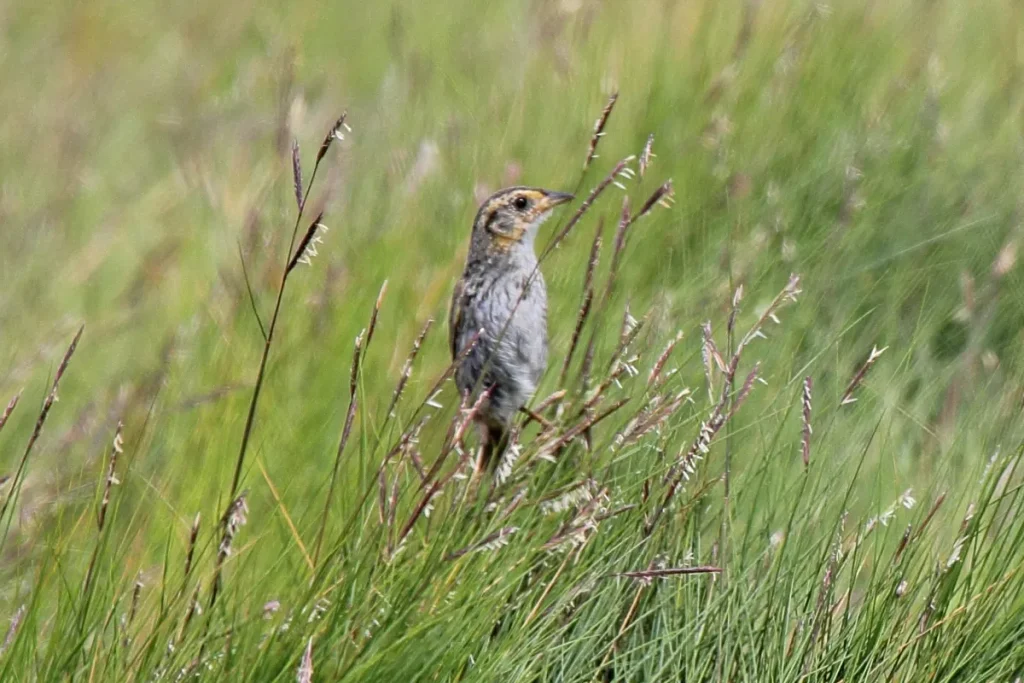
ALT: Saltmarsh sparrow perched among coastal marsh grasses with orange facial markings.
Photo: Dominic Sherony | Source: Wikimedia Commons | License: CC BY-SA 2.0 | Changes: None if original used.
Scientific name: Ammospiza caudacuta
Habitat: Tidal salt marshes along the Atlantic coast of the United States.
Diet: Insects, spiders, other small invertebrates, and seeds.
The Saltmarsh Sparrow is one of North America’s most specialized coastal songbirds.
Unlike familiar backyard sparrows, this species depends strongly on tidal salt marshes for breeding.
Its brown and gray feathers help it blend into dense marsh grasses, while its orange-colored facial markings provide a useful identification feature.
Saltmarsh Sparrows build their nests close to the ground among salt-tolerant vegetation.
Their breeding success depends on the relationship between nesting schedules and tidal flooding.
When unusually high tides cover nesting areas, eggs and young birds may be lost.
Some females attempt to synchronize nesting with the intervals between particularly high tides, reducing the likelihood that nests will be flooded.
However, rising sea levels and increasingly frequent flooding can make successful reproduction more difficult.
How to recognize it: Look for a small, heavily streaked sparrow with orange-buff markings around the face and a relatively long, pointed bill.
Interesting fact: Saltmarsh Sparrows are especially vulnerable to habitat loss because their breeding depends on a narrow range of coastal conditions.
2. Seaside Sparrow
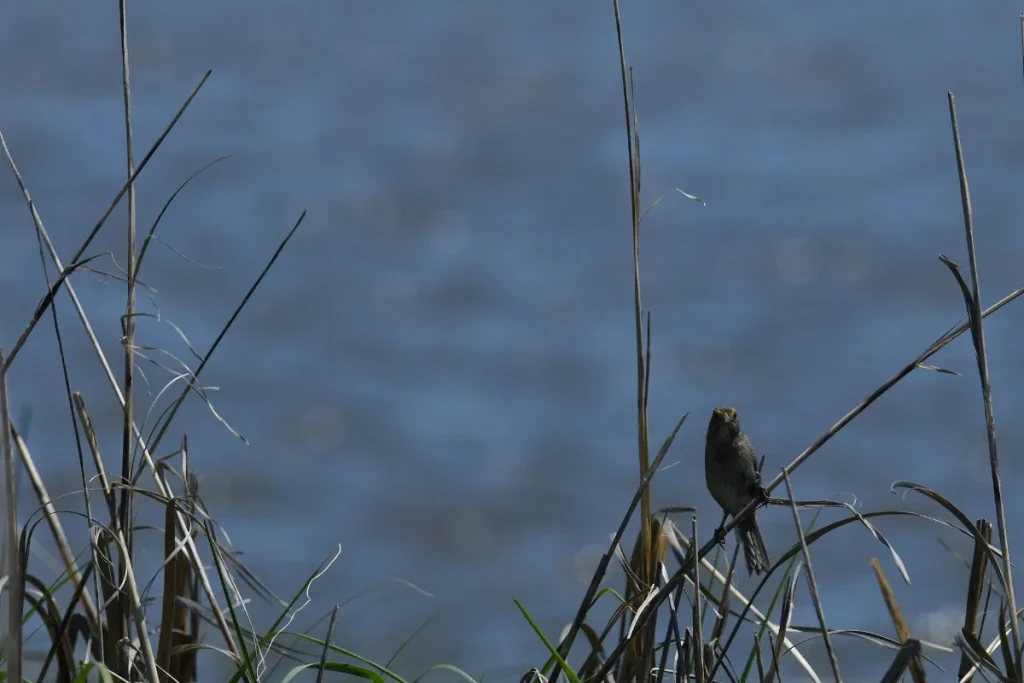
ALT: Seaside sparrow showing dark gray plumage and yellow markings near the eyes.
Photo: lwolfartist (Laura Wolf) | Source: Wikimedia Commons | License: CC BY 2.0 | Changes: None if original used.
Scientific name: Ammospiza maritima
Habitat: Coastal salt marshes along the Atlantic and Gulf coasts.
Diet: Insects, spiders, small crustaceans, and seeds.
The Seaside Sparrow is another songbird closely associated with coastal marshes.
Its relatively dark gray and brown plumage provides excellent camouflage among mud, reeds, and marsh grasses.
Unlike the Saltmarsh Sparrow, which often has noticeable orange-buff facial markings, the Seaside Sparrow generally appears darker and has a distinct yellow area in front of the eyes.
Seaside Sparrows move through dense vegetation, often staying close to the ground.
They build nests among grasses and other marsh plants, where surrounding vegetation helps conceal eggs and young birds.
Their breeding habitats are affected by tidal flooding, vegetation changes, and coastal development.
Although they can be difficult to see, their songs and calls often reveal their presence.
How to recognize it: Look for a dark, stocky sparrow with a substantial bill, grayish plumage, and yellow markings near the eyes.
Interesting fact: Several geographically distinct populations of Seaside Sparrows occur along the American coastline.
3. Clapper Rail
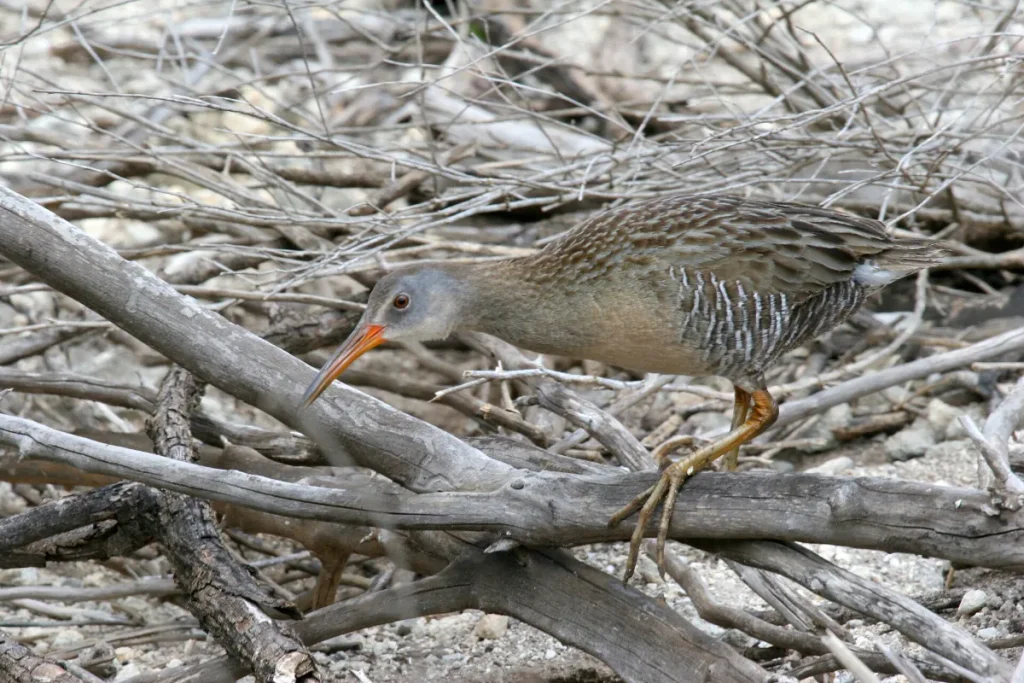
ALT: Clapper rail with a long bill, gray-brown body, and reddish chestnut markings.
Photo: Dominic Sherony | Source: Wikimedia Commons | License: CC BY-SA 2.0 | Changes: None if original used. Photograph taken in Jamaica.
Scientific name: Rallus crepitans
Habitat: Tidal salt marshes, brackish marshes, and coastal mangrove habitats.
Diet: Fiddler crabs, other crustaceans, mollusks, insects, and small fish.
The Clapper Rail is a secretive marsh bird that is often heard long before it is seen.
Its loud, clattering calls can travel across coastal wetlands, especially during the breeding season.
Although it is a relatively large rail, the bird is surprisingly difficult to observe.
Its narrow body allows it to slip between thick marsh grasses, while its brown and gray plumage helps it remain inconspicuous.
Clapper Rails frequently search muddy areas and tidal creek edges for fiddler crabs and other small animals.
Their long, slightly curved bills are useful for investigating mud and vegetation.
They build concealed nests in dense marsh plants, often above the normal water level.
How to recognize it: Look for a chicken-sized marsh bird with long legs, a narrow body, a long slightly curved bill, and gray-brown coloration.
Interesting fact: A Clapper Rail may be only a short distance away, yet remain completely hidden within marsh vegetation.
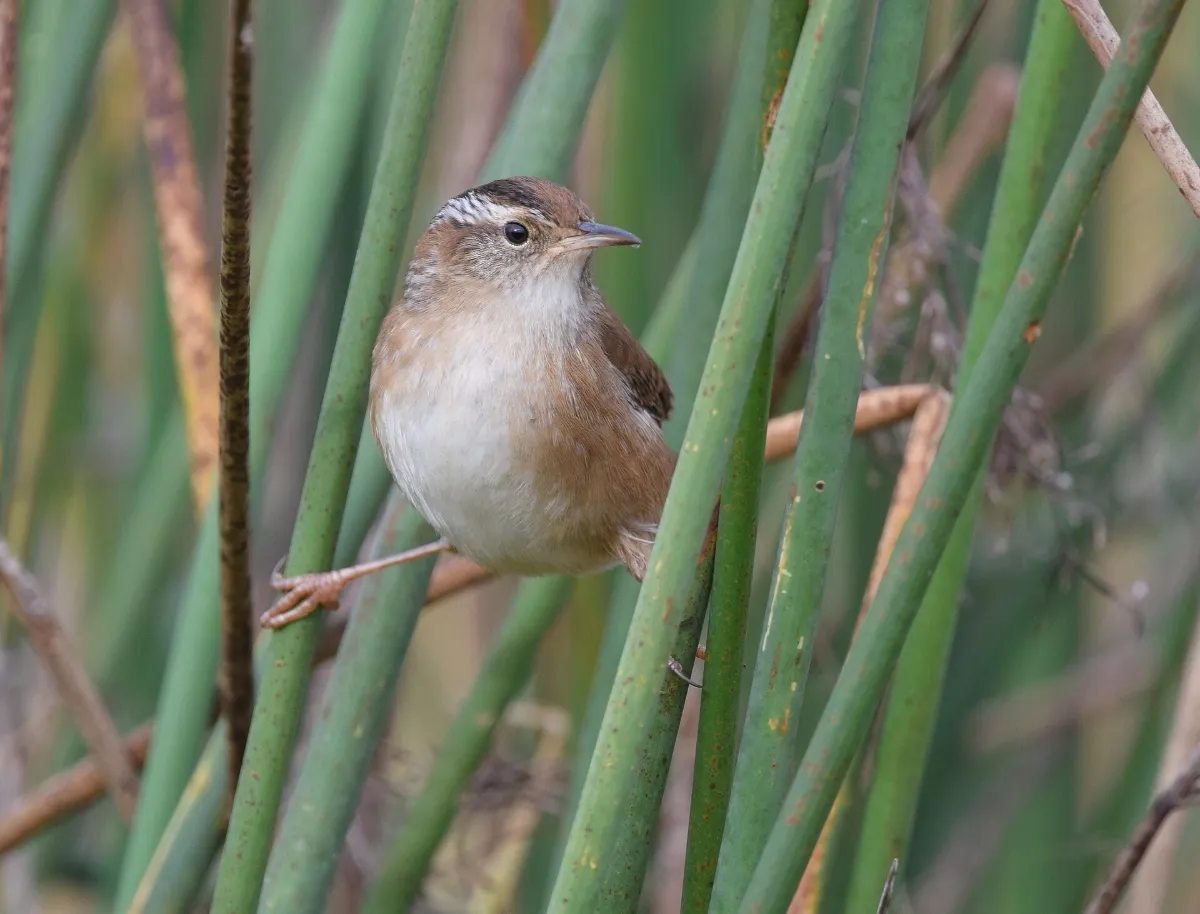
4. Marsh Wren
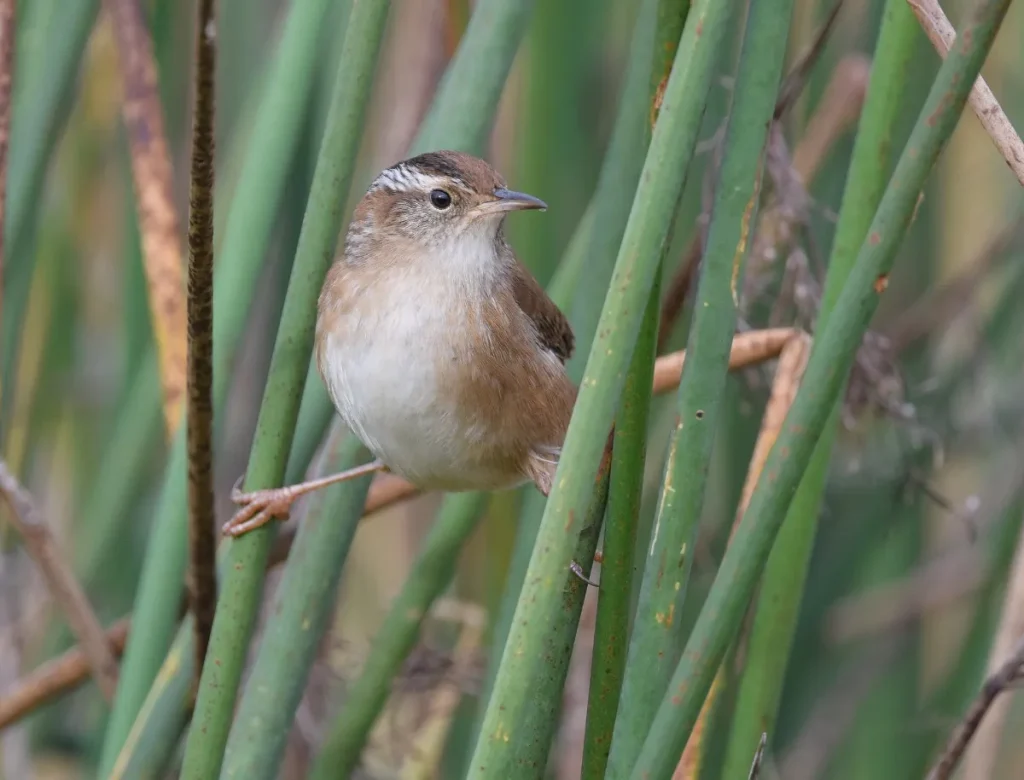
ALT: Marsh wren with a small brown body and an upward-pointing tail.
Photo: Andy Reago and Chrissy McClarren | Source: Wikimedia Commons | License: CC BY 2.0 | Changes: None if original used. Photograph shows the species at an inland wetland in Missouri.
Scientific name: Cistothorus palustris
Habitat: Freshwater marshes, brackish wetlands, and suitable coastal salt marshes.
Diet: Insects, spiders, and other small invertebrates.
The Marsh Wren is a tiny, energetic bird that often disappears into thick vegetation.
It has a rounded brown body, pale eyebrow, and short tail that is frequently held upright.
Although Marsh Wrens are not restricted to salt marshes, suitable coastal wetlands provide important habitat for some populations.
These birds spend much of their time moving through reeds and grasses while searching for insects.
Male Marsh Wrens may construct several nest-like structures during the breeding season.
These woven structures can help attract females, although not all are used for raising young.
The nests are typically attached to upright vegetation.
Their construction demonstrates how even small birds can create complex shelters using natural materials.
Read more about animal architecture in our guide to animals that build their own homes.
How to recognize it: Look for a very small brown bird with a pale eyebrow, a short upward-pointing tail, and a loud, rattling song.
Interesting fact: Despite their small size, male Marsh Wrens can be extremely vocal and territorial during the breeding season.
5. Diamondback Terrapin
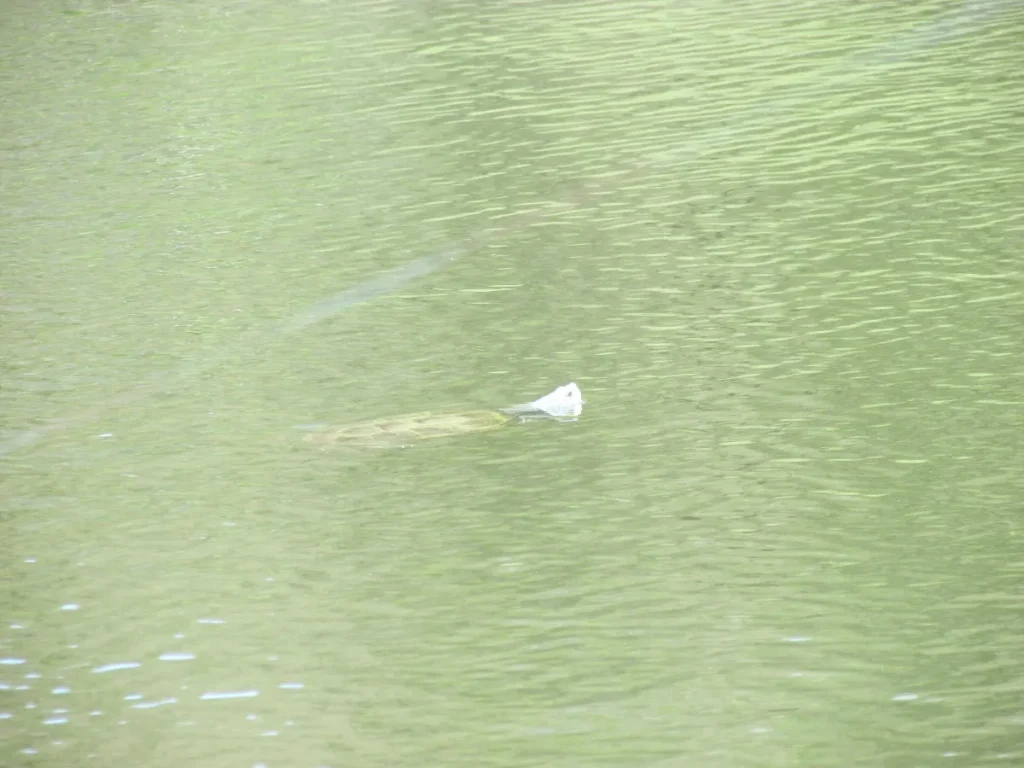
ALT: Diamondback terrapin swimming in a saltwater creek near Ocracoke Island, North Carolina.
Photo: DrStew82 | Source: Wikimedia Commons | License: CC BY-SA 4.0 | Changes: None if original used.
Scientific name: Malaclemys terrapin
Habitat: Brackish tidal creeks, salt marshes, estuaries, and coastal lagoons.
Diet: Snails, crabs, clams, and other aquatic invertebrates.
The Diamondback Terrapin is one of the most distinctive reptiles associated with North American salt marshes.
Unlike most freshwater turtles, it is specially adapted to coastal waters where freshwater mixes with seawater.
Its shell often displays concentric, diamond-like markings, while its skin may have dark spots or speckles.
Diamondback Terrapins frequently forage in tidal creeks and shallow marsh waters.
They consume a variety of invertebrates, including marsh snails and small crustaceans.
Although they spend much of their time in water, females must leave the water to lay eggs on suitable land above the normal tide level.
This makes access to protected nesting areas especially important.
Terrapins face threats from habitat loss, road traffic near nesting sites, and accidental capture in crab traps.
How to recognize it: Look for a medium-sized turtle with a patterned shell, pale spotted skin, and a relatively broad head.
Interesting fact: Diamondback Terrapins are particularly associated with brackish coastal environments rather than typical freshwater ponds.
6. Sand Fiddler Crab
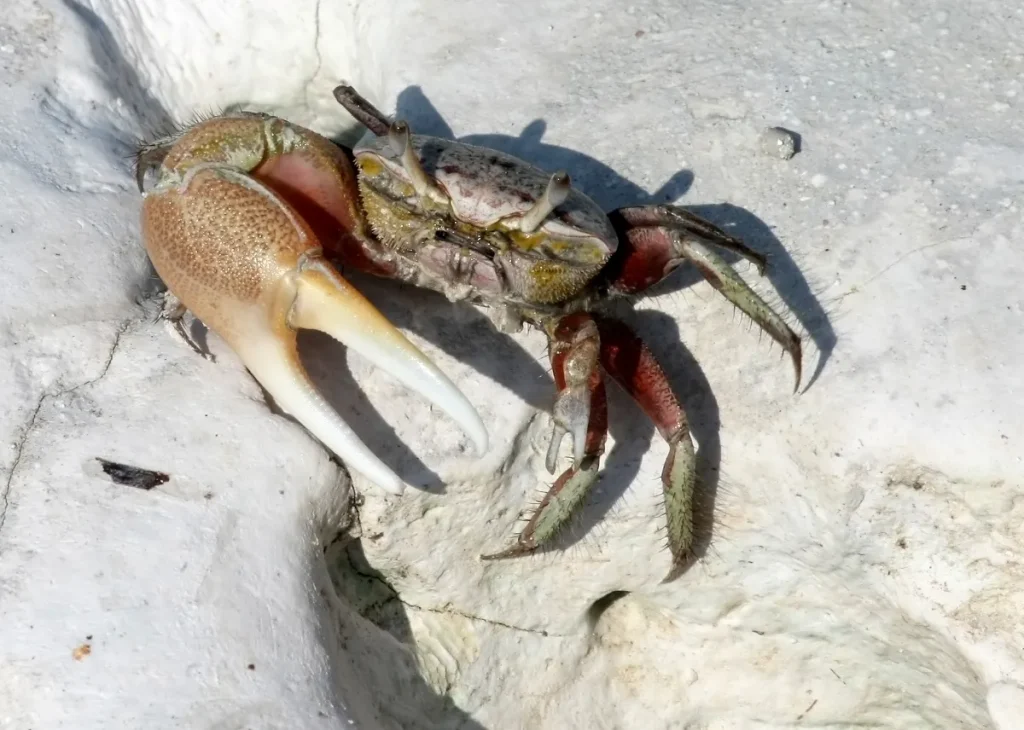
ALT: Male sand fiddler crab beside its burrow with one enlarged claw.
Photo: Ianaré Sévi | Source: Wikimedia Commons | License: CC BY-SA 3.0 | Changes: Source file is cropped; no additional changes if used unchanged.
Scientific name: Leptuca pugilator (formerly Uca pugilator)
Habitat: Sandy tidal flats, coastal marsh edges, and sandy areas within salt marsh ecosystems.
Diet: Microscopic algae, bacteria, and organic particles in sediments.
Fiddler crabs are among the most fascinating small animals found around coastal wetlands.
The sand fiddler crab is particularly associated with sandy areas near salt marshes and tidal flats.
Adult males possess one greatly enlarged claw, which they use primarily for displays and competition.
Females have two smaller claws that are better suited for feeding.
Fiddler crabs collect sediment with their smaller claws and separate edible organic particles from the sand or mud.
They also dig burrows that provide shelter from predators, heat, and changing tidal conditions.
These burrows can influence sediment structure and help water and oxygen penetrate the soil.
During suitable low-tide conditions, groups of fiddler crabs may emerge and move across exposed surfaces.
How to recognize it: Look for a small crab with a squarish body. Adult males have one dramatically oversized claw.
Interesting fact: The male’s enlarged claw is used more for signaling and competition than for eating.
Fiddler crabs are only one group of fascinating coastal crustaceans. Discover more in our article about mangrove crabs.
7. Marsh Periwinkle

ALT: Marsh periwinkle snail attached to salt marsh grass in North Carolina.
Photo: Bpluke01 | Source: Wikimedia Commons | License: CC BY 4.0 | Changes: None if original used.
Scientific name: Littoraria irrorata
Habitat: Salt marsh cordgrass along the Atlantic and Gulf coasts.
Diet: Fungi, algae, and organic material associated with marsh plants.
The Marsh Periwinkle is a small marine snail with a remarkable ability to survive in tidal marshes.
It is frequently found attached to the stems and leaves of saltmarsh cordgrass.
As the tide rises, these snails often climb higher on the vegetation.
This behavior can reduce their exposure to aquatic predators such as blue crabs and Diamondback Terrapins.
When conditions become unfavorable, a periwinkle can withdraw into its shell.
Marsh Periwinkles feed on material growing on marsh plants, including fungal growth associated with plant tissue.
Their grazing activities are an important part of salt marsh ecological interactions.
Although individual snails are small, large numbers can occur within suitable cordgrass habitats.
How to recognize it: Look for a small, elongated, spiral shell attached to the stems of coastal marsh grasses.
Interesting fact: A Marsh Periwinkle may spend considerable time above the water even though it belongs to a group of marine snails.
8. Mummichog
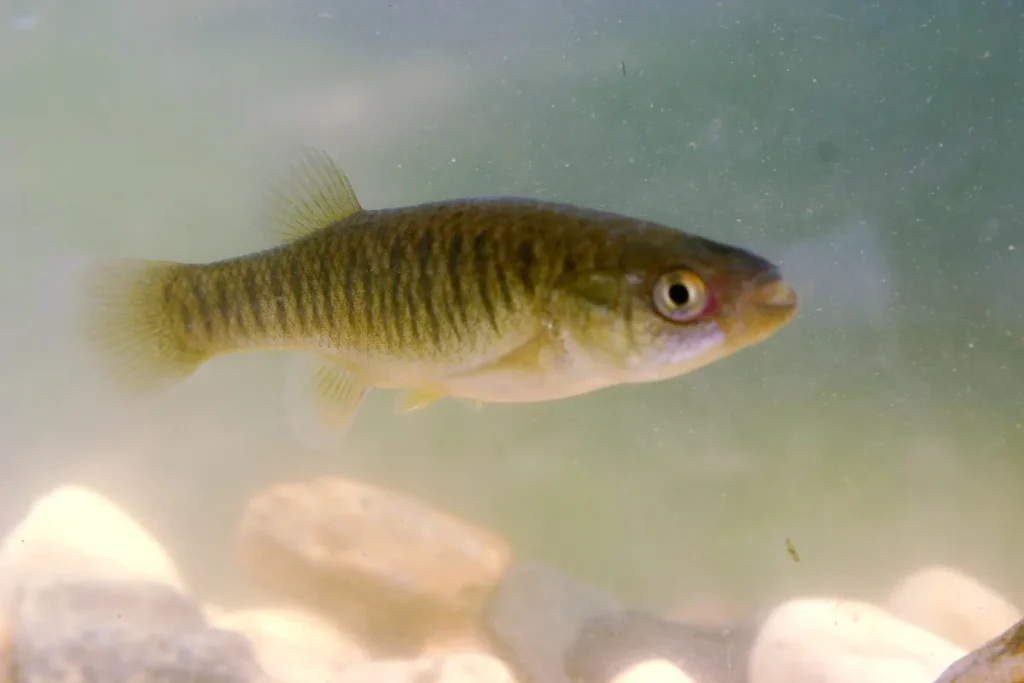
ALT: Mummichog fish photographed in the Chesapeake Bay region.
Photo: Brian Gratwicke | Source: Wikimedia Commons | License: CC BY 2.5 | Changes: The current Wikimedia version has a color adjustment by contributor Togabi; no additional changes if used unchanged.
Scientific name: Fundulus heteroclitus
Habitat: Salt marsh pools, shallow tidal creeks, estuaries, and brackish coastal waters.
Diet: Small crustaceans, insects, worms, algae, and detritus.
The Mummichog is a small, hardy fish that plays an important role in North American coastal food webs.
It may not be as visually impressive as a large predator, but its ability to tolerate challenging conditions is remarkable.
Mummichogs can survive substantial changes in salinity, temperature, and oxygen availability.
These abilities make them well suited to shallow marsh pools that experience changing environmental conditions.
During high tide, Mummichogs may move into flooded marsh vegetation to feed.
As water levels fall, they retreat toward tidal creeks, channels, or pools that retain water.
These small fish are important prey for larger fish, herons, egrets, and other coastal predators.
Scientists also study Mummichogs because of their unusual environmental tolerance.
How to recognize it: Look for a small, stocky fish with a relatively blunt head and brownish or olive coloration. Males may develop stronger markings during the breeding season.
Interesting fact: Mummichogs are among the fish species especially well adapted to the variable conditions of tidal wetlands.
9. Atlantic Ribbed Mussel

ALT: Atlantic ribbed mussels showing dark shells with prominent lengthwise ribs.
Photo: Andrew C | Source: Wikimedia Commons | License: CC BY 2.0 | Changes: None if original used.
Scientific name: Geukensia demissa
Habitat: Salt marsh sediments, creek banks, and areas around marsh grass roots.
Diet: Plankton and suspended organic particles.
The Atlantic Ribbed Mussel is a bivalve mollusk commonly associated with coastal salt marshes.
Its dark shell has strong lengthwise ribs that distinguish it from many smoother-shelled mussel species.
Ribbed mussels often occur in clusters among the roots and stems of salt-tolerant marsh grasses.
Their shells provide protection, while strong attachment threads help them remain anchored.
Like other mussels, they feed by filtering particles from surrounding water.
Their filtration activity can influence the movement of suspended particles and nutrients through marsh ecosystems.
Ribbed mussels also interact with marsh vegetation, contributing to complex relationships between plants, animals, and sediments.
How to recognize it: Look for a dark, elongated mussel shell with prominent ribs running lengthwise.
Interesting fact: Dense groups of ribbed mussels can create small sheltered spaces that other invertebrates use.
10. Atlantic Blue Crab

ALT: Male Atlantic blue crab showing blue claws and flattened swimming legs.
Photo: Karkinos19 | Source: Wikimedia Commons | License: CC BY-SA 4.0 | Changes: None if original used.
Scientific name: Callinectes sapidus
Habitat: Estuaries, tidal creeks, salt marsh channels, and shallow coastal waters.
Diet: Mollusks, small fish, worms, other crustaceans, and organic material.
The Atlantic Blue Crab is a well-known swimming crab found in coastal waters along much of the western Atlantic.
Salt marsh creeks and nearby shallow estuarine habitats can provide important feeding and nursery areas, particularly for younger crabs.
Blue crabs have a flattened pair of rear legs that function like paddles.
These specialized swimming legs help them move efficiently through the water.
Their claws are used for handling food and defending themselves.
Blue crabs are opportunistic feeders, consuming a wide variety of animals and organic material.
They also serve as prey for larger fish, birds, and other predators.
Although adult blue crabs can move into deeper estuarine waters, tidal marsh habitats remain important during parts of their lives.
How to recognize it: Look for a broad shell with sharply pointed sides, blue-tinted claws, and flattened swimming legs.
Interesting fact: Atlantic Blue Crabs are both predators and prey, connecting many different parts of coastal food webs.
What Is a Salt Marsh?
A salt marsh is a coastal wetland that is regularly flooded or influenced by seawater.
Salt marshes typically develop in sheltered coastal environments such as estuaries, bays, and tidal creeks.
They are dominated by salt-tolerant plants rather than the trees commonly associated with many forested wetlands.
Along much of the Atlantic and Gulf coasts, smooth cordgrass is an important salt marsh plant.
Its dense stems and roots create shelter for small animals while helping stabilize wetland sediments.
Salt marshes differ from ordinary freshwater marshes because their water and soils contain substantial amounts of dissolved salts.
The level of salinity can vary depending on rainfall, river flow, tides, and location within the estuary.
High Marsh vs. Low Marsh: Where Do Animals Live?
Not every part of a salt marsh experiences the same amount of flooding.
Ecologists frequently distinguish between low marsh and high marsh habitats.
| Feature | Low Marsh | High Marsh |
|---|---|---|
| Flooding | Frequent tidal flooding | Less frequent tidal flooding |
| Typical Vegetation | Smooth cordgrass and other salt-tolerant plants | Saltmeadow grasses, rushes, and other plants |
| Common Wildlife | Fiddler crabs, snails, mussels, small fish | Saltmarsh Sparrows, insects, nesting birds |
| Main Challenges | Salinity, flooding, changing water levels | High tides, storms, soil salinity |
| Ecological Importance | Feeding and nursery habitat | Nesting, shelter, and specialized plant communities |
These divisions are useful, but they are not absolute.
Animals may move between different parts of a marsh as tides rise and fall.
For example, fish can enter flooded vegetation during high tide, while crabs may emerge onto exposed sediments when the water recedes.
Salt marshes are often part of larger estuarine ecosystems, where freshwater from rivers mixes with seawater. These coastal environments provide important feeding and nursery habitats for fish, crabs, oysters, and many other species. Discover more in our guide to 12 animals that live in estuaries.
How Do Salt Marsh Animals Survive in Salty Water?
Living in a salt marsh requires adaptations to an environment that changes throughout the day.
1. Salt Tolerance
Some salt marsh animals can tolerate relatively high or fluctuating concentrations of dissolved salts.
Mummichogs are particularly well known for their ability to regulate internal salt and water balance under changing environmental conditions.
Diamondback Terrapins are also adapted to brackish coastal waters.
2. Tidal Movement
The rising and falling tide changes where animals can travel and feed.
Fish and swimming crabs may enter flooded areas at high tide.
Shorebirds and other predators can search exposed mudflats and creek banks at low tide.
Marsh Periwinkles may climb vegetation as water levels rise.
3. Burrowing
Fiddler crabs dig burrows that provide shelter and protection.
Burrows can also offer refuge from temperature extremes and predators.
By moving sediment, burrowing animals influence the physical structure of marsh soils.
4. Camouflage
Saltmarsh Sparrows, Seaside Sparrows, and Clapper Rails have colors and patterns that help them blend into vegetation.
This is especially important for birds nesting close to the ground.
Other animals use shell patterns, body coloration, and behavior to reduce their visibility.
5. Specialized Feeding
Many salt marsh animals use specialized feeding structures.
Ribbed mussels filter microscopic particles from water.
Fiddler crabs collect organic material from sediment.
Marsh Periwinkles graze on fungi and other material associated with plants.
Clapper Rails use their bills to capture small animals along muddy creek edges.
Salt Marsh Food Chain: Who Eats Whom?
Salt marshes support complex food webs connecting plants, microbes, invertebrates, fish, reptiles, and birds.
A simplified food chain might look like this:
Marsh Plant Material → Microbial Decomposition → Small Invertebrates → Mummichog → Larger Fish
Another possible feeding relationship is:
Microalgae and Organic Particles → Fiddler Crab → Clapper Rail
Salt marshes also contain numerous predators that consume mollusks and crustaceans.
Diamondback Terrapins may feed on snails, while Atlantic Blue Crabs consume various small aquatic organisms.
These feeding relationships help move energy through the coastal ecosystem.
However, real food webs are rarely simple chains.
Most salt marsh animals have multiple food sources and may be eaten by several different predators.
Salt Marsh vs. Freshwater Marsh vs. Mangrove Forest
Although these habitats are all considered wetlands, they differ in vegetation, water conditions, and animal communities.
| Habitat | Water Conditions | Main Vegetation | Example Animals |
|---|---|---|---|
| Salt Marsh | Saline or brackish, influenced by tides | Salt-tolerant grasses and rushes | Saltmarsh Sparrow, fiddler crab, diamondback terrapin |
| Freshwater Marsh | Mostly freshwater | Cattails, sedges, reeds | Muskrat, painted turtle, American Bullfrog |
| Mangrove Forest | Saline or brackish coastal water | Salt-tolerant trees and shrubs | Mangrove crabs, fish, coastal birds |
All three habitats provide food, shelter, and breeding opportunities for wildlife.
However, a species adapted to freshwater ponds may not tolerate the salinity of a coastal salt marsh.
Some animals, including herons, egrets, and certain fish, can use more than one wetland type.
For a broader overview, explore 15 animals that live in wetlands.
You can also discover wildlife associated with salt-tolerant coastal forests in our guide to 8 mangrove animals and where they live.
Salt Marsh vs. Intertidal Zone: What’s the Difference?
Salt marshes are coastal wetlands dominated by vegetation adapted to wet, saline environments.
The intertidal zone is the broader region between high- and low-tide levels.
A tidal salt marsh includes intertidal habitat, but not all intertidal habitats are salt marshes.
Rocky shores, sandy beaches, and muddy tidal flats can also be part of the intertidal zone.
These environments often support different animal communities.
For example, rocky shores may contain sea stars, limpets, barnacles, and sea anemones.
Salt marshes are especially important for cordgrass-associated snails, burrowing crabs, marsh-nesting birds, and small tidal creek fish.
Discover the differences in our guide to 12 animals that live in the intertidal zone.
Why Are Salt Marshes Important?
Salt marshes provide several valuable ecological functions.
Wildlife Habitat
Salt marshes support specialized birds, fish, reptiles, and invertebrates that depend on coastal wetland environments.
Some species, including Saltmarsh Sparrows, rely on these habitats for reproduction.
Nursery Areas
Shallow tidal creeks and flooded vegetation provide feeding and shelter opportunities for young fish and crustaceans.
These habitats can contribute to the health of larger coastal fisheries.
Coastal Protection
Salt marsh vegetation can help reduce wave energy, trap sediment, and stabilize shorelines.
The level of protection depends on marsh conditions, storm intensity, and other environmental factors.
Water Quality
Salt marsh plants, sediments, and associated organisms can influence nutrient cycling and the movement of suspended particles.
Filter-feeding mussels also contribute to these processes.
Carbon Storage
Healthy salt marshes can store significant amounts of carbon in their plants and waterlogged soils.
This stored carbon is often described as blue carbon.
Protecting existing marshes can help preserve these important coastal carbon stores.
What Threatens Salt Marsh Animals?
Salt marsh ecosystems face a combination of natural and human-related pressures.
Sea-level rise: Increasing water levels can flood nesting habitats and change the distribution of marsh vegetation.
Coastal development: Roads, buildings, and shoreline modification can reduce available habitat and restrict natural marsh movement.
Pollution: Chemicals, excess nutrients, and other pollutants may affect water quality and wildlife.
Changes in sediment supply: Marshes depend partly on sediment accumulation to maintain suitable elevations.
Human disturbance: Walking through sensitive nesting areas, collecting animals, and damaging vegetation can harm local wildlife.
Conservation efforts may include restoring tidal flow, protecting surrounding land, limiting disturbance, and allowing marsh habitats to shift inland where possible.
How to Identify Salt Marsh Wildlife
You can often identify salt marsh animals by their behavior and the places where they occur.
| What You Notice | Possible Animal |
|---|---|
| Small streaked sparrow with orange facial markings | Saltmarsh Sparrow |
| Dark gray sparrow with yellow markings near the eyes | Seaside Sparrow |
| Loud clattering calls from dense marsh grass | Clapper Rail |
| Tiny brown bird with an upright tail | Marsh Wren |
| Turtle with a patterned shell and spotted skin | Diamondback Terrapin |
| Small crab waving one oversized claw | Male fiddler crab |
| Snail climbing a marsh grass stem | Marsh Periwinkle |
| Small fish in a shallow tidal pool | Mummichog or another killifish |
| Cluster of dark, strongly ribbed shells among marsh plants | Atlantic Ribbed Mussels |
| Broad swimming crab with blue claws | Atlantic Blue Crab |
These clues are helpful starting points, but identification should also consider geography, season, and additional physical characteristics.
For the best wildlife observation experience, remain on established paths or boardwalks, watch from a distance, and avoid disturbing nests or marsh vegetation.
Frequently Asked Questions
What animals live in salt marshes?
Common salt marsh animals include Saltmarsh Sparrows, Seaside Sparrows, Clapper Rails, fiddler crabs, Marsh Periwinkles, Mummichogs, Diamondback Terrapins, ribbed mussels, and Atlantic Blue Crabs.
Different species use the marsh for nesting, feeding, shelter, or reproduction.
What birds live in salt marshes?
Saltmarsh Sparrows, Seaside Sparrows, Clapper Rails, and some Marsh Wrens use salt marsh habitats.
Herons, egrets, and other water birds also visit these environments to feed.
What fish live in salt marshes?
Mummichogs are among the best-known small fish associated with Atlantic coastal salt marshes.
Other fish use tidal creeks and estuaries during particular stages of their lives.
Do turtles live in salt marshes?
Yes. Diamondback Terrapins are especially adapted to coastal brackish water environments.
They forage in shallow tidal waters and use suitable nearby land for nesting.
Why do fiddler crabs have one big claw?
Adult male fiddler crabs use their enlarged claws primarily for displays, communication, and competition with other males.
They use their smaller claws for feeding.
What snails live on salt marsh grass?
Marsh Periwinkles are commonly found on saltmarsh cordgrass.
They may climb higher on stems as the tide rises, helping them avoid some aquatic predators.
Are salt marshes freshwater or saltwater?
Salt marshes contain saline or brackish water and are influenced by ocean tides.
Salinity varies according to location, rainfall, river flow, and tidal conditions.
What is the difference between a salt marsh and a swamp?
Salt marshes are commonly dominated by grasses and other salt-tolerant non-woody plants.
Swamps are typically dominated by trees or woody shrubs.
Both are wetlands, but they often support different plant and animal communities.
Why are salt marshes disappearing?
Salt marsh loss can result from coastal development, changes in tidal flow, pollution, erosion, and rising sea levels.
Where marshes cannot accumulate sediment or move inland, increasing flooding can threaten their long-term survival.
Final Thoughts
Salt marshes are much more than grassy coastal wetlands.
They are dynamic ecosystems where small fish, crabs, snails, turtles, and birds depend on the changing rhythm of the tides.
Some of these animals have highly specialized adaptations that allow them to survive in salty water, soft mud, and regularly flooded habitats.
Others use the marsh as a feeding ground or protected nursery before moving into nearby coastal waters.
The next time you visit a coastal marsh, look carefully among the grasses and tidal pools.
You may discover an entire community of wildlife hidden within a landscape that first appeared quiet and empty.
Related Articles
- 15 Animals That Live in Wetlands (With Pictures)
- 12 Animals That Live in the Intertidal Zone (With Pictures)
- 8 Mangrove Animals and Where They Live
- 4 Mangrove Crabs and How to Tell Them Apart
- 10 Animals That Build Dams, Nests, and Other Remarkable Homes
References and Further Reading
- South Carolina Department of Natural Resources – Salt Marsh
- U.S. Fish and Wildlife Service – Saltmarsh Sparrow
- Cornell Lab of Ornithology – Clapper Rail
- Cornell Lab of Ornithology – Seaside Sparrow
- Cornell Lab of Ornithology – Marsh Wren
- Texas Parks and Wildlife – Animal Life on the Salt Marsh
- University of Florida IFAS Extension – Salt Marshes: The Land of the Wet and Muddy
- U.S. Environmental Protection Agency – Wetlands