Imagine walking through a vast northern forest where tall spruce trees rise above a thick layer of moss and snow. The air is cold, the landscape seems quiet, and wildlife may be difficult to spot.
But these forests are far from empty.
Moose feed on woody plants near frozen lakes, Canada lynx search for snowshoe hares, and small birds survive winter temperatures that can fall far below freezing.
Moose, woodland caribou, Canada lynx, snowshoe hares, gray wolves, American martens, and several specialized bird species are among the animals that live in boreal forests.
These animals have developed remarkable ways to cope with cold temperatures, seasonal food shortages, and long winters.
Here are 12 fascinating boreal forest animals, focusing on species found in Canada, Alaska, and other northern parts of North America.
12 Boreal Forest Animals: Quick Comparison
| Animal | Scientific Name | Main Diet | Key Adaptation |
|---|---|---|---|
| Moose | Alces alces | Leaves, twigs, aquatic plants | Long legs and insulating fur |
| Woodland Caribou | Rangifer tarandus caribou | Lichens and vegetation | Broad hooves and cold-resistant coat |
| Canada Lynx | Lynx canadensis | Snowshoe hares and small animals | Large furry feet |
| Snowshoe Hare | Lepus americanus | Grasses, twigs, bark | Seasonal camouflage |
| Gray Wolf | Canis lupus | Large mammals and smaller prey | Cooperative hunting and endurance |
| American Marten | Martes americana | Small mammals, birds, insects | Agile climbing and dense fur |
| American Red Squirrel | Tamiasciurus hudsonicus | Conifer seeds, fungi, buds | Food caching |
| Great Gray Owl | Strix nebulosa | Voles and other small mammals | Sensitive hearing |
| Spruce Grouse | Canachites canadensis | Conifer needles, berries, insects | Winter diet specialization |
| Boreal Chickadee | Poecile hudsonicus | Insects, seeds, spiders | Insulation and food storage |
| Canada Jay | Perisoreus canadensis | Insects, berries, small animals | Year-round food caching |
| Black-backed Woodpecker | Picoides arcticus | Wood-boring beetle larvae | Foraging in burned forests |
1. Moose

ALT: Moose grazing in northern Alaska with a large body, long legs, and dark brown fur.
Photo: Eric Kilby | Source: Wikimedia Commons | License: CC BY-SA 4.0 | Changes: None if original used.
Scientific name: Alces alces
Habitat: Boreal forests, forest wetlands, lakeshores, and northern shrublands.
Diet: Willow leaves, twigs, aquatic plants, and other vegetation.
The moose is the largest living member of the deer family and one of the most impressive animals found in northern forests.
Its enormous body, long legs, and distinctive elongated muzzle make it immediately recognizable.
Moose frequently inhabit areas containing a mixture of conifer forests, wetlands, and open feeding habitats.
During warmer months, they consume leaves and aquatic vegetation. In winter, they rely more heavily on twigs and other woody plant material.
Their long legs help them move through deep snow, while their thick coats provide protection against cold weather.
Adult male moose grow large antlers that are generally shed after the breeding season.
Females do not normally grow antlers.
Although moose may appear slow and calm, they are powerful animals capable of moving surprisingly quickly.
How to recognize it: Look for an enormous deer-like animal with long legs, a drooping muzzle, and a noticeable shoulder hump.
Interesting fact: Moose are strong swimmers and may feed on submerged aquatic plants in lakes and wetlands.
2. Woodland Caribou
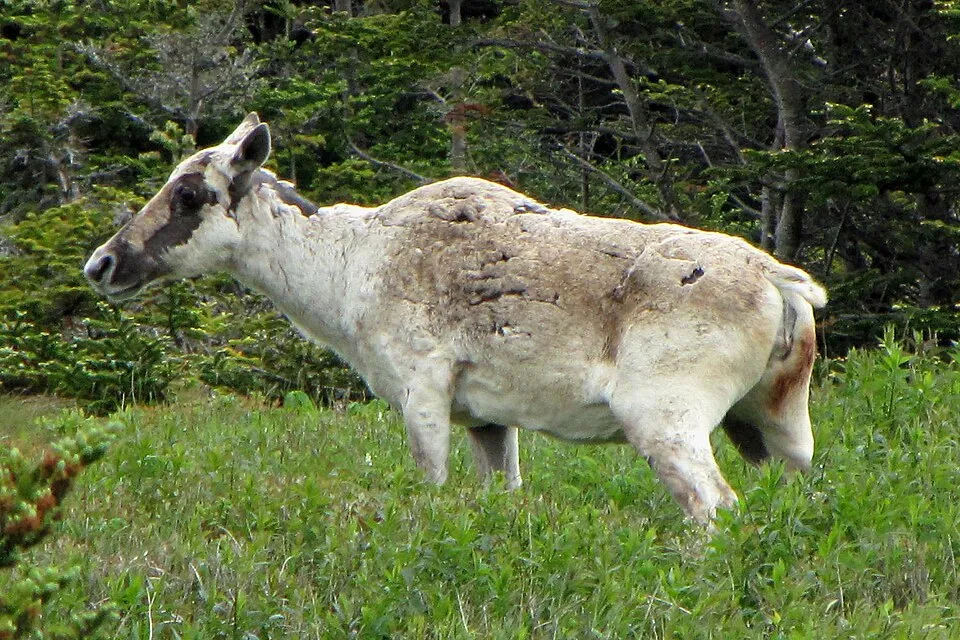
ALT: Female woodland caribou photographed in Newfoundland, Canada.
Photo: D. Gordon E. Robertson | Source: Wikimedia Commons | License: CC BY-SA 3.0 | Changes: None if original used. Photograph shows a migratory woodland caribou in spring.
Scientific name: Rangifer tarandus caribou
Habitat: Boreal forests, peatlands, northern woodlands, and some tundra environments, depending on the population.
Diet: Lichens, leaves, sedges, and other plants.
Woodland caribou are an important part of northern Canadian ecosystems.
They belong to the same species as reindeer, although different caribou populations have distinctive ecological lifestyles.
Some woodland caribou populations remain closely associated with large, relatively undisturbed boreal forests.
Others, including migratory populations, travel across different northern habitats during the year.
Caribou possess broad hooves that help them travel over snow and soft ground.
These hooves are also useful for scraping away snow to expose vegetation.
Their thick winter coats provide effective insulation against freezing conditions.
Lichens are an important winter food source for many woodland caribou populations, particularly those living in mature forests.
Unlike moose, both male and female caribou can grow antlers, although not every female develops them.
How to recognize it: Look for a medium-to-large deer relative with a thick neck, broad hooves, pale markings, and often branching antlers.
Interesting fact: Forest-dependent woodland caribou can be especially sensitive to habitat fragmentation, which may alter predator-prey relationships and movement patterns.
3. Canada Lynx

ALT: Canada lynx showing its long ear tufts, thick fur, and facial ruff.
Photo: Michael Zahra | Source: Wikimedia Commons | License: CC BY-SA 3.0 | Changes: None if original used.
Scientific name: Lynx canadensis
Habitat: Boreal and sub-boreal forests across northern North America.
Diet: Primarily snowshoe hares, along with other small mammals and birds.
The Canada lynx is one of the most specialized predators of North America’s northern forests.
This medium-sized wild cat has a relatively short tail, long black ear tufts, and a thick coat of grayish-brown fur.
Its most remarkable adaptation may be its feet.
Canada lynx have unusually large, densely furred paws that distribute their weight across soft snow.
These natural snowshoes allow them to travel through winter forests while pursuing prey.
The snowshoe hare is particularly important to the Canada lynx.
In many northern regions, the populations of these two animals are closely connected.
When snowshoe hare numbers increase, lynx populations may also increase after a delay.
When hare numbers decline, lynx can face reduced food availability.
Canada lynx are generally solitary and can be difficult to observe because they move quietly through forest habitats.
How to recognize it: Look for black-tipped ear tufts, a prominent facial ruff, long legs, large furry feet, and a short tail with a black tip.
Interesting fact: The Canada lynx and snowshoe hare are a classic example of linked predator-prey population cycles.
4. Snowshoe Hare
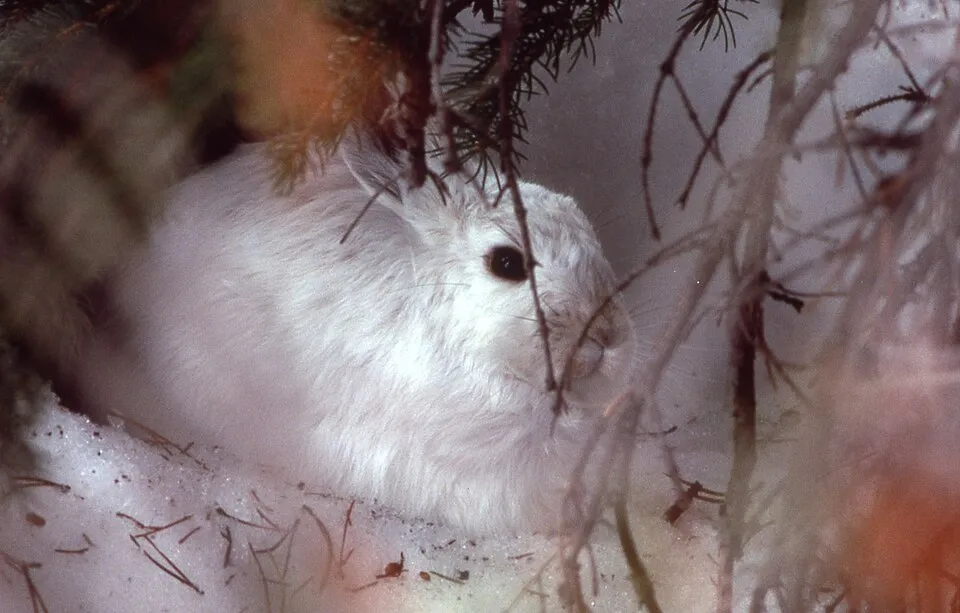
ALT: Snowshoe hare wearing white winter fur while resting in a snowy forest.
Photo: NPS / Jim Peaco | Source: Wikimedia Commons | License: Public Domain, U.S. National Park Service | Changes: None if original used.
Scientific name: Lepus americanus
Habitat: Boreal forests, dense woodland understories, and northern shrublands.
Diet: Grasses, leaves, buds, twigs, and bark.
The snowshoe hare is one of the most important small herbivores in North American boreal forests.
Its name comes from its exceptionally large hind feet.
These broad, furry feet help distribute its body weight across snow, allowing it to move through winter habitats without sinking as deeply as many other animals.
In much of its range, snowshoe hares change their coat color with the seasons.
During summer, they are usually brown.
In winter, many populations develop white fur that helps them blend into snowy surroundings.
This seasonal camouflage is especially valuable because snowshoe hares are prey for lynx, foxes, owls, and other predators.
Snowshoe hares often remain close to dense vegetation that provides protective cover.
They are active throughout winter rather than hibernating.
How to recognize it: Look for a compact hare with very large hind feet, relatively short ears, and brown or white fur depending on the season.
Interesting fact: Snowshoe hare populations often rise and fall in approximately decade-long cycles across parts of the boreal forest.
Learn more about seasonal camouflage in our guide to 10 animals that turn white in winter.
5. Gray Wolf
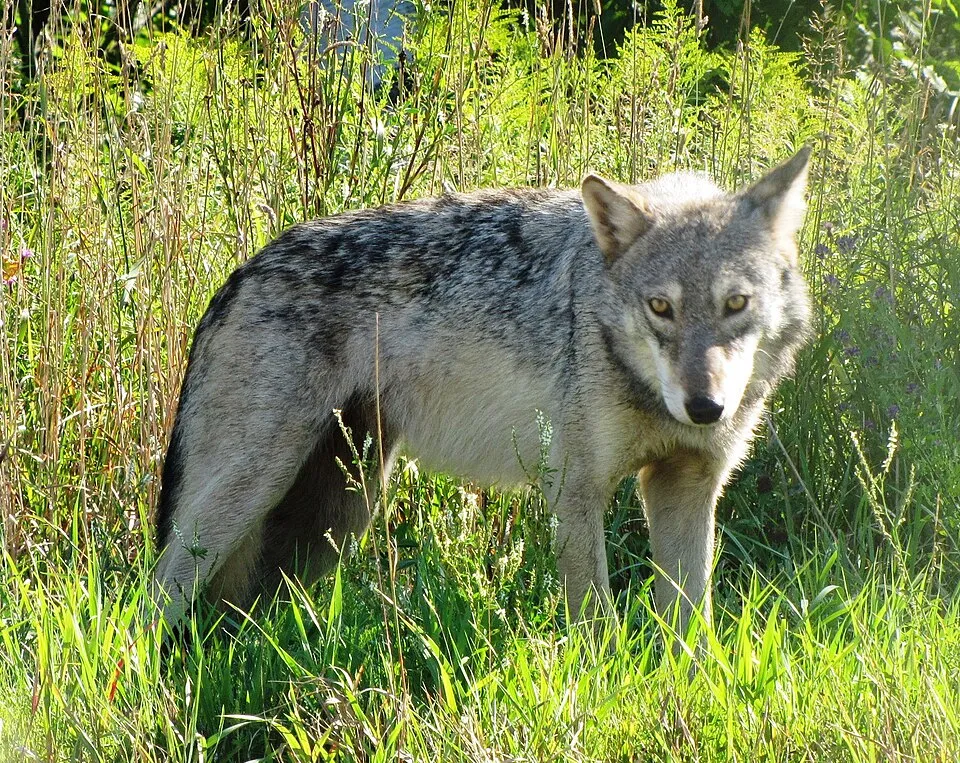
ALT: Gray wolf photographed at Seney National Wildlife Refuge in Michigan.
Photo: Seney Natural History Association | Source: Wikimedia Commons | License: CC BY-SA 2.0 | Changes: None if original used.
Scientific name: Canis lupus
Habitat: Boreal forests, tundra, mountains, grasslands, and other habitats across its range.
Diet: Large mammals, smaller animals, and carrion.
Gray wolves are among the most important large predators in northern forest ecosystems.
They are highly adaptable animals that inhabit a variety of environments, including extensive boreal forests.
Wolves typically live in social family groups commonly called packs.
Group members cooperate in raising young, defending territory, and sometimes hunting large prey.
In northern forests, wolves may hunt moose, deer, and other ungulates.
They also consume smaller animals and carrion.
Their thick winter coats provide insulation, while their long legs and endurance allow them to travel considerable distances.
Wolves communicate through vocalizations, body language, and scent marking.
Their presence can influence prey behavior, population dynamics, and the distribution of scavengers.
How to recognize it: Look for a large, long-legged wild canine with a thick coat, relatively broad muzzle, erect ears, and a bushy tail.
Interesting fact: Wolf packs are generally family groups rather than collections of unrelated animals competing for dominance.
6. American Marten

ALT: American marten showing its slender body, pointed face, and brown fur.
Photo: Cody Connor | Source: Wikimedia Commons | License: CC BY-SA 2.5 | Changes: None if original used. The source file also requests a visible “Image by Cody Connor” credit on the photograph.
Scientific name: Martes americana
Habitat: Mature and structurally complex northern forests in North America.
Diet: Voles, mice, squirrels, birds, insects, and fruits.
The American marten is a small, agile member of the weasel family.
It has an elongated body, short legs, a pointed face, and dense brown fur.
Many individuals also have a pale yellowish or orange throat patch.
American martens are closely associated with forests containing mature trees, fallen logs, and complex vegetation.
These features provide hunting opportunities, travel routes, and places to rest.
Unlike animals that spend nearly all their time on the ground, martens are skilled climbers.
They can move through trees while searching for prey or avoiding danger.
During winter, martens may hunt beneath the snow, where small mammals remain active in protected spaces.
Their fur and ability to use sheltered locations help them cope with cold weather.
How to recognize it: Look for a slender, cat-sized or smaller carnivore with a pointed face, relatively large ears, a bushy tail, and a brown coat.
Interesting fact: Fallen trees and other features of older forests can create important winter hunting habitat for martens.
American martens belong to the same broader family as mink, stoats, and weasels. Explore the differences between two of these relatives in our mink vs. weasel guide.
7. American Red Squirrel
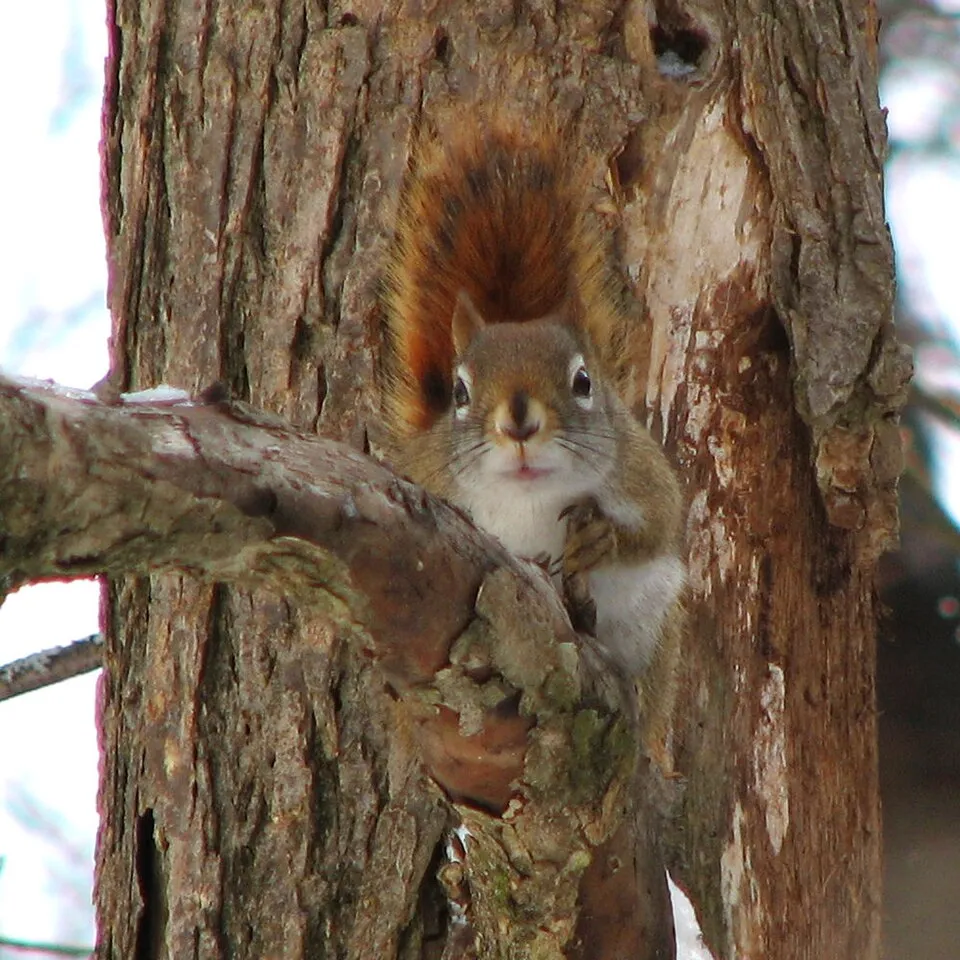
ALT: American red squirrel with reddish-brown fur photographed in Quebec, Canada.
Photo: D. Gordon E. Robertson | Source: Wikimedia Commons | License: CC BY-SA 3.0 | Changes: None if original used.
Scientific name: Tamiasciurus hudsonicus
Habitat: Coniferous and mixed forests across northern North America.
Diet: Conifer seeds, fungi, buds, berries, and other plant material.
The American red squirrel is a small but energetic inhabitant of northern forests.
Its reddish-brown coat, pale underside, and bushy tail distinguish it from many larger squirrel species.
Red squirrels are especially associated with conifer trees.
They collect cones and extract the nutrient-rich seeds inside.
Rather than eating every seed immediately, they frequently store cones and other food in caches.
These storage areas, sometimes called middens, may contain large accumulations of cones and cone fragments.
The stored food helps squirrels survive periods when fresh food is difficult to obtain.
American red squirrels can be highly territorial.
They often make loud calls to warn other squirrels away from valuable food resources.
How to recognize it: Look for a relatively small squirrel with reddish fur, a pale underside, dark eyes, and a bushy tail.
Interesting fact: Red squirrels may defend long-established food caches containing thousands of stored cones.
Learn more about this survival strategy in our article about animals that store food for winter.
8. Great Gray Owl

ALT: Great gray owl with a large rounded facial disc perched in a northern forest.
Photo: Wildreturn (Andy Reago and Chrissy McClarren) | Source: Wikimedia Commons | License: CC BY 2.0 | Changes: None if original used.
Scientific name: Strix nebulosa
Habitat: Northern forests, forest openings, bogs, and meadows.
Diet: Primarily voles and other small mammals.
The great gray owl is among the most impressive birds found in boreal forest environments.
Its enormous rounded head and broad facial disc give it a distinctive appearance.
Although it looks exceptionally large, much of its apparent size comes from its abundant feathers.
Great gray owls have remarkable hearing.
Their facial discs help direct sound toward their ears, allowing them to detect small mammals moving beneath vegetation or snow.
During winter, an owl may listen carefully before plunging into snow to capture prey below the surface.
Great gray owls frequently hunt near forest openings, meadows, and other areas where small mammals are abundant.
They usually do not construct elaborate nests themselves.
Instead, they may use abandoned nests built by large birds or suitable broken tree tops.
How to recognize it: Look for a very large gray owl with a broad circular face, concentric facial markings, yellow eyes, and a long tail.
Interesting fact: Great gray owls can locate hidden prey using sound even when snow prevents direct visual contact.
9. Spruce Grouse

ALT: Spruce grouse photographed in a northern Ontario conifer forest.
Photo: D. Gordon E. Robertson | Source: Wikimedia Commons | License: CC BY-SA 3.0 | Changes: None if original used.
Scientific name: Canachites canadensis (formerly Falcipennis canadensis)
Habitat: Boreal and northern coniferous forests.
Diet: Conifer needles, buds, berries, leaves, and insects.
The spruce grouse is a forest bird exceptionally well adapted to northern conifer habitats.
During summer, it feeds on a variety of plant materials and insects.
In winter, spruce grouse rely heavily on conifer needles, including those of spruce and other suitable trees.
Their digestive systems are adapted to processing this relatively fibrous food.
Spruce grouse spend much of their time walking on the ground or resting in trees.
Their mottled plumage provides camouflage among branches, shadows, and forest vegetation.
Adult males are generally darker, with blackish underparts and a distinctive red patch above the eye.
Females are usually more heavily mottled brown.
Spruce grouse are sometimes unusually tolerant of approaching people, but this should not be taken as permission to disturb them.
How to recognize it: Look for a stocky forest grouse with a small head, rounded body, and heavily patterned feathers.
Interesting fact: Spruce grouse can survive northern winters on a diet containing large amounts of conifer needles.
10. Boreal Chickadee

ALT: Boreal chickadee with a brown cap, pale cheeks, and gray-brown body.
Photo: dfaulder | Source: Wikimedia Commons | License: CC BY 2.0 | Changes: None if original used.
Scientific name: Poecile hudsonicus
Habitat: Boreal spruce forests and other northern conifer-dominated habitats.
Diet: Insects, spiders, seeds, and other small food items.
The boreal chickadee is a small songbird that survives throughout the year in some of North America’s coldest forest environments.
Unlike the more familiar Black-capped Chickadee, the boreal chickadee has a brown cap rather than a black one.
Its face is relatively plain, with a dark throat patch and a grayish-brown body.
These birds often forage among spruce branches, searching for insects and other small prey.
In colder months, seeds and stored food can become increasingly important.
Boreal chickadees may cache food in small hiding places, allowing them to return to stored resources when conditions become difficult.
Their dense feathers provide insulation, and their small size allows them to use sheltered spaces among vegetation.
How to recognize it: Look for a small chickadee with a brown cap, dark throat patch, gray-brown body, and relatively subdued facial contrast.
Interesting fact: Boreal chickadees remain in northern forests through winter rather than undertaking long-distance seasonal migrations.
11. Canada Jay

ALT: Canada jay with a gray body, pale face, and dark head markings photographed in Alaska.
Photo: TRinaud | Source: Wikimedia Commons | License: CC BY 4.0 | Changes: None if original used.
Scientific name: Perisoreus canadensis
Habitat: Boreal forests and other northern coniferous woodlands.
Diet: Insects, berries, seeds, small animals, and carrion.
The Canada jay, formerly widely known as the gray jay, is an intelligent forest bird closely associated with northern conifer environments.
It has a rounded body, soft gray plumage, a pale face, and darker markings around the head.
Canada jays are especially well known for their food-storage behavior.
They collect food and hide small portions in numerous locations throughout their territories.
Some cached items are coated with sticky saliva, which may help the bird attach them to branches or other surfaces.
Food storage is particularly important because Canada jays remain in cold northern forests throughout the winter.
Unlike many birds that wait until spring, Canada jays can begin nesting while snow still covers the ground.
Their ability to obtain food during winter helps support this unusually early breeding schedule.
How to recognize it: Look for a medium-sized gray bird with a rounded head, pale facial markings, and relatively soft, fluffy-looking plumage.
Interesting fact: Canada jays are among the unusual birds capable of raising young during very cold northern spring conditions.
12. Black-backed Woodpecker
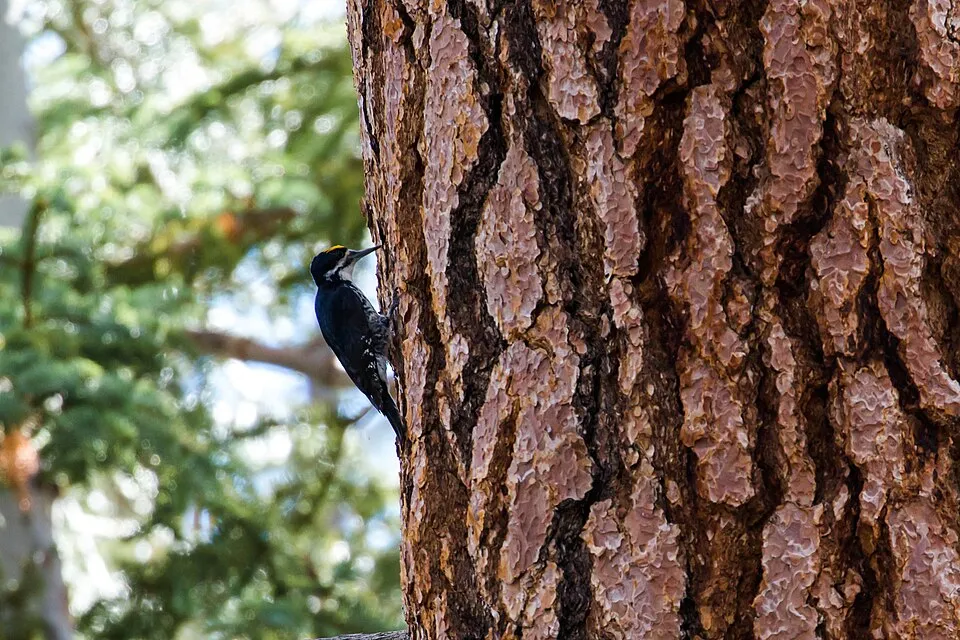
ALT: Black-backed woodpecker with dark upperparts and pale underparts perched on a tree trunk.
Photo: Melissa McMasters | Source: Wikimedia Commons | License: CC BY 2.0 | Changes: None if original used.
Scientific name: Picoides arcticus
Habitat: Boreal conifer forests, especially recently burned or insect-affected forests.
Diet: Primarily wood-boring beetle larvae and other insects.
The black-backed woodpecker demonstrates why forest fires do not always eliminate wildlife habitat.
In parts of the boreal forest, recently burned trees can become important feeding areas for this specialized bird.
After a fire, certain insects may colonize damaged or dead trees.
Black-backed Woodpeckers use their strong bills to remove bark and excavate wood while searching for insect larvae.
Their dark upperparts help distinguish them from some other North American woodpeckers.
Adult males have yellow patches on the crown, while females generally lack this feature.
The species is closely associated with forests containing dead or dying conifer trees.
Its dependence on particular forest conditions makes habitat structure especially important.
How to recognize it: Look for a medium-sized woodpecker with mostly black upperparts, pale underparts, barred sides, and a yellow crown patch in adult males.
Interesting fact: Recently burned forests can provide valuable food and nesting habitat for specialized birds such as black-backed woodpeckers.
What Is a Boreal Forest?
The boreal forest, also known as the taiga, is a vast northern forest biome stretching across parts of North America, Europe, and Asia.
In North America, extensive boreal forests occur across Alaska and Canada.
These forests experience long, cold winters and relatively short growing seasons.
Spruce, pine, fir, and other cold-tolerant trees are common, although many boreal forests also contain deciduous trees such as birch and aspen.
The ground may be covered with mosses, lichens, fallen branches, and thick layers of organic material.
Boreal landscapes frequently include lakes, wetlands, peatlands, rivers, and forest openings.
This mixture of habitats supports an impressive variety of wildlife.
What Animals Live in Each Part of a Boreal Forest?
Different animals depend on different parts of the forest.
| Forest Habitat | Example Animals | Ecological Role |
|---|---|---|
| Mature Conifer Forest | American Marten, Boreal Chickadee | Shelter and feeding habitat |
| Dense Shrub Understory | Snowshoe Hare, Canada Lynx | Cover and predator-prey relationships |
| Forest Wetlands | Moose | Feeding habitat |
| Open Forest and Peatlands | Woodland Caribou | Foraging and movement |
| Forest Edges and Meadows | Great Gray Owl | Hunting habitat |
| Conifer Tree Canopy | Spruce Grouse, Canada Jay | Food and shelter |
| Burned Forest | Black-backed Woodpecker | Feeding on insects in dead trees |
The same species may use several habitat types throughout the year.
Moose, for example, may feed in wetland areas during summer but move into wooded habitats during winter.
Canada lynx often search areas where snowshoe hares are abundant.
Northern forests share some wildlife with the Rocky Mountains, but mountain environments also support specialized species adapted to steep cliffs, alpine meadows, and exposed rocky slopes. Discover bighorn sheep, mountain goats, American pikas, and other remarkable species in our guide to 10 animals that live in the Rocky Mountains.
How Do Boreal Forest Animals Survive Winter?
Winter is one of the defining features of the boreal forest.
Temperatures can remain below freezing for extended periods, and deep snow may cover the ground for months.
Different animals survive through specialized physical and behavioral adaptations.
1. Thick Fur and Feathers
Moose, wolves, lynx, and martens grow insulating coats that help reduce heat loss.
Birds such as Boreal Chickadees and Canada Jays rely on dense feathers and behavioral strategies that reduce exposure to cold.
2. Large Feet for Traveling on Snow
Canada lynx and snowshoe hares have broad, furry feet that distribute their weight across soft snow.
Caribou also possess broad hooves suited to moving over snow and soft ground.
These structures help the animals travel and forage under difficult winter conditions.
3. Seasonal Camouflage
Many snowshoe hares develop white winter coats.
This coloration helps them blend into snow-covered habitats.
However, populations in regions with shorter or less predictable snow seasons may experience camouflage mismatches.
4. Food Storage
Red squirrels and Canada Jays store food for later use.
Boreal Chickadees may also cache food.
These behaviors reduce dependence on finding fresh resources during the coldest parts of the year.
5. Specialized Winter Diets
Spruce grouse consume large amounts of conifer needles during winter.
Woodland caribou often rely heavily on lichens.
Moose feed on woody twigs and other available vegetation.
These diets allow animals to use resources that remain accessible when other foods are buried beneath snow.
Canada Lynx vs. Snowshoe Hare: A Remarkable Predator-Prey Relationship
One of the best-known ecological relationships in the boreal forest involves the Canada lynx and snowshoe hare.
Snowshoe hares are important prey for lynx.
When hare populations increase, lynx may have access to more food, supporting improved survival and reproduction.
As lynx populations rise, predation can contribute to declining hare numbers.
Food availability, other predators, habitat conditions, and additional ecological factors also influence the cycles.
| Feature | Canada Lynx | Snowshoe Hare |
|---|---|---|
| Ecological Role | Predator | Herbivore and prey |
| Main Food | Snowshoe hares and other animals | Plants and woody vegetation |
| Winter Adaptation | Large furry paws | Large furry hind feet |
| Coat Color | Mostly grayish or brown | Often white in winter |
| Habitat | Northern forests with suitable prey | Forest understory and dense vegetation |
The relationship demonstrates how changes in one animal population can affect another.
It is also an important example of how predators, prey, and habitat conditions are connected.
Boreal Forest vs. Temperate Forest vs. Tundra
Although these environments can occur near one another, their conditions differ.
| Feature | Boreal Forest | Temperate Forest | Arctic Tundra |
|---|---|---|---|
| Climate | Long, cold winters | Generally milder and more variable | Very cold, short growing season |
| Dominant Vegetation | Spruce, pine, fir, mixed trees | Deciduous or mixed forests | Low shrubs, grasses, mosses, lichens |
| Typical Trees | Cold-tolerant conifers | Oaks, maples, beeches, conifers | Mostly treeless |
| Example Animals | Lynx, moose, spruce grouse | Deer, squirrels, woodland birds | Arctic foxes, tundra hares, lemmings |
| Main Challenge | Cold, snow, short growing season | Seasonal habitat changes | Cold exposure and limited vegetation |
Boreal forests are generally located south of Arctic tundra environments.
The transition between these regions is not always sharply defined.
Some animals may use both forest and tundra habitats depending on the season.
Explore other cold-climate ecosystems in our guide to Arctic tundra animals.
What Do Boreal Forest Animals Eat?
Boreal forest food webs connect trees, shrubs, lichens, insects, herbivores, and predators.
A simplified food chain might look like this:
Willow Leaves → Snowshoe Hare → Canada Lynx
Another possible feeding relationship is:
Spruce Seeds → Red Squirrel → American Marten
These examples illustrate how energy moves between different organisms.
Real food webs are more complex because animals often eat multiple types of food.
Wolves may hunt several kinds of mammals.
Great Gray Owls feed on a range of small rodents.
Canada Jays have flexible diets that include plant and animal material.
Dead plants and animals are eventually broken down by decomposers, helping recycle nutrients within the ecosystem.
Why Are Forest Fires Important in the Boreal Forest?
Fire is a natural ecological process in many boreal forest ecosystems.
Although large fires can cause immediate habitat loss and wildlife mortality, they can also create conditions that support regeneration.
Some conifer species possess adaptations that allow seeds to be released following exposure to heat.
Burned forests may provide important feeding habitats for insects and specialized woodpeckers.
New vegetation that develops after disturbance can support herbivores such as snowshoe hares.
However, fire effects depend on their intensity, frequency, location, and environmental conditions.
Not every fire is beneficial, and increasingly severe or frequent fires may threaten some forest communities.
A healthy boreal landscape often contains forests of different ages and structures.
Why Are Boreal Forests Important?
Boreal forests are among the world’s largest forest ecosystems.
They provide essential habitat for mammals, birds, insects, and numerous other organisms.
Wildlife Habitat
Large forest landscapes allow wide-ranging animals such as wolves and caribou to move between feeding, breeding, and seasonal habitats.
Bird Breeding Grounds
Many migratory birds breed in northern forests during the short summer.
Other birds, including Canada Jays and Boreal Chickadees, remain throughout the year.
Carbon Storage
Boreal forests store carbon in trees, soils, peatlands, and other organic materials.
Some boreal landscapes contain particularly large belowground carbon stores.
Freshwater Ecosystems
Boreal forests include extensive lakes, streams, wetlands, and peatlands.
These habitats support fish, amphibians, aquatic insects, and mammals.
Ecological Connections
Predators, herbivores, trees, insects, and decomposers all influence one another.
Changes to forest structure can therefore affect wildlife throughout the ecosystem.
What Threatens Boreal Forest Animals?
Boreal forests face several environmental pressures.
Habitat fragmentation: Roads, logging, and other developments can divide formerly connected forest habitats.
Climate change: Warmer temperatures can influence snow cover, fire patterns, vegetation, and species distributions.
Changing fire regimes: More frequent or severe fires can alter forest regeneration and habitat availability.
Industrial development: Resource extraction and associated infrastructure may disturb sensitive species and change movement patterns.
Invasive pests and diseases: Some insects and pathogens can affect forest health.
Conservation strategies often focus on maintaining connected habitats, protecting important breeding and feeding areas, and monitoring ecological changes.
How to Identify Boreal Forest Wildlife
You may not always see an animal clearly during a forest visit.
Tracks, feeding signs, calls, and other evidence can provide useful clues.
| What You Notice | Possible Animal |
|---|---|
| Very large hoofprints near wetland edges | Moose |
| Broad hoofprints in northern forest or peatland | Caribou, depending on region |
| Rounded feline tracks in snow | Canada Lynx or another wild cat |
| Small hare tracks with large hind-foot impressions | Snowshoe Hare |
| Large canine tracks along forest trails | Gray Wolf or another canid |
| Small carnivore moving through fallen logs | American Marten |
| Piles of conifer cone fragments | Red Squirrel |
| Very large gray owl near a forest opening | Great Gray Owl |
| Stocky, mottled grouse beneath conifers | Spruce Grouse |
| Small bird with a brown cap | Boreal Chickadee |
| Gray bird caching food in trees | Canada Jay |
| Woodpecker foraging in recently burned trees | Black-backed Woodpecker |
Tracks and feeding signs are not always species-specific.
Accurate identification should consider geography, season, habitat, and several physical characteristics.
Observe wildlife from a safe distance and avoid approaching large mammals or active nests.
Frequently Asked Questions
What animals live in boreal forests?
Boreal forests support moose, woodland caribou, Canada lynx, snowshoe hares, gray wolves, American martens, red squirrels, owls, grouse, chickadees, and many other species.
The exact wildlife community depends on geography and local habitat conditions.
What is another name for the boreal forest?
The boreal forest is also commonly called the taiga.
Both terms describe northern forest environments characterized by long winters and relatively short growing seasons.
What predators live in boreal forests?
Common boreal forest predators include gray wolves, Canada lynx, American martens, bears, owls, and other carnivorous birds and mammals.
Different predators specialize in different prey.
What animals live in the Canadian boreal forest?
The Canadian boreal forest supports moose, woodland caribou, snowshoe hares, Canada lynx, wolves, red squirrels, Canada Jays, Spruce Grouse, and numerous other species.
What birds live in boreal forests?
Boreal birds include Boreal Chickadees, Canada Jays, Spruce Grouse, Great Gray Owls, Black-backed Woodpeckers, and many migratory songbirds.
Some remain year-round while others migrate.
How do animals survive the cold in the taiga?
Animals survive using adaptations such as thick fur, insulating feathers, broad feet, food storage, specialized diets, and protected resting habitats.
Some species also change their coat color during winter.
Do boreal forest animals hibernate?
Some animals, including certain bear populations, spend winter in dens.
However, many species remain active.
Wolves, lynx, moose, snowshoe hares, martens, and several bird species continue feeding throughout winter.
What is the largest animal in the boreal forest?
The moose is among the largest land mammals regularly found in North American boreal forests.
Adult males can weigh several hundred kilograms.
Why are snowshoe hares important to the boreal forest?
Snowshoe hares are important herbivores and major prey for many predators.
Their populations can influence the abundance and behavior of species such as Canada lynx.
Do forest fires help boreal wildlife?
Some boreal species benefit from habitats created by natural fires.
For example, Black-backed Woodpeckers can find food in burned trees.
However, intense or unusually frequent fires can also damage habitats and threaten wildlife.
Final Thoughts
Boreal forests may appear quiet during winter, but they support a remarkable diversity of animals.
From moose feeding among snowy trees to Canada lynx following snowshoe hares, each species has developed ways to survive the challenges of northern environments.
Small animals are just as important as large predators.
Red squirrels store food, Boreal Chickadees search for insects, and woodpeckers help connect forest disturbances with wildlife communities.
Together, these animals form complex food webs that depend on healthy, connected forests.
The next time you see a photograph of a vast snowy forest, remember that it may be home to an entire community of animals working to survive the changing seasons.
Related Articles
- 10 Animals That Turn White in Winter (With Pictures)
- 10 Animals That Store Food for Winter
- Arctic Tundra Animals
- 6 Alpine Tundra Animals Found Above the Treeline
- 10 Animals That Build Dams, Nests, and Other Remarkable Homes
- Mink vs. Weasel
References and Further Reading
- Hinterland Who’s Who – Boreal Forest
- Ontario Government – The Ecosystems of Ontario
- U.S. Forest Service – Canada Lynx Species Review
- Natural Resources Canada – Forests
- Cornell Lab of Ornithology – Spruce Grouse
- Cornell Lab – Boreal Chickadee
- Cornell Lab – Canada Jay
- Cornell Lab – Black-backed Woodpecker
- Cornell Lab – Great Gray Owl