A brown hare can disappear among fallen leaves in summer, yet the same animal would stand out against a blanket of winter snow. For some animals, surviving this seasonal transformation means growing an entirely different coat.
Snowshoe hares, Arctic foxes, mountain hares, stoats, and several species of ptarmigan are among the animals that turn white in winter. Their seasonal color change helps them blend into snowy landscapes, avoid predators, or approach prey without being detected.
Unlike animals that stay white year-round, these remarkable creatures can change their appearance as the seasons change.
Here are 10 animals that turn white in winter, where they live, how to recognize them, and why seasonal camouflage matters.
10 Animals That Turn White in Winter: Quick Comparison
| Animal | Summer Color | Winter Color | Main Habitat |
|---|---|---|---|
| Snowshoe Hare | Brown | White | Northern forests |
| Arctic Fox | Brown or gray | White | Arctic tundra |
| Mountain Hare | Brown or gray | White | Mountains and moorlands |
| Arctic Hare | Gray or brownish gray | White | Arctic tundra |
| Stoat | Brown and cream | White with black tail tip | Woodlands and grasslands |
| Least Weasel | Brown and white | White in some populations | Grasslands and woodlands |
| Northern Collared Lemming | Brown or gray | White | Arctic tundra |
| Willow Ptarmigan | Reddish brown | Mostly white | Shrubby tundra |
| Rock Ptarmigan | Mottled brown | Mostly white | Rocky tundra |
| White-tailed Ptarmigan | Grayish brown | White | Alpine mountains |
Note: Not every population of these animals changes color. The extent of seasonal whitening depends on geography, genetics, and environmental conditions.
1. Snowshoe Hare

ALT: Snowshoe hare in its white winter coat.
Photo: NPS / Jim Peaco | Source: Wikimedia Commons | License: Public Domain | Changes: None if original used.
Scientific name: Lepus americanus
Habitat: Boreal forests and dense woodlands of North America.
The snowshoe hare is one of the best-known mammals that turn white in winter. Its brown summer coat matches vegetation, soil, and fallen leaves. In autumn, newly grown white fur gradually replaces much of its darker coat.
This transformation helps the hare avoid predators such as Canada lynxes, foxes, and owls.
Color is not its only adaptation. The snowshoe hare has exceptionally large, furry hind feet that distribute its weight across soft snow. These natural snowshoes help it move through winter forests without sinking as deeply.
Snowshoe hares remain active throughout winter, feeding on twigs, bark, and woody vegetation.
How to recognize it: Look for large hind feet, dark ear tips, and a compact body.
Some populations in regions with relatively mild winters retain brown fur instead of turning completely white.
Snowshoe hares are especially important in northern forest ecosystems, where they serve as major prey for Canada lynx and other predators. Discover more wildlife adapted to these cold environments in our guide to 12 animals that live in boreal forests.
2. Arctic Fox
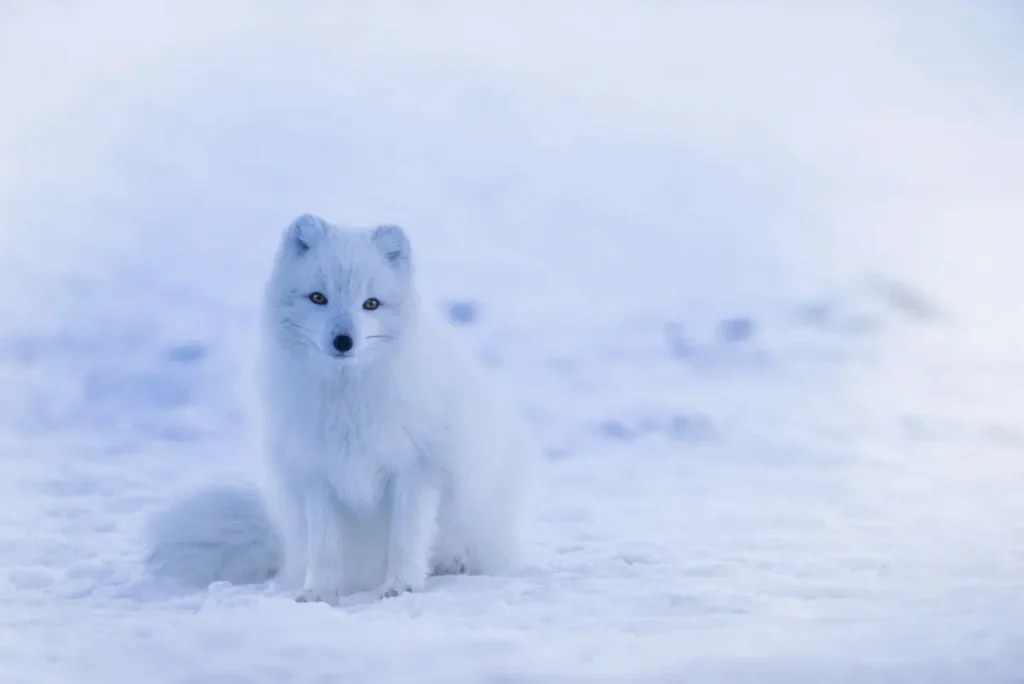
ALT: Arctic fox resting in snow with its thick white winter coat.
Photo: David Mark | Source: Wikimedia Commons | License: CC0 1.0 | Changes: None if original used.
Scientific name: Vulpes lagopus
Habitat: Arctic tundra and northern coastal regions.
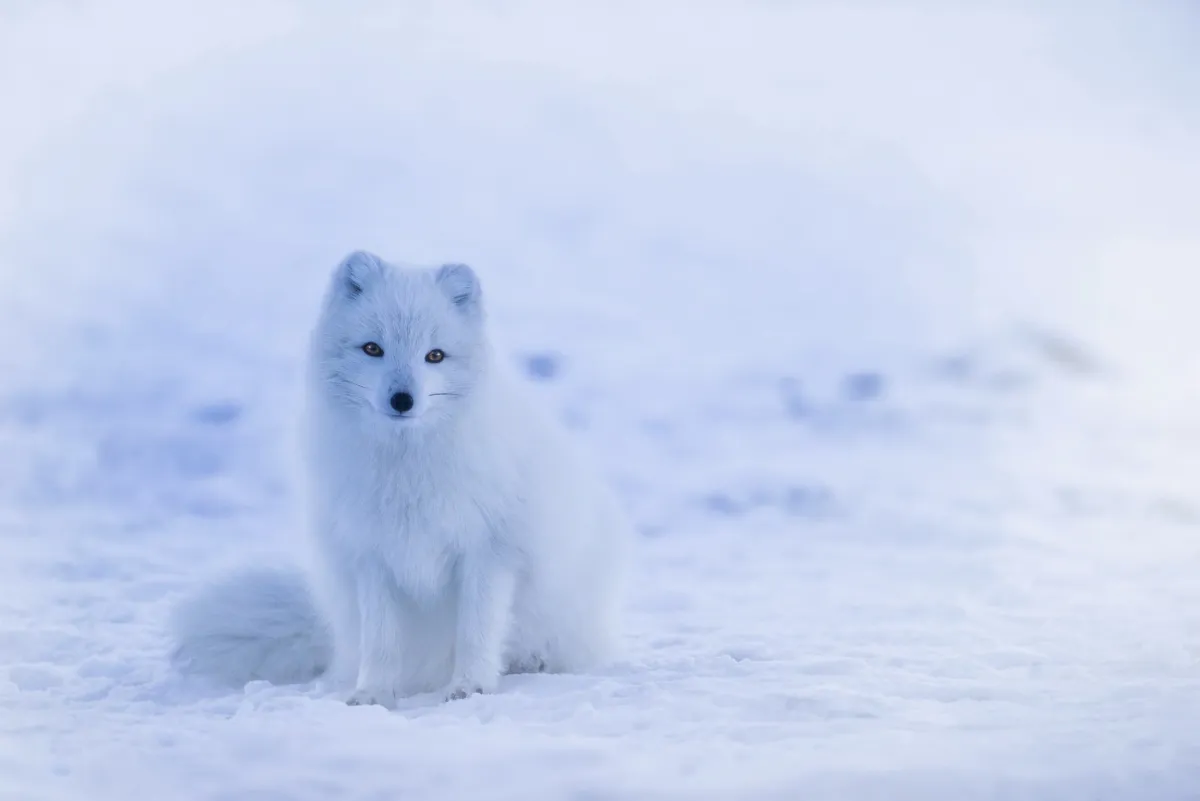
The Arctic fox is exceptionally well adapted to life in freezing environments. White-morph Arctic foxes develop a brownish or grayish summer coat before growing dense white fur for winter.
This white coat makes the fox difficult to detect against snow and ice, helping it approach small mammals and other prey.
Its compact body, small rounded ears, furry paws, and thick tail also help reduce heat loss.
An Arctic fox may use its bushy tail as extra protection by curling it around its body while resting. These adaptations make it particularly well suited to life among other Arctic tundra animals.
Interestingly, not all Arctic foxes turn white. Individuals belonging to the blue color morph remain relatively dark throughout the year.
How to recognize it: A small fox with rounded ears, a short muzzle, and an exceptionally bushy tail.
3. Mountain Hare
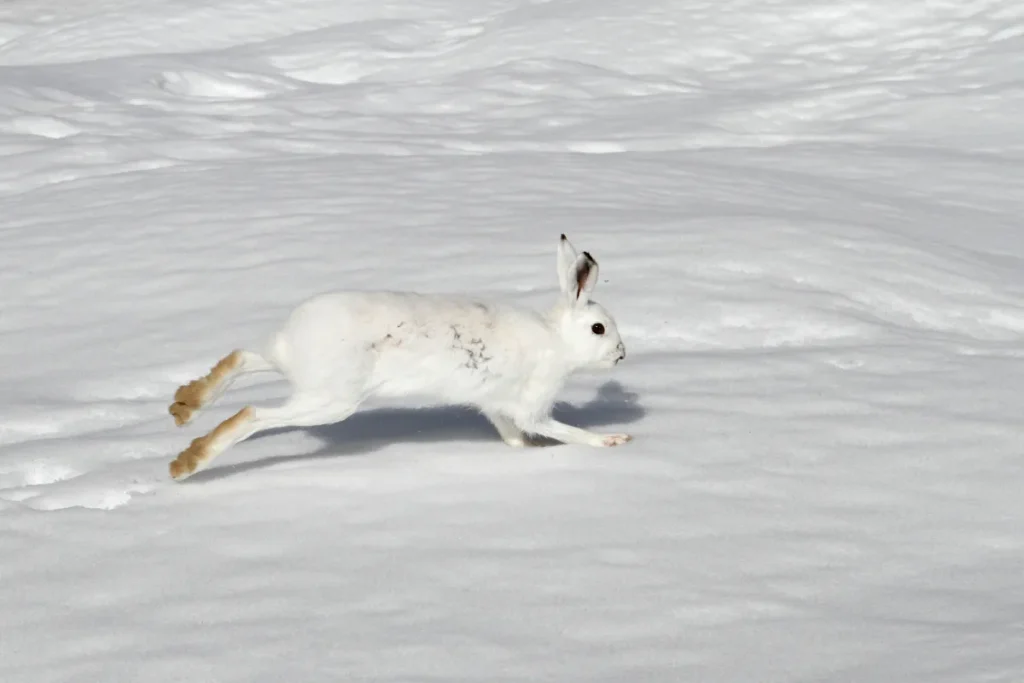
ALT: Mountain hare wearing its white winter coat.
Photo: Bouke ten Cate | Source: Wikimedia Commons | License: CC BY-SA 4.0 | Changes: No additional changes if original used. The source photographer digitally removed a GPS collar.
Scientific name: Lepus timidus
Habitat: Northern Eurasia, Scotland, and parts of the European Alps.
The mountain hare lives in environments where temperatures, vegetation, and snow cover change dramatically throughout the year.
Its summer fur is generally brown or gray, providing camouflage among rocks, grasses, and mountain vegetation. Many populations develop a white winter coat as snow begins to cover their habitat.
Mountain hares feed on grasses, heather, bark, and woody plants, depending on the season.
Their seasonal transformation can be especially striking in mountainous landscapes, where individual hares sometimes appear patchy brown and white during spring and autumn.
How to recognize it: A rounded body, powerful hind legs, and dark tips on the ears.
The extent of winter whitening varies between populations. Mountain hares in some milder regions may retain darker winter coats.
4. Arctic Hare

ALT: Arctic hare photographed in Greenland.
Photo: Drew Avery | Source: Wikimedia Commons | License: CC BY 2.0 | Changes: None if original used. Photograph taken in August.
Scientific name: Lepus arcticus
Habitat: Northern Canada and Greenland.
The Arctic hare is a large, heavily built hare adapted to cold, open landscapes with relatively little vegetation.
In parts of its range, the Arctic hare develops grayish or brownish summer fur before becoming white in winter. This transformation makes it less conspicuous across snow-covered tundra.
However, populations in the far north may remain white throughout the year, where summers are short and snowy conditions can persist.
Arctic hares have strong hind legs, relatively short ears, and thick fur. They can dig through snow to reach vegetation and may also use sheltered depressions to escape harsh winds.
How to recognize it: Its large body, muscular hindquarters, and black-tipped ears distinguish it from many smaller hares.
Unlike the snowshoe hare, which typically inhabits forests, the Arctic hare is commonly associated with open tundra landscapes.
5. Stoat

ALT: Stoat in white winter fur with a distinctive black tail tip.
Photo: Steven Hint | Source: Wikimedia Commons | License: CC BY-SA 3.0 | Changes: None if original used.
Scientific name: Mustela erminea
Habitat: Woodlands, grasslands, farmland, and tundra across much of Eurasia.
The stoat, also known as the ermine when wearing its white winter coat, is a small and agile carnivore with a long, slender body.
During summer, its back is brown while its underside is pale. In colder parts of its range, the stoat grows white fur for winter.
One feature remains unchanged: the black tip of its tail.
Its slender shape enables it to investigate narrow tunnels, burrows, and spaces beneath the snow while hunting small mammals.
Despite its charming appearance, the stoat is an efficient predator capable of hunting prey larger than itself.
How to recognize it: A long white body, short legs, and a distinctive black tail tip.
Stoats living in regions with mild winters may remain brown or only partially change color.
6. Least Weasel
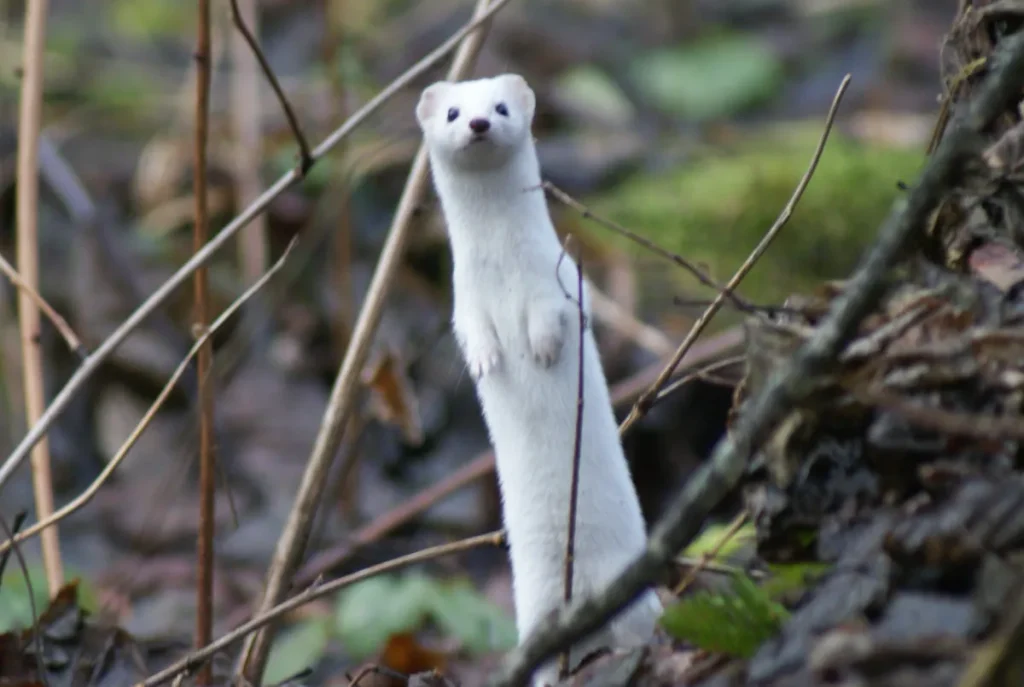
ALT: Least weasel wearing white winter fur in Białowieża Forest.
Photo: Stormbringer76 | Source: Wikimedia Commons | License: CC BY-SA 3.0 | Changes: None if original used.
Scientific name: Mustela nivalis
Habitat: Grasslands, forest edges, farmland, and tundra.
The least weasel is among the smallest members of the carnivore order.
Its narrow body allows it to pursue mice and voles through underground tunnels and other spaces that larger predators cannot enter.
In snowy northern regions, some least weasel populations replace their brown summer fur with white winter fur. This camouflage helps them remain inconspicuous when traveling across snow.
Although a white least weasel can resemble a stoat, the two animals have an important distinguishing feature.
The least weasel generally has a much shorter tail without the prominent black tip found on a stoat.
How to recognize it: A tiny, elongated body and a short tail without a distinct black tip.
Its winter color varies considerably depending on the population and climate.
For more information about identifying these small carnivores, read our mink vs. weasel comparison.
7. Northern Collared Lemming
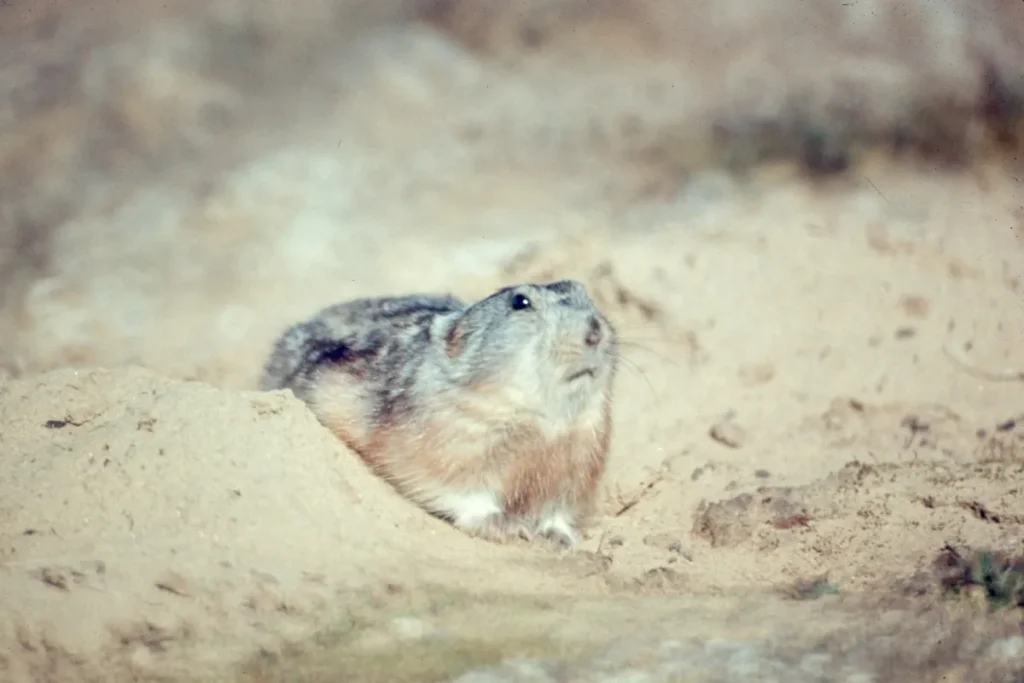
ALT: Northern collared lemming lying on the ground.
Photo: Warren Garst | Source: Wikimedia Commons | License: CC BY-SA 4.0 | Changes: None if original used. Image shows the species for identification rather than its winter-white coat.
Scientific name: Dicrostonyx groenlandicus
Habitat: Arctic tundra in northern North America and Greenland.
The northern collared lemming is a small rodent that survives some of the coldest conditions on Earth.
Unlike many other rodents, northern collared lemmings grow white winter fur as the seasons change.
They also develop enlarged, specialized digging claws during winter, allowing them to move through packed snow and reach vegetation beneath the surface.
Collared lemmings remain active during winter rather than hibernating. Much of their activity takes place underneath the snow, where temperatures can be less extreme than those above it.
They are an important food source for Arctic predators, including snowy owls and Arctic foxes.
How to recognize it: A small, rounded body, short ears, a short tail, and enlarged forefoot claws in winter.
8. Willow Ptarmigan
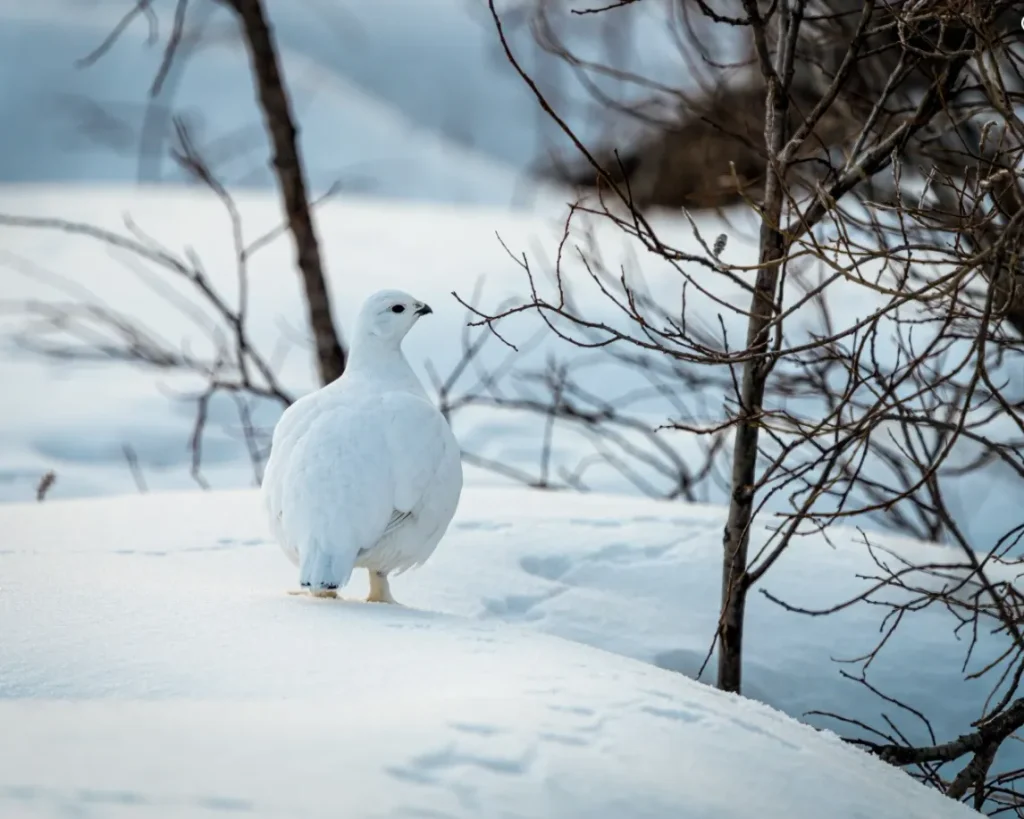
ALT: Willow ptarmigan in white winter plumage in Alaska.
Photo: Colin Canterbury / USFWS | Source: Wikimedia Commons | License: Public Domain | Changes: None if original used.
Scientific name: Lagopus lagopus
Habitat: Subarctic tundra, shrublands, and northern mountain regions.
Mammals are not the only animals that turn white in winter. Several birds also replace their darker feathers with white plumage.
The willow ptarmigan is a ground-dwelling member of the grouse family.
Its warm-season plumage contains reddish-brown and darker markings, helping it blend among shrubs and vegetation. During winter, it becomes predominantly white.
The willow ptarmigan also has heavily feathered feet, which provide insulation and help it travel across snow.
During particularly cold conditions, it may shelter inside snow burrows, taking advantage of the insulating properties of snow.
How to recognize it: A plump, chicken-shaped bird with a relatively large bill and feather-covered feet.
9. Rock Ptarmigan

ALT: Rock ptarmigan pair showing contrasting seasonal plumage.
Photo: Jan Frode Haugseth | Source: Wikimedia Commons | License: CC BY-SA 3.0 | Changes: None if original used. Photograph shows a pair in May, with the male retaining much of his winter plumage.
Scientific name: Lagopus muta
Habitat: Rocky Arctic tundra and high mountain environments.
The rock ptarmigan is another remarkable example of seasonal camouflage in birds.
In summer, its dark, mottled feathers blend with rocky ground and patches of tundra vegetation. In winter, its plumage becomes predominantly white.
The transformation makes it difficult to locate against snowy slopes.
Rock ptarmigans feed on buds, leaves, and other plant material and are well equipped to survive in cold, windswept environments.
Their feathered feet help them move through snow, while their relatively compact bodies are suited to cold climates.
How to recognize it: White winter plumage, dark tail feathers, and, particularly in males, a dark stripe between the bill and eye.
The exact appearance varies with sex and season.
10. White-tailed Ptarmigan
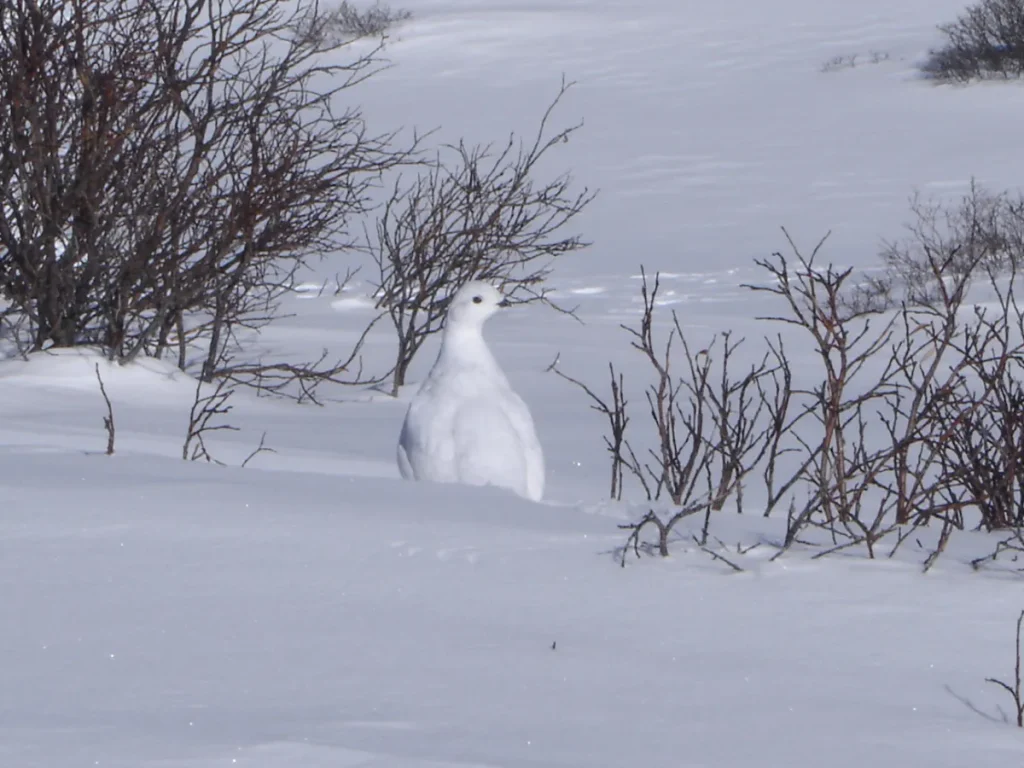
ALT: White-tailed ptarmigan camouflaged in its snowy alpine habitat.
Photo: Craig Hansen / USFWS Mountain-Prairie | Source: Wikimedia Commons | License: CC BY 2.0 | Changes: None if original used.
Scientific name: Lagopus leucura
Habitat: Alpine tundra in western North America.
The white-tailed ptarmigan is a small mountain bird that spends its life in high-elevation environments.
In summer, its mottled brown and gray feathers make it remarkably difficult to distinguish from rocks and low-growing plants.
During winter, it becomes white, allowing it to blend with snowfields high above the tree line.
Its densely feathered body and feet provide protection from freezing temperatures. It may also shelter in snowbanks to conserve body heat.
Unlike the willow and rock ptarmigans, this species has white tail feathers throughout the year.
How to recognize it: A small, stocky mountain bird with an entirely white tail.
Discover more wildlife adapted to high mountain environments in our guide to alpine tundra animals.
Why Do Animals Turn White in Winter?
The primary reason for seasonal whitening is camouflage.
A dark-colored animal can be easy to spot against a snowy background. Growing white fur or feathers reduces this visual contrast and makes the animal more difficult to detect.
Seasonal camouflage benefits both prey and predators.
- Avoiding predators: White coats help animals such as snowshoe hares and ptarmigans blend into snow.
- Hunting more effectively: Arctic foxes and stoats can approach prey without being easily noticed.
- Surviving seasonal changes: Animals can maintain effective camouflage as their surroundings change throughout the year.
Many of these animals also grow thicker winter coats or denser plumage. However, the insulation comes mainly from the structure and density of their fur or feathers rather than simply from their white color.
How Do Animals Change Color With the Seasons?
Most winter-white animals do not instantaneously change the color of existing fur or feathers.
Instead, they undergo a process called seasonal molting, in which old fur or feathers are replaced by new growth with different pigmentation.
Changes in daylight duration, also known as photoperiod, are an important seasonal signal for many species.
As daylight becomes shorter in autumn, physiological changes prepare the animal for its winter coat. Longer spring days help initiate the reverse transformation.
Temperature, genetics, and local conditions can also influence the timing and extent of the change.
This is different from the rapid color changes seen in animals such as octopuses and some chameleons.
Explore these fascinating mechanisms in our guide to animals that change color.
How Climate Change Affects Winter Camouflage
Seasonal camouflage works best when an animal’s appearance matches its surroundings.
But what happens when an animal grows white fur before snow arrives, or remains white after the snow has melted?
Scientists call this camouflage mismatch.
A white snowshoe hare surrounded by brown vegetation becomes much easier for predators to see.
As snow cover becomes shorter or less predictable in some regions, animals whose seasonal molts are strongly linked to daylight may face new survival challenges.
Researchers continue to study whether these animals can adjust the timing of their molts or adapt through changes across generations.
Seasonal color change is therefore not only a fascinating wildlife adaptation but also an important example of how animals depend on predictable environmental conditions.
Animals That Stay White All Year
Not every white animal undergoes seasonal color change.
| Animal | Color Pattern | Seasonal Whitening |
|---|---|---|
| Polar Bear | White or cream appearance throughout the year | No |
| Adult Beluga Whale | Predominantly white throughout the year | No |
| Far-northern Arctic Hare | Often white throughout the year | Limited or none |
| Snowshoe Hare | Usually brown in summer and white in winter | Yes, in many populations |
| White-morph Arctic Fox | Brown or gray in summer and white in winter | Yes |
Permanent coloration and seasonal camouflage are related but distinct adaptations.
Frequently Asked Questions
What animals turn white in winter?
Snowshoe hares, Arctic foxes, mountain hares, Arctic hares, stoats, least weasels, northern collared lemmings, and several species of ptarmigan can develop white winter coats or plumage.
Do all Arctic foxes turn white in winter?
No. White-morph Arctic foxes typically become white during winter, but blue-morph Arctic foxes remain relatively dark throughout the year.
What birds turn white in winter?
Willow ptarmigans, rock ptarmigans, and white-tailed ptarmigans are three well-known birds that develop predominantly white winter plumage.
What is the difference between a white stoat and a white weasel?
A stoat has a distinctive black tail tip, even when the rest of its coat is white. A least weasel has a shorter tail without this prominent black tip.
Do animals turn white because of the cold?
Cold conditions can influence seasonal molting in some species, but changes in daylight are an important trigger. Genetics and other environmental factors also affect winter coloration.
Do animals that turn white in winter hibernate?
Many winter-white animals remain active throughout the colder months. Snowshoe hares, Arctic foxes, stoats, and collared lemmings continue searching for food during winter.
Their seasonal camouflage helps them survive without needing to hibernate.
Final Thoughts
Animals that turn white in winter demonstrate how closely wildlife is connected to seasonal changes.
From the snowshoe hare hiding in a northern forest to the white-tailed ptarmigan resting high in the mountains, each species has evolved its own combination of camouflage, insulation, and survival strategies.
Not every animal responds to winter in the same way. Some change color, some migrate, while others prepare for colder months by storing food.
The next time you see a photograph of a white animal in the snow, remember that the same creature may look remarkably different when summer returns.
Related Articles
- Animals That Change Color
- Arctic Tundra Animals
- 6 Alpine Tundra Animals Found Above the Treeline
- 10 Animals That Store Food for Winter
- Mink vs. Weasel
References and Further Reading
- National Park Service – Snowshoe Hare
- Alaska Department of Fish and Game – Arctic Fox
- Cornell Lab of Ornithology – Willow Ptarmigan
- Cornell Lab of Ornithology – Rock Ptarmigan
- Cornell Lab of Ornithology – White-tailed Ptarmigan
- Biological Reviews – Function and Underlying Mechanisms of Seasonal Colour Moulting in Mammals and Birds
- PNAS – Camouflage Mismatch in Seasonal Coat Color Due to Decreased Snow Duration