
The quickest way to tell an American mink from a long-tailed weasel is to look at the belly and tail together. An American mink usually looks dark brown across most of its body, sometimes with a white chin or scattered pale patches. A long-tailed weasel in its brown coat usually has a pale underside and a clearly defined black tail tip. Both can turn up beside streams, so the markings are more useful than the location alone. FWC
This guide compares the American mink and the long-tailed weasel, two members of the weasel family found in North America. FWC
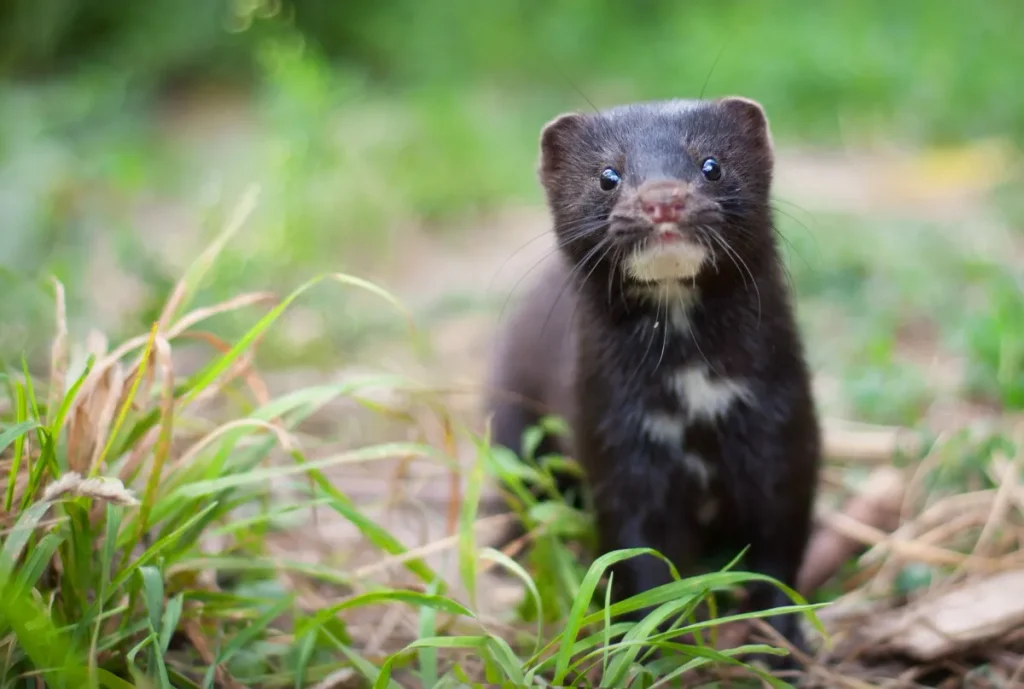
An American mink with a pale chin and small pale patches on its chest.
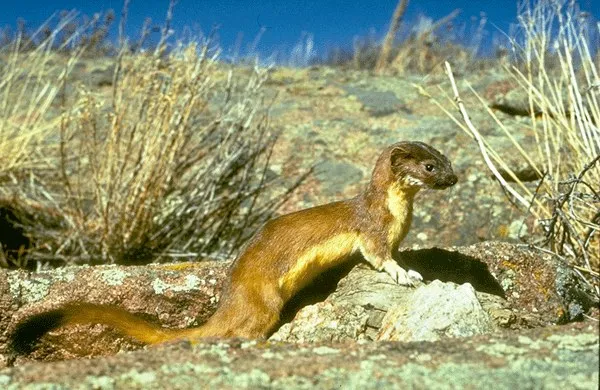
A long-tailed weasel with a pale underside and a dark tail tip. The photos are shown at different scales.
Mink vs. Weasel at a Glance
| What to check | American mink | Long-tailed weasel |
|---|---|---|
| Belly and throat | Mostly dark, sometimes with pale patches | Broad pale or yellowish underside in its brown coat |
| Tail | Usually fuller, and may darken toward the tip | Slimmer, with a distinct black tip |
| Build | Generally heavier and thicker through the body | Generally smaller and more slender |
| Winter coat | Usually stays dark brown | Can turn white in snowy regions, keeping the black tail tip |
| Habitat | Often close to rivers, ponds, marshes, and shorelines | Also uses brushy field edges, woods, and stream banks |
1. Look at How Far the Pale Fur Extends
A pale chin can appear on either animal. Look farther down. On an American mink, the light fur may appear as a small chin patch or irregular spots on the chest or belly. Much of the underside stays dark.
A long-tailed weasel in its brown coat usually has a broader band of pale fur below. If the animal is standing upright or climbing, the boundary between the brown back and pale underside is often easier to see. Missouri Department of Conservation
2. Check the Tail for a Distinct Black Tip
A long-tailed weasel has a black tip that stands out against the rest of the tail. The mark is especially easy to see when the tail is white in winter.
A mink’s tail can also get darker toward the end. In a shadowy photo, look back at the belly before deciding. A sharply defined black tip and a broad pale underside together point toward a long-tailed weasel. Missouri Department of Conservation
3. Compare Body Build When You Have a Scale Reference
Both animals have long bodies, short legs, and rounded ears. An American mink is generally heavier and thicker through the torso. A long-tailed weasel looks slimmer, with a narrow neck and small head.
Size is easier to judge if the photo includes a familiar object next to the animal, such as a fence post. Camera distance can make a small weasel fill the frame or make a mink look tiny. FWC
4. Check the Coat in Winter

A long-tailed weasel in its white winter coat, with a black tail tip.
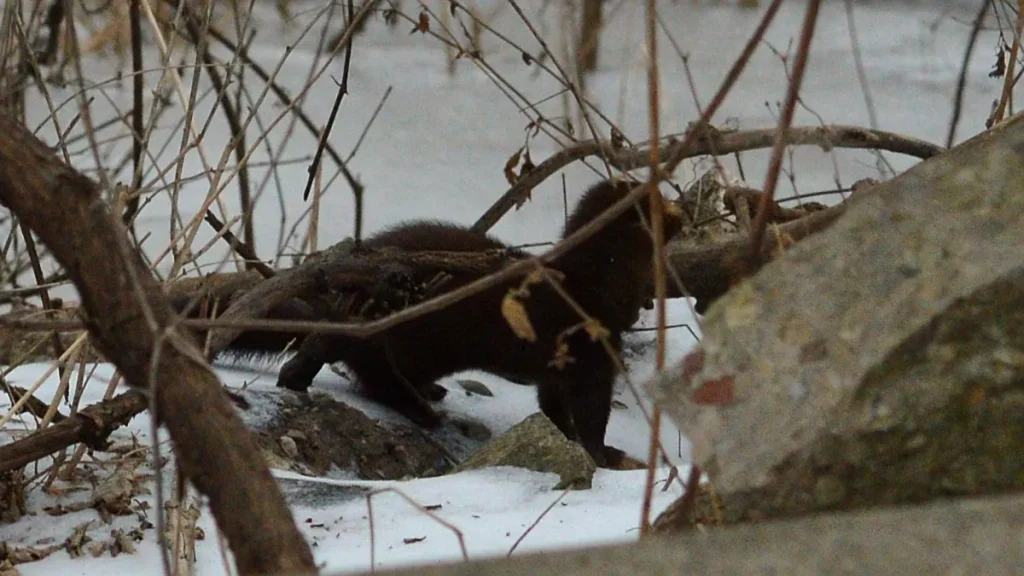
An American mink in Cambridge, Ontario, photographed in February. Its coat is still dark.
In parts of its range, a long-tailed weasel grows a white winter coat. The tail tip remains black. In milder areas, it can stay brown or become only somewhat paler. A wild American mink typically keeps a dark coat through winter.
A white animal with a black tail tip can also be an ermine. If you need a species-level identification, use the animal’s size, tail proportions, and location together. Missouri Department of Conservation
5. Use Habitat as a Supporting Clue
American mink often travel along stream banks, ponds, marshes, and other shorelines. They can shelter under roots and logs or use muskrat burrows and lodges. See how a muskrat lodge differs from a beaver lodge. Missouri Department of Conservation
Long-tailed weasels use a wider variety of places, including woodland edges, brushy fencerows, and thickets along streams. A sighting beside water supports a mink identification, especially when the animal has a dark underside. A stream bank by itself fits either species. Missouri Department of Conservation
Can You Tell Mink and Weasel Tracks Apart?
Mink tracks tend to be larger than long-tailed weasel tracks. Both can leave prints with four or five visible toes, depending on which toes register. If you find tracks, photograph several prints with a ruler beside them and capture the spacing between groups. A measured trail gives you more to work with than a single print. Missouri Department of Conservation
Sources
- Florida Fish and Wildlife Conservation Commission — Public Asked to Share Weasel and Mink Sightings
- Missouri Department of Conservation — American Mink and Long-Tailed Weasel
- MassWildlife — Meet the Mustelids


