Imagine standing on a mountain trail surrounded by towering peaks, alpine meadows, and dense evergreen forests. Somewhere above you, a golden eagle may be circling the cliffs. Farther down the valley, elk graze in open grasslands while a tiny pika gathers plants between the rocks.
The Rocky Mountains are home to an incredible variety of wildlife.
Stretching from western Canada through the United States to New Mexico, this mountain system contains forests, grasslands, lakes, rugged cliffs, and high-elevation tundra.
Bighorn sheep, mountain goats, elk, moose, American pikas, marmots, black bears, mountain lions, and several remarkable bird species are among the animals that live in the Rocky Mountains.
Some spend their lives on steep rocky slopes, while others prefer forests, wetlands, or alpine meadows.
Here are 10 fascinating Rocky Mountain animals, including their habitats, diets, identification features, and adaptations for surviving mountain environments.
10 Rocky Mountain Animals: Quick Comparison
| Animal | Scientific Name | Main Habitat | Key Adaptation |
|---|---|---|---|
| Bighorn Sheep | Ovis canadensis | Rocky cliffs and alpine slopes | Specialized hooves for climbing |
| Mountain Goat | Oreamnos americanus | Steep cliffs and alpine terrain | Gripping hooves and thick fur |
| Elk | Cervus canadensis | Forests and mountain meadows | Seasonal movement and strong legs |
| Moose | Alces alces | Forest wetlands and willow habitats | Long legs and insulating coat |
| American Pika | Ochotona princeps | Talus slopes and rocky fields | Haypile food storage |
| Yellow-bellied Marmot | Marmota flaviventris | Rocky meadows and mountain slopes | Hibernation and burrowing |
| American Black Bear | Ursus americanus | Mountain forests and shrublands | Flexible diet and winter denning |
| Mountain Lion | Puma concolor | Forests and rugged mountain terrain | Stealth and powerful jumping |
| Clark’s Nutcracker | Nucifraga columbiana | High-elevation conifer forests | Seed caching and spatial memory |
| Golden Eagle | Aquila chrysaetos | Open mountains and cliffs | Powerful talons and soaring flight |
The Rocky Mountains cover an enormous geographical area, so not every species occurs in every region.
Some animals are common in particular national parks, while others are rarely seen or occupy only certain parts of the mountain range.
1. Bighorn Sheep

ALT: Rocky Mountain bighorn sheep ram showing its large curved horns in Rocky Mountain National Park.
Photo: dw_ross | Source: Wikimedia Commons | License: CC BY 2.0 | Changes: None if original used.
Scientific name: Ovis canadensis
Habitat: Rocky cliffs, mountain slopes, alpine meadows, and nearby open habitats.
Diet: Grasses, sedges, shrubs, and other vegetation.
Bighorn sheep are among the most recognizable animals living in the Rocky Mountains.
Their name comes from the enormous curved horns of adult males, known as rams.
These horns can become exceptionally large and are used during competition between males, especially during the breeding season.
Female bighorn sheep, called ewes, also have horns, but theirs are generally much smaller and less curved.
Bighorn sheep possess specialized hooves that help them move across rugged mountain terrain.
The hard outer edges provide support, while the more flexible inner surfaces help them grip uneven rocks.
This adaptation allows bighorn sheep to climb steep slopes and escape many predators.
They frequently use rocky terrain as protective habitat, while nearby grasslands and meadows provide feeding opportunities.
How to recognize it: Look for a stocky, tan-colored wild sheep with a white rump, short tail, and curved horns.
Interesting fact: During the breeding season, adult rams may clash their horns in dramatic contests that can be heard from considerable distances.
2. Mountain Goat

ALT: Mountain goat with a thick white coat standing on rocky terrain at Mount Massive, Colorado.
Photo: Darklich14 | Source: Wikimedia Commons | License: CC BY 3.0 | Changes: None if original used.
Scientific name: Oreamnos americanus
Habitat: Steep mountain cliffs, alpine slopes, and rugged high-elevation terrain.
Diet: Grasses, sedges, flowering plants, and other mountain vegetation.
Mountain goats are extraordinary climbers adapted to some of the most rugged landscapes in western North America.
Their thick white coats help protect them from cold mountain weather.
Both males and females have relatively slender black horns that curve slightly backward.
Their hooves are specially adapted for climbing.
A hard outer rim helps support the animal’s weight, while the softer inner pad provides traction on uneven rock.
Mountain goats can navigate ledges and steep slopes that would be extremely difficult for many other large mammals.
Despite their name, mountain goats are not true goats in the same sense as domestic goats. They belong to a distinctive lineage within the goat-antelope group.
Mountain goats are native to parts of the northern Rocky Mountains, including regions of western Canada and the northern United States.
They were introduced to Colorado during the twentieth century and now occur in several high mountain areas there.
How to recognize it: Look for a large white mountain mammal with a shaggy coat, short black horns, and a beard-like tuft of hair.
Interesting fact: Mountain goats can remain in steep alpine habitats throughout the year, although some move to lower elevations during winter.
3. Elk
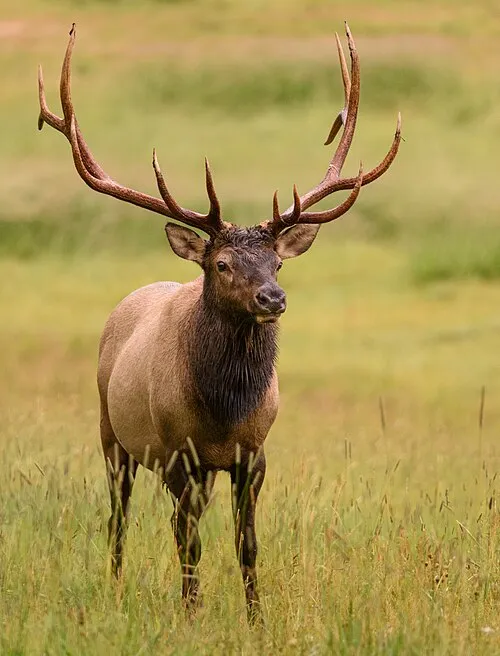
ALT: Bull elk showing its large branching antlers in Rocky Mountain National Park, Colorado.
Photo: Andrew Russell | Source: Wikimedia Commons | License: CC BY 2.0 | Changes: None if original used.
Scientific name: Cervus canadensis
Habitat: Mountain meadows, open woodlands, valleys, and forest edges.
Diet: Grasses, sedges, leaves, shrubs, and other plant material.
Elk are among the largest deer species in North America and are especially famous for their impressive antlers.
Adult males, known as bulls, grow branching antlers that are generally shed and replaced each year.
During autumn, the breeding season known as the rut brings remarkable changes in elk behavior.
Bulls produce loud, high-pitched vocalizations called bugles.
These calls help attract females and communicate with competing males.
Elk frequently move between habitats according to season, snow conditions, and food availability.
In warmer months, some animals use higher-elevation meadows and forest openings.
During winter, they may move toward lower valleys where vegetation is more accessible.
Their strong legs allow them to travel considerable distances across uneven mountain terrain.
How to recognize it: Look for a large deer with a tan or brown body, pale rump patch, darker neck, and large branching antlers in adult males.
Interesting fact: Elk bugling is one of the most distinctive wildlife sounds associated with autumn in Rocky Mountain National Park.
4. Moose

ALT: Moose standing near a campground in Rocky Mountain National Park.
Photo: Wusel007 | Source: Wikimedia Commons | License: CC BY 3.0 | Changes: None if original used.
Scientific name: Alces alces
Habitat: Mountain forests, wetlands, willow thickets, lakeshores, and stream valleys.
Diet: Willow leaves, aquatic plants, shrubs, twigs, and other vegetation.
The moose is the largest living member of the deer family.
Its long legs, elongated muzzle, and enormous body make it one of the most recognizable mammals in the Rocky Mountains.
Moose often prefer habitats containing water and abundant vegetation.
They may be seen feeding near lakes, streams, wetlands, and willow-covered valleys.
Their long legs help them move through deep snow, shallow water, and dense vegetation.
Moose are also capable swimmers and may feed on aquatic plants during warmer months.
Adult male moose grow broad antlers, which are generally shed after the breeding season.
Females do not normally have antlers.
Although moose are now regularly observed in Colorado’s Rocky Mountain National Park, they were not historically common in that particular region. Their presence in parts of Colorado has increased following introductions and population expansion.
How to recognize it: Look for an exceptionally large deer with long legs, a drooping muzzle, a shoulder hump, and broad antlers in mature males.
Interesting fact: A moose may appear calm while feeding, but it can move very quickly and become dangerous when threatened.
Always give moose plenty of space, especially females with calves.
5. American Pika
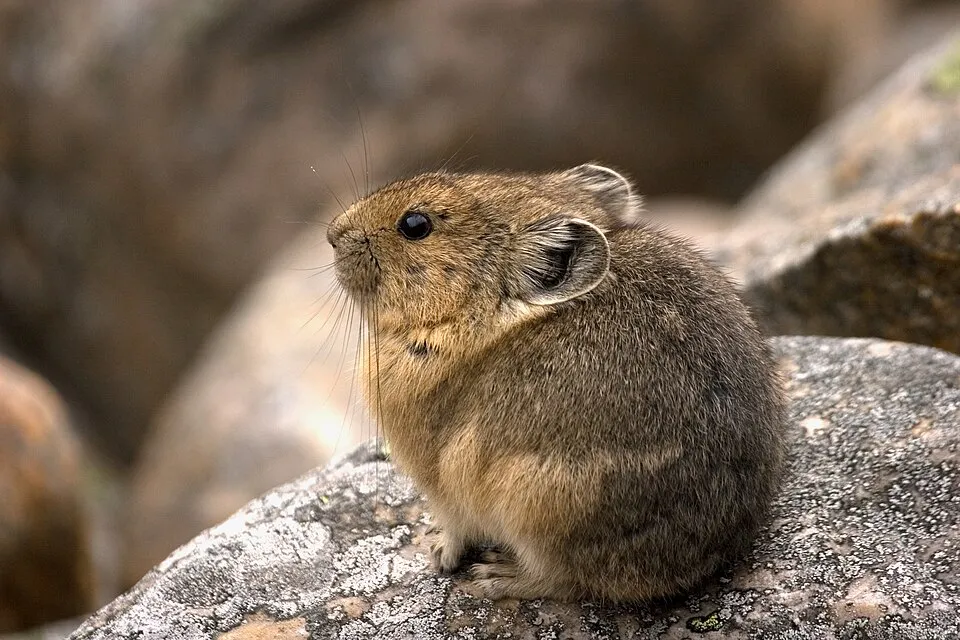
ALT: American pika sitting among alpine rocks in Banff National Park, Canada.
Photo: Naturedata | Source: Wikimedia Commons | License: CC0 1.0 | Changes: None if original used.
Scientific name: Ochotona princeps
Habitat: Rocky mountain slopes, talus fields, and boulder piles.
Diet: Grasses, sedges, wildflowers, and other alpine vegetation.
The American pika is a small mountain mammal that resembles a round-eared hamster.
However, pikas are not rodents.
They belong to the same mammalian order as rabbits and hares.
American pikas are strongly associated with rocky mountain habitats, particularly areas containing deep spaces between rocks.
These crevices provide shelter from predators and extreme weather.
Pikas are famous for gathering vegetation during the short mountain growing season.
They carry grasses, leaves, and flowers to protected locations where the plants can dry.
The resulting piles of stored vegetation are called haypiles.
During winter, pikas remain active rather than hibernating.
They can use their stored food while sheltering among rocks beneath the snow.
Their relatively small bodies and adaptations to cool environments make them especially interesting subjects for research on changing mountain climates.
How to recognize it: Look for a small, round-bodied mammal with short rounded ears, no obvious external tail, and brownish-gray fur.
Interesting fact: American pikas often make short, high-pitched calls that can reveal their presence before they are visible.
Learn more about animal food storage in our guide to 10 animals that store food for winter.
6. Yellow-bellied Marmot
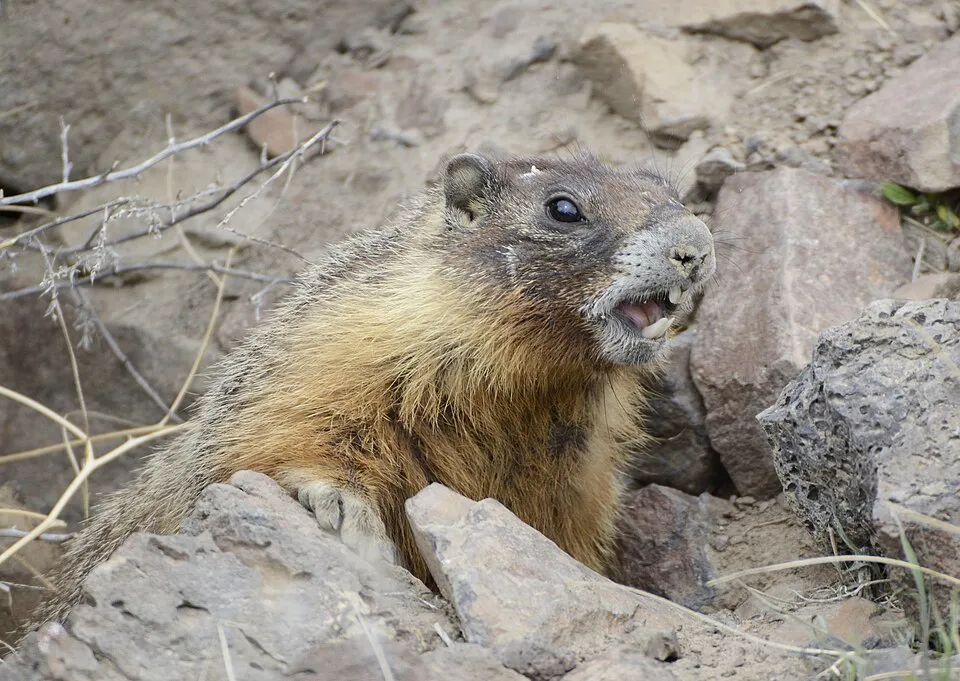
ALT: Yellow-bellied marmot making an alarm call in a rocky habitat in Washington State.
Photo: VJAnderson | Source: Wikimedia Commons | License: CC BY-SA 4.0 | Changes: None if original used. The photograph shows this Rocky Mountain species in Washington State.
Scientific name: Marmota flaviventris
Habitat: Rocky slopes, alpine meadows, grasslands, and mountain valleys.
Diet: Grasses, flowering plants, and other vegetation.
The yellow-bellied marmot is a large ground-dwelling squirrel commonly associated with rocky mountain habitats.
Its rounded body, short legs, and yellowish or reddish-brown underside make it relatively easy to recognize.
Yellow-bellied marmots live in burrow systems that provide shelter from predators and unfavorable weather.
They are highly alert animals.
When danger approaches, a marmot may produce a sharp whistle or alarm call.
This behavior has earned marmots the nickname “whistle pigs” in some regions.
Marmots spend much of the warmer season feeding and accumulating body fat.
Unlike American pikas, they survive winter largely through hibernation.
Their body temperature, heart rate, and metabolic activity decrease during prolonged periods of inactivity underground.
This strategy allows marmots to survive when mountain vegetation becomes buried beneath snow.
How to recognize it: Look for a large, stocky ground squirrel with a broad head, short ears, and a yellowish underside.
Interesting fact: Yellow-bellied marmots may spend more than half the year in hibernation, depending on elevation and local conditions.
Read about more underground shelter strategies in our guide to 12 animals that live underground.
7. American Black Bear

ALT: American black bear photographed in the Canadian Rocky Mountains near Lake Louise.
Photo: Harvey Barrison | Source: Wikimedia Commons | License: CC BY-SA 2.0 | Changes: None if original used.
Scientific name: Ursus americanus
Habitat: Mountain forests, shrublands, wooded valleys, and forest edges.
Diet: Berries, nuts, insects, vegetation, carrion, and occasional animal prey.
American black bears are widespread across forested regions of North America, including large parts of the Rocky Mountains.
Despite their name, they are not always black.
Some individuals have brown, cinnamon, or even much lighter coats.
Black bears are omnivores, meaning they eat both plant and animal material.
Their diet changes throughout the year according to food availability.
During spring and summer, bears may feed on vegetation, insects, and other available foods.
In late summer and autumn, they often increase their food consumption while preparing for winter.
Many black bears spend winter in dens, where their metabolism slows substantially.
Mountain forests provide shelter, denning sites, and access to seasonal food sources.
Black bears can also climb trees, especially when young.
How to recognize it: Look for a medium-to-large bear with rounded ears, a relatively straight facial profile, and no prominent shoulder hump.
Interesting fact: Brown-colored black bears can sometimes be confused with grizzly bears. Identifying bears requires several features rather than coat color alone.
Never approach a bear or attempt to feed it.
8. Mountain Lion

ALT: Mountain lion showing its tawny coat, rounded ears, and muscular body.
Photo: Stephen Lea | Source: Wikimedia Commons | License: CC BY-SA 3.0 | Changes: The Wikimedia image was cropped from a photograph taken at the Arizona-Sonora Desert Museum; no further changes if this file is used unchanged. This is a captive animal photograph.
Scientific name: Puma concolor
Habitat: Mountain forests, rocky slopes, canyons, and rugged woodland environments.
Diet: Deer, elk calves, smaller mammals, and other available prey.
The mountain lion is one of the largest wild cats found in North America.
Also known as a cougar or puma, it is a powerful predator capable of surviving in many different habitats.
In the Rocky Mountains, mountain lions commonly use forested slopes, rocky canyons, and other areas that provide cover.
They are generally solitary animals.
Mountain lions rely heavily on stealth rather than long-distance pursuit when hunting.
Their powerful hind legs allow them to leap considerable distances, while their muscular bodies help them move across rugged terrain.
A long tail provides balance during climbing and rapid movements.
Their tawny coats help them blend into dry grasses, rocks, and forest shadows.
Mountain lions are important predators that can influence the abundance and behavior of deer and other prey animals.
How to recognize it: Look for a large, uniformly tawny wild cat with a relatively small head, rounded ears, muscular body, and exceptionally long tail.
Interesting fact: Mountain lions have one of the widest geographical ranges of any native land mammal in the Americas.
They are rarely seen by visitors because they usually avoid humans.
9. Clark’s Nutcracker
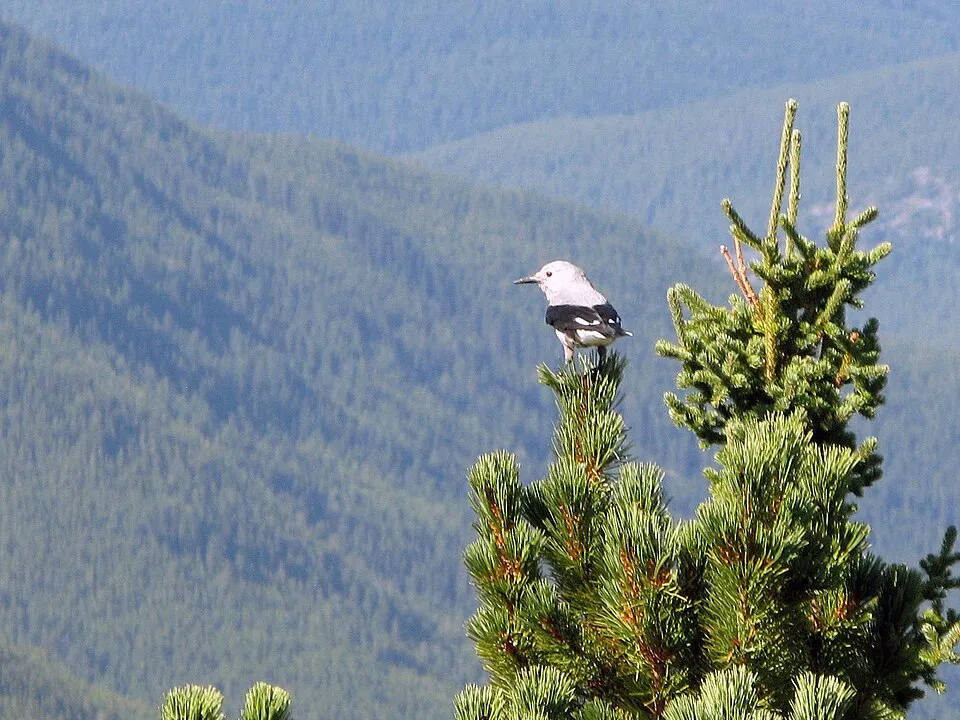
ALT: Clark’s Nutcracker photographed on Sulphur Mountain in Banff National Park, Canada.
Photo: Bill Tyne | Source: Wikimedia Commons | License: CC BY-SA 2.0 | Changes: None if original used.
Scientific name: Nucifraga columbiana
Habitat: High-elevation conifer forests, forest edges, and rocky mountain environments.
Diet: Pine seeds, insects, berries, and other food items.
Clark’s Nutcracker is one of the most fascinating birds found in the Rocky Mountains.
It belongs to the crow and jay family.
Its gray body, black wings, black tail feathers, and contrasting white wing and tail patches make it distinctive.
These birds are especially well known for their relationship with mountain pine trees.
Clark’s Nutcrackers collect seeds from certain pine species, including whitebark pine and limber pine.
They carry seeds in a specialized pouch beneath the tongue and bury them in numerous locations.
These hidden food supplies help sustain the birds during periods when fresh seeds are less available.
Clark’s Nutcrackers have remarkable spatial memory that allows them to recover many of their caches.
However, not every buried seed is retrieved.
Some forgotten seeds can germinate, helping pine trees spread into suitable habitats.
This creates an important ecological relationship between the bird and mountain forests.
How to recognize it: Look for a medium-sized gray bird with a long pointed bill, black wings, and bold white wing and tail patches.
Interesting fact: Clark’s Nutcrackers help regenerate certain mountain pine forests through their seed-caching behavior.
For more examples of animal food storage, explore our guide to animals that store food for winter.
10. Golden Eagle
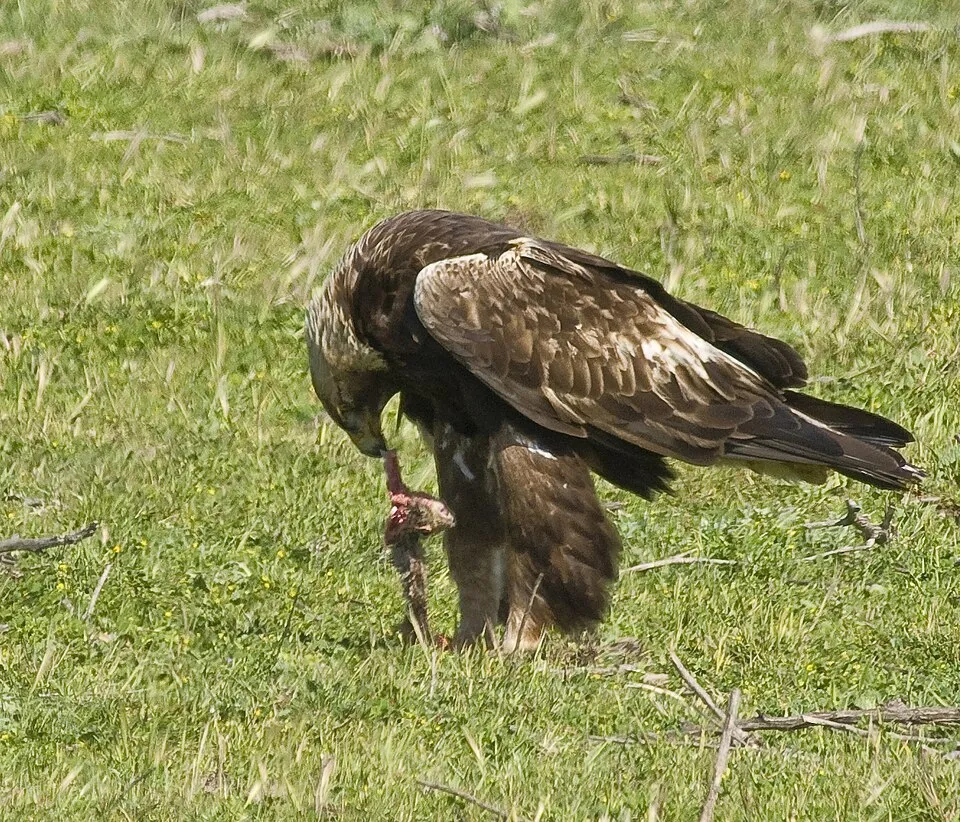
ALT: Golden Eagle showing its dark brown plumage, powerful hooked bill, and golden-colored feathers around the head.
Photo: Chuck Abbe | Source: Wikimedia Commons | License: CC BY 2.0 | Changes: None if original used. The photograph was taken in California.
Scientific name: Aquila chrysaetos
Habitat: Mountain cliffs, open slopes, grasslands, and other landscapes with suitable prey.
Diet: Rabbits, hares, ground squirrels, marmots, and other animals.
The Golden Eagle is one of North America’s most powerful birds of prey.
It is widely associated with mountainous regions, including the Rocky Mountains.
Golden Eagles have broad wings, strong talons, and impressive soaring abilities.
They frequently use rising air currents to travel over large areas while searching for food.
Their vision allows them to detect potential prey from considerable distances.
Golden Eagles often hunt mammals such as rabbits, hares, and ground squirrels.
They may also capture other birds or feed on carrion.
Nesting sites are commonly located on cliffs or large trees, depending on the surrounding environment.
Adult Golden Eagles are mostly dark brown, with golden or tawny feathers around the head and neck.
Immature birds may show conspicuous white areas on their wings and tails.
How to recognize it: Look for a very large dark eagle with broad wings, a relatively small-looking head, a golden nape, and feathered legs.
Interesting fact: Golden Eagles can soar over rugged mountain terrain for long periods while using relatively little energy.
Where Are the Rocky Mountains?
The Rocky Mountains are a major mountain system extending through western North America.
They stretch from the Canadian Rockies through several western U.S. states, including Montana, Idaho, Wyoming, Utah, Colorado, and New Mexico.
The mountain system contains numerous peaks, valleys, forests, rivers, and alpine environments.
Different parts of the Rockies experience different climates.
Northern regions can have very cold winters, while southern mountains often experience warmer and drier conditions at comparable elevations.
Elevation also strongly influences temperature and vegetation.
As a result, the animals found in a forested mountain valley may be very different from those living on exposed rocky slopes above the tree line.
Rocky Mountain Wildlife by Habitat
The Rocky Mountains contain several major habitat types.
Each supports different wildlife communities.
| Habitat | Main Characteristics | Example Animals |
|---|---|---|
| Montane Forest | Lower and middle-elevation forests | Black Bear, Mountain Lion, Elk |
| Mountain Valley | Meadows, streams, and open grasslands | Elk, Moose |
| Subalpine Forest | Cold conifer forests below the tree line | Clark’s Nutcracker, Black Bear |
| Alpine Meadow | Open high-elevation grasslands | Bighorn Sheep, Yellow-bellied Marmot |
| Rocky Alpine Slopes | Exposed boulders, cliffs, and talus | Mountain Goat, American Pika |
| Open Mountain Skies and Cliffs | Soaring and nesting habitat | Golden Eagle |
These habitats are connected.
Elk may move between forests and meadows.
Moose often feed in wet valleys while using nearby wooded areas for shelter.
Golden Eagles may nest on cliffs but hunt across open habitats.
Bighorn Sheep vs. Mountain Goat: How to Tell Them Apart
Bighorn sheep and mountain goats are two of the most recognizable Rocky Mountain animals.
However, they are frequently confused because both live on steep mountain terrain.
| Feature | Bighorn Sheep | Mountain Goat |
|---|---|---|
| Scientific Name | Ovis canadensis | Oreamnos americanus |
| Body Color | Usually tan or brown | Usually white |
| Horns | Large curved horns in mature males | Narrow, dark, slightly curved horns |
| Coat | Shorter, brownish coat | Thick, shaggy white coat |
| Habitat | Cliffs, alpine slopes, open terrain | Steep cliffs and alpine slopes |
| Taxonomic Group | Wild sheep | Goat-antelope relative |
| Identification Clue | Curled horns and tan body | White coat and black horns |
Both species possess hooves adapted to rocky terrain.
However, their appearance is quite different.
Quick identification tip: A large tan mountain animal with enormous curling horns is likely a bighorn sheep. A white, shaggy mountain animal with short black horns is likely a mountain goat.
American Pika vs. Yellow-bellied Marmot
These two animals often live in rocky mountain habitats, but their sizes, behavior, and winter survival strategies differ significantly.
| Feature | American Pika | Yellow-bellied Marmot |
|---|---|---|
| Body Size | Very small | Much larger |
| Animal Group | Rabbit and hare relative | Ground squirrel |
| Tail | Almost invisible externally | Short but noticeable |
| Main Habitat | Talus slopes and rock piles | Rocky meadows and burrows |
| Winter Strategy | Remains active and uses stored vegetation | Hibernates |
| Common Sound | High-pitched call | Loud whistle or alarm call |
A pika may resemble a tiny round-eared rabbit.
A marmot looks more like a large, stocky ground squirrel.
Both species can be observed around rocky mountain environments, especially during warmer months.
How Do Rocky Mountain Animals Survive Harsh Conditions?
Mountain environments can be difficult places to survive.
Temperatures change rapidly, snow may remain for months, and vegetation becomes scarce at higher elevations.
Rocky Mountain animals have developed numerous adaptations.
1. Specialized Hooves
Bighorn sheep and mountain goats use specialized hooves to navigate rocky terrain.
These structures help provide stability and traction on steep slopes.
2. Thick Fur
Mountain goats, moose, and other mammals develop insulating coats that help reduce heat loss during cold weather.
3. Food Storage
American pikas gather vegetation for winter.
Clark’s Nutcrackers bury seeds in numerous locations to provide food during colder periods.
4. Hibernation
Yellow-bellied marmots spend much of winter hibernating underground.
Their metabolism slows dramatically, reducing energy requirements.
5. Seasonal Movement
Elk and some other large mammals move between higher and lower elevations according to seasonal conditions.
6. Camouflage
Many mountain animals have fur or feathers that blend into rocks, vegetation, and surrounding terrain.
Mountain lions use their tawny coloration to remain inconspicuous while stalking prey.
7. Efficient Flight
Golden Eagles use rising air currents to soar across mountainous landscapes while searching for prey.
What Do Animals in the Rocky Mountains Eat?
The Rocky Mountains support complex food webs that connect plants, herbivores, predators, and scavengers.
A simplified example is:
Alpine Vegetation → American Pika → Golden Eagle
Another possible feeding relationship is:
Mountain Grasses → Elk → Mountain Lion
However, real mountain food webs are much more complex.
Black bears consume both plant and animal material.
Golden Eagles hunt several kinds of mammals and birds.
Bighorn sheep and elk eat different types of vegetation depending on season and habitat.
Decomposers also help return nutrients to mountain soils.
These ecological connections are important because changes affecting one species may influence many others.
Rocky Mountain Animals vs. Boreal Forest Animals
The Rocky Mountains and boreal forests share some wildlife, but they are not identical ecosystems.
Boreal forests are primarily defined by northern climate and forest vegetation.
The Rocky Mountains are a geographical mountain system containing multiple ecosystems.
| Feature | Rocky Mountains | Boreal Forest |
|---|---|---|
| Main Environment | Mountains with multiple elevation zones | Northern forests |
| Vegetation | Grasslands, conifers, shrubs, alpine plants | Spruce, pine, fir, mosses |
| Typical Animals | Bighorn Sheep, Mountain Goat, Pika, Elk | Canada Lynx, Snowshoe Hare, Spruce Grouse |
| Major Environmental Challenge | Elevation, steep terrain, changing weather | Long cold winters and short growing seasons |
| Wildlife Distribution | Often changes strongly with elevation | Changes with latitude, habitat, and forest structure |
Some boreal-type forests occur within the northern Rocky Mountains.
The two environments can therefore overlap.
Explore northern forest wildlife in our guide to 12 animals that live in boreal forests.
Rocky Mountains vs. Alpine Tundra
The Rocky Mountains contain extensive alpine tundra above the tree line.
However, alpine tundra is only one part of the entire mountain system.
Lower mountain slopes may contain forests and grasslands.
Higher elevations support shrubs, alpine meadows, and exposed rocky terrain.
Animals such as American pikas and marmots are commonly associated with high-elevation habitats.
Moose, bears, and elk may use forested valleys and other lower-elevation areas.
Discover more animals adapted to conditions above the tree line in our guide to alpine tundra animals.
Where Can You See Wildlife in the Rocky Mountains?
Several national parks and protected landscapes offer opportunities to observe Rocky Mountain wildlife.
Rocky Mountain National Park, Colorado
This park is famous for elk, bighorn sheep, yellow-bellied marmots, American pikas, moose, and numerous birds.
Different animals are associated with different elevations and habitats.
Banff National Park, Alberta
Banff supports elk, bighorn sheep, mountain goats, black bears, grizzly bears, and other Rocky Mountain wildlife.
Its forests, valleys, and alpine environments provide a variety of habitats.
Jasper National Park, Alberta
Jasper contains large mountain landscapes supporting elk, bighorn sheep, bears, mountain goats, and other wildlife.
Glacier National Park, Montana
Glacier National Park is known for mountain goats, bighorn sheep, grizzly bears, pikas, and numerous other mountain animals.
Grand Teton National Park, Wyoming
Grand Teton National Park supports moose, elk, bears, bighorn sheep, and other species associated with mountainous landscapes and river valleys.
Although the Teton Range is geographically distinct from the main Rocky Mountain ranges in some classifications, the park is commonly included in broader Rocky Mountain travel and wildlife discussions.
Important: Wildlife sightings are never guaranteed, and species distributions differ between parks and seasons.
Always check official park information before visiting.
How to Identify Rocky Mountain Wildlife
Animals can sometimes be difficult to recognize from a distance.
The following clues may help.
| What You Notice | Possible Animal |
|---|---|
| Large tan sheep with curling horns | Bighorn Sheep |
| White shaggy animal on a rocky cliff | Mountain Goat |
| Large deer with branching antlers | Elk |
| Enormous deer with a drooping muzzle | Moose |
| Tiny round-eared animal among rocks | American Pika |
| Large ground squirrel whistling near boulders | Yellow-bellied Marmot |
| Stocky bear with rounded ears | American Black Bear |
| Large tawny cat with a very long tail | Mountain Lion |
| Gray bird with black-and-white wings | Clark’s Nutcracker |
| Large dark raptor with a golden nape | Golden Eagle |
These are useful identification clues rather than definitive rules.
When observing wildlife, consider body size, habitat, behavior, and geographical location.
How to Watch Rocky Mountain Wildlife Safely
Wildlife observation can be one of the most rewarding parts of visiting the Rocky Mountains.
However, the safety of both visitors and animals depends on responsible behavior.
- Keep a safe distance. Never approach wildlife for photographs.
- Use binoculars or a zoom lens. These allow you to observe animals without disturbing them.
- Never feed wild animals. Human food can harm wildlife and encourage dangerous behavior.
- Stay on designated trails. Alpine vegetation and fragile soils can be easily damaged.
- Respect closures. Some areas are temporarily closed to protect nesting or breeding wildlife.
- Watch for changing weather. Conditions at high elevations can change very quickly.
- Avoid blocking animals’ movement. Give wildlife room to travel and escape.
- Store food securely. Use approved food-storage practices in bear country.
Different national parks may establish specific minimum distances for different animals.
Always follow the current guidance provided by the park you are visiting.
Frequently Asked Questions
What animals live in the Rocky Mountains?
Animals living in the Rocky Mountains include bighorn sheep, mountain goats, elk, moose, black bears, mountain lions, American pikas, marmots, and many birds.
Species vary according to location, elevation, and habitat.
What is the most famous animal in the Rocky Mountains?
Bighorn sheep are among the most iconic Rocky Mountain animals because of their enormous horns and ability to navigate steep cliffs.
Elk and mountain goats are also especially recognizable.
What animals live high in the Rocky Mountains?
American pikas, yellow-bellied marmots, mountain goats, bighorn sheep, and certain birds use high-elevation mountain habitats.
Not all individuals remain at the highest elevations throughout the year.
Are there bears in the Rocky Mountains?
Yes. American black bears occur across many Rocky Mountain forests.
Grizzly bears also inhabit portions of the northern Rocky Mountains, including parts of western Canada and the northern United States.
Are there wolves in the Rocky Mountains?
Yes. Gray wolves occur in parts of the Rocky Mountains, although their distribution varies by region and has changed over time.
They are not equally common in every national park.
Do mountain lions live in the Rocky Mountains?
Yes. Mountain lions inhabit many forested and rugged areas of the Rocky Mountains.
They are generally secretive and rarely seen by visitors.
What is the difference between a mountain goat and a bighorn sheep?
Mountain goats have thick white coats and relatively slender black horns.
Bighorn sheep are usually brown or tan, with mature males developing very large curved horns.
Do Rocky Mountain animals hibernate?
Some do.
Yellow-bellied marmots hibernate during winter, while American pikas remain active and rely partly on stored vegetation.
Black bears generally spend winter in dens in colder regions.
What birds live in the Rocky Mountains?
Rocky Mountain birds include Golden Eagles, Clark’s Nutcrackers, various jays, woodpeckers, grouse, and numerous mountain songbirds.
Different species occupy different elevations and habitat types.
What is the largest animal in the Rocky Mountains?
Moose are among the largest land mammals found in the Rocky Mountains.
Adult males can weigh several hundred kilograms.
Are Rocky Mountain animals dangerous?
Most wildlife avoids people when given sufficient space.
However, large mammals such as moose, elk, bears, and mountain lions can pose risks in certain situations.
Never approach, feed, or attempt to handle wild animals.
Final Thoughts
The Rocky Mountains support an extraordinary diversity of wildlife, from enormous moose and bighorn sheep to tiny American pikas hidden among alpine rocks.
Each species has developed different strategies for surviving the challenges of mountain life.
Some rely on powerful hooves, others store food, and some move between elevations as the seasons change.
Birds such as Clark’s Nutcrackers also play important ecological roles by helping disperse seeds and regenerate mountain forests.
Together, these animals demonstrate how forests, meadows, cliffs, and alpine ecosystems are connected.
The next time you visit the Rocky Mountains, observe the landscape carefully.
A quiet hillside or distant rocky slope may be home to some of North America’s most remarkable wildlife.
Related Articles
- 12 Animals That Live in Boreal Forests (With Pictures)
- 6 Alpine Tundra Animals Found Above the Treeline
- 10 Animals That Store Food for Winter
- 10 Animals That Turn White in Winter (With Pictures)
- 12 Animals That Live Underground (With Pictures)
- Animals That Build Their Own Homes
References and Further Reading
- National Park Service – Rocky Mountain National Park Wildlife Viewing
- National Park Service – Mammals of Rocky Mountain National Park
- National Park Service – Montane Ecosystem
- National Park Service – Alpine Tundra Ecosystem
- Colorado Parks and Wildlife – Mountain Goat
- Colorado Parks and Wildlife – American Pika
- National Park Service – Clark’s Nutcracker
- Cornell Lab of Ornithology – Golden Eagle
- Parks Canada – Banff National Park Wildlife
- U.S. Geological Survey – Ecology of Rocky Mountain National Park