A freshwater pond may look peaceful from the shore, but beneath its surface lies a surprisingly busy world. Fish swim among underwater plants, frogs wait at the water’s edge, and insects hunt both above and below the surface.
Even a small pond can support an impressive variety of animals.
Bluegill, green frogs, eastern newts, musk turtles, water snakes, coots, dragonflies, and aquatic insects are just some of the animals that live in freshwater ponds across North America.
Some spend nearly their entire lives in water. Others depend on ponds for breeding, feeding, or shelter.
Here are 10 fascinating freshwater pond animals, including their habitats, diets, identification features, and roles in the pond ecosystem.
10 Freshwater Pond Animals: Quick Comparison
| Animal | Scientific Name | Where to Find It | Main Food |
|---|---|---|---|
| Bluegill | Lepomis macrochirus | Shallow water and aquatic vegetation | Insects and small invertebrates |
| Green Frog | Lithobates clamitans | Pond edges and shallow water | Insects and small animals |
| Eastern Newt | Notophthalmus viridescens | Vegetated ponds and nearby woodlands | Aquatic invertebrates |
| Northern Water Snake | Nerodia sipedon | Pond edges, rocks, and shallow water | Fish and amphibians |
| Common Musk Turtle | Sternotherus odoratus | Pond bottoms and submerged vegetation | Aquatic invertebrates |
| American Coot | Fulica americana | Open pond water and marsh vegetation | Aquatic plants and invertebrates |
| Common Water Strider | Aquarius remigis | Calm water surfaces | Insects |
| American Giant Water Bug | Lethocerus americanus | Vegetated freshwater habitats | Insects, tadpoles, and small fish |
| Common Whitetail Dragonfly | Plathemis lydia | Pond edges and shallow freshwater | Flying insects |
| Virile Crayfish | Faxonius virilis | Pond bottoms, rocks, and submerged cover | Plants, detritus, and small animals |
These animals occupy different parts of a pond. Some are surface hunters, while others spend most of their time among plants, rocks, or bottom sediments.
1. Bluegill
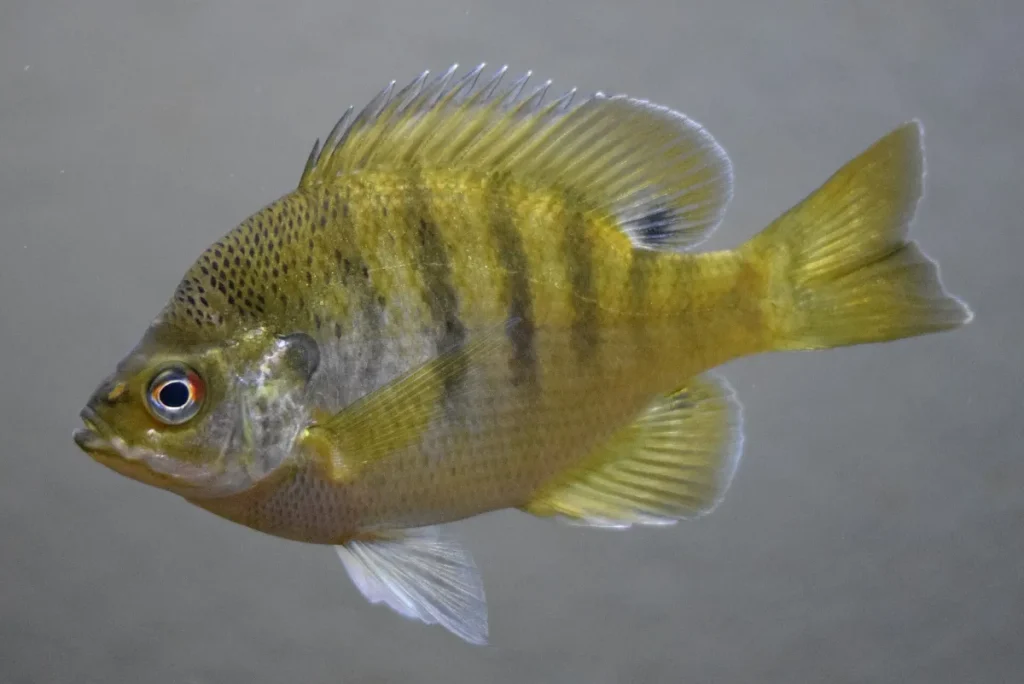
ALT: Bluegill sunfish showing its deep body, dark ear flap, and vertical body markings.
Photo: Scott Harden | Source: Wikimedia Commons | License: CC BY-SA 4.0 | Changes: None if original used. The wild fish was temporarily photographed in an aquarium before being released.
Scientific name: Lepomis macrochirus
Habitat: Freshwater ponds, lakes, reservoirs, and slow-moving waterways.
Diet: Aquatic insects, zooplankton, small crustaceans, and other small animals.
The bluegill is one of the most familiar freshwater fish in North America.
It is a member of the sunfish family and commonly inhabits ponds with aquatic vegetation, submerged branches, and other forms of cover.
Its relatively deep, flattened body allows it to maneuver among plants and underwater structures.
Bluegills often feed on aquatic insect larvae, tiny crustaceans, and other invertebrates.
Larger individuals may also consume small fish.
During the breeding season, male bluegills create shallow nests on the pond bottom. They may gather in nesting colonies, forming groups of circular depressions in suitable areas.
Males guard their nests against potential predators.
Bluegills are also an important food source for larger fish, including largemouth bass, as well as fish-eating birds.
How to recognize it: Look for a deep-bodied fish with a dark ear flap, faint vertical bands, and often a blue or violet tone around the cheek and gill cover.
Interesting fact: Male bluegills defend nests and newly hatched young, providing an example of parental care in freshwater fish.
2. Green Frog
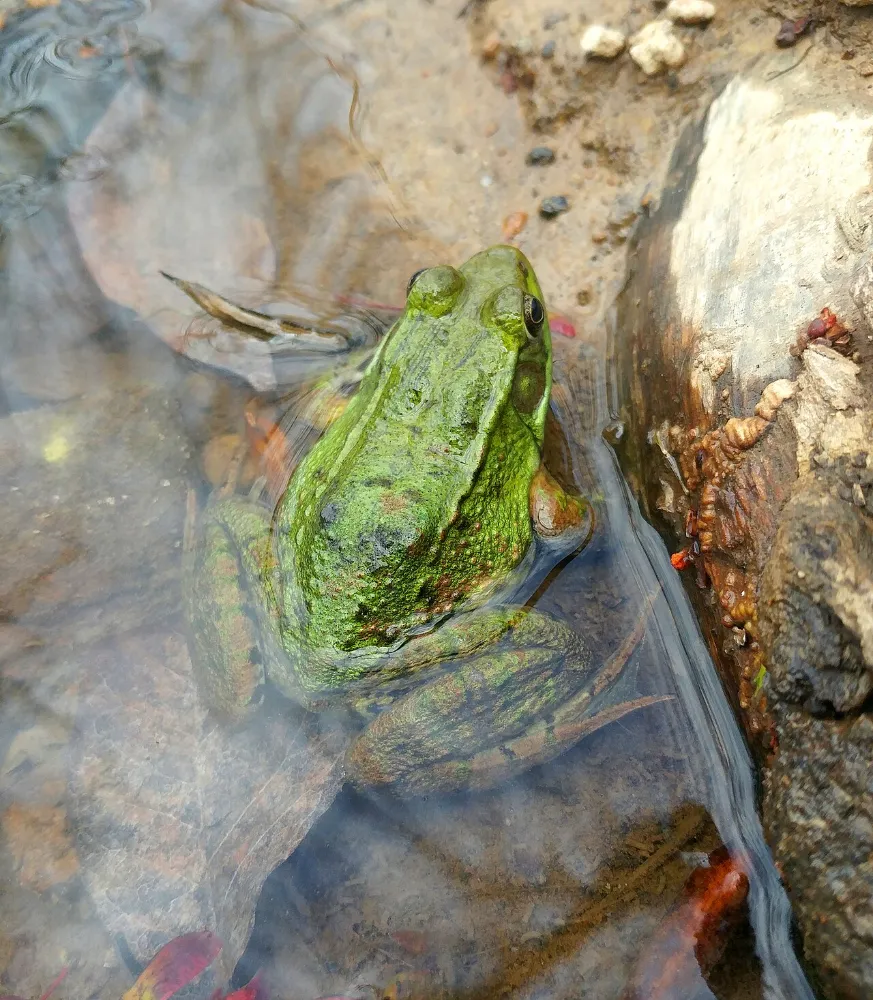
ALT: Green frog sitting at the edge of a freshwater pond.
Photo: Otofrog | Source: Wikimedia Commons | License: CC BY-SA 4.0 | Changes: None if original used.
Scientific name: Lithobates clamitans
Habitat: Freshwater ponds, marshes, lakeshores, and slow-moving streams.
Diet: Insects, spiders, worms, and other small animals.
The green frog is a common amphibian found around freshwater habitats in eastern North America.
Despite its name, not every green frog is bright green.
Some individuals have green heads with brownish bodies, while others appear mostly brown or olive.
Green frogs often rest near the water’s edge, ready to jump into the pond when disturbed.
Their powerful hind legs allow them to leap quickly, while their webbed feet help them swim.
Like other frogs, green frogs begin life as aquatic tadpoles.
Tadpoles develop in water before undergoing metamorphosis and eventually becoming air-breathing adults.
Green frogs produce a distinctive call that is often compared to the sound of a loose banjo string being plucked.
Males commonly call from shallow water during the breeding season.
How to recognize it: Look for a medium-sized frog with a prominent circular eardrum behind the eye and ridges running along the sides of its back.
Interesting fact: Green frogs can be confused with American Bullfrogs, but green frogs usually have prominent dorsolateral ridges extending down the back.
Green Frog vs. Bullfrog
| Feature | Green Frog | American Bullfrog |
|---|---|---|
| Typical Size | Smaller | Usually larger |
| Back Ridges | Extend along the sides of the back | Generally absent along the back |
| Eardrum | Prominent | Prominent |
| Call | Often compared to a banjo string | Deep, resonant call |
| Habitat | Ponds, marshes, streams | Permanent freshwater habitats |
3. Eastern Newt
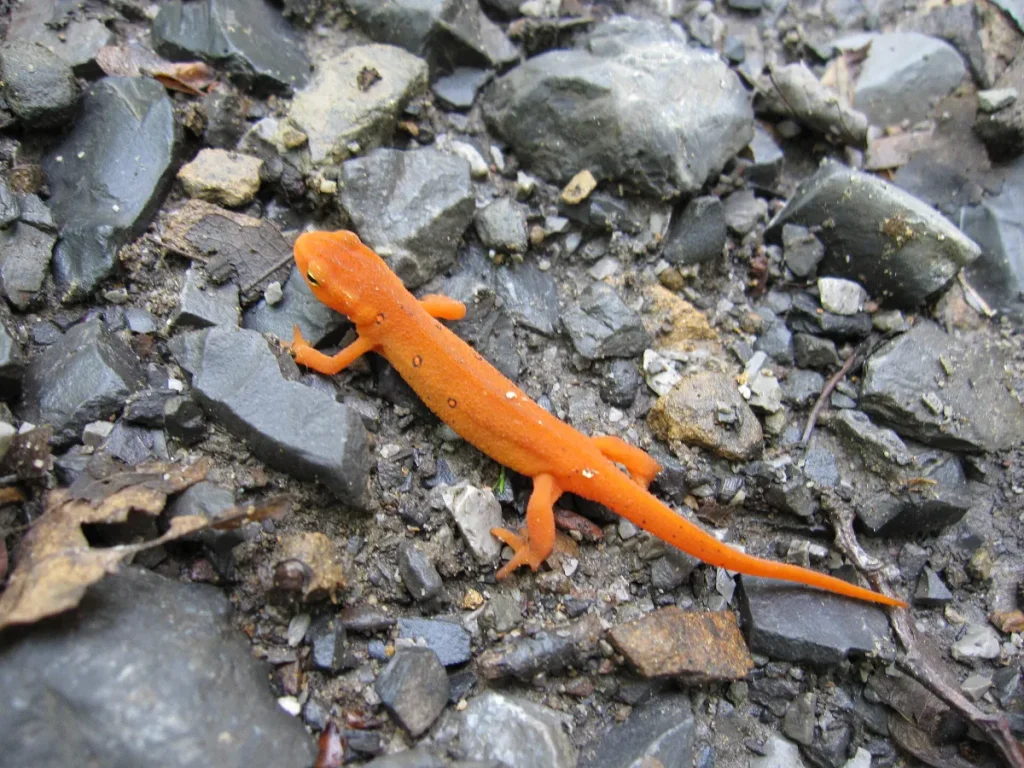
ALT: Eastern newt photographed in a North American forest habitat.
Photo: Chris M | Source: Wikimedia Commons | License: CC BY 2.0 | Changes: None if original used. Photograph taken in Pennsylvania.
Scientific name: Notophthalmus viridescens
Habitat: Freshwater ponds, marshes, small lakes, and surrounding woodlands.
Diet: Aquatic insects, worms, tiny crustaceans, and other small invertebrates.
The eastern newt has one of the most remarkable life cycles among North American amphibians.
Unlike a frog, which usually transforms from a tadpole into a four-legged adult, the eastern newt may pass through three distinct life stages.
The first stage is an aquatic larva.
In many populations, the second stage is a brightly colored terrestrial juvenile known as a red eft.
Red efts often have orange or reddish skin with small spots.
After spending time on land, they may return to water and develop into aquatic adults.
Adult eastern newts usually have olive-green or brownish upperparts, a yellowish underside, and a vertically flattened tail that helps with swimming.
Their skin contains defensive toxins, and the conspicuous coloration of red efts can serve as a warning to predators.
Eastern newts often inhabit ponds with submerged plants, where they search for small aquatic animals.
How to recognize it: Aquatic adults have smooth olive-green skin, small red spots in many populations, and a laterally flattened tail. Terrestrial red efts are much brighter orange or reddish.
Interesting fact: An eastern newt may spend part of its life living on land before returning to a freshwater pond as an adult.
4. Northern Water Snake

ALT: Northern water snake resting near the edge of a freshwater pond in Connecticut.
Photo: John Stockla | Source: Wikimedia Commons | License: CC BY 4.0 | Changes: None if original used.
Scientific name: Nerodia sipedon
Habitat: Freshwater ponds, lakeshores, rivers, marshes, and streams.
Diet: Fish, frogs, and other small aquatic animals.
The northern water snake is a common nonvenomous snake associated with freshwater habitats in eastern North America.
It is an excellent swimmer and frequently hunts in shallow water.
Its body is usually brown, gray, or reddish brown with darker bands or blotches.
Older individuals may appear nearly uniform in color because their markings become less obvious.
Northern water snakes often bask on rocks, logs, or branches near the water.
When disturbed, they may escape into the pond and swim away.
These snakes are important predators of small fish and amphibians.
Although they are not venomous, they can bite defensively when handled and should always be left undisturbed.
Northern water snakes are sometimes confused with venomous cottonmouths, particularly in areas where both species occur.
However, coloration alone is not a reliable identification method.
How to recognize it: Look for a relatively thick-bodied snake with dark crossbands or blotches, keeled scales, and a strong association with freshwater habitats.
Interesting fact: Northern water snakes give birth to live young rather than laying eggs.
Safety note: Never attempt to identify a potentially venomous snake by approaching or handling it. Observe from a safe distance.
5. Common Musk Turtle
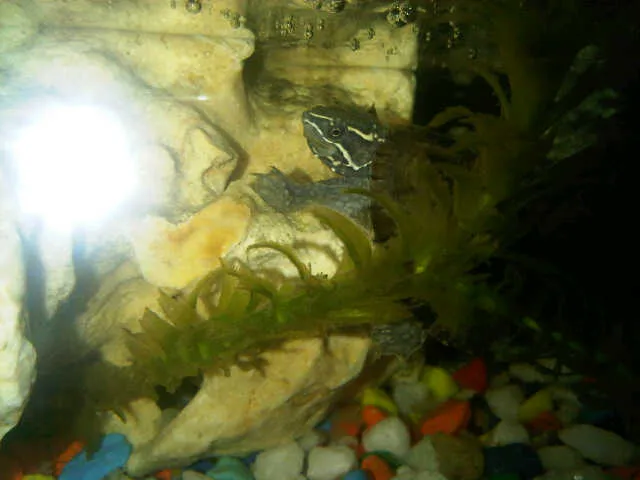
ALT: Common musk turtle showing its dark shell and distinctive facial stripes.
Photo: Karlwj1985 | Source: Wikimedia Commons | License: CC BY-SA 3.0 | Changes: None if original used.
Scientific name: Sternotherus odoratus
Habitat: Ponds, lakes, swamps, and slow-moving freshwater habitats.
Diet: Aquatic insects, snails, crayfish, worms, and other small animals.
The common musk turtle is a small freshwater turtle that spends much of its time underwater.
Unlike some turtles that frequently bask on exposed logs, musk turtles often remain near the bottom of a pond.
They move through submerged vegetation, mud, and fallen branches while searching for food.
Their relatively small shells and strong jaws allow them to feed on a variety of aquatic invertebrates.
Common musk turtles are sometimes called stinkpots because they can release an unpleasant-smelling secretion from specialized glands when threatened.
This defensive mechanism helps discourage predators.
Despite their small size, musk turtles play an important role in freshwater food webs.
They consume invertebrates and other organic material while serving as prey for larger animals, especially when young.
How to recognize it: Look for a small turtle with a relatively dark, oval shell and two light stripes along each side of the head.
Interesting fact: Common musk turtles are often more difficult to observe than basking turtles because they spend so much time walking along the pond bottom.
6. American Coot

ALT: American coot swimming on freshwater with a dark body and white bill.
Photo: Andy Reago and Chrissy McClarren (Wildreturn) | Source: Wikimedia Commons | License: CC BY 2.0 | Changes: None if original used.
Scientific name: Fulica americana
Habitat: Freshwater ponds, marshes, lakes, and wetlands with aquatic vegetation.
Diet: Aquatic plants, algae, seeds, and small aquatic animals.
The American coot may look like a duck at first glance, but it belongs to the rail family.
Its dark gray body, blackish head, and white bill make it relatively easy to recognize.
One of its most unusual features is its feet.
Instead of having fully webbed feet like ducks, American coots have broad lobes along their toes.
These lobes help them swim while allowing them to move across muddy ground and vegetation.
American coots frequently feed on aquatic plants, sometimes diving beneath the surface to reach submerged vegetation.
They also consume small invertebrates when available.
During the breeding season, coots construct nests among aquatic plants, often in floating or partially submerged vegetation.
Their young have surprisingly colorful orange-red and yellowish down around the head.
How to recognize it: Look for a dark, rounded water bird with a bright white bill, white frontal shield, and lobed toes.
Interesting fact: American coots are not ducks, even though they share many freshwater habitats with them.
7. Common Water Strider

ALT: Common water strider standing on the surface of freshwater.
Photo: Bruce J. Marlin | Source: Wikimedia Commons | License: CC BY-SA 2.5 | Changes: None if original used.
Scientific name: Aquarius remigis (formerly Gerris remigis)
Habitat: Calm freshwater surfaces, including ponds, pools, and slow-moving streams.
Diet: Small insects and other organisms found at the water surface.
Water striders are among the most fascinating insects found around freshwater ponds.
They appear to walk or skate directly on the water without sinking.
Their ability to remain on the surface is made possible by a combination of water surface tension, specialized leg structures, and water-repellent hairs.
These hairs help prevent their legs from becoming easily wetted.
Water striders also distribute their weight across long legs, reducing pressure on any single point of the water surface.
They are effective predators.
When a small insect falls onto the surface, the water strider can detect vibrations through its legs.
It may then move quickly toward the struggling prey and capture it using its shorter front legs.
How to recognize it: Look for a slender, dark insect with long legs moving rapidly across calm water.
Interesting fact: Water striders do not need to swim beneath the surface to hunt. They can find prey by sensing ripples and vibrations on the water.
8. American Giant Water Bug

ALT: American giant water bug showing its broad, flattened body and powerful grasping front legs.
Photo: The High Fin Sperm Whale | Source: Wikimedia Commons | License: CC BY-SA 3.0 | Changes: None if original used. The photograph was taken in British Columbia, away from the water.
Scientific name: Lethocerus americanus
Habitat: Freshwater ponds, marshes, and other vegetated aquatic habitats.
Diet: Aquatic insects, tadpoles, small fish, and other aquatic animals.
The American giant water bug is a large predatory insect sometimes called a toe-biter.
It belongs to a group of aquatic true bugs with strong front legs adapted for grasping prey.
Unlike water striders, which usually remain at the surface, giant water bugs often hide among submerged plants or other underwater structures.
They are ambush predators.
When suitable prey approaches, they grab it with powerful front legs and use piercing mouthparts to feed.
Giant water bugs can capture animals much larger than the prey usually taken by smaller aquatic insects.
Although they spend considerable time underwater, they must obtain atmospheric oxygen.
Some giant water bugs are also capable of flying, allowing them to move between aquatic habitats.
How to recognize it: Look for a large, flattened, oval-shaped insect with powerful grasping front legs and a brownish body.
Interesting fact: Giant water bugs can deliver a painful defensive bite. They should never be handled.
9. Common Whitetail Dragonfly
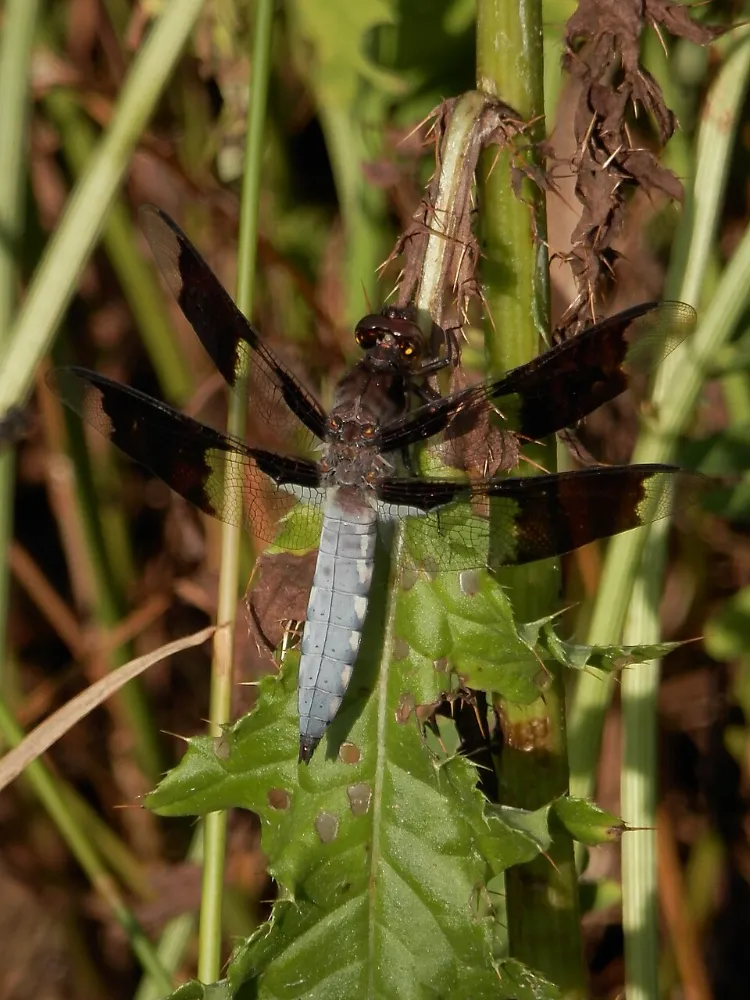
ALT: Male Common Whitetail dragonfly with a pale abdomen and dark wing bands.
Photo: Ryan Hodnett | Source: Wikimedia Commons | License: CC BY-SA 4.0 | Changes: None if original used.
Scientific name: Plathemis lydia
Habitat: Freshwater ponds, marshes, lakeshores, and other shallow water environments.
Diet: Flying insects as adults; aquatic invertebrates during the larval stage.
The Common Whitetail is a distinctive North American dragonfly frequently seen around freshwater ponds.
Adult males have pale, almost white abdomens and broad dark bands on their wings.
Females have brownish bodies with patterned wings, giving them a very different appearance.
Like other dragonflies, the Common Whitetail has an aquatic juvenile stage.
Its larvae, also called nymphs, live underwater and prey on small aquatic animals.
After completing their development, they leave the water and emerge as flying adults.
Adult Common Whitetails often perch on the ground, rocks, or low vegetation near water.
From these positions, they watch for flying insects and launch quick hunting flights.
How to recognize it: Adult males have a short, broad, pale abdomen and dark bands across otherwise transparent wings.
Interesting fact: Dragonflies connect underwater and aboveground food webs because their young live in water while adults hunt in the air.
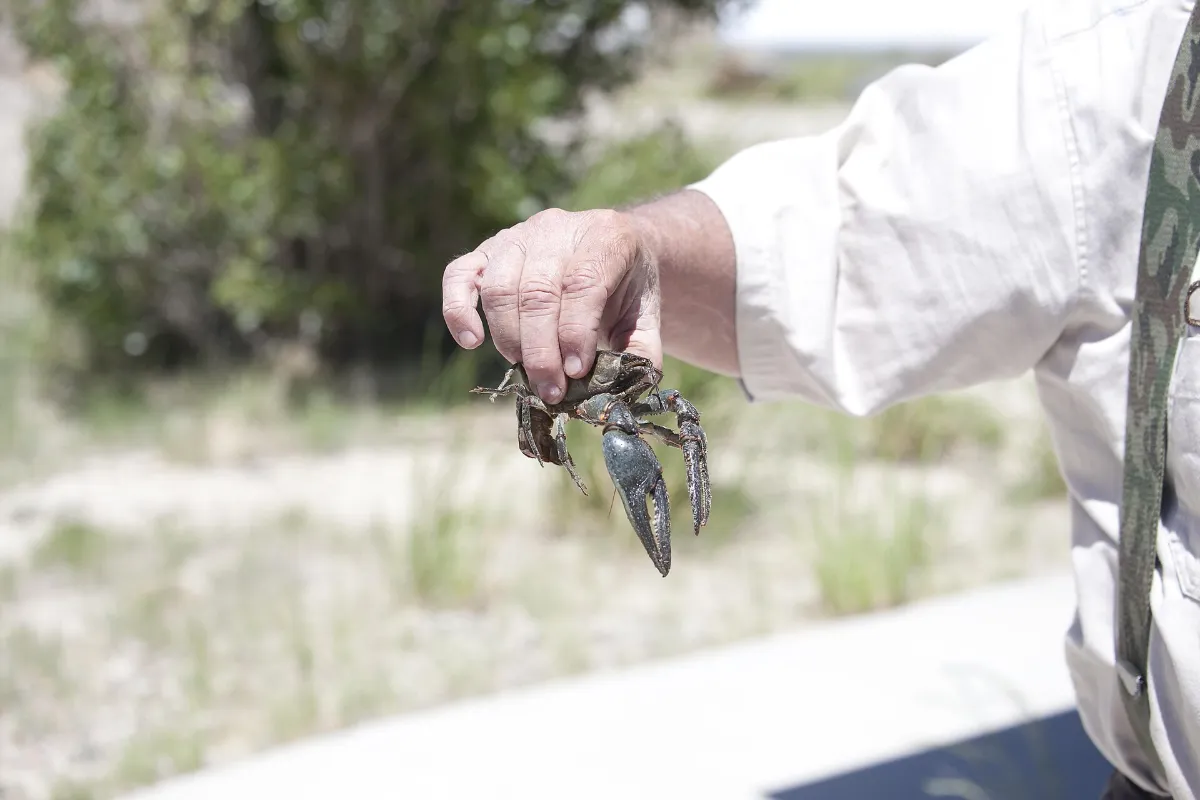
10. Virile Crayfish
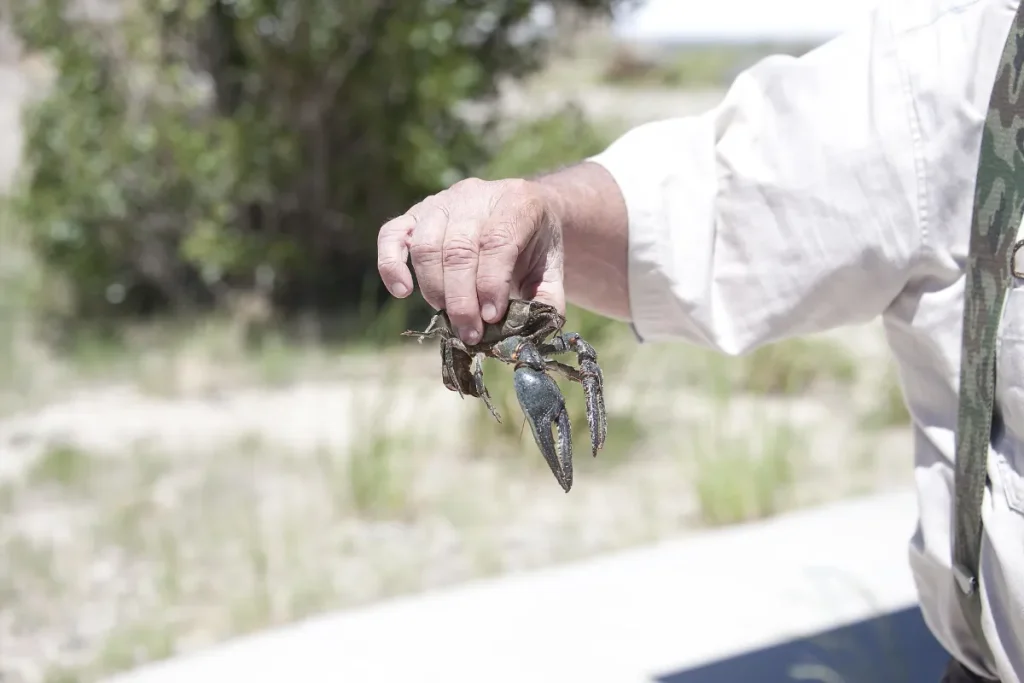
ALT: Virile crayfish photographed near the Green River in Wyoming.
Photo: Katie Theule / USFWS Mountain-Prairie | Source: Wikimedia Commons | License: CC BY 2.0 | Changes: None if original used. The photograph was taken at a river rather than a pond.
Scientific name: Faxonius virilis (formerly Orconectes virilis)
Habitat: Freshwater ponds, lakes, streams, and rivers with suitable shelter.
Diet: Aquatic plants, algae, detritus, small invertebrates, and other available food.
The virile crayfish is a freshwater crustacean found across a broad area of North America, although it has also been introduced beyond parts of its native range.
Like other crayfish, it resembles a small lobster.
It has a hard external skeleton, two prominent claws, several walking legs, and a muscular tail.
Crayfish frequently shelter beneath rocks, submerged branches, or other underwater objects.
They use their claws to handle food, defend themselves, and compete with other crayfish.
Their feeding habits are varied.
Virile crayfish may consume aquatic vegetation, algae, dead organic material, and small animals.
Their activities can influence underwater vegetation, nutrient cycling, and the structure of freshwater communities.
Crayfish are also important prey for fish, birds, and mammals.
How to recognize it: Look for a freshwater crustacean with a broad body, prominent claws, long antennae, and a segmented tail.
Interesting fact: Crayfish must periodically shed their hard external skeletons to grow. This process is called molting.
Where Do Different Animals Live in a Pond?
A freshwater pond contains several small habitats, each supporting different types of wildlife.
Some animals live at the water surface, while others remain underwater or move between aquatic and terrestrial environments.
| Pond Area | Typical Conditions | Example Animals |
|---|---|---|
| Water Surface | Air-water boundary | Water striders |
| Open Water | Swimming and feeding areas | Bluegill, American Coot |
| Shallow Vegetated Water | Plants and protective cover | Eastern newts, giant water bugs |
| Pond Bottom | Mud, rocks, and submerged debris | Musk turtles, crayfish |
| Pond Edge | Shallow water and shoreline vegetation | Green frogs, northern water snakes |
| Air Above the Pond | Flying insect habitat | Adult dragonflies |
An animal’s location can change throughout the day.
For example, a bluegill may move between shallow vegetation and deeper water, while a water snake can hunt in the pond before resting on land.
What Is a Freshwater Pond Ecosystem?
A freshwater pond is a relatively small body of standing water that provides habitat for aquatic and semi-aquatic organisms.
Some ponds occur naturally, while others are created by people or by animals such as beavers.
Ponds differ in depth, size, vegetation, temperature, and the amount of time they retain water.
Many support a mixture of aquatic plants, algae, microscopic organisms, insects, amphibians, reptiles, fish, and birds.
Aquatic plants are especially important because they provide food, shelter, egg-laying surfaces, and places where smaller animals can hide.
Healthy pond ecosystems depend on interactions between living organisms and environmental conditions such as water quality, sunlight, oxygen, and temperature.
Pond Animals vs. Wetland Animals: What’s the Difference?
Freshwater ponds and wetlands are closely related, but they are not identical.
A pond is a standing body of water, while a wetland is an ecosystem in which water saturates or covers the soil sufficiently to influence its plants and ecological processes.
Some ponds are surrounded by wetlands, and shallow pond margins may support wetland vegetation.
Other wetlands, such as salt marshes, may contain substantial amounts of water without resembling a typical freshwater pond.
| Feature | Freshwater Pond | Freshwater Marsh | Salt Marsh |
|---|---|---|---|
| Water | Primarily freshwater | Primarily freshwater | Saline or brackish |
| Typical Vegetation | Floating and submerged plants | Reeds, sedges, cattails | Salt-tolerant grasses |
| Example Animals | Bluegill, green frog, musk turtle | Muskrat, marsh birds, frogs | Fiddler crabs, marsh sparrows |
| Main Water Influence | Standing water | Saturated soil and shallow flooding | Coastal tides |
Many animals can use both ponds and marshes.
Explore more examples in our guide to 15 animals that live in wetlands.
How Do Freshwater Pond Animals Survive?
Pond animals have developed numerous adaptations that allow them to breathe, move, feed, and avoid predators.
1. Breathing Underwater
Fish such as bluegill use gills to absorb oxygen from water.
Many aquatic insect larvae also obtain oxygen from water, although the exact mechanism varies between groups.
Freshwater turtles, snakes, and adult frogs breathe atmospheric oxygen using lungs.
Some amphibians can also exchange gases through their skin.
2. Swimming and Moving Through Water
Fish use fins and streamlined bodies for movement.
Turtles and frogs use powerful limbs and partially or fully webbed feet.
Water snakes move through water using wave-like movements of their bodies.
Crayfish can walk along the bottom and rapidly move backward using their tails when escaping danger.
3. Camouflage
Green frogs, water snakes, crayfish, and many aquatic insects have colors or markings that help them blend into their surroundings.
Camouflage can help prey avoid detection and predators approach their next meal.
Some pond animals remain motionless among vegetation or submerged structures.
4. Hunting at the Water Surface
Water striders are adapted to moving along the surface.
They detect vibrations made by insects struggling on the water.
Other predators, including dragonflies, hunt flying insects above the pond.
5. Reproducing in Water
Many pond animals depend on water during reproduction.
Frogs lay eggs that develop into aquatic tadpoles.
Eastern newts have aquatic larvae and complex life cycles.
Dragonfly nymphs develop underwater before emerging as winged adults.
A Freshwater Pond Food Chain
A pond food chain describes how energy moves between organisms.
Plants and algae use sunlight to produce organic matter.
Small aquatic animals consume algae or other available food.
Fish, amphibians, and predatory insects eat smaller animals.
Larger predators may then consume fish or amphibians.
One simplified pond food chain is:
Algae → Zooplankton → Bluegill → Northern Water Snake
Another possible feeding relationship is:
Aquatic Plants → Small Invertebrates → Giant Water Bug
These examples illustrate how organisms can be connected through feeding.
However, real pond ecosystems contain food webs rather than isolated chains.
An individual animal may consume several types of food and be hunted by different predators throughout its life.
Decomposers, including bacteria and fungi, also recycle nutrients from dead plants and animals.
Salt marshes are often part of larger estuarine ecosystems, where freshwater from rivers mixes with seawater. These coastal environments provide important feeding and nursery habitats for fish, crabs, oysters, and many other species. Discover more in our guide to 12 animals that live in estuaries.
How to Identify Animals in a Freshwater Pond
Careful observation can reveal many pond animals without disturbing their habitats.
| What You Notice | Possible Animal |
|---|---|
| Deep-bodied fish with a dark ear flap | Bluegill |
| Frog with long ridges down its back | Green Frog |
| Small amphibian with olive skin and a flattened tail | Adult Eastern Newt |
| Brown, banded snake swimming near shore | Northern Water Snake |
| Small turtle with light facial stripes | Common Musk Turtle |
| Dark water bird with a white bill | American Coot |
| Long-legged insect moving across the water surface | Water Strider |
| Large, flat aquatic insect with grasping front legs | Giant Water Bug |
| Dragonfly with a pale abdomen and dark wing bands | Male Common Whitetail |
| Small lobster-like animal beneath submerged cover | Crayfish |
These characteristics are useful identification clues, but they may not be sufficient for identifying every individual.
Always consider location, season, body size, and additional physical features.
What Animals Live in a Pond During Winter?
Pond wildlife changes throughout the year.
Some birds migrate when food becomes scarce or water freezes.
Many fish remain underwater, often becoming less active as temperatures fall.
Frogs and turtles may spend colder months in protected aquatic habitats or nearby terrestrial locations, depending on the species.
Some aquatic insects survive winter as larvae or eggs.
In areas where ponds freeze, the layer of water beneath the ice can provide habitat for animals capable of surviving cold conditions.
However, winter survival also depends on oxygen availability, water depth, and the characteristics of the pond.
For more seasonal animal adaptations, explore 10 animals that turn white in winter.
How to Observe Pond Wildlife Safely
Ponds are excellent places to learn about wildlife, but observation should be done carefully.
Here are several important practices:
- Observe from a safe location. Pond banks may be muddy, slippery, or unstable.
- Use binoculars or a camera. These help you identify birds and other animals without approaching too closely.
- Do not handle unfamiliar wildlife. Some snakes, insects, and other animals can bite defensively.
- Avoid disturbing underwater shelters. Rocks, plants, and fallen branches may provide homes for many organisms.
- Never release aquarium animals into natural ponds. Introduced species and pathogens can damage local ecosystems.
- Do not move frogs, fish, or aquatic plants between ponds. Movement can spread diseases and invasive species.
- Keep children supervised near water. Even shallow ponds can present drowning hazards.
Observing wildlife in its natural habitat is usually more informative than capturing or moving animals.
Why Are Freshwater Ponds Important?
Freshwater ponds provide valuable habitats for many species, including animals that cannot survive without access to water.
Breeding Habitats
Frogs, newts, dragonflies, and numerous other organisms depend on ponds during their early development.
Food Sources
Ponds support insects, aquatic plants, fish, and invertebrates that become food for larger animals.
Shelter
Submerged vegetation, muddy bottoms, and shoreline plants provide hiding places for wildlife.
Biodiversity
Small ponds can support communities of organisms that differ substantially from those in nearby rivers, forests, or grasslands.
Connections Between Habitats
Ponds link aquatic and terrestrial ecosystems.
Adult dragonflies hunt above water, amphibians move between ponds and surrounding land, and birds transport nutrients between habitats.
Even relatively small ponds can therefore contribute significantly to local biodiversity.
Frequently Asked Questions
What animals live in freshwater ponds?
Freshwater ponds may contain fish, frogs, newts, turtles, water snakes, aquatic insects, crayfish, snails, and water birds.
The exact species depend on the pond’s location, depth, vegetation, water quality, and surrounding habitat.
What fish live in freshwater ponds?
Common North American pond fish include bluegill, largemouth bass, pumpkinseed sunfish, and various minnows.
Not every pond supports fish, especially temporary ponds that dry out during part of the year.
What amphibians live in ponds?
Green frogs, American Bullfrogs, eastern newts, and many other amphibians use freshwater ponds for breeding, feeding, or shelter.
Different species have different requirements for vegetation, water depth, and seasonal conditions.
What reptiles live in freshwater ponds?
Common examples include musk turtles, painted turtles, snapping turtles, and water snakes.
Some spend considerable time underwater, while others regularly move between water and land.
What insects live on the surface of ponds?
Water striders are among the most recognizable insects that move across the water surface.
Other aquatic insects, including whirligig beetles, may also be seen swimming rapidly at or near the surface.
What insects live underwater in ponds?
Giant water bugs, diving beetles, dragonfly nymphs, and numerous other aquatic insects inhabit freshwater ponds.
Some remain aquatic as adults, while others leave the water after metamorphosis.
What animals live at the bottom of a pond?
Crayfish, aquatic snails, insect larvae, and certain turtles commonly forage or shelter near the bottom.
Fish may also use bottom habitats depending on the species.
Do all ponds have fish?
No. Some ponds have no fish, particularly temporary or isolated ponds.
Fish-free ponds can be valuable breeding habitats for amphibians and aquatic invertebrates.
What is the difference between a pond and a lake?
There is no universally accepted size boundary between ponds and lakes.
Ponds are often smaller and shallower, but definitions differ between scientific studies and management agencies.
Are freshwater pond animals dangerous?
Most pond animals pose little risk when observed without disturbance.
However, some can bite defensively, and unidentified snakes should never be handled.
The water itself can also present hazards, including steep banks, deep mud, and poor visibility.
Final Thoughts
Freshwater ponds are miniature ecosystems filled with remarkable wildlife.
A bluegill swimming among aquatic plants, a green frog waiting at the shoreline, and a water strider moving across the surface all occupy different ecological roles.
Some animals depend on ponds throughout their lives, while others use them during particular seasons or stages of development.
By observing these habitats carefully, we can better understand how aquatic plants, insects, fish, amphibians, reptiles, and birds interact.
The next time you visit a quiet pond, look beyond the water’s surface.
An entire community of fascinating animals may be living just out of sight.
Related Articles
- 15 Animals That Live in Wetlands (With Pictures)
- 12 Animals That Live in the Intertidal Zone (With Pictures)
- 10 Animals That Live in Salt Marshes (With Pictures)
- 10 Animals That Turn White in Winter (With Pictures)
- 8 Mangrove Animals and Where They Live
References and Further Reading
- Natural History Museum – Pond Life: Habitats, Plants and Animals
- Missouri Department of Conservation – Education Resources
- U.S. Environmental Protection Agency – Wetlands
- Cornell Lab of Ornithology – American Coot
- University of Florida IFAS Extension – Fisheries and Aquatic Sciences
- U.S. Fish and Wildlife Service – National Wildlife Refuge System
- The Wildlife Trusts – Ponds