A river flows toward the ocean, carrying freshwater through a landscape of marsh grasses, muddy banks, and winding channels. As the river approaches the coast, its water begins mixing with salty seawater.
This meeting place is called an estuary, and it supports an extraordinary variety of wildlife.
Fish move between rivers and coastal waters, crabs search for food along muddy bottoms, oysters build reefs, and birds patrol the shallows for their next meal.
Striped bass, Atlantic menhaden, red drum, oysters, blue crabs, horseshoe crabs, diamondback terrapins, and ospreys are among the many animals that live in or regularly use estuaries.
Some spend their entire lives in estuarine environments, while others depend on these protected waters during particular stages of development.
Here are 12 fascinating estuary animals, focusing on species found along the Atlantic and Gulf coasts of North America, including their habitats, diets, identification features, and adaptations.
12 Estuary Animals: Quick Comparison
| Animal | Scientific Name | Main Estuary Habitat | Main Diet |
|---|---|---|---|
| Striped Bass | Morone saxatilis | Tidal rivers and estuarine channels | Fish and crustaceans |
| Atlantic Menhaden | Brevoortia tyrannus | Coastal bays and estuaries | Plankton |
| Red Drum | Sciaenops ocellatus | Tidal creeks, seagrass beds, and bays | Crustaceans and fish |
| Atlantic Silverside | Menidia menidia | Shallow bays and salt marsh edges | Zooplankton and small invertebrates |
| Atlantic Sturgeon | Acipenser oxyrinchus oxyrinchus | Rivers and estuarine channels | Bottom-dwelling invertebrates |
| Eastern Oyster | Crassostrea virginica | Oyster reefs and tidal channels | Plankton and suspended particles |
| Atlantic Blue Crab | Callinectes sapidus | Tidal creeks and shallow estuaries | Mollusks, fish, and crustaceans |
| Atlantic Horseshoe Crab | Limulus polyphemus | Estuarine bottoms and sandy tidal shores | Worms and mollusks |
| Daggerblade Grass Shrimp | Palaemon pugio | Marsh creeks and submerged vegetation | Detritus and small organisms |
| Diamondback Terrapin | Malaclemys terrapin | Brackish tidal creeks and marshes | Snails, crabs, and mollusks |
| Osprey | Pandion haliaetus | Estuarine bays and coastal rivers | Fish |
| Brown Pelican | Pelecanus occidentalis | Coastal bays, estuaries, and inlets | Fish |
These animals do not all occupy the same part of an estuary. Some prefer shallow vegetation, while others inhabit deeper channels, oyster reefs, mudflats, or nearby shorelines.
1. Striped Bass

ALT: Striped bass showing dark horizontal stripes along its silver body.
Photo: Tim Van Vliet | Source: Wikimedia Commons | License: CC BY-SA 3.0 | Changes: None if original used. Photograph shows a fish caught in the Atlantic Ocean off New Jersey.
Scientific name: Morone saxatilis
Habitat: Coastal estuaries, tidal rivers, bays, and Atlantic coastal waters.
Diet: Small fish, shrimp, and other crustaceans.
The striped bass is one of the best-known migratory fish associated with North American estuaries.
Its silver body has several prominent dark horizontal stripes running from behind the head toward the tail.
Striped bass can occupy freshwater, brackish water, and saltwater during different parts of their lives.
Many populations migrate between coastal waters and rivers.
Adults typically spawn in freshwater portions of tidal rivers, where their eggs and larvae develop.
Young striped bass frequently use river and estuarine habitats for feeding and growth.
As they mature, many move into coastal marine waters, although some populations remain in freshwater reservoirs and other inland habitats.
Striped bass are active predators that consume smaller fish and crustaceans.
They play an important role in connecting freshwater and coastal food webs.
How to recognize it: Look for a streamlined silver fish with several continuous dark horizontal stripes along its sides.
Interesting fact: Striped bass are anadromous fish, meaning many populations migrate from marine waters into freshwater to reproduce.
2. Atlantic Menhaden

ALT: Atlantic menhaden showing its silvery body and distinctive shoulder spot.
Photo: Bobby McCabe | Source: Wikimedia Commons | License: CC BY 4.0 | Changes: None if original used.
Scientific name: Brevoortia tyrannus
Habitat: Atlantic coastal waters, bays, and estuaries.
Diet: Phytoplankton, zooplankton, and other suspended organic particles.
Atlantic menhaden are relatively small, silvery fish that form large schools in coastal waters.
Although they are less famous than striped bass or red drum, menhaden are extremely important to Atlantic coastal ecosystems.
Their bodies are relatively deep and compressed, with a distinctive dark spot behind the gill cover.
Menhaden are filter feeders.
Instead of actively hunting large prey, they use specialized gill structures to strain small organisms and food particles from the water.
Young menhaden often develop in nutrient-rich estuarine environments.
These habitats provide food and relatively protected waters during important early life stages.
Menhaden also serve as prey for numerous predators, including striped bass, bluefish, ospreys, and Brown Pelicans.
Because of their position in the food web, they help transfer energy from plankton to larger animals.
How to recognize it: Look for a silvery, laterally compressed fish with a dark shoulder spot and a relatively blunt head.
Interesting fact: Atlantic menhaden are sometimes described as forage fish because they provide an important food source for many larger predators.
3. Red Drum
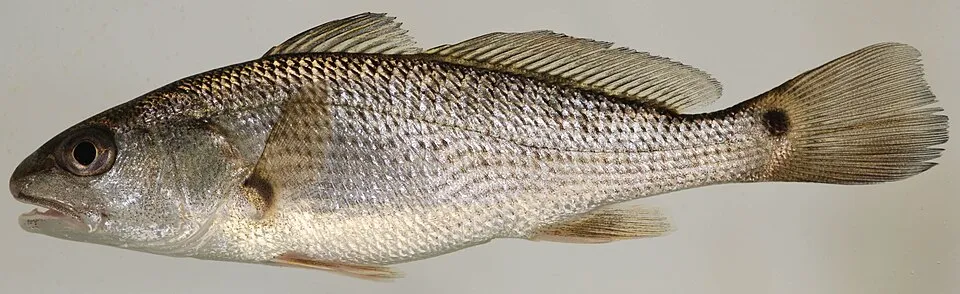
ALT: Juvenile red drum photographed by the Smithsonian Environmental Research Center in Maryland.
Photo: Robert Aguilar / Smithsonian Environmental Research Center | Source: Wikimedia Commons | License: CC BY 2.0 | Changes: None if original used.
Scientific name: Sciaenops ocellatus
Habitat: Coastal bays, estuaries, tidal creeks, seagrass beds, and shallow nearshore waters.
Diet: Shrimp, crabs, small fish, and other aquatic animals.
The red drum is a popular coastal fish commonly associated with estuaries along the southeastern United States and Gulf Coast.
It is also known as redfish or channel bass.
Its body often has a coppery or reddish appearance, particularly across the back and sides.
One of its most recognizable features is a dark spot near the base of the tail.
Some individuals have several spots rather than just one.
Red drum reproduce in coastal waters near inlets and passes.
Their larvae can move into estuaries, where shallow tidal creeks, marsh edges, and seagrass beds provide important nursery habitats.
Young red drum use these protected environments to feed and avoid predators.
As they grow, they may move into larger channels and nearshore coastal habitats.
Red drum feed on a variety of crustaceans and fish.
Larger individuals can be powerful predators in coastal ecosystems.
How to recognize it: Look for a copper-colored fish with a strong body and one or more dark spots near the tail.
Interesting fact: The name “drum” refers to sounds produced by muscles associated with the swim bladder, particularly during reproductive activity.
4. Atlantic Silverside
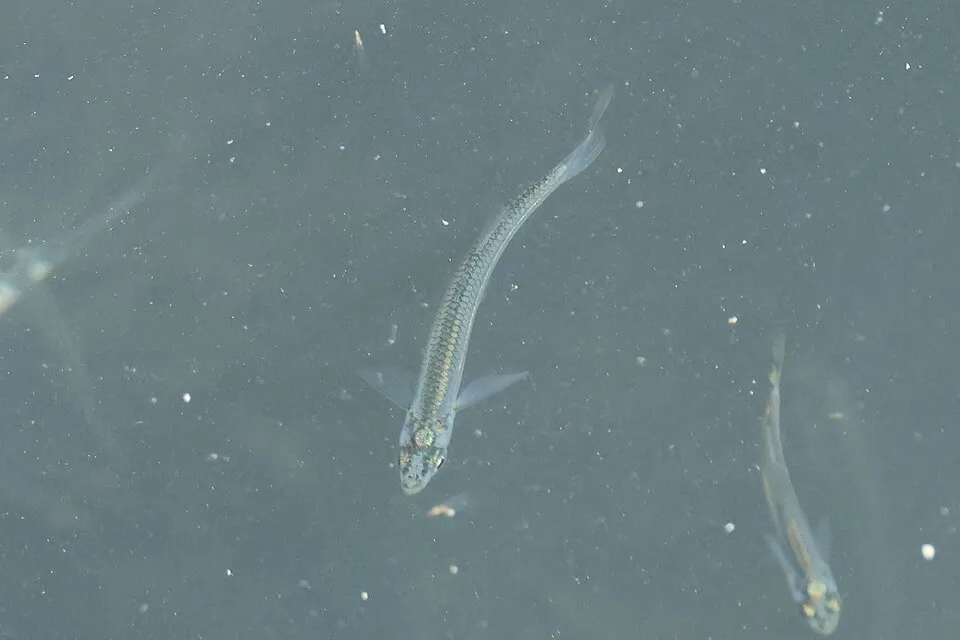
ALT: Atlantic silverside fish showing a slender body and shiny silver stripe.
Photo: er-birds | Source: Wikimedia Commons | License: CC BY 4.0 | Changes: None if original used.
Scientific name: Menidia menidia
Habitat: Shallow coastal bays, estuaries, salt marsh edges, and nearby marine waters.
Diet: Zooplankton and other small invertebrates.
The Atlantic silverside is a small, schooling fish commonly found in shallow coastal environments.
Its slender body is relatively translucent, with a distinctive silver stripe running along each side.
These fish often gather in schools near the water’s surface.
Moving in groups can help reduce the risk of predation while allowing them to search for food.
Atlantic silversides consume tiny crustaceans and other small organisms suspended in the water.
They are an important food source for larger predatory fish and coastal birds.
Their movements can change seasonally.
In northern areas, some populations move toward deeper or more offshore waters during colder months.
During the warmer season, they may return to shallow estuarine habitats for feeding and reproduction.
How to recognize it: Look for a small, slender, silvery fish with a translucent body and a distinct horizontal silver stripe.
Interesting fact: Atlantic silversides help transfer energy from small planktonic organisms to larger fish and birds.
5. Atlantic Sturgeon
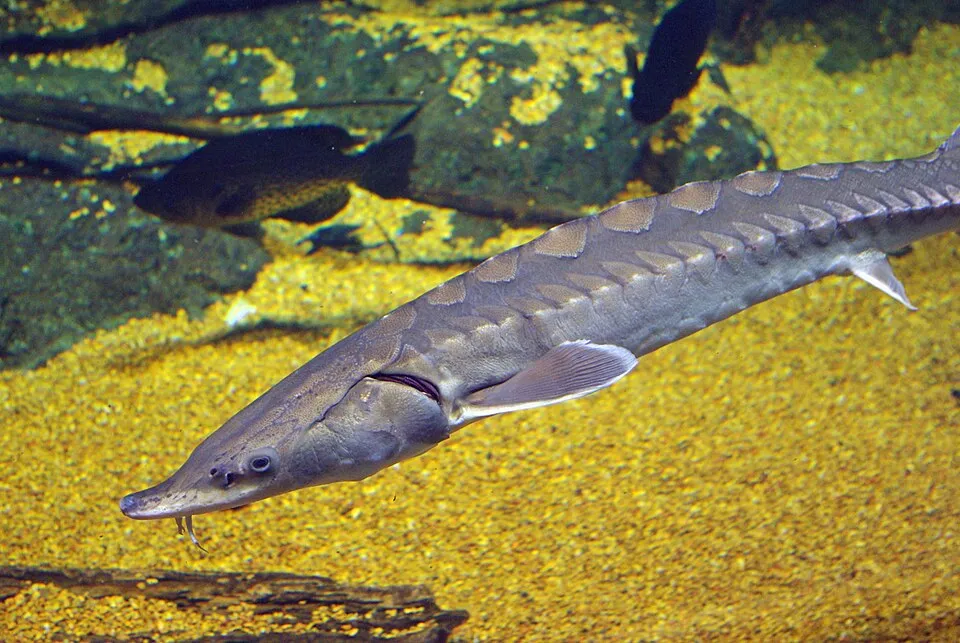
ALT: Atlantic sturgeon showing an elongated body and rows of protective bony plates.
Photo: Virginia State Parks staff | Source: Wikimedia Commons | License: CC BY 2.0 | Changes: None if original used.
Scientific name: Acipenser oxyrinchus oxyrinchus
Habitat: Large Atlantic coastal rivers, estuaries, and nearshore marine waters.
Diet: Bottom-dwelling invertebrates, including worms, mollusks, and crustaceans.
The Atlantic sturgeon is one of the most remarkable fish associated with eastern North American estuaries.
Its unusual appearance reflects an ancient evolutionary lineage.
Instead of having a body covered entirely with ordinary fish scales, sturgeons possess rows of hard bony plates called scutes.
They also have elongated snouts and sensory barbels near the mouth.
These structures help them locate food along the bottom of rivers and estuaries.
Atlantic sturgeon are migratory fish.
Adults spend much of their lives in marine environments but return to freshwater rivers for spawning.
Young sturgeon may remain in river and estuarine habitats for several years before moving into coastal waters.
Estuaries provide important feeding and nursery environments during these stages.
Atlantic sturgeon populations have experienced substantial declines due to historical overfishing, habitat alteration, dams, water quality problems, and other threats.
In the United States, Atlantic sturgeon populations are federally protected under the Endangered Species Act.
How to recognize it: Look for a large, elongated fish with a pointed snout, whisker-like barbels, and five rows of bony scutes.
Interesting fact: Atlantic sturgeon can live for several decades, although lifespan and age at maturity vary geographically.
6. Eastern Oyster
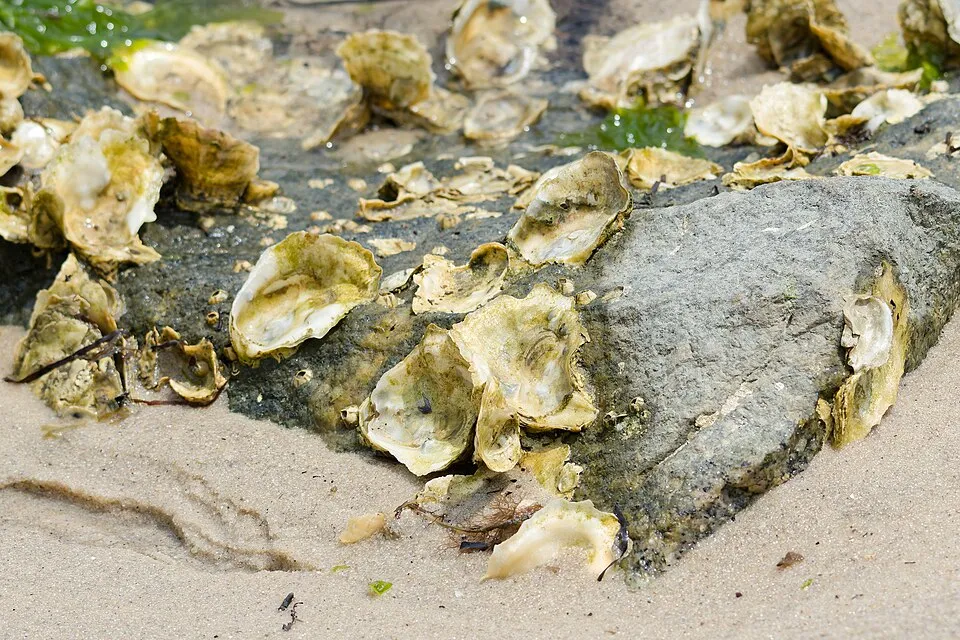
ALT: Eastern oyster shells growing together in a coastal estuary.
Photo: Donald Davesne | Source: Wikimedia Commons | License: CC BY 4.0 | Changes: None if original used.
Scientific name: Crassostrea virginica
Habitat: Estuarine oyster reefs, tidal channels, and suitable shallow coastal bottoms.
Diet: Phytoplankton and suspended organic particles.
The Eastern Oyster is one of the most ecologically important invertebrates found in Atlantic and Gulf Coast estuaries.
Unlike fish, oysters spend most of their adult lives attached to hard surfaces.
Young oysters begin life as free-swimming larvae.
After settling, they attach to suitable substrates, often including the shells of other oysters.
Over time, groups of oysters can form extensive reef structures.
These reefs provide shelter for numerous animals, including small fish, crabs, shrimp, and other invertebrates.
Oysters feed by filtering water and capturing microscopic organisms and organic particles.
This process can influence water clarity and nutrient cycling.
However, oyster filtration does not remove every type of pollution and cannot replace broader water quality management.
Oyster reefs are sometimes described as living infrastructure because they can also reduce wave energy and help stabilize shorelines under suitable conditions.
How to recognize it: Look for irregular, rough-surfaced shells that are often tightly attached to one another.
Interesting fact: An oyster reef can function as an underwater neighborhood, supporting many species that use its spaces for food and shelter.
7. Atlantic Blue Crab
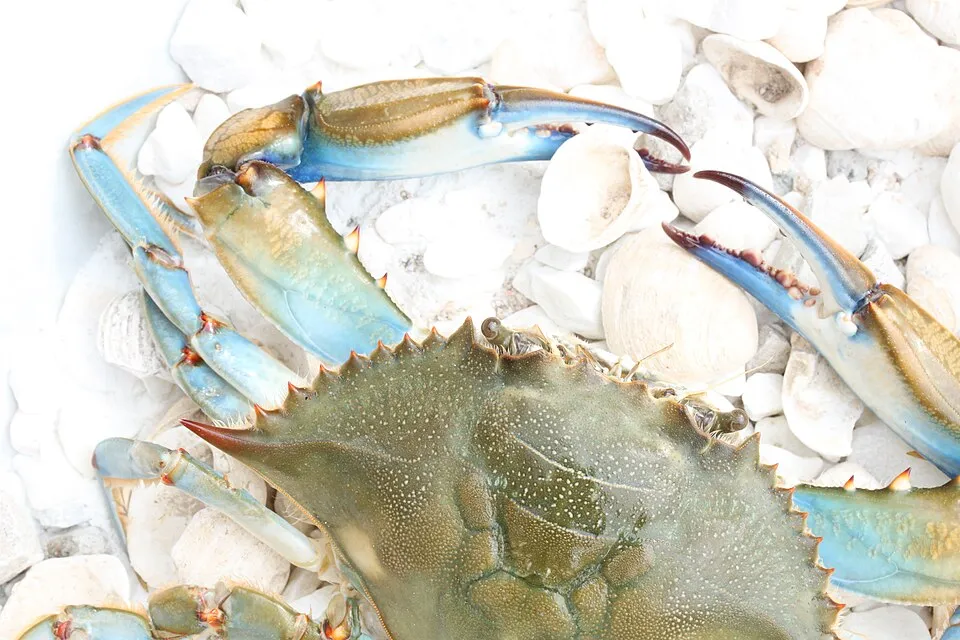
ALT: Male Atlantic blue crab displaying blue claws and paddle-shaped swimming legs.
Photo: Karkinos19 | Source: Wikimedia Commons | License: CC BY-SA 4.0 | Changes: None if original used.
Scientific name: Callinectes sapidus
Habitat: Estuaries, tidal creeks, salt marshes, shallow bays, and coastal waters.
Diet: Mollusks, fish, worms, smaller crustaceans, and organic material.
The Atlantic Blue Crab is one of the best-known crustaceans associated with the Chesapeake Bay and other coastal estuaries.
It has a broad shell with pointed projections along the sides.
The claws often display blue coloration, while females may have orange or reddish tips.
Its last pair of walking legs has been modified into flattened paddles.
These specialized legs allow blue crabs to swim efficiently.
Blue crabs are opportunistic predators and scavengers.
They consume a wide variety of animals, including small fish, mollusks, worms, and other crustaceans.
Estuaries are especially important during their life cycles.
Young crabs frequently use shallow nursery habitats, including submerged aquatic vegetation.
Adult females may move toward higher-salinity waters for spawning, while young stages eventually return to estuarine environments.
Blue crabs also provide food for larger fish, birds, and other predators.
How to recognize it: Look for a broad, flattened crab with pointed sides, blue claws, and paddle-shaped rear legs.
Interesting fact: Blue crabs must shed their external skeletons to grow, making molting an essential part of their development.
8. Atlantic Horseshoe Crab

ALT: Atlantic horseshoe crab showing its rounded protective shell and long tail spine.
Photo: Steven Bodzin | Source: Wikimedia Commons | License: CC BY 4.0 | Changes: None if original used.
Scientific name: Limulus polyphemus
Habitat: Shallow coastal waters, estuarine bottoms, sandy beaches, and tidal flats.
Diet: Marine worms, small mollusks, and other bottom-dwelling animals.
Despite its name, the Atlantic horseshoe crab is not a true crab.
It belongs to the chelicerates, a larger arthropod group that also includes spiders and scorpions.
Horseshoe crabs have existed in recognizable forms for an exceptionally long evolutionary history.
Their bodies are protected by broad, hard shells.
A long, pointed tail spine, called the telson, extends from the rear of the body.
Although it may look intimidating, the telson is not a venomous stinger.
Horseshoe crabs use it partly to help right themselves when overturned.
Estuaries and nearby sandy beaches are important during reproduction.
Along parts of the Atlantic coast, including Delaware Bay, large numbers of horseshoe crabs may gather on beaches to lay eggs.
These eggs provide an important seasonal food source for migrating shorebirds.
How to recognize it: Look for a broad, horseshoe-shaped shell, multiple legs underneath the body, and a long pointed tail spine.
Interesting fact: Horseshoe crab spawning events help support the migration of shorebirds, including the Red Knot.
9. Daggerblade Grass Shrimp

ALT: Daggerblade grass shrimp with a transparent body photographed in Chesapeake Bay.
Photo: Brian Gratwicke | Source: Wikimedia Commons | License: CC BY 2.5 | Changes: None if original used. Photograph shows a shrimp carrying developing young.
Scientific name: Palaemon pugio (formerly Palaemonetes pugio)
Habitat: Estuarine tidal creeks, salt marshes, submerged vegetation, and shallow coastal waters.
Diet: Detritus, algae, microscopic organisms, and small invertebrates.
Daggerblade grass shrimp are small, mostly transparent crustaceans found in coastal estuaries.
Their translucent bodies help them blend into surrounding water and vegetation.
These shrimp often occupy shallow habitats containing seagrass, marsh plants, or other protective structures.
They consume a variety of small food particles and organisms.
Some feed on decomposing organic material, helping move energy through the estuary’s food web.
Grass shrimp are also important prey for fish and other aquatic predators.
Their small size makes them easy to overlook, even when they occur in relatively large numbers.
Female grass shrimp may carry developing eggs beneath their bodies until the young are ready to hatch.
How to recognize it: Look for a small, almost transparent shrimp with a slender body, long antennae, and delicate walking legs.
Interesting fact: Grass shrimp connect microscopic food sources and decomposing organic matter with larger predators in estuarine food webs.
10. Diamondback Terrapin
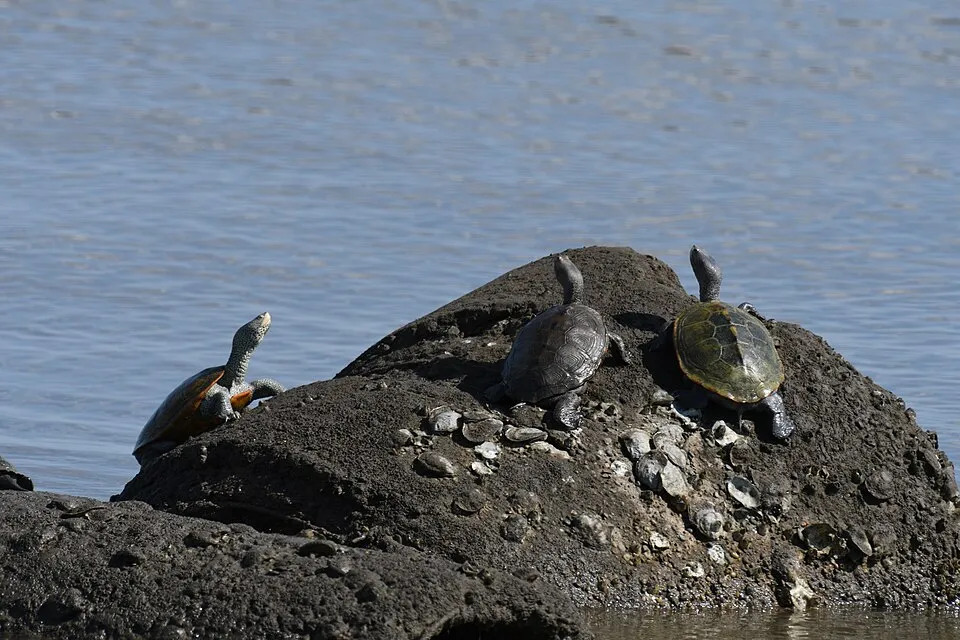
ALT: Diamondback terrapin showing its patterned shell and spotted skin in a coastal habitat.
Photo: lwolfartist | Source: Wikimedia Commons | License: CC BY 2.0 | Changes: None if original used.
Scientific name: Malaclemys terrapin
Habitat: Brackish tidal creeks, salt marshes, estuaries, and coastal lagoons.
Diet: Snails, crabs, clams, and other aquatic invertebrates.
The Diamondback Terrapin is one of the most distinctive turtles associated with North American coastal wetlands.
Unlike most familiar freshwater turtles, this species is adapted to brackish environments.
Its shell often has intricate concentric markings that resemble diamond-shaped patterns.
The skin may be pale gray with dark spots or irregular markings.
Diamondback Terrapins spend considerable time in shallow estuarine waters, where they search for mollusks and crustaceans.
Females leave the water to lay eggs in suitable sandy nesting habitats.
This movement between water and land makes access to safe nesting areas especially important.
Terrapins can be threatened by shoreline development, road traffic near nesting sites, and accidental capture in fishing gear.
How to recognize it: Look for a medium-sized turtle with a patterned shell, spotted skin, and a relatively broad head.
Interesting fact: Diamondback Terrapins are among the turtle species most closely associated with brackish coastal environments.
11. Osprey

ALT: Osprey showing its white head, dark eye stripe, hooked bill, and brown wings.
Photo: lwolfartist | Source: Wikimedia Commons | License: CC BY 2.0 | Changes: None if original used.
Scientific name: Pandion haliaetus
Habitat: Coastal estuaries, bays, rivers, lakes, and other waters containing suitable fish prey.
Diet: Almost entirely fish.
The osprey is a large bird of prey strongly associated with water.
It can often be seen flying over coastal bays and estuaries while searching for fish near the surface.
Ospreys have long wings, a mostly white underside, a dark brown back, and a distinctive dark stripe running through each eye.
Their hunting technique is remarkable.
After spotting a fish, an osprey may hover briefly before diving toward the water with its feet extended.
Sharp talons help it grasp slippery prey.
Specialized foot structures assist with holding fish securely during flight.
Ospreys often carry captured fish head-first, which can reduce air resistance.
Estuaries provide valuable feeding areas because they support abundant fish populations.
Ospreys may build large stick nests in trees, on navigation structures, or on artificial nesting platforms.
How to recognize it: Look for a large brown-and-white raptor with long, angled wings, a white head, and dark eye stripes.
Interesting fact: Ospreys are unusually specialized fish hunters compared with most other birds of prey.
12. Brown Pelican

ALT: Brown pelican flying over coastal waters near Sanibel Island, Florida.
Photo: Hans Hillewaert | Source: Wikimedia Commons | License: CC BY-SA 3.0 | Changes: None if original used.
Scientific name: Pelecanus occidentalis
Habitat: Coastal bays, estuaries, tidal inlets, beaches, and shallow marine waters.
Diet: Primarily small schooling fish.
The Brown Pelican is one of the most recognizable birds along the coasts of North America.
Its enormous bill and expandable throat pouch give it an unmistakable appearance.
Brown Pelicans frequently search for fish over estuaries and shallow coastal waters.
Unlike many other pelican species, they are well known for plunge-diving.
A pelican may fly above the water, spot a school of fish, and dive headfirst toward its prey.
The throat pouch expands as the bird enters the water, helping it capture fish.
After resurfacing, the pelican drains excess water before swallowing its catch.
Brown Pelicans also rest on sandbars, pilings, and coastal islands near productive feeding areas.
Young birds are usually browner overall, while adults develop more distinctive head and neck coloration.
How to recognize it: Look for a large coastal bird with a long bill, expandable throat pouch, broad wings, and brown or grayish plumage.
Interesting fact: Brown Pelicans are among the birds especially well adapted to catching fish by diving from the air into coastal waters.
What Is an Estuary?
An estuary is a coastal body of water where freshwater from rivers or streams mixes with seawater.
Estuaries are often partly enclosed by land and protected from the full force of ocean waves.
However, every estuary is different.
Some contain broad open bays, while others consist of narrow tidal rivers, salt marshes, mudflats, oyster reefs, and winding channels.
The amount of freshwater entering an estuary can change according to rainfall, river flow, and season.
Tides also influence how seawater moves through the system.
As a result, an estuary may contain areas with different salt concentrations, temperatures, and water depths.
These changing conditions create opportunities for a wide variety of animals.
What Is Brackish Water?
Brackish water is water with a salinity between that of typical freshwater and seawater.
It commonly occurs where rivers meet the ocean.
Freshwater generally contains very little dissolved salt, while typical ocean water has a salinity of approximately 35 parts per thousand.
Brackish water falls between these conditions, although its exact salinity can vary considerably.
Some animals can tolerate a wide range of salinity levels.
Others prefer relatively stable conditions or occupy particular parts of an estuary.
| Water Type | Typical Salinity | Example Habitat |
|---|---|---|
| Freshwater | Usually less than 0.5 ppt | Rivers and freshwater ponds |
| Brackish Water | Approximately 0.5–30 ppt | Many estuaries and tidal creeks |
| Seawater | Typically around 35 ppt | Open ocean |
These categories are approximate. Salinity classification systems may use somewhat different boundaries.
How Do Estuary Animals Survive Changing Salinity?
Estuaries can be challenging environments because water conditions change with tides, rainfall, and river discharge.
Animals use different strategies to survive.
1. Osmoregulation
Some fish and crustaceans can regulate the balance of salts and water inside their bodies.
This process is called osmoregulation.
Species with broad salinity tolerance are sometimes described as euryhaline.
Striped bass and several other estuarine fish can tolerate substantial salinity changes during different life stages.
2. Moving Between Habitats
Many animals respond to changing conditions by moving.
Fish may travel between tidal creeks, deeper channels, and coastal waters.
Some species use low-salinity habitats as juveniles and move toward saltier water as they mature.
3. Using Protective Structures
Oysters close their shells when conditions become unfavorable.
Terrapins can move between water and suitable shoreline habitats.
Small shrimp seek shelter among submerged vegetation and other complex structures.
4. Feeding Flexibility
Estuaries contain abundant organic material and a variety of food sources.
Some species consume plankton, while others hunt fish or feed on bottom-dwelling organisms.
This diversity of feeding strategies helps support complex food webs.
Why Are Estuaries Called Nurseries of the Sea?
Estuaries are frequently called the nurseries of the sea because many fish and shellfish use them during early development.
Shallow water, underwater vegetation, tidal marshes, and oyster reefs can provide shelter from some predators.
These habitats also contain abundant food.
For example:
- Young red drum use shallow tidal creeks and marsh habitats.
- Juvenile striped bass use river and estuarine waters.
- Young Atlantic menhaden develop in estuarine environments.
- Blue crabs use shallow estuarine nursery areas.
- Juvenile Atlantic sturgeon spend important developmental periods in river and estuarine habitats.
Not every animal begins life in an estuary.
Some spawn in rivers, some reproduce near the ocean, and others complete most of their life cycles within coastal waters.
The important point is that estuaries connect these different habitats.
Where Do Different Animals Live in an Estuary?
An estuary contains several smaller habitats.
Each provides different food sources, shelter, and environmental conditions.
| Estuary Habitat | Typical Conditions | Example Animals |
|---|---|---|
| Tidal River Channel | Changing freshwater and saltwater influence | Striped Bass, Atlantic Sturgeon |
| Open Estuarine Water | Schooling fish and larger aquatic predators | Atlantic Menhaden, Atlantic Silverside |
| Tidal Creek | Shallow, sheltered water | Red Drum, Blue Crab |
| Oyster Reef | Hard shell structures | Eastern Oyster, Blue Crab, small fish |
| Salt Marsh Edge | Vegetation and muddy sediments | Grass Shrimp, Diamondback Terrapin |
| Sandy Tidal Shore | Tidal exposure and suitable nesting sediment | Atlantic Horseshoe Crab |
| Air Above Bays and Channels | Feeding areas for fish-eating birds | Osprey, Brown Pelican |
Animals frequently move between these habitats.
The location of a particular species can change with tide level, season, life stage, and food availability.
Estuary Animals vs. Salt Marsh Animals: What’s the Difference?
Salt marshes and estuaries are closely related, but they are not identical.
An estuary is a broader coastal water system influenced by freshwater and seawater.
A salt marsh is a coastal wetland typically dominated by salt-tolerant grasses and other vegetation.
Salt marshes frequently occur within estuaries.
| Feature | Estuary | Salt Marsh |
|---|---|---|
| Main Characteristic | Freshwater and seawater mixing | Salt-tolerant marsh vegetation |
| Typical Habitats | Bays, channels, reefs, mudflats, marshes | Marsh grasses, tidal creeks, muddy soils |
| Common Animals | Striped Bass, Menhaden, Oysters, Sturgeon | Saltmarsh Sparrow, Fiddler Crab, Marsh Periwinkle |
| Main Ecological Role | Connects river and marine ecosystems | Provides specialized coastal wetland habitat |
Some species, such as Blue Crabs and Diamondback Terrapins, use both environments.
Other animals may primarily occupy deeper estuarine channels rather than marsh vegetation.
Explore more specialized coastal wildlife in our guide to 10 animals that live in salt marshes.
For a broader introduction to wetlands, read 15 animals that live in wetlands.
Estuaries vs. the Intertidal Zone
The intertidal zone is the coastal region between high and low tide levels.
An estuary is a coastal ecosystem where river water mixes with seawater.
Parts of an estuary may be intertidal, including tidal flats and marsh edges.
However, estuaries also contain deeper channels and other habitats that remain underwater throughout the tidal cycle.
Rocky shores outside estuaries may also contain intertidal zones.
For examples of animals adapted to changing tidal exposure, read our guide to 12 animals that live in the intertidal zone.
What Do Estuary Animals Eat?
Estuary food webs connect microscopic organisms, aquatic plants, invertebrates, fish, birds, and reptiles.
Many food chains begin with primary producers such as phytoplankton and algae.
These organisms are consumed by smaller animals or filter feeders.
Larger predators then feed on fish and invertebrates.
One simplified feeding relationship is:
Phytoplankton → Atlantic Menhaden → Striped Bass
Another possible food chain is:
Plankton → Small Fish → Osprey
A third example is:
Organic Detritus → Small Invertebrates → Grass Shrimp → Predatory Fish
Real estuary food webs are much more complex.
Different species may change their diets as they grow or move between habitats.
The breakdown of dead plants and other organic material is also important because it helps recycle nutrients within the ecosystem.
Why Are Oyster Reefs Important in Estuaries?
Oyster reefs are among the most valuable habitats found in many Atlantic and Gulf Coast estuaries.
They provide several important ecological functions.
Shelter for Wildlife
The spaces between oyster shells create hiding places for small fish, shrimp, and crabs.
Water Filtration
Oysters remove suspended food particles while feeding.
This can influence water clarity and nutrient cycling.
Shoreline Protection
Under suitable conditions, oyster reefs can reduce wave energy and help protect adjacent shorelines.
Habitat Complexity
Hard oyster shells provide attachment surfaces for other organisms.
These structures increase the variety of small habitats available within an estuary.
Oyster reef restoration is therefore an important part of coastal conservation in many regions.
Why Are Estuaries Important for Migratory Animals?
Estuaries connect freshwater rivers with the ocean.
This makes them important migration routes for animals that move between different water types.
Striped bass and Atlantic sturgeon are examples of fish whose life cycles can include freshwater spawning and marine feeding habitats.
Estuaries also provide stopover and feeding areas for migratory birds.
Shallow mudflats may expose small invertebrates that shorebirds consume during migration.
Coastal bays can support large schools of fish that attract Ospreys, pelicans, and other fish-eating birds.
Because these habitats are connected, environmental changes in one part of the system can influence animals elsewhere.
What Threatens Estuary Animals?
Although estuaries support abundant wildlife, they are also sensitive to environmental changes.
Water Pollution
Excess nutrients, chemicals, and other pollutants can affect water quality and aquatic organisms.
Severe nutrient enrichment can sometimes contribute to low-oxygen conditions that threaten fish and other animals.
Coastal Development
Shoreline construction, dredging, and habitat conversion can damage oyster reefs, marshes, and shallow nursery areas.
Habitat Fragmentation
Dams and other barriers can interfere with the movement of migratory fish between freshwater and coastal habitats.
Climate Change
Changes in temperature, sea level, rainfall, and river flow can alter estuarine habitats.
Overharvesting and Bycatch
Some estuarine species have experienced population declines associated with historical overharvesting and accidental capture.
Conservation efforts often involve habitat restoration, water quality management, improved fish passage, and protection of sensitive breeding or nursery areas.
How to Identify Common Estuary Animals
Observing a coastal estuary can reveal many species if you know what to look for.
| What You Notice | Possible Animal |
|---|---|
| Silver fish with dark horizontal stripes | Striped Bass |
| Small silvery schooling fish with a dark shoulder spot | Atlantic Menhaden |
| Copper-colored fish with a dark spot near the tail | Red Drum |
| Slender translucent fish with a silver side stripe | Atlantic Silverside |
| Large fish with bony plates and a pointed snout | Atlantic Sturgeon |
| Clusters of rough, irregular shells | Eastern Oyster |
| Broad crab with blue claws and swimming paddles | Atlantic Blue Crab |
| Horseshoe-shaped shell with a long pointed tail | Atlantic Horseshoe Crab |
| Small transparent shrimp among underwater plants | Daggerblade Grass Shrimp |
| Turtle with a patterned shell and spotted skin | Diamondback Terrapin |
| Brown-and-white raptor diving toward fish | Osprey |
| Large coastal bird with an enormous bill and throat pouch | Brown Pelican |
These are useful identification clues rather than definitive rules.
The best identification also considers habitat, geographical location, animal size, and behavior.
How to Observe Estuary Wildlife Safely
Estuaries are excellent places for wildlife observation, but their conditions can change rapidly.
- Check the tide schedule. Some mudflats and shorelines become covered by water unexpectedly.
- Use binoculars or a camera. Observe birds and other wildlife without approaching too closely.
- Stay on established trails and boardwalks. Muddy coastal sediments may be unstable.
- Avoid disturbing oyster reefs. Their shells are sharp, and the reefs provide important habitat.
- Do not collect protected wildlife. Some estuarine fish and other animals are subject to strict conservation laws.
- Do not handle horseshoe crabs unnecessarily. Observe them carefully and follow local guidance.
- Keep pets under control. Dogs and other pets can disturb nesting or feeding birds.
- Never feed wild animals. Feeding can change behavior and create health risks.
Responsible wildlife watching helps protect both visitors and the animals living in these fragile coastal environments.
Frequently Asked Questions
What animals live in estuaries?
Animals that live in or regularly use estuaries include striped bass, Atlantic menhaden, red drum, oysters, Blue Crabs, horseshoe crabs, grass shrimp, Diamondback Terrapins, Ospreys, and Brown Pelicans.
The species present depend on the estuary’s location, salinity, and habitats.
What fish live in estuaries?
Common North American estuary fish include striped bass, Atlantic menhaden, red drum, Atlantic silversides, Atlantic sturgeon, and many other species.
Some remain in estuaries for much of their lives, while others use them during migration or early development.
Why do fish live in estuaries?
Estuaries often provide abundant food, shallow nursery habitats, and sheltered areas.
Many fish use these conditions during juvenile development.
What animals live in brackish water?
Brackish-water animals include several fish, crustaceans, mollusks, and reptiles.
Examples include Blue Crabs, Diamondback Terrapins, grass shrimp, and some estuarine fish.
Are oysters found in estuaries?
Yes. Eastern Oysters form reefs in suitable Atlantic and Gulf Coast estuaries.
Their shells provide habitat for numerous other animals.
Do sharks live in estuaries?
Some shark species use estuaries, bays, and coastal nursery areas.
However, not every estuary supports sharks, and their occurrence varies according to species, geography, salinity, and season.
Do turtles live in estuaries?
Yes. Diamondback Terrapins are particularly associated with brackish tidal creeks and salt marshes.
Other turtle species may use estuarine habitats depending on their environmental tolerances.
What birds live near estuaries?
Ospreys, Brown Pelicans, herons, egrets, gulls, terns, and shorebirds frequently use estuaries for feeding or resting.
Some species also nest in nearby coastal habitats.
What is the difference between an estuary and a salt marsh?
An estuary is a coastal water system where freshwater mixes with seawater.
A salt marsh is a vegetated coastal wetland that commonly forms part of an estuary.
Are estuaries freshwater or saltwater?
Estuaries contain a mixture of freshwater and saltwater.
Their salinity changes according to river flow, tides, rainfall, and location.
Why are estuaries important to the ocean?
Estuaries provide nursery habitats, feeding grounds, migration routes, and shelter for numerous marine and coastal species.
They also connect rivers, wetlands, and ocean ecosystems.
Final Thoughts
Estuaries are among the most fascinating ecosystems in North America because they connect two very different aquatic worlds.
Freshwater rivers bring nutrients and sediment toward the coast, while ocean tides introduce saltwater and marine organisms.
Within this changing environment, oysters form reefs, small fish grow in protected waters, Blue Crabs search for food, and birds hunt above the shallows.
Some animals remain in estuaries throughout their lives.
Others depend on them only during particular seasons or life stages.
Together, these species form complex food webs that support coastal biodiversity.
The next time you visit a river mouth, coastal bay, or tidal creek, look carefully at the water, shoreline, and surrounding vegetation.
You may discover an entire community of remarkable animals living where the river meets the sea.
Related Articles
- 15 Animals That Live in Wetlands (With Pictures)
- 10 Animals That Live in Salt Marshes (With Pictures)
- 12 Animals That Live in the Intertidal Zone (With Pictures)
- 8 Mangrove Animals and Where They Live
- 4 Mangrove Crabs and How to Tell Them Apart
- 10 Animals That Live in Freshwater Ponds (With Pictures)
References and Further Reading
- NOAA – What Types of Plants and Animals Live in an Estuary?
- NOAA Fisheries – Estuary Habitat
- NOAA – Life in an Estuary
- NOAA – Estuaries Tutorial
- NOAA Fisheries – Oyster Reef Habitat
- South Carolina Department of Natural Resources – Estuaries
- South Carolina Department of Natural Resources – Red Drum
- Texas Parks and Wildlife – Bays and Estuaries
- NOAA Fisheries – Atlantic Sturgeon
- Cornell Lab of Ornithology – Brown Pelican
- Cornell Lab of Ornithology – Osprey