Start with the claws when you’re trying to identify a mangrove crab. A small crab holding one oversized claw beside its burrow is likely a male fiddler crab. A crab with two heavy claws and flattened rear legs has the build of a swimming crab, such as the green mud crab. For a crab on a trunk or root, look more closely at its legs and the pattern on its shell. wildsingapore.com
The four examples below come from mangrove shores in different parts of the world. Location helps narrow the possibilities, especially when you’re identifying a crab from a photo. invasions.si.edu
Mangrove Crabs at a Glance
| Crab | What to look for | Where you might see it |
|---|---|---|
| Porcelain fiddler crab | One oversized claw on the male | Exposed sand or mud near a burrow |
| Mangrove tree crab | Mottled shell and slender legs gripping bark or leaves | Roots, trunks, and branches |
| Mangrove root crab | Dark upper shell and red legs with pale spots | Roots and trunks around the waterline |
| Green mud crab | Broad shell, two heavy claws, and paddle-shaped rear legs | Muddy estuaries and tidal channels |
1. Porcelain Fiddler Crab

A male porcelain fiddler crab at Talsari, India, raises its oversized claw.
The porcelain fiddler crab (Austruca annulipes) occurs on sandy or silty shores near mangroves. The male’s oversized claw is easy to spot when he stands near his burrow and waves it. He uses his smaller claw to pick up sediment and feed. Females have two small claws, so they can be harder to recognize at a glance. wildsingapore.com
If the crab disappears as you approach, check the mud around the opening. Fiddler crabs sift sediment for food and leave small pellets behind. A field of pellets and burrow openings can be easier to see than the crabs themselves. wildsingapore.com
2. Mangrove Tree Crab
A mangrove tree crab clings to bark on Sanibel Island, Florida.

The mangrove tree crab (Aratus pisonii) has slender legs and a mottled shell that blends into bark. You can find it on roots, trunks, and even leaves. At high tide, it can move up into the branches. When the water recedes, it can return to exposed roots and the ground to look for food. Smithsonian Ocean
If you’re identifying it from a photo, look at where the feet are gripping. A crab clinging to the side of a trunk may blend in so well that its legs are easier to see than its shell. Smithsonian Ocean
3. Mangrove Root Crab

A mangrove root crab showing its dark upper shell and red, spotted legs.
The mangrove root crab (Goniopsis cruentata) often has a dark, roughly square shell, red legs with pale spots, and two claws of similar size. The leg markings are especially useful when the shell is partly hidden behind a root. sta.uwi.edu
Despite its name, this crab can climb mangrove trees. If you’re deciding between a root crab and a tree crab, check the legs and shell pattern before relying on where you saw it. Both can be found on the same part of a tree. invasions.si.edu
4. Green Mud Crab
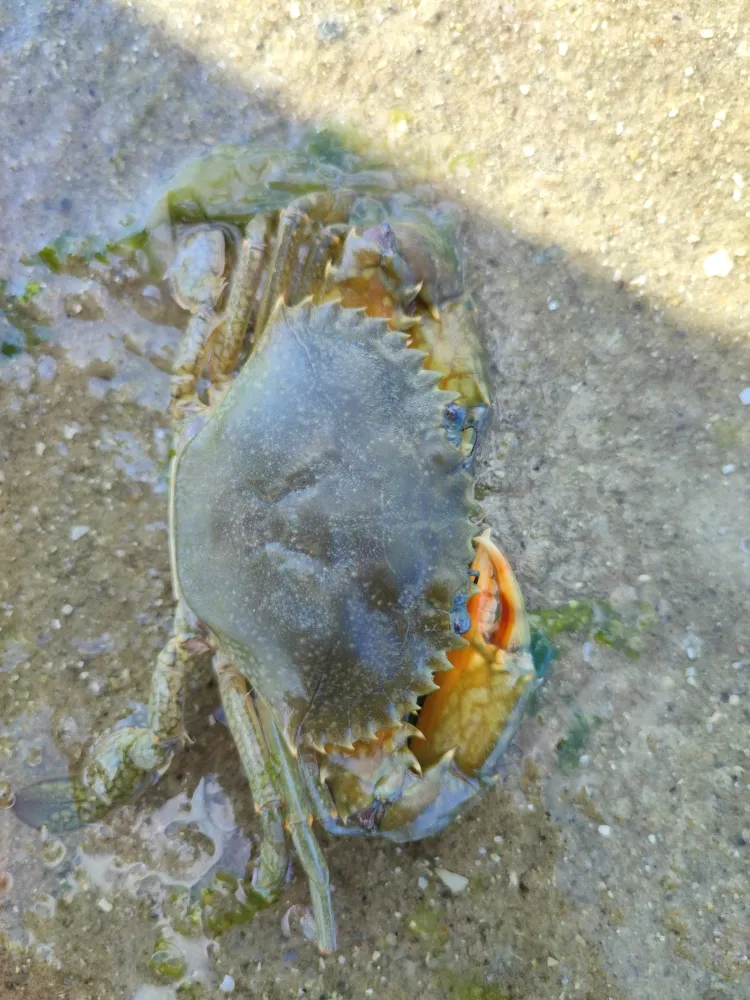
A green mud crab photographed in Tanzania, with its broad shell and heavy claws.
The green mud crab (Scylla serrata) has a wide, sturdy shell and two heavy claws. Its shell can range from dark brown to mottled green. If the rear legs are visible, look at the last pair. They flatten into paddles that help the crab swim. dpird.nsw.gov.au
Green mud crabs use estuaries and mangrove waterways with soft, muddy bottoms. Some occupy burrows in the intertidal zone, while many adults remain below the low-tide mark. At low tide, a fiddler crab may be out on the exposed mud while a green mud crab is still underwater nearby. wildsingapore.com
What About the Mangrove Horseshoe Crab?
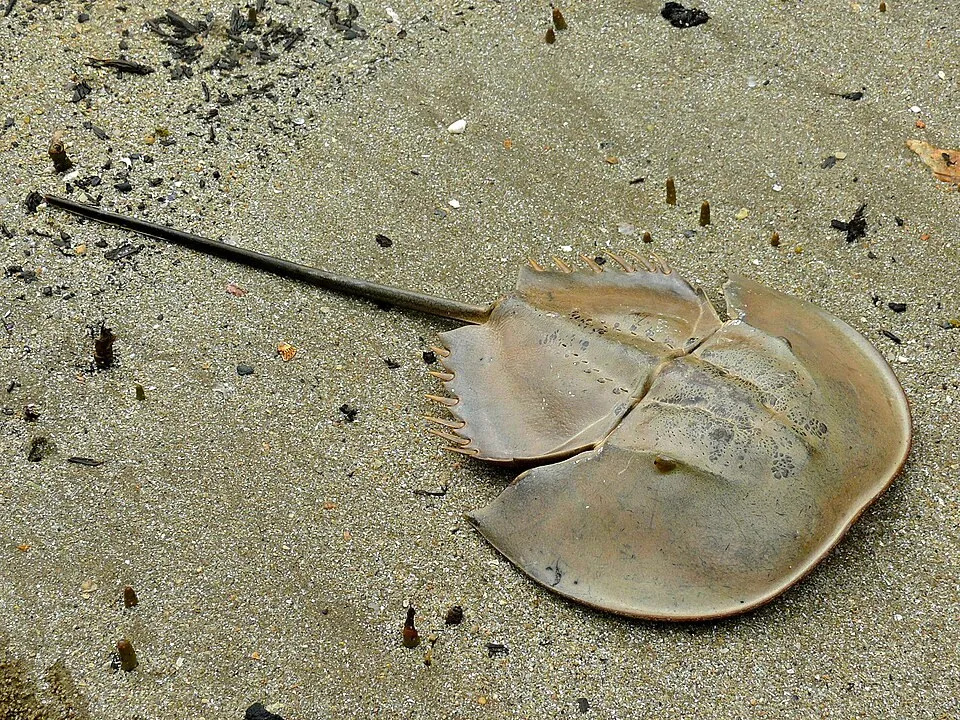
A mangrove horseshoe crab at Bako National Park, Malaysia. Its long tail extends behind the shell.
The mangrove horseshoe crab (Carcinoscorpius rotundicauda) has a rounded shield and a long tail that is round in cross-section. In Southeast Asia, mangrove shores and muddy flats are among the places it lives. It belongs to the chelicerates, the group that also includes spiders and scorpions. Fiddler crabs, tree crabs, root crabs, and mud crabs are crustaceans. nparks.gov.sg
Sources
- WildSingapore — Porcelain Fiddler Crab
- Smithsonian Ocean — Mangrove Tree Crab
- Smithsonian Environmental Research Center — Mangrove Root Crab
- University of the West Indies — Mangrove Root Crab Field Guide
- NSW Department of Primary Industries and Regional Development — Mud Crab
- Western Australia Department of Primary Industries and Regional Development — Green Mud Crab Fact Sheet
- Singapore National Parks Board — Mangrove Horseshoe Crab