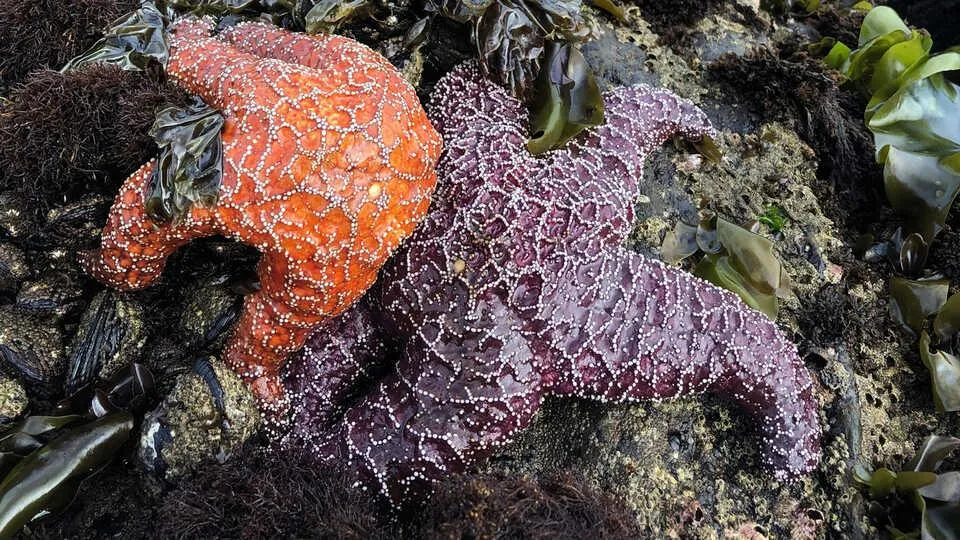
The ocean has pulled away from a rocky shoreline, revealing shallow pools filled with sea stars, crabs, mussels, and other fascinating creatures. What looks like an ordinary stretch of wet rocks is actually one of the most challenging habitats on Earth.
The intertidal zone is the area between the ocean’s high- and low-tide marks. Animals living here must survive crashing waves, changing water levels, exposure to air, and sometimes dramatic temperature changes.
Sea stars, barnacles, shore crabs, limpets, sea anemones, and tidepool fish are among the many animals adapted to these conditions.
Some cling tightly to rocks, while others hide in crevices, seal themselves inside shells, or retreat into pools of seawater until the tide returns.
Here are 12 fascinating animals that live in the intertidal zone, focusing on species found along the Pacific coast of North America, from California to British Columbia.
12 Intertidal Zone Animals: Quick Comparison
| Animal | Scientific Name | Common Habitat | Main Adaptation |
|---|---|---|---|
| Ochre Sea Star | Pisaster ochraceus | Middle and lower rocky shore | Strong tube feet |
| Giant Green Sea Anemone | Anthopleura xanthogrammica | Tide pools and lower shore | Retractable tentacles |
| California Mussel | Mytilus californianus | Wave-exposed rocks | Strong attachment threads |
| Acorn Barnacle | Balanus glandula | Upper and middle shore | Protective shell plates |
| Fingered Limpet | Lottia digitalis | Rocky surfaces | Powerful muscular foot |
| Black Leather Chiton | Katharina tunicata | Middle and lower shore | Eight flexible shell plates |
| Purple Sea Urchin | Strongylocentrotus purpuratus | Lower shore and tide pools | Protective spines |
| Blueband Hermit Crab | Pagurus samuelis | Rocky tide pools | Reused snail shells |
| Striped Shore Crab | Pachygrapsus crassipes | Rocky shore crevices | Fast sideways movement |
| Black Turban Snail | Tegula funebralis | Rocky intertidal habitats | Protective shell and operculum |
| Tidepool Sculpin | Oligocottus maculosus | Shallow tide pools | Camouflage and tolerance of changing conditions |
| Opalescent Nudibranch | Hermissenda opalescens | Tide pools and shallow coastal water | Chemical defenses and warning coloration |
Different species occupy different parts of the shoreline. Some can tolerate long periods exposed to air, while others need to remain wet or submerged.
1. Ochre Sea Star
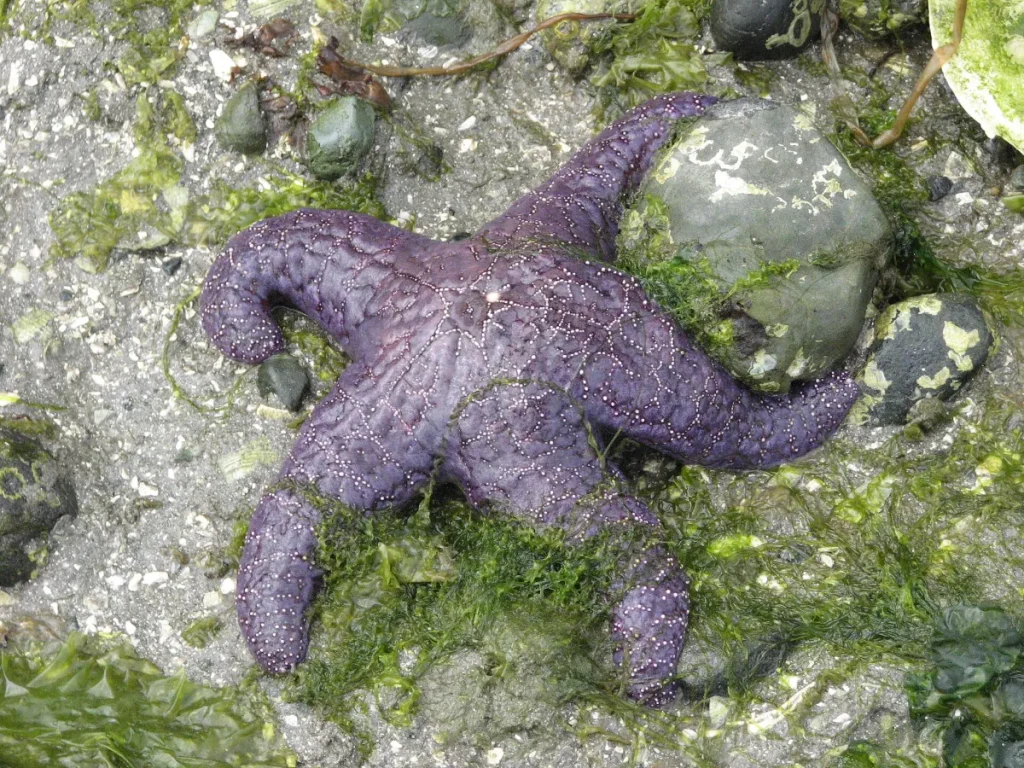
ALT: Ochre sea star attached to a rocky shoreline in British Columbia.
Photo: D. Gordon E. Robertson | Source: Wikimedia Commons | License: CC BY-SA 3.0 | Changes: None if original used.
Scientific name: Pisaster ochraceus
Habitat: Rocky shores and tide pools along the Pacific coast of North America.
Diet: Mussels, barnacles, and other marine invertebrates.
The ochre sea star is one of the most recognizable animals found in Pacific Coast tide pools.
Despite its name, this sea star is not always orange. Individuals may appear purple, reddish brown, or yellowish.
Most have five thick arms covered with small spines.
On the underside of each arm are numerous tube feet connected to a water vascular system. These structures allow the animal to move, attach to rocks, and handle prey.
Ochre sea stars are particularly important predators of mussels.
Using their tube feet, they can exert sustained force on a mussel’s shell. Once a small opening is created, the sea star can extend part of its stomach into the shell to digest its prey.
By limiting mussel dominance in some rocky shore communities, ochre sea stars can help maintain space for other organisms.
How to identify it: Look for a large, five-armed sea star with a rough surface and orange, purple, or brown coloration.
Interesting fact: The ochre sea star is a classic example of a keystone species because its feeding activity can strongly influence the diversity of rocky shore communities.
2. Giant Green Sea Anemone
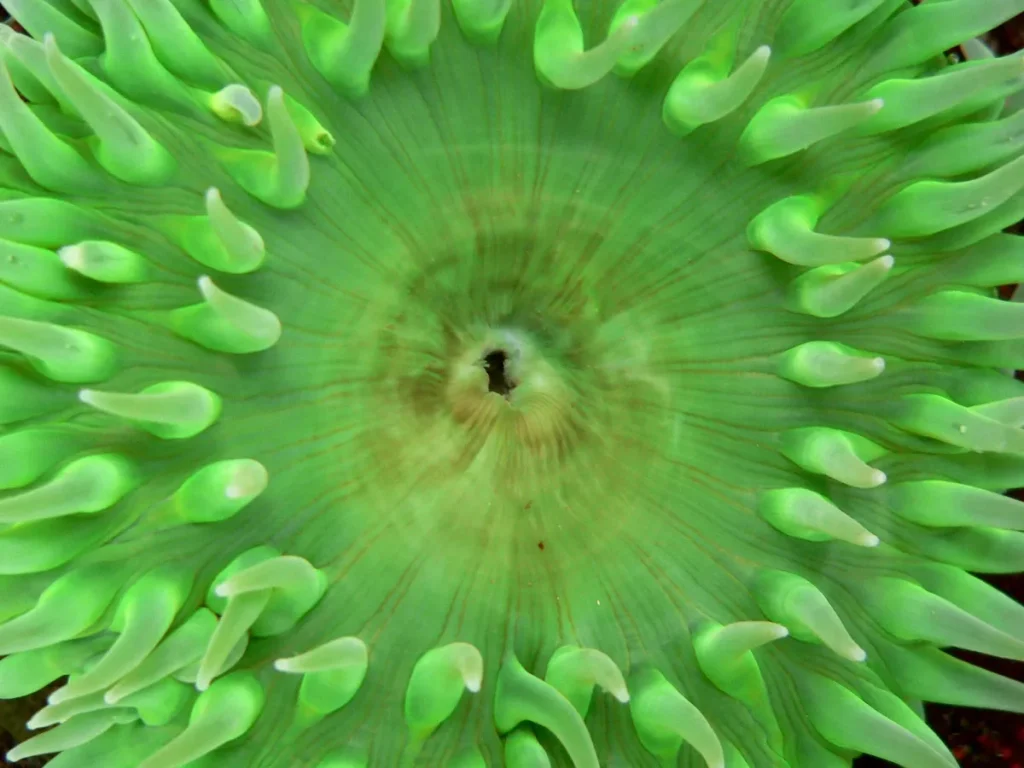
ALT: Giant green sea anemone with green tentacles extending underwater.
Photo: Stan Shebs | Source: Wikimedia Commons | License: CC BY-SA 3.0 | Changes: None if original used. Photograph taken at Vancouver Aquarium.
Scientific name: Anthopleura xanthogrammica
Habitat: Rocky tide pools, crevices, and wave-exposed coastal habitats.
Diet: Small fish, crustaceans, and other marine animals.
The giant green sea anemone may look like a strange underwater flower, but it is actually a predatory animal.
It belongs to the same major animal group as corals and jellyfish.
Its cylindrical body attaches firmly to rocks, while a circle of tentacles surrounds its central mouth.
These tentacles contain specialized stinging cells called cnidocytes, which help capture prey.
The vivid green appearance of many individuals comes partly from symbiotic photosynthetic organisms living within their tissues.
When exposed during low tide, the anemone can retract its tentacles and close its body, reducing water loss.
Underwater, it extends its tentacles to capture food carried by the surrounding water.
How to identify it: Look for a large, green, flower-shaped animal firmly attached to a rock.
Interesting fact: Giant green sea anemones often remain attached to the same location for long periods, although they can move slowly when necessary.
3. California Mussel

ALT: California mussels attached to rocks along the Pacific coast.
Photo: Dr. Sophie McCoy / NOAA Photo Library | Source: Wikimedia Commons | License: CC BY 2.0 | Changes: None if original used.
Scientific name: Mytilus californianus
Habitat: Wave-exposed rocky shores along the Pacific coast of North America.
Diet: Plankton and suspended organic particles.
California mussels often form dense clusters across the middle portions of rocky shores.
These dark-shelled mollusks can survive in places where waves repeatedly crash against exposed rocks.
Their remarkable attachment system is one reason for their success.
Each mussel produces strong protein-based threads called byssal threads. These threads anchor it to rock surfaces and neighboring mussels.
When submerged, a mussel opens its shells and filters seawater to collect microscopic food particles.
During low tide, it can close its shell to reduce water loss.
Dense mussel beds also provide shelter for numerous smaller animals, including worms, tiny crustaceans, and juvenile mollusks.
How to identify it: Look for dark blue or black elongated shells growing closely together on rocky surfaces.
Interesting fact: A mussel bed is more than a collection of shellfish. It creates a complex miniature habitat for many other intertidal organisms.
4. Acorn Barnacle
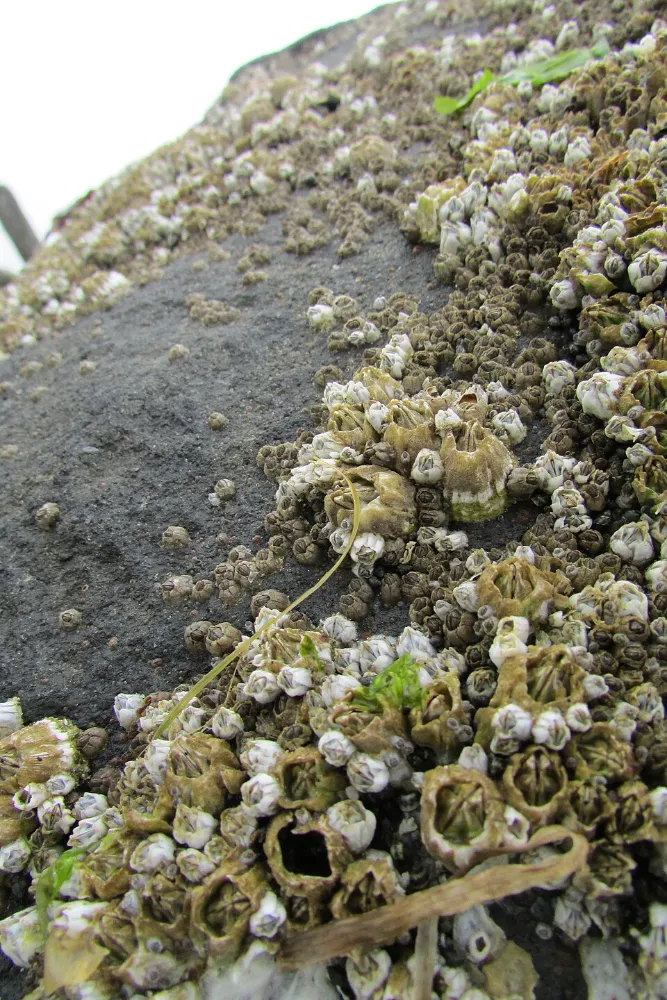
ALT: Acorn barnacles attached to rocks at Saltwater State Park in Washington.
Photo: Chris Light | Source: Wikimedia Commons | License: CC BY-SA 4.0 | Changes: None if original used.
Scientific name: Balanus glandula
Habitat: Upper and middle rocky intertidal zones.
Diet: Plankton and suspended food particles.
Acorn barnacles may look like tiny shells or miniature volcanoes attached to rocks.
However, they are crustaceans, making them relatives of crabs and shrimp.
During their early development, barnacles swim freely as larvae. Eventually, they attach permanently to a suitable hard surface.
Once settled, they develop protective plates around their bodies.
When submerged, a barnacle extends specialized feathery appendages called cirri through an opening in its shell.
These appendages sweep food particles from the surrounding water.
When the tide recedes, the barnacle closes its plates to help retain moisture.
This adaptation allows many barnacles to survive in parts of the shore where they may be exposed to air for long periods.
How to identify it: Look for small, pale, cone-shaped structures growing in clusters on rocks.
Interesting fact: Although adult barnacles remain attached to one place, their larvae travel through seawater before choosing a permanent home.
5. Fingered Limpet

ALT: Fingered limpet shell showing its low, conical shape.
Photo: H. Zell | Source: Wikimedia Commons | License: CC BY-SA 3.0 | Changes: None if original used. Image shows a shell specimen rather than a living animal.
Scientific name: Lottia digitalis
Habitat: Rocky shores of the northeastern Pacific Ocean.
Diet: Microscopic algae and other organic material on rock surfaces.
Limpets are marine snails with simple, cone-shaped shells.
Unlike snails with spiral shells, limpets have a protective shell that resembles a small cap.
Their most important attachment tool is a broad, muscular foot.
This foot creates strong contact with the rock surface, helping the animal resist waves and avoid being washed away.
Limpets feed by scraping algae and other material from rocks using a specialized feeding structure called a radula.
Some limpets return to familiar resting areas on the rock.
By positioning their shells closely against the surface, they can reduce exposure to drying conditions during low tide.
How to identify it: Look for a small, low-profile, cap-shaped shell attached tightly to a rock.
Interesting fact: The feeding structures of some limpets contain exceptionally hard biological materials, demonstrating how specialized these apparently simple animals can be.
6. Black Leather Chiton

ALT: Black leather chiton photographed in Bamfield, British Columbia.
Photo: Qwexcxewq | Source: Wikimedia Commons | License: CC BY 4.0 | Changes: None if original used.
Scientific name: Katharina tunicata
Habitat: Rocky intertidal habitats along the Pacific coast.
Diet: Primarily algae.
The black leather chiton is a marine mollusk with a flattened, oval-shaped body.
At first glance, it may resemble an unusual dark patch attached to a rock.
A closer look reveals eight overlapping shell plates along its back.
These plates provide protection while allowing enough flexibility for the animal to conform to uneven surfaces.
A thick, dark, leathery tissue called the girdle surrounds the plates.
Like limpets, chitons use a broad muscular foot to attach to rocks and a radula to scrape food from surfaces.
Their flattened bodies help them withstand strong waves.
How to identify it: Look for an oval, dark-colored animal with eight distinct shell plates running along its back.
Interesting fact: Chitons belong to a distinctive group of mollusks whose eight shell plates provide both protection and flexibility.
7. Purple Sea Urchin

ALT: Purple sea urchin showing its dense covering of protective spines.
Photo: Toby Hudson | Source: Wikimedia Commons | License: CC BY-SA 3.0 | Changes: None if original used.
Scientific name: Strongylocentrotus purpuratus
Habitat: Rocky tide pools and shallow coastal waters.
Diet: Algae, including kelp and other seaweeds.
Purple sea urchins are round marine animals covered with numerous sharp spines.
They belong to the echinoderms, the same larger animal group as sea stars.
Their spines provide protection and assist with movement, while small tube feet help them attach to surfaces.
Sea urchins feed on algae using a complex jaw structure commonly called Aristotle’s lantern.
This structure contains five teeth that help scrape and process food.
In some coastal ecosystems, excessive sea urchin grazing can contribute to the decline of kelp forests, particularly when predators are scarce.
Purple sea urchins are commonly found in rocky crevices and tide pools where they can remain submerged during low tide.
How to identify it: Look for a round, purple animal densely covered with pointed spines.
Interesting fact: Sea urchins have no eyes like those of humans, but they can still respond to light and environmental conditions.
8. Blueband Hermit Crab

ALT: Blueband hermit crab showing blue markings on its legs while occupying a snail shell.
Photo: Jerry Kirkhart | Source: Wikimedia Commons | License: CC BY 2.0 | Changes: The Wikimedia version was cropped from the original Flickr photograph; no further changes if this file is used unchanged.
Scientific name: Pagurus samuelis
Habitat: Rocky tide pools along the Pacific coast.
Diet: Algae, detritus, and small organic particles.
Hermit crabs have one of the most unusual housing arrangements in the animal kingdom.
Unlike true crabs with broad, heavily armored abdomens, hermit crabs have softer, asymmetrical abdomens.
To protect this vulnerable body region, they occupy empty snail shells.
The blueband hermit crab is commonly found in Pacific Coast tide pools, where it may crawl among rocks, seaweed, and other marine organisms.
Its legs often display blue bands that help distinguish it from some other hermit crab species.
As a hermit crab grows, it must find a larger shell.
Suitable shells are valuable resources, and hermit crabs may compete for them.
How to identify it: Look for a small crab extending its legs and claws from an empty snail shell, often with noticeable blue markings.
Interesting fact: A hermit crab does not grow the shell it lives in. It must find an abandoned shell created by another animal.
9. Striped Shore Crab

ALT: Striped shore crab resting on a rocky surface in Half Moon Bay, California.
Photo: Kai Medina (mk170101) | Source: Wikimedia Commons | License: CC BY-SA 4.0 | Changes: None if original used.
Scientific name: Pachygrapsus crassipes
Habitat: Rocky intertidal shores, crevices, and tide pools.
Diet: Algae, detritus, and small marine organisms.
The striped shore crab is a fast-moving crustacean frequently seen along rocky Pacific shorelines.
It has a relatively flattened body and strong walking legs that allow it to navigate uneven rock surfaces.
When disturbed, it often escapes sideways into a narrow crevice or beneath a rock.
Its dark greenish, brownish, or striped carapace helps it blend into the coastal environment.
Shore crabs are opportunistic feeders that consume algae and various organic materials.
Their activity helps transfer nutrients through rocky shore food webs.
How to identify it: Look for a small, flattened crab with a squarish shell, striped or mottled markings, and quick sideways movements.
Interesting fact: A crab’s hard exoskeleton cannot expand continuously, so it must molt periodically as it grows.
Other coastal habitats also support specialized crab species. Explore our guide to mangrove crabs and how to identify them.
10. Black Turban Snail

ALT: Black turban snail with a dark spiral shell photographed along the Pacific coast.
Photo: Peter Pearsall / U.S. Fish and Wildlife Service Pacific Region | Source: Wikimedia Commons | License: CC BY 2.0 | Changes: None if original used.
Scientific name: Tegula funebralis (also classified as Chlorostoma funebralis in some taxonomic treatments)
Habitat: Rocky intertidal shorelines of the northeastern Pacific.
Diet: Algae and other material growing on rocks.
Black turban snails are common members of Pacific Coast rocky shore communities.
Their dark, rounded spiral shells make them relatively easy to recognize.
They move slowly across wet rocks using a muscular foot while scraping algae with their radula.
When threatened or exposed to unfavorable conditions, they can withdraw into their shells.
A hard structure called an operculum helps close the shell opening.
This protects the soft body and helps reduce water loss during low tide.
Black turban snails also play a role in the rocky shore food web, serving as prey for animals such as crabs and sea stars.
How to identify it: Look for a small, dark, rounded spiral shell attached to coastal rocks.
Interesting fact: Empty black turban snail shells may become homes for hermit crabs, connecting the life histories of two very different marine animals.
11. Tidepool Sculpin
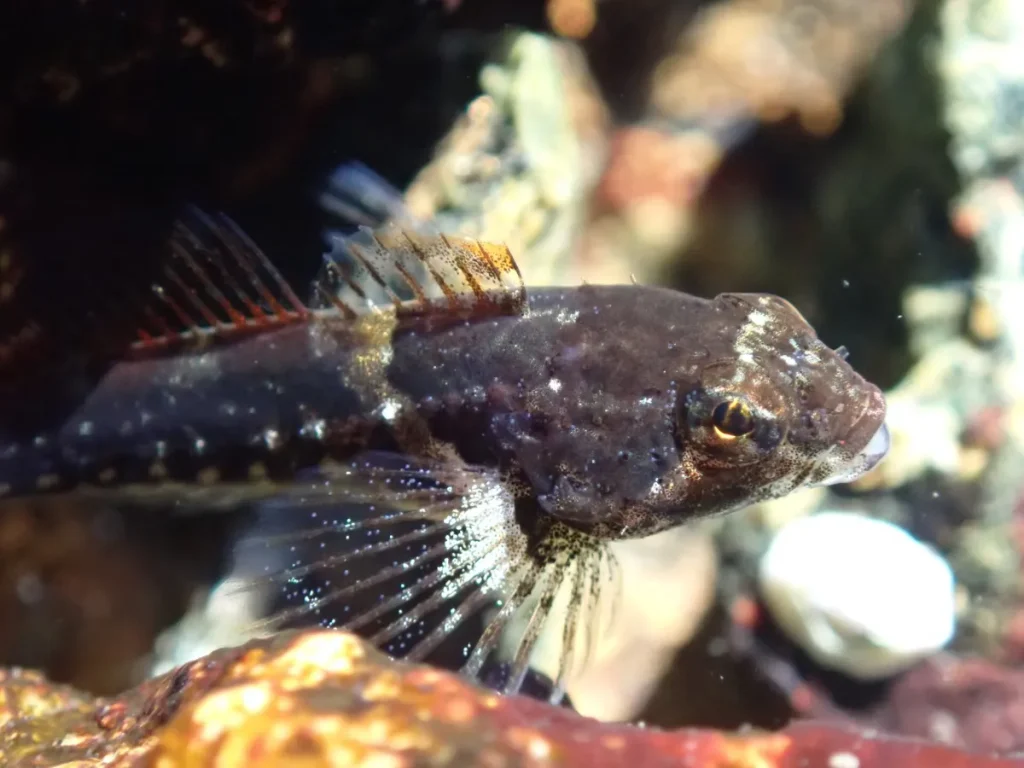
ALT: Tidepool sculpin with mottled camouflage in its rocky coastal habitat.
Photo: Guerric Haché | Source: Wikimedia Commons | License: CC0 1.0 | Changes: None if original used.
Scientific name: Oligocottus maculosus
Habitat: Rocky tide pools along the Pacific coast of North America.
Diet: Small crustaceans, worms, and other marine invertebrates.
Not every intertidal animal is a shellfish or other invertebrate.
The tidepool sculpin is a small fish specially adapted to life in shallow coastal pools.
Its body is usually mottled brown, gray, or greenish, helping it blend into rocks, algae, and other surfaces.
It often rests motionless near the bottom, where its camouflage makes it difficult to detect.
A tidepool sculpin may remain in a relatively small area rather than moving far along the coast.
During low tide, it can tolerate environmental conditions that would be difficult for many other fish.
Tide pools may experience rapid changes in temperature, oxygen availability, and salinity.
How to identify it: Look for a small, broad-headed fish with mottled coloration resting on the bottom of a rocky tide pool.
Interesting fact: Tidepool sculpins are adapted to living in shallow pools that can become isolated from the open ocean for hours between tides.
12. Opalescent Nudibranch
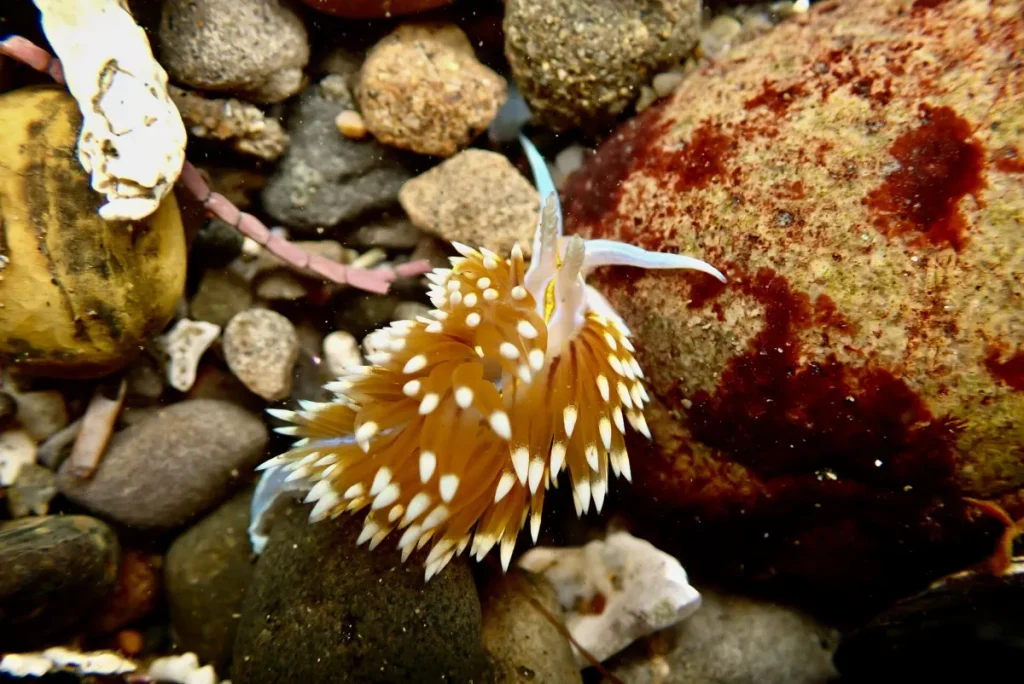
ALT: Opalescent nudibranch showing colorful cerata and delicate head tentacles.
Photo: Allison Gong | Source: Wikimedia Commons | License: CC BY 4.0 | Changes: None if original used.
Scientific name: Hermissenda opalescens
Habitat: Rocky tide pools and shallow coastal waters of the northeastern Pacific.
Diet: Small marine invertebrates, including hydroids and other soft-bodied prey.
The opalescent nudibranch is one of the most colorful animals that visitors may encounter in Pacific Coast tide pools.
It is a type of sea slug, belonging to a group of marine gastropods that typically lack an external protective shell as adults.
Its body is decorated with numerous slender projections called cerata.
These structures can display striking orange, blue, white, and other colors.
The cerata help with respiration and may also function in defense.
Some nudibranchs can retain stinging structures obtained from their prey, providing protection against predators.
Unlike animals that rely on thick external shells, nudibranchs often depend on chemical or biological defenses.
How to identify it: Look for a small, elongated sea slug with colorful finger-like projections along its body.
Interesting fact: Despite their delicate appearance, nudibranchs can be effective predators of other marine invertebrates.
What Is the Intertidal Zone?
The intertidal zone is the coastal region between the average high-tide and low-tide levels.
At high tide, seawater covers much of this habitat.
At low tide, previously submerged rocks, sandy beaches, mudflats, and pools may become exposed.
This creates an environment where animals must cope with changing water levels several times a day.
Many intertidal animals have specialized physical structures or behaviors that allow them to survive these conditions.
Although this article focuses on rocky Pacific Coast habitats, intertidal environments also include sandy shores, muddy estuaries, and other coastal ecosystems.
The Four Zones of a Rocky Shore
Ecologists commonly describe rocky shore habitats using several vertical zones.
The exact boundaries vary with local tides, wave exposure, and coastal geography.
| Zone | Conditions | Typical Animals |
|---|---|---|
| Splash Zone | Mostly exposed to air, occasionally wetted by spray | Especially hardy barnacles and some shore-dwelling organisms |
| High Intertidal | Submerged during higher tides; exposed for long periods | Acorn barnacles, limpets, some snails |
| Middle Intertidal | Alternates regularly between exposure and submersion | Mussels, barnacles, chitons, sea stars |
| Low Intertidal | Submerged most of the time | Sea anemones, sea urchins, nudibranchs, tidepool fish |
These zones are not completely separate.
Different species may overlap, and an animal’s position can vary depending on the availability of pools, shade, and shelter.
Tide pools can remain underwater even when the surrounding rocks are exposed, creating important refuges for marine life.
How Do Intertidal Animals Survive?
Intertidal animals face challenges that many permanently submerged marine organisms rarely experience.
Their survival depends on specialized adaptations.
1. Preventing Water Loss
Exposure to air can cause marine animals to dry out.
Barnacles close their protective plates, while mussels seal their shells tightly.
Sea anemones can retract their tentacles, reducing the area exposed to air.
Limpets and snails use their shells and attachment structures to help conserve moisture.
2. Surviving Powerful Waves
Waves can create tremendous physical forces against coastal rocks.
Mussels use strong byssal threads to remain attached.
Limpets and chitons use muscular feet to grip rock surfaces.
Sea stars rely on numerous tube feet to maintain their positions.
These adaptations reduce the chance of being swept away.
3. Avoiding Predators
Predators remain active throughout the tidal cycle.
Sea stars feed on mussels, crabs hunt smaller invertebrates, and shorebirds search exposed surfaces for food.
Some prey animals rely on hard shells, while others hide beneath rocks or use camouflage.
Sea urchin spines provide another form of protection.
4. Coping With Temperature Changes
Small tide pools can warm rapidly under direct sunlight.
They may also cool substantially during cold weather or nighttime exposure.
Intertidal organisms have different levels of tolerance for changing temperatures.
Their distributions along the shore partly reflect these physiological limits.
5. Managing Changes in Salinity
Rainwater can dilute seawater in shallow tide pools.
Conversely, evaporation can increase salt concentrations.
Some intertidal species tolerate significant changes in salinity, while others remain in more stable environments closer to the ocean.
Intertidal Zone Food Web: Who Eats Whom?
The intertidal zone supports a complex network of predators, grazers, filter feeders, and scavengers.
A simplified food chain might look like this:
Phytoplankton → California Mussel → Ochre Sea Star
Another example is:
Rock Algae → Black Turban Snail → Shore Crab
These examples illustrate how energy passes between organisms.
However, real intertidal food webs are much more complicated.
Many animals eat multiple prey species, while others switch between food sources depending on availability.
Sea stars can influence the abundance of mussels, while grazing animals such as limpets and sea urchins help shape the growth of algae.
The relationships between these organisms help determine the structure of rocky shore communities.
Rocky Intertidal Zone vs. Tide Pools: What’s the Difference?
The terms intertidal zone and tide pool are closely related, but they do not mean exactly the same thing.
The intertidal zone refers to the entire coastal region between high and low tides.
A tide pool is a depression that retains seawater when the surrounding shore becomes exposed.
Tide pools are therefore habitats found within parts of the intertidal zone.
Some intertidal animals live mainly on exposed rocks, while others depend heavily on pools that remain underwater during low tide.
For example, many barnacles can tolerate long periods of air exposure.
Tidepool sculpins, by contrast, generally need to remain in water, even when the ocean has receded.
How Is the Intertidal Zone Different From a Wetland?
Intertidal rocky shores and coastal wetlands are both influenced by water, but they have different physical characteristics.
Rocky intertidal habitats are dominated by rocks, waves, and regular tidal exposure.
Wetlands may have waterlogged soils, marsh grasses, mangrove trees, or other vegetation adapted to saturated conditions.
Both habitats can support crabs, mollusks, birds, and numerous other animals.
However, the species and their adaptations often differ.
To explore animals living in freshwater marshes, swamps, and coastal wetlands, read our guide to 15 animals that live in wetlands.
For another specialized coastal environment, discover 8 mangrove animals and where they live.
How to Explore Tide Pools Without Harming Wildlife
Exploring tide pools is an excellent way to observe marine animals in their natural habitats.
However, these ecosystems can be damaged by careless visitors.
Follow these basic guidelines:
- Check the tide schedule. Visit during a suitable low tide and allow enough time to return safely.
- Watch the waves. Unexpected waves can reach exposed rocks, even when the tide appears low.
- Wear appropriate footwear. Wet rocks and seaweed can be extremely slippery.
- Observe animals in place. Avoid removing animals from rocks or pulling them out of shells.
- Do not disturb shelters. Turning rocks over can damage organisms living underneath them.
- Leave shells and organisms where they belong. Empty shells may provide future homes for hermit crabs.
- Follow local protection rules. Many marine parks and protected areas prohibit collecting organisms.
Photographs, careful observation, and identification notes are usually the best ways to appreciate these remarkable animals.
Frequently Asked Questions
What animals live in the intertidal zone?
Common intertidal animals include sea stars, barnacles, mussels, limpets, chitons, crabs, sea anemones, marine snails, sea urchins, and some fish.
The exact species depend on the coastline, temperature, and type of habitat.
What animals live in rocky tide pools?
Rocky tide pools may contain sea anemones, hermit crabs, sea stars, sea urchins, small fish, marine snails, and nudibranchs.
Some pools support many different species within a relatively small area.
Why do barnacles live in the upper intertidal zone?
Certain barnacle species can tolerate substantial exposure to air.
Their hard protective plates close during low tide, helping reduce water loss until seawater returns.
How do mussels stay attached to rocks?
Mussels produce strong protein-based threads called byssal threads.
These structures anchor them to surfaces and help them resist the force of ocean waves.
Are sea stars found in tide pools?
Yes. Many sea star species inhabit rocky shores and tide pools.
Ochre sea stars are particularly well known along the northeastern Pacific coast.
Can fish survive in tide pools?
Yes. Some fish, including tidepool sculpins, are adapted to shallow pools that become temporarily separated from the ocean.
They can tolerate environmental changes that would be challenging for many other fish species.
Are all intertidal animals invertebrates?
No. Although many intertidal animals are invertebrates, some vertebrates also use these habitats.
Tidepool fish are one example. Shorebirds and marine mammals may also feed in intertidal areas, although they do not necessarily remain there throughout the tidal cycle.
What is the most important adaptation for intertidal animals?
There is no single adaptation that is most important for every species.
Different animals rely on different combinations of strong attachment, protective shells, water conservation, camouflage, physiological tolerance, and behavioral responses.
Final Thoughts
The intertidal zone is one of the most remarkable places to observe the relationship between marine life and its environment.
Every tide reveals a different scene.
Barnacles close their shells as the water retreats, sea stars search for prey, hermit crabs move between rocks, and colorful anemones wait for the ocean to return.
These animals demonstrate how evolution has produced numerous solutions to the challenges of living between land and sea.
The next time you visit a rocky shoreline at low tide, take a closer look at the pools and crevices.
You may discover an extraordinary miniature ecosystem hiding in plain sight.
Related Articles
- 15 Animals That Live in Wetlands (With Pictures)
- 8 Mangrove Animals and Where They Live
- 4 Mangrove Crabs and How to Tell Them Apart
- 15 Animals That Can Change Color
References and Further Reading
- NOAA – What Is the Intertidal Zone?
- National Park Service – Intertidal Ecosystems
- National Park Service – On the Edge: The Curious Lives of Intertidal Organisms
- Monterey Bay National Marine Sanctuary – Tidepooling Tips
- Monterey Bay Aquarium – Life on the Rocky Shore
- California Academy of Sciences – Tidepooling 101
- Oregon Sea Grant – Rocky Intertidal Ecology