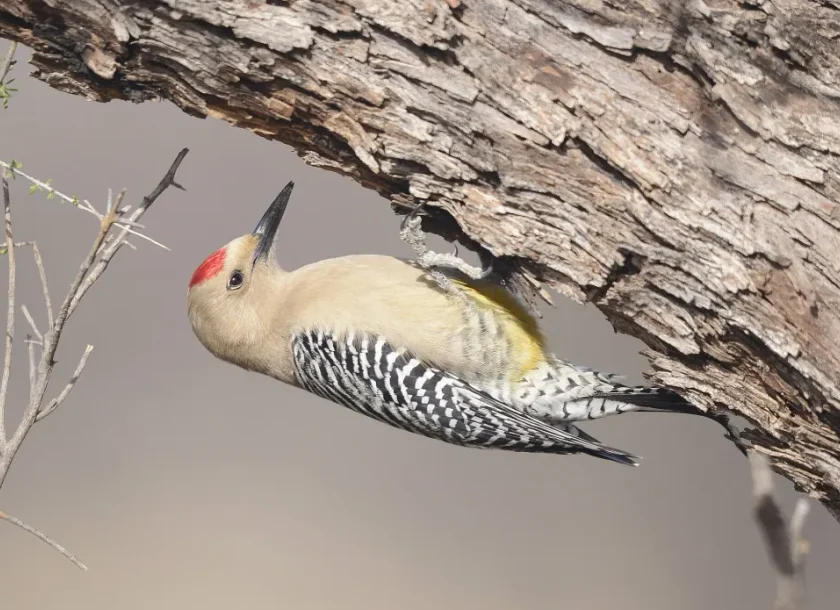
Walk into a North American forest in autumn, and you may hear dry leaves rustling beneath your feet, squirrels moving through oak branches, and woodpeckers calling from tall trees. A white-tailed deer might appear between the trunks, while much smaller animals remain hidden beneath fallen logs.
This is the temperate deciduous forest, an ecosystem that changes dramatically throughout the year.
White-tailed deer, gray squirrels, eastern chipmunks, raccoons, wood thrushes, barred owls, box turtles, and salamanders are among the animals found in temperate deciduous forests.
Some live high in the tree canopy. Others depend on leaf litter, rotting wood, underground burrows, or temporary woodland pools.
Here are 12 fascinating temperate deciduous forest animals, focusing on species found in eastern North America, including their diets, habitats, identification features, and remarkable adaptations.
12 Temperate Deciduous Forest Animals: Quick Comparison
| Animal | Scientific Name | Main Forest Habitat | Diet |
|---|---|---|---|
| White-tailed Deer | Odocoileus virginianus | Forest understory and edges | Leaves, shoots, acorns |
| Eastern Gray Squirrel | Sciurus carolinensis | Hardwood trees and canopy | Nuts, seeds, buds |
| Eastern Chipmunk | Tamias striatus | Forest floor and burrows | Seeds, nuts, fungi |
| Raccoon | Procyon lotor | Woodlands and streams | Fruits, invertebrates, small animals |
| Virginia Opossum | Didelphis virginiana | Woodlands and forest edges | Insects, fruits, small animals |
| Wood Thrush | Hylocichla mustelina | Moist forest understory | Insects, snails, berries |
| Pileated Woodpecker | Dryocopus pileatus | Mature forests and deadwood | Carpenter ants, beetle larvae, fruit |
| Barred Owl | Strix varia | Mature and mixed woodlands | Rodents, amphibians, birds |
| Wild Turkey | Meleagris gallopavo | Forests and woodland openings | Acorns, seeds, insects |
| Eastern Box Turtle | Terrapene carolina carolina | Moist forest floor | Invertebrates, fruits, fungi |
| Spotted Salamander | Ambystoma maculatum | Forest floor and seasonal pools | Worms, insects, invertebrates |
| Eastern Red-backed Salamander | Plethodon cinereus | Moist leaf litter and logs | Small forest invertebrates |
Not all these animals depend exclusively on deciduous forests. Deer, raccoons, opossums, and several others also use nearby habitats. However, deciduous woodlands provide important food, cover, and breeding opportunities for them.
1. White-tailed Deer
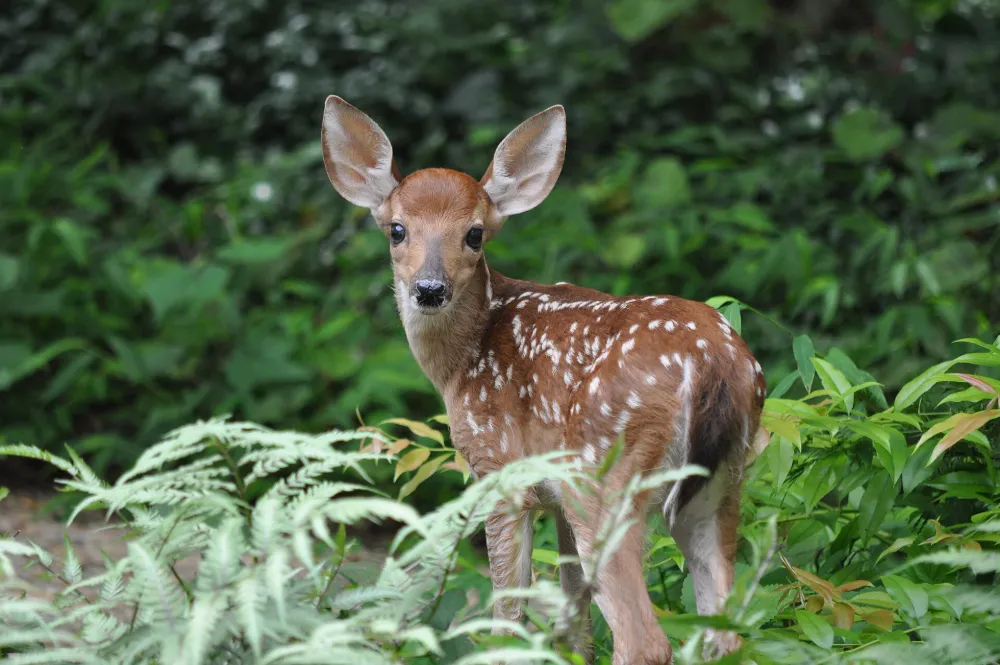
ALT: White-tailed deer photographed in Raleigh, North Carolina.
Photo: Clay Heaton | Source: Wikimedia Commons | License: CC BY-SA 3.0 | Changes: None if the original file is used unchanged.
Scientific name: Odocoileus virginianus
Habitat: Deciduous forests, woodland edges, forest openings, and nearby fields.
Diet: Leaves, buds, shoots, acorns, fruits, and other vegetation.
The white-tailed deer is one of the most familiar large mammals in the forests of eastern North America.
Its reddish-brown summer coat becomes grayer and thicker during winter, helping it cope with seasonal temperature changes.
The most recognizable feature is the white underside of its tail.
When alarmed, a white-tailed deer may raise its tail, revealing a bright white patch as it runs away.
Adult males usually develop antlers that are shed and regrown each year. Females generally lack antlers.
Deer are browsers, meaning they frequently feed on leaves, shoots, and other plant material.
In autumn, acorns and other tree seeds can become important food sources.
White-tailed deer are also an important part of forest ecology.
At moderate densities, they contribute to natural browsing and seed movement. However, unusually high deer populations can reduce the regeneration of certain trees and shrubs by consuming young plants.
How to recognize it: Look for a slender brown deer with a pale throat, large ears, and a tail that flashes white when raised.
Interesting fact: The abundance of white-tailed deer can influence which young trees and wildflowers survive on the forest floor.
2. Eastern Gray Squirrel
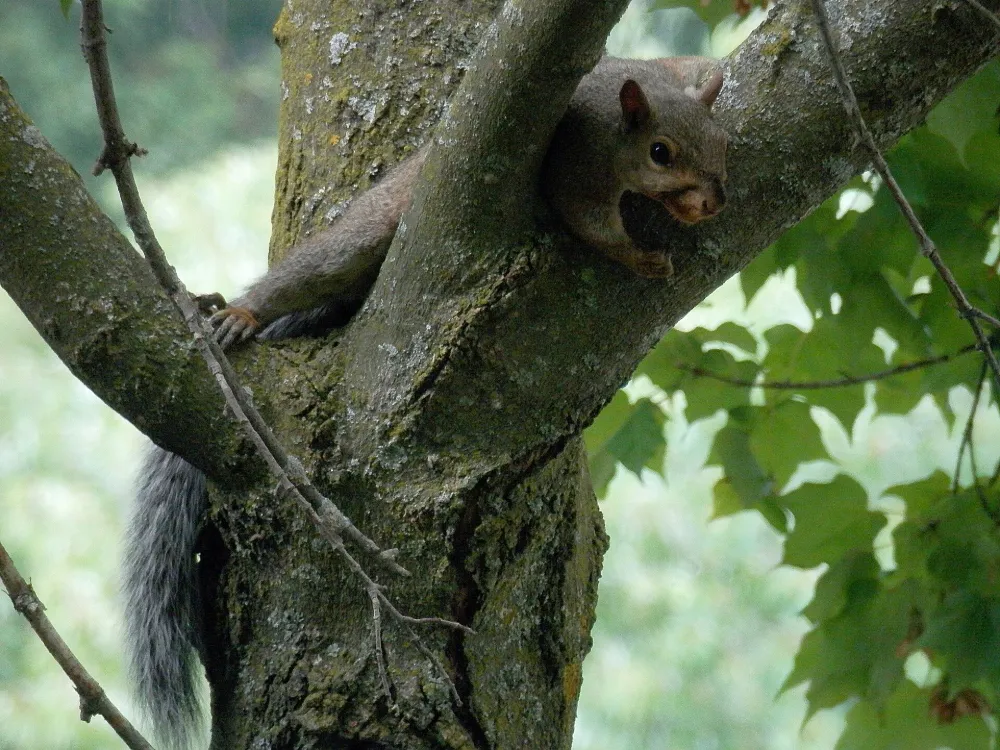
ALT: Eastern gray squirrel showing its gray-brown coat and large bushy tail.
Photo: Ryan Hodnett | Source: Wikimedia Commons | License: CC BY-SA 4.0 | Changes: None if the original file is used unchanged.
Scientific name: Sciurus carolinensis
Habitat: Hardwood forests, mixed woodlands, parks, and suburban areas with mature trees.
Diet: Acorns, hickory nuts, seeds, buds, fungi, and other available food.
The eastern gray squirrel is among the most recognizable mammals found in temperate deciduous forests.
Its bushy tail helps with balance when climbing and leaping between branches.
Although most individuals are gray, their fur can contain brownish tones, and some populations include black-colored individuals.
Gray squirrels frequently forage in oak, hickory, and other hardwood trees.
During autumn, they collect nuts and bury them in scattered locations.
This behavior is known as scatter hoarding.
Squirrels use their memory and other cues to relocate stored food, but not every buried nut is recovered.
Some forgotten seeds may germinate and develop into young trees.
This makes gray squirrels important seed dispersers in many woodland communities.
Eastern gray squirrels also build nests called dreys, often using leaves and twigs high in tree branches.
They may use tree cavities for additional shelter.
How to recognize it: Look for a medium-sized gray squirrel with a pale underside and a large, fluffy tail.
Interesting fact: A gray squirrel’s habit of burying nuts can help shape the next generation of forest trees.
Read more about this behavior in our guide to animals that store food for winter.
3. Eastern Chipmunk
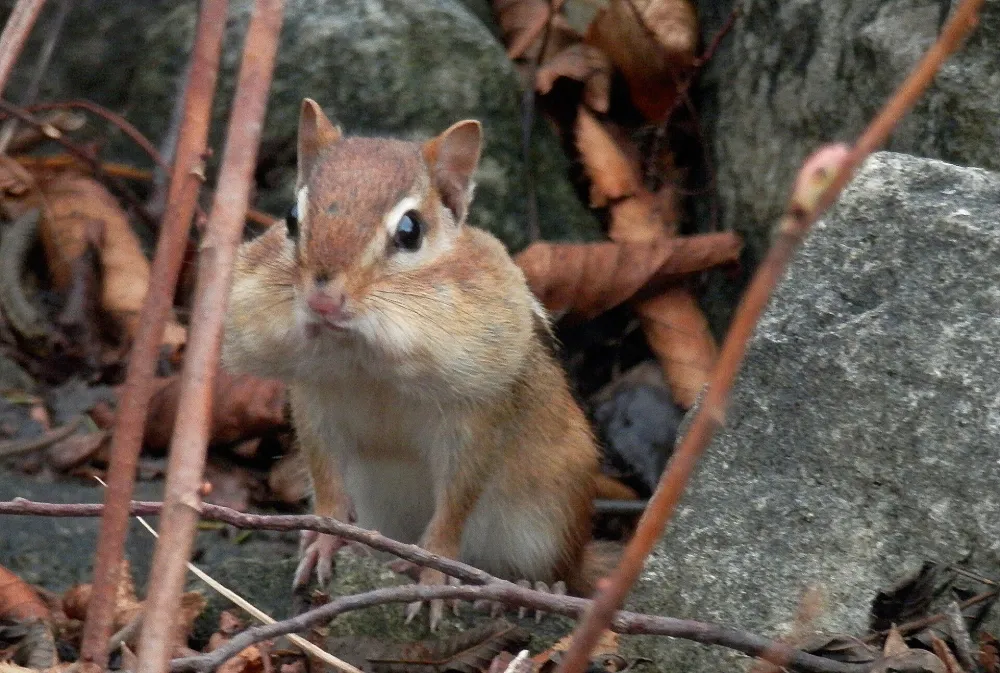
ALT: Eastern chipmunk with brown fur and distinctive dark and pale stripes.
Photo: Ryan Hodnett | Source: Wikimedia Commons | License: CC BY-SA 4.0 | Changes: None if the original file is used unchanged.
Scientific name: Tamias striatus
Habitat: Deciduous woodlands, forest edges, rocky areas, and places with fallen logs.
Diet: Seeds, nuts, berries, fungi, and small invertebrates.
The eastern chipmunk is a small ground-dwelling squirrel frequently found beneath trees and among fallen leaves.
Its most distinctive feature is a pattern of alternating dark and pale stripes along the body and head.
Eastern chipmunks spend much of their active time gathering food.
They possess expandable cheek pouches that allow them to carry seeds and nuts back to underground storage areas.
Unlike tree squirrels, chipmunks rely heavily on burrows for shelter.
Their underground tunnels can contain nesting chambers, food-storage areas, and additional passages.
Chipmunks generally remain near suitable cover, such as rocks, roots, or fallen logs.
During winter, they spend extended periods inside their burrows and enter bouts of torpor, waking periodically to consume stored food.
This strategy differs from the prolonged seasonal hibernation of some other mammals.
How to recognize it: Look for a small brown rodent with prominent black-and-white back stripes, facial stripes, and a relatively short bushy tail.
Interesting fact: Chipmunk food caches can contain large quantities of seeds collected during autumn.
Discover more about underground shelters in our article on 12 animals that live underground.
4. Raccoon
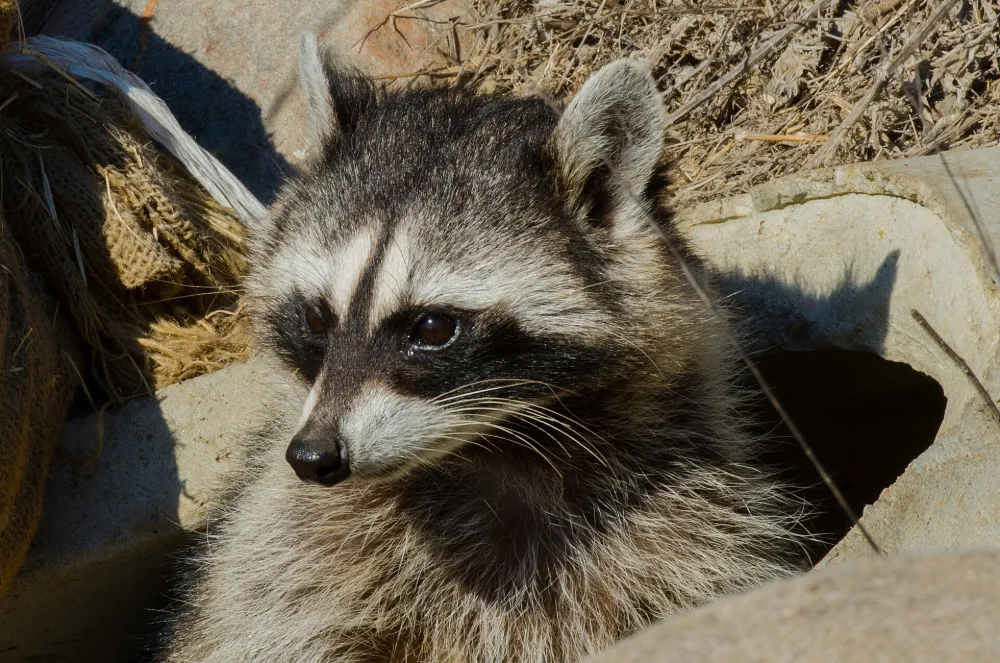
ALT: Common raccoon with a black facial mask and ringed tail.
Photo: Franco Folini | Source: Wikimedia Commons | License: CC BY-SA 2.0 | Changes: None if the original file is used unchanged. Photograph taken in Marin County, California.
Scientific name: Procyon lotor
Habitat: Deciduous forests, wooded waterways, wetlands, forest edges, and developed areas.
Diet: Fruits, nuts, insects, crayfish, eggs, and other plant and animal food.
Raccoons are adaptable mammals that commonly inhabit forests containing mature trees and nearby sources of water.
They are especially recognizable because of their dark facial masks and tails marked with alternating dark and light rings.
Raccoons have highly sensitive front paws.
These allow them to investigate objects, handle food, and explore complex environments.
Contrary to a common misconception, raccoons do not need to wash their food before eating it.
Their frequent manipulation of objects in water is related to exploratory and feeding behavior.
Raccoons are mostly active at night, although they can occasionally be seen during daylight hours.
They use hollow trees, fallen logs, rock crevices, and other protected spaces for resting.
Their flexible diets allow them to survive in many types of deciduous woodland.
How to recognize it: Look for a stocky grayish mammal with a black facial mask, rounded ears, and a thick ringed tail.
Interesting fact: Raccoons are excellent climbers and may use tree cavities as secure resting sites.
5. Virginia Opossum

ALT: Virginia opossum showing its pale face, rounded ears, and pointed snout.
Photo: Matthew Gerke | Source: Wikimedia Commons | License: CC BY 4.0 | Changes: None if the original file is used unchanged.
Scientific name: Didelphis virginiana
Habitat: Deciduous woodlands, forest edges, streamsides, and other habitats with shelter.
Diet: Insects, fruits, carrion, small animals, and other available food.
The Virginia opossum is one of North America’s most unusual woodland mammals.
It is the only naturally occurring marsupial species native to the United States and Canada.
Like other marsupials, female Virginia opossums give birth to extremely small young that continue developing while attached to teats inside the mother’s pouch.
Opossums have pointed snouts, pale faces, nearly hairless ears, and long, relatively hairless tails.
Their hind feet possess opposable digits that help them grip branches while climbing.
Virginia opossums are mostly nocturnal and search for a wide variety of food.
They may use hollow trees, brush piles, or abandoned shelters made by other animals.
One of their best-known defensive behaviors is becoming motionless and appearing dead when extremely threatened.
This response is involuntary rather than a deliberately planned trick.
How to recognize it: Look for a grayish mammal with a pale pointed face, dark rounded ears, and a long, mostly hairless tail.
Interesting fact: Young opossums may ride on their mother’s back after they become too large to remain inside her pouch.
6. Wood Thrush

ALT: Wood thrush perched on a tree branch showing its reddish-brown upperparts and spotted white breast.
Photo: Wildreturn (Andy Reago and Chrissy McClarren) | Source: Wikimedia Commons | License: CC BY 2.0 | Changes: None if the original file is used unchanged.
Scientific name: Hylocichla mustelina
Habitat: Moist deciduous and mixed forests, especially areas with trees, understory vegetation, and leaf litter.
Diet: Insects, spiders, snails, other small invertebrates, and berries.
The wood thrush is one of the most characteristic songbirds of eastern North American deciduous forests.
It has warm reddish-brown upperparts and a white breast covered with bold dark spots.
Its relatively large eyes and pale eye rings give it a distinctive appearance.
Unlike birds that feed mainly high in the canopy, wood thrushes frequently search the forest floor.
They turn over fallen leaves and probe through leaf litter to find insects and other small animals.
This feeding behavior makes a healthy forest floor especially important.
Wood thrushes are also famous for their beautiful, flute-like songs.
Their calls can echo through shaded woodlands during the breeding season.
They are migratory birds, breeding in North America and spending the nonbreeding season mainly in Central America.
The species has experienced long-term population declines associated with a combination of habitat changes and other pressures.
How to recognize it: Look for a medium-sized brown songbird with reddish upperparts and large dark spots on a white breast.
Interesting fact: Wood thrush songs contain complex, overlapping musical notes that make them among the most distinctive sounds of eastern forests.
7. Pileated Woodpecker
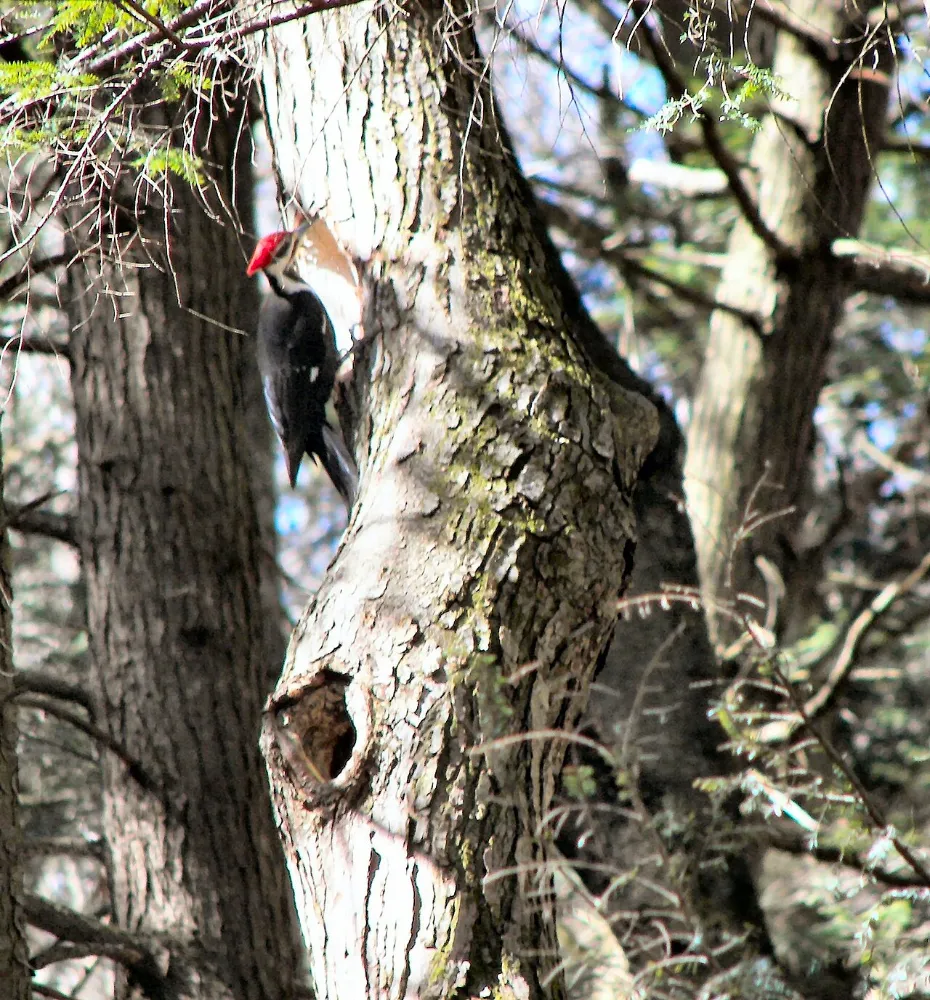
ALT: Male pileated woodpecker with a red crest and black-and-white facial stripes.
Photo: Amy | Source: Wikimedia Commons | License: CC BY 2.0 | Changes: None if the original file is used unchanged. Photograph taken in Pennsylvania.
Scientific name: Dryocopus pileatus
Habitat: Mature deciduous and mixed forests containing large trees, fallen logs, and deadwood.
Diet: Carpenter ants, beetle larvae, other insects, and fruits.
The pileated woodpecker is one of the largest woodpeckers in North America.
Its tall red crest and predominantly black plumage make it particularly easy to recognize.
White stripes along the face and neck provide additional identification clues.
Pileated woodpeckers use powerful bills to excavate trees and fallen logs while searching for insects.
They are especially well known for creating large rectangular feeding holes in wood.
Carpenter ants are an important part of their diet.
However, these woodpeckers do more than search for food.
They excavate large nesting cavities in suitable trees.
After a cavity is abandoned, other animals may use it for shelter or nesting.
These can include smaller birds and mammals that cannot excavate large cavities themselves.
This makes pileated woodpeckers important creators of wildlife habitat.
How to recognize it: Look for a large black woodpecker with a prominent red crest, white facial stripes, and a long bill.
Interesting fact: A single woodpecker cavity may eventually provide shelter for several different animal species.
Learn about other remarkable animal-built shelters in our guide to animals that build their own homes.
For additional woodpecker identification tips, explore 10 birds with red heads in North America.
8. Barred Owl
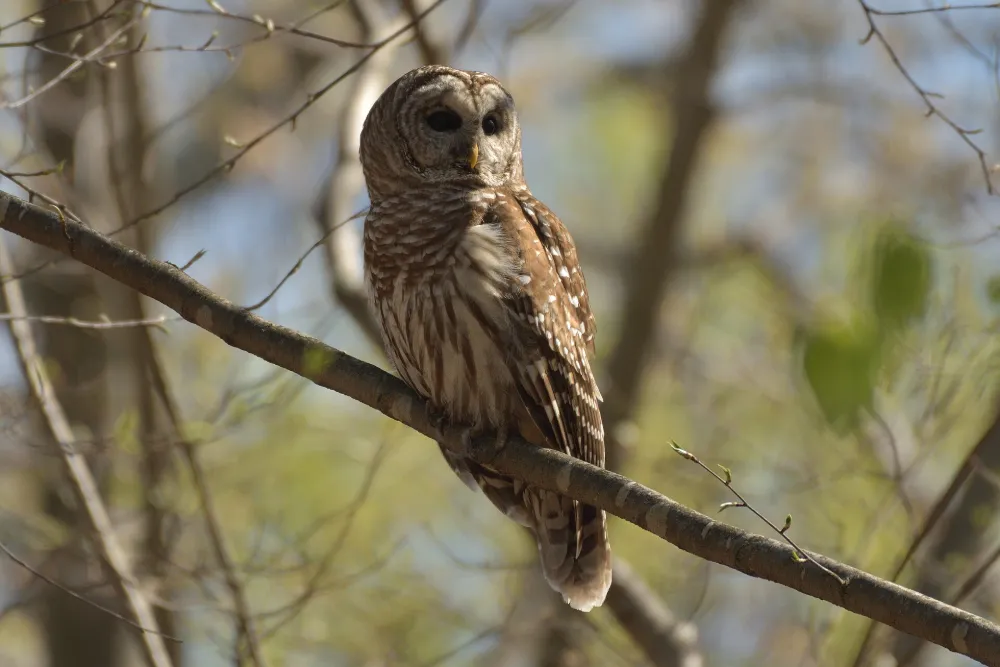
ALT: Barred owl perched in a tree in New Haven County, Connecticut.
Photo: John Stockla | Source: Wikimedia Commons | License: CC BY 4.0 | Changes: None if the original file is used unchanged.
Scientific name: Strix varia
Habitat: Mature deciduous forests, mixed woodlands, forested wetlands, and wooded waterways.
Diet: Mice, voles, small birds, amphibians, and other small animals.
The barred owl is a large woodland owl with dark eyes, a rounded head, and heavily patterned feathers.
Unlike some other North American owls, barred owls do not have prominent ear tufts.
Their faces are rounded and marked by concentric feather patterns.
The upper body is usually brown and white, while the underparts display a combination of horizontal barring and vertical streaking.
Barred owls are particularly associated with wooded habitats that contain large trees.
They often use natural tree cavities or abandoned nesting structures.
Although generally most active at night, barred owls can also hunt during daylight hours.
Their sensitive hearing and quiet flight help them locate prey beneath the forest canopy.
One of their most recognizable features is their call, frequently described by birdwatchers as sounding like a repeated question.
How to recognize it: Look for a large brown-and-white owl with dark eyes, a rounded head, and no obvious ear tufts.
Interesting fact: Barred owls frequently hunt from hidden perches beneath the forest canopy.
9. Wild Turkey

ALT: Wild turkey photographed in central Illinois showing its large body and dark feathers.
Photo: Amos Doyle | Source: Wikimedia Commons | License: CC BY-SA 4.0 | Changes: None if the original file is used unchanged.
Scientific name: Meleagris gallopavo
Habitat: Deciduous forests, woodland openings, forest edges, and nearby grasslands.
Diet: Acorns, seeds, berries, leaves, insects, and other available foods.
The wild turkey is one of the largest ground-dwelling birds found in North American forests.
Despite its heavy body, it is capable of flying.
Wild turkeys often spend the day walking across the forest floor, searching for seeds, nuts, insects, and other food.
At night, they commonly roost in trees.
This behavior provides protection from some ground predators while the birds rest.
Acorns from oak trees can be an important food source during autumn and winter.
Male wild turkeys, called toms or gobblers, are larger and more colorful than females.
During courtship, males may spread their tails into broad fans, puff up their feathers, and display brightly colored skin around the head.
Females usually have less conspicuous coloration that helps them remain hidden while nesting.
How to recognize it: Look for a large, dark-bodied bird with a small bare head, long legs, and a broad tail. Adult males may display fanned tail feathers.
Interesting fact: Wild turkeys spend much of their time on the ground but commonly sleep high in trees.
10. Eastern Box Turtle

ALT: Eastern box turtle showing its domed shell and woodland coloration.
Photo: David Carey | Source: Wikimedia Commons | License: CC BY 4.0 | Changes: None if the original file is used unchanged.
Scientific name: Terrapene carolina carolina
Habitat: Moist deciduous forests, woodland floors, forest clearings, and nearby grassy areas.
Diet: Insects, worms, snails, mushrooms, fruits, and other plant and animal material.
The eastern box turtle is a land-dwelling turtle commonly associated with eastern North American woodlands.
Unlike many freshwater turtles, it spends most of its life on land.
Its shell is highly domed and may display intricate yellow, orange, or brown patterns.
One of its most remarkable features is a hinged lower shell, called the plastron.
This allows the turtle to close its shell tightly when threatened, helping protect its head and limbs.
Eastern box turtles frequently move through leaf litter and damp forest vegetation while searching for food.
They consume a mixture of plants, fungi, and small animals.
Box turtles are also relatively long-lived animals.
However, their slow reproduction can make populations vulnerable to losses caused by roads, habitat fragmentation, and illegal collection.
How to recognize it: Look for a land turtle with a high, rounded shell decorated with variable yellow or orange markings.
Interesting fact: Eastern box turtles can close their shells using a movable hinge, an adaptation that helps protect them from predators.
If you find a box turtle in the wild, leave it in its natural habitat and avoid relocating it.
11. Spotted Salamander
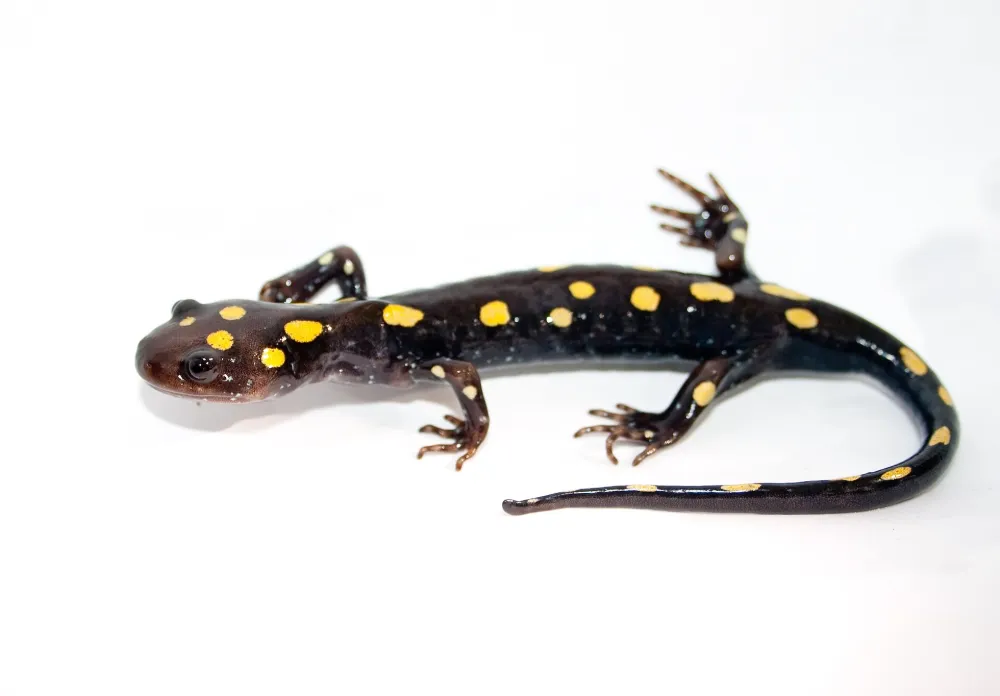
ALT: Spotted salamander showing yellow spots along a dark body.
Photo: Brian Gratwicke | Source: Wikimedia Commons | License: CC BY 2.0 | Changes: None if the original file is used unchanged.
Scientific name: Ambystoma maculatum
Habitat: Moist deciduous forests, underground retreats, leaf litter, and seasonal woodland pools during breeding.
Diet: Earthworms, insects, slugs, and other small invertebrates.
The spotted salamander is a secretive amphibian that spends much of its life hidden beneath the forest floor.
Its dark body is decorated with rows of bright yellow or orange spots.
These markings make it one of the most recognizable salamanders in eastern North America.
Despite its striking appearance, this species is rarely seen during ordinary daytime forest walks.
Spotted salamanders often remain underground or beneath protected objects where moisture levels are suitable.
One of the best-known parts of their life cycle occurs during early spring.
On rainy nights, adults may migrate toward temporary woodland pools to breed.
These pools, known as vernal pools, can provide suitable breeding habitat because many lack permanent fish populations that would otherwise eat amphibian eggs and larvae.
After breeding, adults return to terrestrial forest habitats.
Their eggs develop in water, and the larvae eventually transform into juvenile salamanders.
How to recognize it: Look for a sturdy dark salamander with conspicuous yellow or orange spots arranged along its body.
Interesting fact: A temporary pool that dries out during summer can still provide essential breeding habitat for spotted salamanders.
For more about animals using protected spaces beneath the ground, see our guide to 12 animals that live underground.
12. Eastern Red-backed Salamander
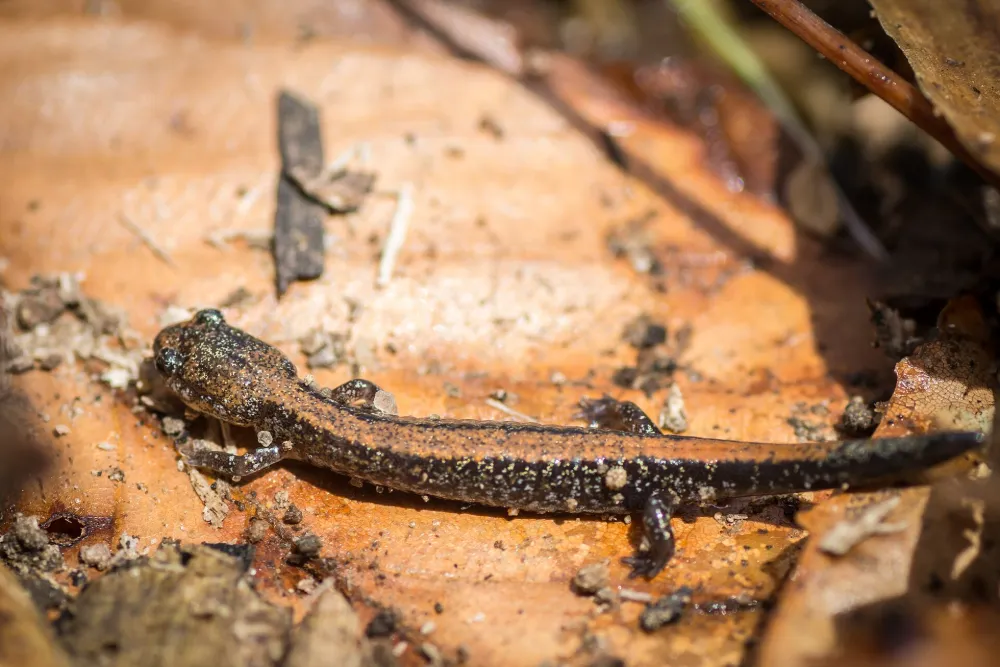
ALT: Eastern red-backed salamander found in a wooded habitat at Hueston Woods State Park, Ohio.
Photo: Andrew C | Source: Wikimedia Commons | License: CC BY 2.0 | Changes: None if the original file is used unchanged.
Scientific name: Plethodon cinereus
Habitat: Moist leaf litter, decaying logs, and forest-floor crevices in eastern North America.
Diet: Small insects, springtails, mites, and other tiny invertebrates.
The eastern red-backed salamander is a small amphibian that plays an important role in many temperate deciduous forests.
It is often hidden beneath logs, stones, and moist leaf litter.
Many individuals have a reddish or orange stripe running down the middle of the back.
However, some have a darker, unstriped appearance.
One of the most remarkable features of this species is that it has no lungs.
Instead, it obtains oxygen through its skin and the lining of its mouth.
This makes maintaining moist body surfaces essential for survival.
Unlike spotted salamanders, eastern red-backed salamanders do not require ponds for their normal reproductive cycle.
Females lay eggs in moist terrestrial locations, and the young develop directly into small salamanders without a free-swimming larval stage.
These animals consume numerous tiny invertebrates in forest soils and leaf litter.
Because they are closely associated with moist forest conditions, their abundance can be affected by changes in leaf litter, soil moisture, and ground cover.
How to recognize it: Look for a small, slender salamander with a reddish back stripe or an entirely dark body, often hidden beneath moist forest debris.
Interesting fact: Eastern red-backed salamanders are lungless amphibians that can complete their entire life cycles on land.
What Is a Temperate Deciduous Forest?
A temperate deciduous forest is a woodland ecosystem dominated by trees that shed their leaves during a particular season, usually autumn in the Northern Hemisphere.
These forests typically experience four distinct seasons.
Spring brings new leaves and flowering plants.
Summer provides warm temperatures and a dense green canopy.
Autumn is marked by changing leaf colors and falling foliage.
Winter brings colder conditions, reduced plant growth, and a more open canopy.
In eastern North America, common deciduous forest trees include:
- Oaks
- Maples
- Hickories
- American beech
- Tulip trees
- Birch
- Basswood
These trees provide food, shelter, and nesting spaces for numerous animals.
Some forests also contain evergreen trees, so not every tree in a temperate deciduous forest necessarily loses its leaves.
Where Are Temperate Deciduous Forests Found?
Temperate deciduous forests occur in several parts of the world.
Major regions include eastern North America, parts of Europe, and portions of eastern Asia.
The animal communities differ between continents.
For example, North American deciduous forests may support white-tailed deer, eastern gray squirrels, and Virginia opossums.
European deciduous forests support animals such as European badgers, roe deer, and red squirrels.
Parts of East Asia contain additional species adapted to temperate hardwood woodlands.
This article focuses on eastern North America because it contains several well-studied temperate deciduous forest ecosystems and a rich variety of recognizable wildlife.
The Four Main Layers of a Deciduous Forest
Temperate deciduous forests contain several vertical habitat layers.
Different animals use different parts of the forest.
| Forest Layer | Main Features | Example Animals |
|---|---|---|
| Canopy | Mature branches, leaves, and tree cavities | Gray Squirrel, Pileated Woodpecker |
| Understory | Smaller trees, saplings, and shrubs | Wood Thrush, Barred Owl |
| Forest Floor | Leaf litter, fallen branches, and low plants | Wild Turkey, Box Turtle, Salamanders |
| Soil and Underground | Roots, burrows, and moist soil | Eastern Chipmunk, Spotted Salamander |
These categories overlap.
Gray squirrels regularly descend to the ground.
Barred owls may nest in tree cavities but hunt across several forest layers.
Eastern chipmunks forage aboveground while depending on underground burrows.
The presence of multiple layers creates additional habitats and helps support biodiversity.
Why Is Leaf Litter Important for Forest Animals?
The layer of fallen leaves covering the ground is much more than seasonal debris.
It is an essential part of the forest ecosystem.
Leaf litter helps protect soil from rapid drying and temperature changes.
As leaves decompose, fungi, bacteria, and other organisms recycle nutrients.
Numerous tiny animals live within this material, including insects, mites, springtails, worms, and other invertebrates.
These organisms become food for larger animals.
Wood thrushes search through leaf litter for insects and other prey.
Eastern red-backed salamanders hunt tiny invertebrates in moist forest-floor habitats.
Box turtles also explore leaf litter while searching for food.
Removing extensive amounts of natural leaf litter can reduce shelter and moisture for many forest-floor species.
How Do Deciduous Forest Animals Survive Winter?
Winter presents several challenges to animals living in deciduous forests.
Food supplies change, leaves disappear from trees, and temperatures become colder.
Different species use different survival strategies.
1. Food Storage
Gray squirrels bury nuts, while eastern chipmunks store seeds in underground chambers.
Stored food becomes especially important when fresh resources are scarce.
2. Thicker Insulation
White-tailed deer develop thicker winter coats.
Many resident birds also rely on insulating feathers and behavioral strategies to reduce heat loss.
3. Reduced Activity
Eastern box turtles enter a period of winter dormancy in suitable protected locations.
Many salamanders retreat into protected soil spaces or beneath the frost line when conditions become too cold.
4. Winter Denning
Raccoons may remain inactive for extended periods during very cold weather, although they are not considered true long-term hibernators.
5. Migration
Wood thrushes migrate south from their breeding grounds and spend the nonbreeding season in warmer regions.
This allows them to use food resources that may not remain available in northern forests during winter.
6. Changing Diets
White-tailed deer rely more heavily on woody vegetation when tender leaves and other seasonal foods are less abundant.
Wild turkeys may search for acorns and other food that remains accessible.
What Do Temperate Deciduous Forest Animals Eat?
Deciduous forests support complex food webs.
Trees and other plants are primary producers.
Herbivores consume leaves, seeds, and other plant material.
Predators and omnivores feed on animals or a combination of plant and animal food.
One simplified feeding relationship is:
Oak Tree → Acorn → Eastern Chipmunk → Barred Owl
Another possible chain is:
Fallen Leaves → Decomposers and Small Invertebrates → Red-backed Salamander → Larger Predator
Real forest food webs contain many overlapping relationships.
A raccoon may eat fruit during one season and aquatic invertebrates during another.
Wood thrushes may feed heavily on insects during the breeding season but consume more fruit at other times.
Deadwood and fallen leaves also support organisms that are essential for nutrient cycling.
These connections explain why protecting a forest involves much more than protecting its largest animals.
Deciduous Forest Animals vs. Boreal Forest Animals
Temperate deciduous forests and boreal forests are both major woodland ecosystems, but their climates and vegetation differ.
| Feature | Temperate Deciduous Forest | Boreal Forest |
|---|---|---|
| Main Trees | Oak, maple, beech, hickory | Spruce, fir, pine |
| Climate | Four distinct seasons, generally milder winters | Long, cold winters and shorter growing seasons |
| Forest Floor | Often rich in leaf litter | Often includes mosses, needles, and peat |
| Example Mammals | White-tailed Deer, Gray Squirrel, Raccoon | Moose, Canada Lynx, Snowshoe Hare |
| Example Birds | Wood Thrush, Pileated Woodpecker | Spruce Grouse, Boreal Chickadee |
| Key Seasonal Feature | Leaf fall and spring regrowth | Prolonged snow cover and cold |
Both forest types can contain a mixture of broadleaf and coniferous trees.
Their boundaries can also overlap in transition zones.
Explore animals adapted to colder northern forests in our guide to 12 animals that live in boreal forests.
Eastern Gray Squirrel vs. Eastern Chipmunk
These two animals are often seen in the same forest, but they have different body shapes and habits.
| Feature | Eastern Gray Squirrel | Eastern Chipmunk |
|---|---|---|
| Size | Larger | Smaller |
| Tail | Long and very bushy | Shorter and less bushy |
| Fur Pattern | Mostly gray with a pale belly | Distinct dark and pale stripes |
| Main Activity | Climbing trees and foraging | Foraging near the ground |
| Shelter | Tree nests and cavities | Underground burrows |
| Food Storage | Buries food in scattered locations | Carries food to underground stores |
Quick identification tip: A large gray animal with a fluffy tail climbing a tree is likely a gray squirrel. A much smaller striped animal darting across the forest floor is likely an eastern chipmunk.
Spotted Salamander vs. Red-backed Salamander
Both salamanders use moist deciduous forest habitats, but their life cycles differ dramatically.
| Feature | Spotted Salamander | Eastern Red-backed Salamander |
|---|---|---|
| Body | Larger and sturdier | Smaller and slimmer |
| Markings | Bright yellow or orange spots | Often a reddish back stripe |
| Lungs | Present | Absent |
| Breeding Habitat | Usually seasonal woodland pools | Moist terrestrial locations |
| Young | Aquatic larvae | Direct-developing young |
| Typical Shelter | Underground retreats | Moist leaf litter, logs, and soil |
This comparison helps explain why both vernal pools and moist woodland floors are important for amphibian conservation.
Why Are Vernal Pools Important in Deciduous Forests?
Vernal pools are seasonal bodies of water that fill during wetter parts of the year and may dry out later.
Many occur within or near deciduous forests.
Because these pools are often temporary, they frequently lack permanent fish populations.
This can make them suitable breeding areas for amphibians whose eggs and larvae would otherwise be vulnerable to fish predation.
Spotted salamanders are a classic example.
Adults may spend much of the year hidden in the surrounding forest but travel to temporary pools during breeding season.
After eggs are laid, the larvae develop in water.
The surrounding forest remains essential because adults and juveniles need suitable terrestrial habitats.
Protecting only the water-filled depression may therefore be insufficient if surrounding woodland habitat is lost.
For a broader look at aquatic and semi-aquatic wildlife, explore 10 animals that live in freshwater ponds.
How to Identify Animals in a Deciduous Forest
You do not always need a close-up view to identify forest wildlife.
Appearance, sounds, feeding evidence, and behavior can provide valuable clues.
| What You Notice | Possible Animal |
|---|---|
| Brown deer raising a bright white tail | White-tailed Deer |
| Gray animal with a large bushy tail | Eastern Gray Squirrel |
| Small striped rodent near fallen logs | Eastern Chipmunk |
| Mammal with a dark face mask and ringed tail | Raccoon |
| Gray mammal with a pointed pale face and hairless tail | Virginia Opossum |
| Brown songbird with dark spots on a white breast | Wood Thrush |
| Large black woodpecker with a bright red crest | Pileated Woodpecker |
| Large owl with dark eyes and no ear tufts | Barred Owl |
| Large ground bird with a bare head | Wild Turkey |
| Land turtle with a high domed shell | Eastern Box Turtle |
| Dark salamander with rows of yellow spots | Spotted Salamander |
| Small salamander with a reddish back stripe | Eastern Red-backed Salamander |
These clues are not always sufficient for a definite identification.
Regional species, lighting, season, age, and individual variation should also be considered.
Why Are Temperate Deciduous Forests Important?
Temperate deciduous forests provide essential habitat for numerous animal species.
Food and Shelter
Hardwood trees produce leaves, seeds, nuts, and fruits.
Tree cavities, fallen logs, roots, and shrubs provide shelter for many animals.
Breeding Habitats
Forests support cavity-nesting birds, ground-nesting birds, amphibians, mammals, and numerous invertebrates.
Nutrient Recycling
Fungi, bacteria, invertebrates, and other decomposers break down fallen organic matter and return nutrients to the soil.
Wildlife Movement
Connected forest habitats allow animals to move between feeding, breeding, and seasonal areas.
Water and Soil Protection
Forest vegetation and soil influence runoff, moisture retention, erosion, and local water conditions.
These functions support wildlife both inside and beyond the forest.
What Threatens Deciduous Forest Animals?
Although many eastern North American forests have recovered from historical clearing, they still face serious pressures.
Habitat fragmentation: Roads, buildings, and agriculture can divide large forests into smaller patches.
Invasive species: Non-native plants, insects, and pathogens can change forest communities.
Excessive browsing: High deer densities can reduce the regeneration of certain trees and understory plants.
Loss of mature trees: Removing large trees and deadwood can reduce shelter and nesting opportunities for cavity-dependent wildlife.
Changes in climate: Temperature and precipitation changes can affect seasonal timing, forest composition, and animal habitats.
Loss of wetlands and vernal pools: Amphibians may lose essential breeding sites when woodland water habitats are filled or drained.
Conservation depends on maintaining healthy forests, protecting habitat connections, and preserving different forest structures and age classes.
How to Observe Forest Wildlife Responsibly
Temperate deciduous forests are excellent places for wildlife observation.
However, many animals are sensitive to disturbance.
Follow these guidelines:
- Walk quietly and stay on established trails. This reduces disturbance and protects delicate plants.
- Use binoculars or a zoom lens. Observe animals without approaching nests or dens.
- Do not feed wildlife. Human food can change behavior and create health risks.
- Leave fallen logs and leaf litter in place. They provide important habitat for small animals.
- Avoid handling salamanders. Their skin is delicate and sensitive to drying and contamination.
- Do not collect box turtles or other wild animals. Removing them can harm local populations.
- Keep pets under control. Unrestrained pets may disturb wildlife.
- Observe seasonal changes. Spring and autumn can reveal different animal behaviors.
If you find a salamander beneath a log or stone, avoid disturbing it and leave its shelter intact.
Frequently Asked Questions
What animals live in temperate deciduous forests?
Temperate deciduous forests support deer, squirrels, chipmunks, raccoons, opossums, woodpeckers, owls, wild turkeys, box turtles, salamanders, and many other animals.
The species differ between geographical regions.
What are the most common deciduous forest animals?
Common animals in many eastern North American deciduous forests include white-tailed deer, eastern gray squirrels, eastern chipmunks, and various woodland birds.
Local abundance varies according to habitat conditions.
What mammals live in deciduous forests?
Mammals include white-tailed deer, gray squirrels, chipmunks, raccoons, Virginia opossums, foxes, black bears, bats, and numerous small rodents.
What birds live in deciduous forests?
Wood thrushes, pileated woodpeckers, barred owls, wild turkeys, and many other birds inhabit deciduous woodland environments.
Some remain throughout winter, while others migrate.
What reptiles live in temperate deciduous forests?
Eastern box turtles and several snake species use deciduous forests and nearby habitats.
Their occurrence depends on local climate and geography.
What amphibians live on the forest floor?
Spotted salamanders, eastern red-backed salamanders, and other woodland amphibians use moist forest habitats.
Some breed in temporary pools, while others reproduce entirely on land.
How do deciduous forest animals survive winter?
Different animals store food, develop thicker insulation, reduce activity, enter dormancy, change diets, or migrate.
There is no single winter survival strategy shared by every species.
Do all animals in deciduous forests hibernate?
No. Gray squirrels, deer, many birds, and several other animals remain active during winter.
Some reptiles and amphibians enter seasonal dormancy, while certain mammals use torpor or winter denning.
What animals live in trees in deciduous forests?
Eastern gray squirrels, pileated woodpeckers, barred owls, and numerous other birds and mammals use trees for shelter, feeding, or reproduction.
Why are fallen leaves important to forest animals?
Leaf litter helps retain moisture, protects soil, supports decomposers, and creates habitat for small invertebrates.
These organisms become food for birds, salamanders, and other animals.
What animals live in the deciduous forest floor?
Chipmunks, wild turkeys, box turtles, salamanders, insects, earthworms, and many other organisms use the forest floor.
Some animals spend much of their time hidden beneath leaves, logs, or soil.
Are temperate deciduous forests found only in North America?
No. They also occur in parts of Europe and Asia, as well as other suitable temperate regions.
The animal species differ between continents.
Final Thoughts
Temperate deciduous forests are dynamic ecosystems that change dramatically throughout the year.
In spring, migratory birds return and salamanders move toward woodland breeding pools.
During summer, the forest canopy provides shade and shelter for countless organisms.
Autumn brings acorns, falling leaves, and intense food-gathering activity.
Winter reveals a quieter but still active landscape where animals use stored food, protected shelters, and specialized survival strategies.
From white-tailed deer and gray squirrels to tiny lungless salamanders, each species plays a role in these complex woodland communities.
The next time you explore a deciduous forest, look beyond the tall trees.
Some of its most fascinating inhabitants may be hidden among the leaves, fallen branches, and damp soil beneath your feet.
Related Articles
- 12 Animals That Live in Boreal Forests (With Pictures)
- 10 Animals That Live in the Rocky Mountains (With Pictures)
- 12 Animals That Live Underground (With Pictures)
- Animals That Build Their Own Homes
- Animals That Store Food for Winter
- 10 Birds With Red Heads in North America
- 10 Animals That Live in Freshwater Ponds
References and Further Reading
- National Park Service – Eastern Deciduous Forest
- NatureWorks – Temperate Deciduous Forests
- Penn State Extension – Forest Stewardship: Wildlife
- Penn State Extension – From the Woods: Amphibians
- Penn State Extension – Pennsylvania Wetlands: Vernal Pools
- Cornell Lab of Ornithology – Wood Thrush
- Cornell Lab of Ornithology – Pileated Woodpecker
- Cornell Lab of Ornithology – Barred Owl
- Cornell Lab of Ornithology – Wild Turkey