Imagine swimming beneath a forest of enormous golden-brown kelp. Sunlight filters through long underwater blades, schools of fish move between the swaying stems, and sea urchins crawl across the rocky seafloor.
This is a kelp forest, one of the most fascinating ecosystems in the ocean.
Sea otters, purple sea urchins, kelp crabs, garibaldi fish, rockfish, and giant Pacific octopuses are among the many animals found in kelp forests.
Some graze directly on kelp, while others hunt animals that live among its fronds. Many depend on the forest for shelter, feeding opportunities, or nursery habitat.
Here are 10 remarkable kelp forest animals found along the Pacific coast of North America, including their diets, identification features, adaptations, and ecological roles.
10 Kelp Forest Animals: Quick Comparison
| Animal | Scientific Name | Main Habitat | Main Food |
|---|---|---|---|
| Sea Otter | Enhydra lutris | Kelp canopy and coastal waters | Urchins, crabs, mollusks |
| Purple Sea Urchin | Strongylocentrotus purpuratus | Rocky seafloor | Kelp and other algae |
| Northern Kelp Crab | Pugettia producta | Kelp blades and rocky habitats | Kelp and other seaweeds |
| Garibaldi | Hypsypops rubicundus | Southern California rocky reefs and kelp forests | Small invertebrates |
| Kelp Bass | Paralabrax clathratus | Rocky reefs and kelp forests | Fish and crustaceans |
| Giant Kelpfish | Heterostichus rostratus | Kelp and other seaweed beds | Small crustaceans and fish |
| California Sheephead | Semicossyphus pulcher | Kelp forests and rocky reefs | Urchins, crabs, mollusks |
| Giant Pacific Octopus | Enteroctopus dofleini | Rocky dens and coastal kelp habitats | Crabs, clams, fish |
| Sunflower Sea Star | Pycnopodia helianthoides | Rocky coastal seafloor and kelp habitats | Urchins and other invertebrates |
| Black Rockfish | Sebastes melanops | Coastal reefs and kelp forests | Fish and crustaceans |
Important: These animals do not all occur together in every kelp forest. Species distributions vary with latitude, water temperature, habitat structure, and local ocean conditions.
1. Sea Otter

ALT: California sea otter resting among floating kelp near Morro Bay.
Photo: Michael L. Baird (mikebaird) | Source: Wikimedia Commons | License: CC BY 2.0 | Changes: None if original used.
Scientific name: Enhydra lutris
Habitat: Coastal waters, kelp forests, and other suitable nearshore marine environments of the North Pacific.
Diet: Sea urchins, crabs, clams, mussels, and other marine invertebrates.
The sea otter is one of the most important mammals associated with kelp forest ecosystems.
Unlike seals and sea lions, sea otters spend much of their time floating on their backs at the ocean’s surface.
Their exceptionally dense fur helps keep them warm in cold water. Unlike many other marine mammals, sea otters do not rely on a thick layer of blubber for insulation.
Sea otters frequently dive to the seafloor to search for food.
They use their sensitive paws and whiskers to locate prey such as sea urchins, crabs, and shellfish.
Some sea otters also use rocks as tools to help open hard-shelled prey.
Their relationship with kelp forests is particularly important.
In some coastal ecosystems, sea otters help control sea urchin populations through predation.
When urchins are less abundant or behave differently because of predators, kelp forests may experience reduced grazing pressure.
Sea otters also use floating kelp as a resting area. They sometimes wrap themselves in kelp blades to reduce drifting while sleeping.
How to recognize it: Look for a marine mammal with dense brown fur, a broad whiskered face, small ears, and a habit of floating on its back.
Interesting fact: Sea otters are often considered keystone predators because their feeding activity can strongly influence kelp forest communities.
2. Purple Sea Urchin
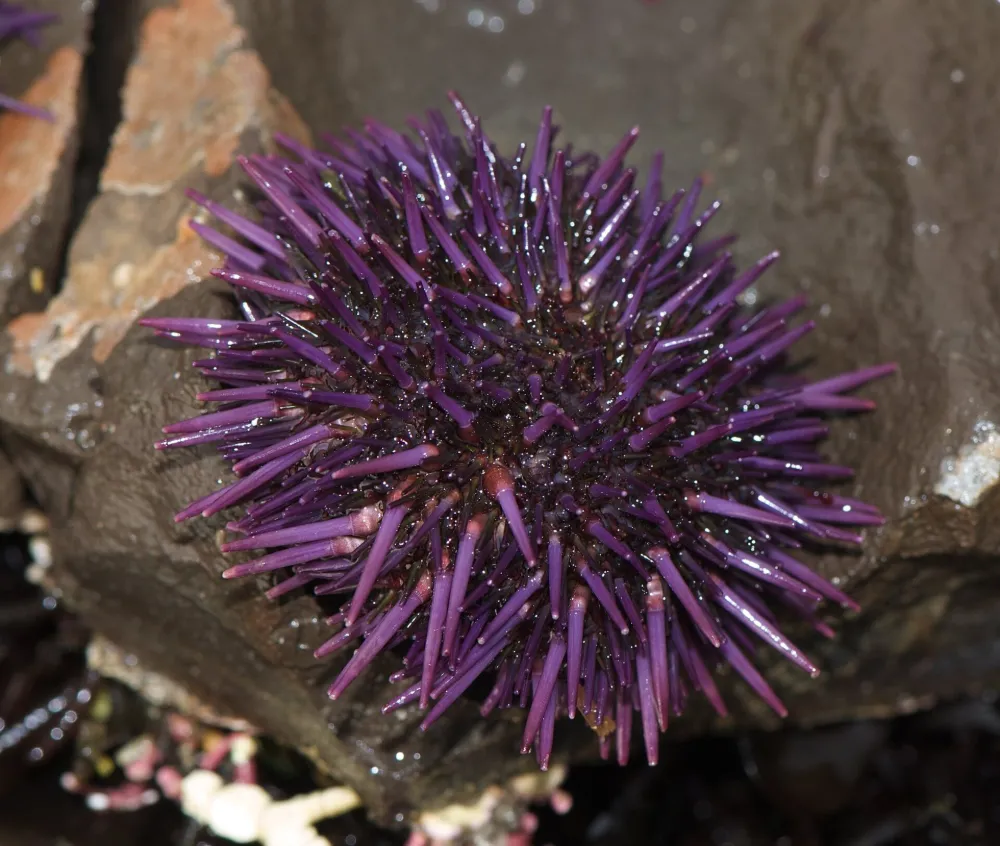
ALT: Purple sea urchin showing its dense purple spines and small tube feet.
Photo: Jerry Kirkhart | Source: Wikimedia Commons | License: CC BY 2.0 | Changes: None if original used.
Scientific name: Strongylocentrotus purpuratus
Habitat: Rocky tide pools, coastal reefs, and kelp forest seafloors.
Diet: Kelp and other marine algae.
Purple sea urchins are small, round marine animals covered with sharp purple spines.
They belong to the echinoderms, the same broader animal group as sea stars and sea cucumbers.
Although they appear simple, sea urchins possess a complex body structure.
Their spines provide protection, while small tube feet help them move and attach to surfaces.
On the underside of the body is a specialized feeding structure commonly called Aristotle’s lantern.
This structure contains teeth used to scrape and process algae.
Purple sea urchins frequently feed on detached pieces of kelp and other seaweeds.
However, when food is scarce or grazing pressure increases, they may feed on living kelp plants.
Large aggregations of urchins can remove extensive areas of kelp vegetation.
When kelp disappears and the rocky bottom becomes dominated by sea urchins, the habitat may be described as an urchin barren.
These changes can reduce the amount of shelter available to fish and other animals.
How to recognize it: Look for a small, rounded marine animal covered in numerous sharp purple spines.
Interesting fact: Purple sea urchins can influence the survival of an entire kelp forest when their grazing becomes intense.
To learn more about their coastal habitat, explore our guide to 12 animals that live in the intertidal zone.
3. Northern Kelp Crab

ALT: Northern kelp crab photographed in Ganges Harbour, British Columbia.
Photo: D. Gordon E. Robertson | Source: Wikimedia Commons | License: CC BY-SA 3.0 | Changes: None if original used.
Scientific name: Pugettia producta
Habitat: Kelp beds, rocky coastal habitats, and other areas containing abundant seaweed.
Diet: Kelp and other marine algae, occasionally supplemented by animal material.
The Northern Kelp Crab is a specialized crustacean frequently associated with large seaweeds along the Pacific coast.
Its body is often described as shield-shaped or triangular.
Relatively long walking legs allow it to climb through kelp and other marine vegetation.
Its brown, reddish, or greenish coloration helps it blend into the surrounding seaweed.
Unlike actively swimming crabs, kelp crabs spend considerable time crawling among plants and rocky surfaces.
They use their claws to handle food and interact with their surroundings.
Kelp crabs are primarily grazers, consuming different types of seaweed.
Their feeding activity connects kelp and other algae with the broader coastal food web.
They may also become prey for larger fish and other predators.
How to recognize it: Look for a crab with a pointed, shield-like body and long legs, often resting among kelp fronds.
Interesting fact: Kelp crabs can be difficult to notice because their shape and coloration blend into the underwater vegetation.
4. Garibaldi
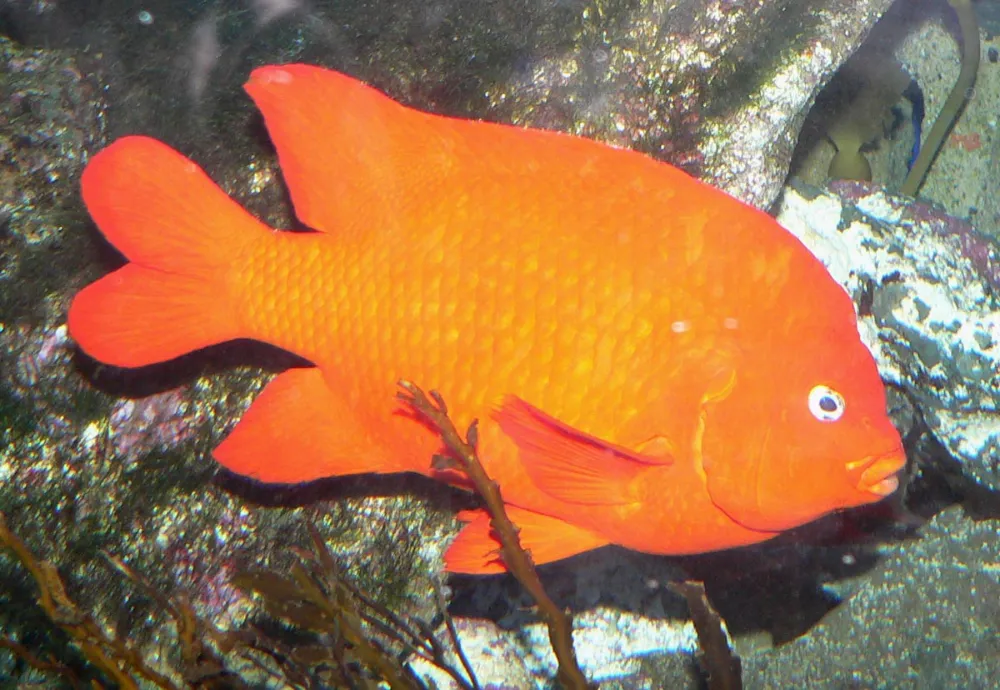
ALT: Adult Garibaldi fish with brilliant orange coloration photographed at Birch Aquarium.
Photo: Stan Shebs | Source: Wikimedia Commons | License: CC BY-SA 3.0 | Changes: None if original used. Photograph taken at Birch Aquarium, San Diego.
Scientific name: Hypsypops rubicundus
Habitat: Rocky reefs and kelp forests in southern California and nearby regions of the northeastern Pacific.
Diet: Small crustaceans, worms, and other marine invertebrates.
The Garibaldi is one of the most colorful fish found in California’s coastal waters.
Adult fish are an unmistakable bright orange.
This vivid coloration makes them especially noticeable against dark underwater rocks and greenish-brown kelp.
Garibaldi belong to the damselfish family.
They are strongly associated with rocky reefs and may occupy territories within or near kelp forests.
Adult males establish and defend nesting areas on rocky surfaces.
They prepare suitable sites containing algae, where females can deposit eggs.
After spawning, males guard the eggs until they hatch.
This territorial behavior can be especially noticeable during the breeding season.
Young Garibaldi look quite different from adults.
Juveniles typically have orange bodies decorated with striking blue markings.
As the fish mature, the blue markings gradually disappear.
How to recognize it: Look for a deep-bodied, bright orange fish with a rounded profile.
Interesting fact: The Garibaldi is California’s official state marine fish.
5. Kelp Bass

ALT: Kelp bass showing its mottled brown body and spiny dorsal fin.
Photo: Brian Gratwicke | Source: Wikimedia Commons | License: CC BY 2.0 | Changes: None if original used. Photograph taken in California.
Scientific name: Paralabrax clathratus
Habitat: Kelp forests, rocky reefs, and nearby coastal waters, particularly in southern California and Baja California.
Diet: Small fish, crabs, shrimp, and other marine animals.
Kelp bass are predatory fish commonly associated with rocky reefs and kelp-covered habitats.
They have relatively large mouths, spiny dorsal fins, and mottled brown or olive-colored bodies.
Their coloration helps them remain inconspicuous among rocks, shadows, and marine vegetation.
Kelp forests provide useful hunting and sheltering habitats for these fish.
Juveniles may use structured underwater vegetation and rocky areas to avoid larger predators.
Adults often hunt smaller fish and crustaceans.
Despite their name, kelp bass do not depend exclusively on kelp forests.
They also inhabit suitable rocky reef environments without dense kelp vegetation.
This distinction is important because a species can benefit from kelp forest habitats without being restricted to them.
How to recognize it: Look for a medium-sized predatory fish with a relatively large mouth, mottled body, and prominent spiny dorsal fin.
Interesting fact: Kelp bass are also commonly called calico bass because of their patchy coloration.
6. Giant Kelpfish

ALT: Giant kelpfish showing its elongated, leaf-like body and mottled coloration.
Photo: Kjaergaard (Magnus Kjaergaard) | Source: Wikimedia Commons | License: CC BY-SA 3.0 | Changes: None if original used.
Scientific name: Heterostichus rostratus
Habitat: Giant kelp forests and other seaweed-rich coastal habitats.
Diet: Small crustaceans, fish, and other marine invertebrates.
The giant kelpfish is an excellent example of an animal adapted to blending into underwater vegetation.
Its long, narrow body resembles a piece of drifting seaweed.
Unlike many fish with deep, rounded bodies, giant kelpfish have an elongated shape that allows them to hide among kelp blades and other marine plants.
Their coloration can vary considerably.
Some individuals appear brown, greenish, reddish, or patterned with lighter markings.
This variation helps them blend into different seaweed habitats.
Giant kelpfish often remain near vegetation, where they search for small prey.
Their camouflage provides protection from predators while also helping them approach smaller animals.
Although the name suggests a very large fish, giant kelpfish are not giants compared with many other marine species.
Their unusual body shape is more distinctive than their size.
How to recognize it: Look for an elongated fish with a pointed snout, narrow body, and seaweed-like coloration.
Interesting fact: Giant kelpfish demonstrate how body shape and color can work together to create effective underwater camouflage.
Learn more about these remarkable strategies in our guide to animals that change color.
7. California Sheephead

ALT: California sheephead fish photographed in coastal waters of southern California.
Photo: Donald Davesne | Source: Wikimedia Commons | License: CC BY 4.0 | Changes: None if original used.
Scientific name: Semicossyphus pulcher
Habitat: Rocky reefs and kelp forests in southern California and Baja California.
Diet: Sea urchins, crabs, mollusks, and other hard-shelled invertebrates.
The California sheephead is a remarkable fish belonging to the wrasse family.
It is especially known for its powerful jaws and ability to feed on hard-shelled prey.
Sheephead can crush sea urchins, mollusks, and crustaceans using specialized teeth and strong jaw structures.
This feeding behavior makes them important predators in rocky reef and kelp forest ecosystems.
California sheephead also undergo major changes in appearance as they grow.
Juveniles are generally reddish or pinkish.
Adult females are usually pinkish or reddish-orange.
Large adult males develop a distinctive combination of a black head and tail with a reddish or pink middle section.
The species is also known for sequential hermaphroditism.
Individuals generally begin life as females, and some later change sex to become males.
The timing and occurrence of this transition depend on social and biological conditions.
How to recognize it: Large adult males have black heads and tails, a reddish middle body, thick lips, and prominent teeth.
Interesting fact: California sheephead can help control populations of hard-shelled invertebrates, including sea urchins.
8. Giant Pacific Octopus

ALT: Giant Pacific octopus with large arms and visible suckers.
Photo: Cliff | Source: Wikimedia Commons | License: CC BY 2.0 | Changes: None if original used.
Scientific name: Enteroctopus dofleini
Habitat: Rocky coastal habitats, underwater crevices, and suitable areas around kelp forests in the North Pacific.
Diet: Crabs, clams, shrimp, fish, and other marine animals.
The giant Pacific octopus is one of the largest octopus species in the world.
It inhabits rocky marine environments where crevices and other structures provide hiding places.
Kelp forests can offer suitable hunting grounds because they support numerous fish, crabs, and other prey animals.
Giant Pacific octopuses have eight muscular arms lined with suckers.
These suckers help them explore surfaces, grasp prey, and move through complex underwater environments.
Their flexible bodies allow them to squeeze into surprisingly narrow spaces.
They also possess sophisticated camouflage abilities.
Specialized pigment cells allow an octopus to change its appearance rapidly.
It can adjust its color and skin texture to blend into rocks, algae, and other surrounding objects.
When threatened, an octopus may release a cloud of ink to help distract predators.
Giant Pacific octopuses are intelligent predators that can manipulate objects and investigate their environment.
How to recognize it: Look for a large, soft-bodied marine animal with eight arms, rows of suckers, and variable reddish-brown coloration.
Interesting fact: Unlike many animals that rely on hard shells or armor, octopuses depend heavily on camouflage, flexibility, and behavioral defenses.
9. Sunflower Sea Star
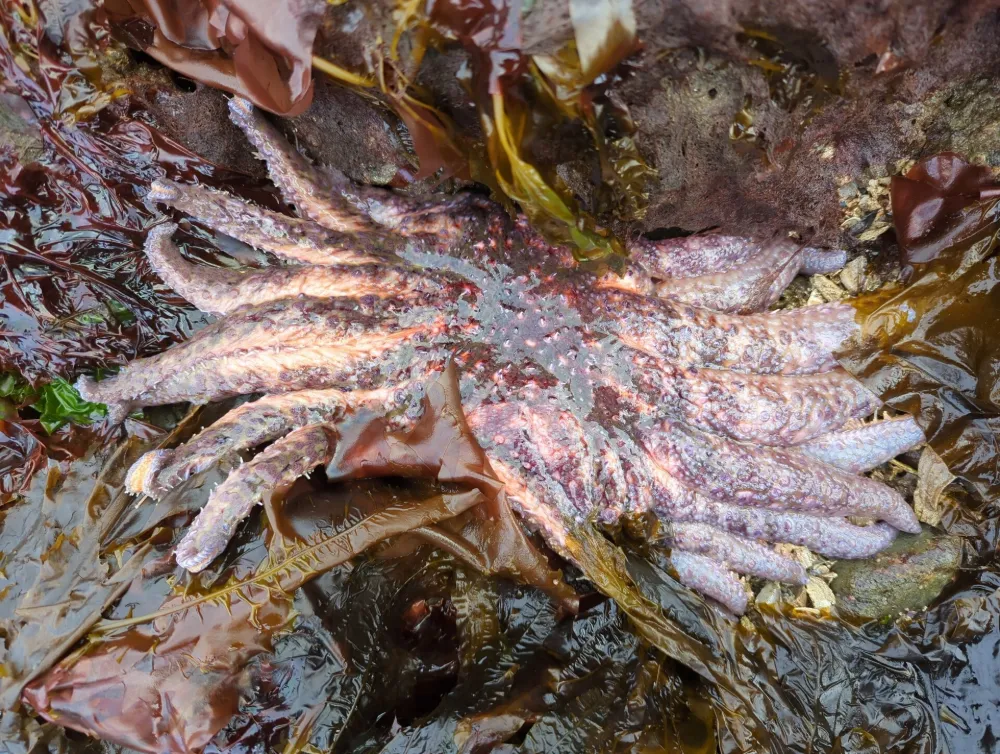
ALT: Sunflower sea star photographed in Alaska with numerous radiating arms.
Photo: Matt Muir | Source: Wikimedia Commons | License: CC BY 4.0 | Changes: None if original used.
Scientific name: Pycnopodia helianthoides
Habitat: Rocky coastal seafloors, kelp forest habitats, and other nearshore marine environments of the northeastern Pacific.
Diet: Sea urchins, mollusks, and other marine invertebrates.
The sunflower sea star is one of the most extraordinary sea stars found in Pacific coastal ecosystems.
Unlike the familiar five-armed sea star, adult sunflower sea stars may have more than 20 arms.
Their bodies can become exceptionally large, and numerous tube feet help them move across the seafloor.
Sunflower sea stars are active predators.
They can hunt sea urchins and other marine invertebrates, making them important members of kelp forest food webs.
By feeding on sea urchins, they may help reduce grazing pressure on kelp in suitable ecosystems.
Unfortunately, sunflower sea stars have experienced severe population declines across much of their historical range.
Sea star wasting disease has been a major factor associated with these losses.
Researchers and conservation organizations continue working to understand the species’ recovery potential and restore populations.
How to recognize it: Look for a large sea star with many arms extending around a broad central body.
Interesting fact: Sunflower sea stars can play a major role in kelp forest ecosystems because they are powerful predators of sea urchins.
10. Black Rockfish
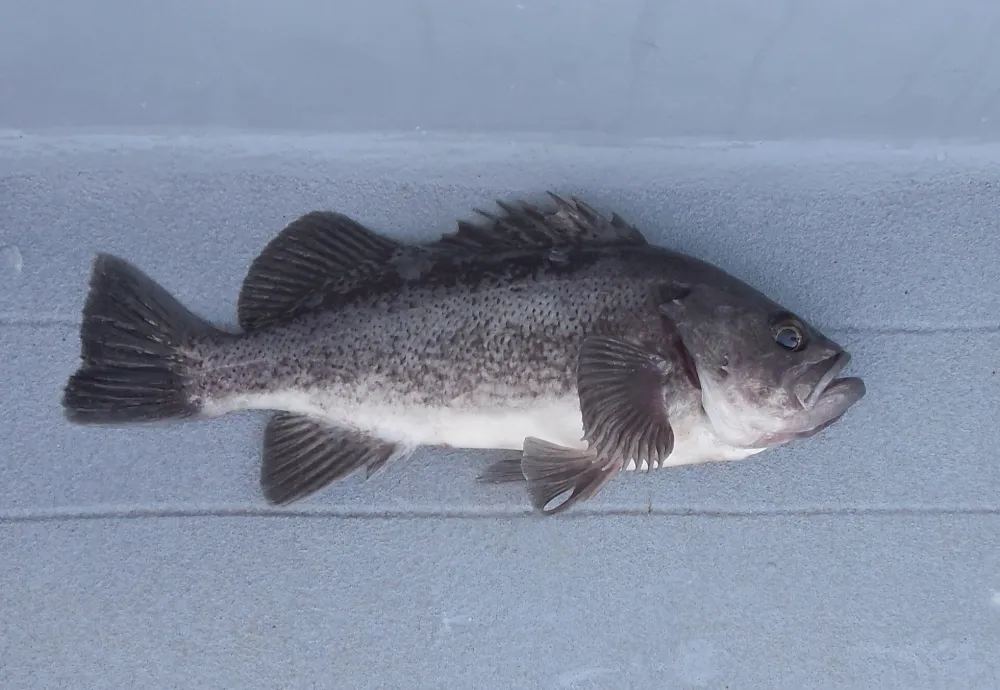
ALT: Black rockfish photographed off the Pacific coast of Washington State.
Photo: 66dodge | Source: Wikimedia Commons | License: CC BY 4.0 | Changes: None if original used.
Scientific name: Sebastes melanops
Habitat: Rocky reefs, kelp forests, and coastal waters of the northeastern Pacific.
Diet: Small fish, crustaceans, and other marine animals.
Black rockfish are among the many rockfish species associated with kelp forest ecosystems.
They have relatively deep bodies, spiny dorsal fins, and dark gray or blackish coloration.
Some individuals have lighter mottling along their sides.
Black rockfish often occur around rocky reefs and kelp-covered habitats that provide shelter and feeding opportunities.
Younger fish may use kelp vegetation and other complex coastal habitats as protective nursery areas.
Adults may form groups above reefs or around underwater structures.
These fish are predators that consume smaller fish and crustaceans.
Rockfish are also known for their relatively slow growth and, in some species, long lifespans.
Unlike many fish that release eggs into water, female rockfish give birth to live larvae after internal fertilization and development.
This reproductive strategy is an important feature of the rockfish group.
How to recognize it: Look for a robust fish with a dark body, spiny dorsal fin, and relatively large mouth.
Interesting fact: Kelp forests can provide nursery and feeding habitats for several different rockfish species.
What Is a Kelp Forest?
A kelp forest is an underwater ecosystem formed by dense growths of large brown algae called kelp.
Although kelp resembles an underwater plant, it belongs to the algae rather than the true plants.
Some kelp species, including giant kelp, can grow into extremely long underwater structures.
These algae use sunlight for photosynthesis and obtain nutrients directly from seawater.
Kelp forests usually develop along cool, nutrient-rich coastlines with suitable rocky surfaces.
Their enormous underwater structures provide habitats for numerous fish, mammals, and invertebrates.
Kelp forests can be compared with terrestrial forests because they create multiple habitat layers.
However, the organisms forming these underwater forests differ fundamentally from land trees.
Where Are Kelp Forests Found?
Kelp forests occur along many temperate coastlines around the world.
In North America, major kelp forest regions include:
- California
- Oregon
- Washington
- British Columbia
- Alaska
- Parts of Baja California, Mexico
The animals found in these regions vary considerably.
Garibaldi and California sheephead are especially associated with warmer southern portions of the northeastern Pacific.
Giant Pacific octopuses, rockfish, and kelp crabs occur across broader or different parts of the coast.
Sea otter populations are not continuous along the entire coastline.
Local water temperature, ocean currents, rocky habitats, and ecological conditions influence where kelp forests develop and which species inhabit them.
The Three Main Layers of a Kelp Forest
Like a forest on land, a kelp forest has a complex three-dimensional structure.
| Kelp Forest Layer | Main Characteristics | Example Animals |
|---|---|---|
| Surface Canopy | Floating kelp fronds near the ocean surface | Sea Otters |
| Midwater Forest | Long kelp stems and blades | Garibaldi, Kelp Bass, Giant Kelpfish, Rockfish |
| Seafloor and Holdfasts | Rocks, kelp attachment structures, and crevices | Purple Sea Urchins, Kelp Crabs, Octopuses, Sunflower Sea Stars |
These layers are not isolated.
Fish move between vegetation and rocky habitats.
Sea otters dive from the surface toward the seafloor to hunt.
Sea urchins may feed on detached kelp or living underwater vegetation.
The structure of the forest creates many opportunities for feeding, shelter, and reproduction.
Why Are Sea Otters Important to Kelp Forests?
Sea otters are a famous example of a keystone predator.
A keystone species can have an ecological influence that is disproportionately large compared with its abundance.
In some coastal systems, sea otters help maintain kelp forests by consuming sea urchins.
The relationship can be summarized as:
More Sea Otter Predation → Reduced Urchin Grazing Pressure → Greater Potential for Kelp Growth
However, the strength of this relationship varies with local conditions.
Not every kelp forest has sea otters, and healthy kelp ecosystems can also depend on other predators, temperature, nutrients, and environmental factors.
California sheephead and sunflower sea stars are additional examples of predators that can consume sea urchins.
The sea otter relationship demonstrates how a predator can indirectly influence the abundance of underwater vegetation.
What Are Urchin Barrens?
An urchin barren is a rocky marine habitat where dense sea urchin populations and heavy grazing have reduced much of the surrounding kelp vegetation.
Under suitable conditions, purple sea urchins and other species graze on kelp.
However, when grazing becomes excessive, living kelp may disappear from large areas.
The result can be a landscape dominated by bare rock, crustose algae, and numerous urchins.
This transformation changes the habitat available to fish and other marine organisms.
A kelp forest provides extensive vertical structures and hiding places.
An urchin barren generally contains far less of this complex vegetation.
Urchin barrens can be difficult to reverse because surviving urchins may continue grazing on newly growing kelp.
Restoration efforts sometimes involve reducing grazing pressure and improving conditions for kelp recovery.
What Do Kelp Forest Animals Eat?
Kelp forest food webs include primary producers, grazers, filter feeders, predators, and decomposers.
Kelp and other algae form an important part of the food web by producing organic matter through photosynthesis.
Some animals eat algae directly.
Others consume the smaller organisms living among kelp structures.
A simplified feeding relationship is:
Kelp → Purple Sea Urchin → Sea Otter
Another possible chain is:
Kelp and Other Algae → Sea Urchin → California Sheephead
Kelp forest habitats also contain food webs based on plankton.
Phytoplankton → Small Crustaceans → Small Fish → Kelp Bass
Real food webs are more complex because most animals have several food sources.
Sea otters consume more than sea urchins.
Kelp bass eat different prey according to size and availability.
Octopuses hunt a variety of crustaceans, mollusks, and fish.
Dead and detached kelp also supplies organic material to organisms living beyond the forest itself.
How Do Kelp Forest Animals Adapt to Their Habitat?
Animals living in kelp forests have developed different strategies for using the underwater environment.
Camouflage
Giant kelpfish can resemble long pieces of seaweed.
Kelp crabs have colors and body shapes that help them blend into vegetation.
Giant Pacific octopuses can rapidly change color and skin texture.
Strong Attachment
Sea urchins use tube feet and spines to move across rocky surfaces.
Other kelp forest organisms attach to rocks or underwater structures to resist currents and waves.
Specialized Feeding
Sea otters use sensitive paws to locate shellfish and other prey.
California sheephead have strong jaws adapted to crushing hard-shelled animals.
Kelp bass use their large mouths to capture fish and crustaceans.
Defensive Structures
Sea urchins rely partly on sharp spines.
Some animals hide in crevices, while others depend on camouflage or fast escape responses.
Flexible Body Shapes
Giant Pacific octopuses have soft bodies that can enter narrow spaces.
Giant kelpfish have elongated, leaf-like bodies that help conceal them among seaweeds.
Kelp Forest Animals vs. Tide Pool Animals
Kelp forests and tide pools are both coastal marine habitats, but they differ in depth, environmental conditions, and structure.
| Feature | Kelp Forest | Rocky Tide Pool |
|---|---|---|
| Typical Location | Mostly submerged coastal waters | Rocky intertidal shore |
| Main Habitat Structure | Large kelp and rocky reefs | Rock depressions containing seawater |
| Water Exposure | Usually remains underwater | Surrounding shore exposed during low tide |
| Example Animals | Sea Otter, Kelp Bass, Giant Kelpfish | Limpets, Barnacles, Shore Crabs |
| Main Challenges | Currents, grazing, water temperature | Tidal exposure, drying, temperature changes |
The habitats can overlap near rocky shorelines.
Some sea urchins, crabs, sea stars, and marine snails occur in both environments.
However, animals living in tide pools must often tolerate more extreme changes in water level and exposure to air.
Explore more examples in our guide to 12 animals that live in the intertidal zone.
Why Are Kelp Forests Important?
Kelp forests provide several important ecological benefits.
Shelter for Marine Animals
Long kelp blades and rocky habitats create hiding places for fish, crustaceans, and other marine animals.
Nursery Habitats
Young fish and invertebrates may use kelp forests as relatively sheltered areas during early life stages.
Food Production
Kelp produces organic material through photosynthesis.
This material supports marine food webs both within the forest and in nearby habitats.
Biodiversity
Kelp forests can support diverse communities of fish, marine mammals, mollusks, crustaceans, and echinoderms.
Coastal Ecosystem Connections
Detached kelp may drift or sink into other coastal habitats, providing food and organic material beyond the original forest.
These relationships make kelp forests important components of temperate coastal ecosystems.
What Threatens Kelp Forest Animals?
Kelp forests face several environmental pressures.
Marine heatwaves: Unusually warm water can reduce kelp growth or survival, especially when nutrients become less available.
Excessive sea urchin grazing: Large urchin populations can remove kelp vegetation and contribute to barren habitats.
Changes in predator populations: Losses of important predators can alter food-web relationships.
Pollution: Contaminants and changes in water quality may affect marine organisms.
Habitat disturbance: Coastal activities and certain fishing practices may damage sensitive underwater habitats.
Diseases: Sea star wasting disease has caused severe declines in some sea star populations, including sunflower sea stars.
Conservation and restoration efforts may include protecting important predators, monitoring kelp cover, reducing harmful disturbances, and supporting habitat recovery.
How to Identify Common Kelp Forest Animals
When looking at underwater photographs or observing a kelp forest, physical characteristics can help narrow down the species.
| What You See | Possible Animal |
|---|---|
| Brown mammal floating on its back among kelp | Sea Otter |
| Round purple animal covered in spines | Purple Sea Urchin |
| Long-legged crab climbing seaweed | Northern Kelp Crab |
| Bright orange fish near a rocky reef | Garibaldi |
| Mottled brown predatory fish with a large mouth | Kelp Bass |
| Long, narrow fish resembling seaweed | Giant Kelpfish |
| Fish with black head and tail and reddish middle body | Adult Male California Sheephead |
| Large soft-bodied animal with eight arms | Giant Pacific Octopus |
| Large sea star with numerous arms | Sunflower Sea Star |
| Dark, robust fish with a spiny dorsal fin | Black Rockfish |
These clues are useful starting points rather than definitive identification rules.
Several species can look similar, especially in poor underwater lighting.
Geographical location, body size, markings, and behavior should also be considered.
How to Explore Kelp Forests Responsibly
Kelp forests can be observed while snorkeling, scuba diving, kayaking, or visiting coastal aquariums.
However, they are dynamic marine environments.
Follow these basic precautions:
- Check local ocean conditions. Currents, waves, visibility, and water temperature can change quickly.
- Avoid entering dense kelp without appropriate training. Underwater vegetation can create entanglement hazards.
- Observe marine mammals from a distance. Never approach, touch, chase, or feed sea otters.
- Do not remove animals from the habitat. Sea stars, urchins, crabs, and other organisms should generally be observed in place.
- Avoid damaging kelp holdfasts. These structures anchor kelp to rocky surfaces.
- Follow marine protected area rules. Collection and other activities may be restricted.
- Use responsible diving practices. Avoid touching fragile underwater organisms or disturbing the seafloor.
For readers who cannot visit a kelp forest, the Monterey Bay Aquarium’s online Kelp Forest Cam offers an excellent opportunity to observe the underwater environment.
Frequently Asked Questions
What animals live in kelp forests?
Animals found in kelp forests include sea otters, sea urchins, kelp crabs, rockfish, kelp bass, garibaldi, giant kelpfish, octopuses, and sea stars.
The species present depend on geography and local environmental conditions.
What mammals live in kelp forests?
Sea otters are among the mammals most closely associated with kelp forests.
Sea lions, seals, and other marine mammals may also use kelp forest habitats for feeding, shelter, or movement.
What fish live in kelp forests?
Common examples include kelp bass, giant kelpfish, garibaldi, California sheephead, and several species of rockfish.
Different fish occupy different parts of the forest.
Do sea otters live in kelp forests?
Yes. Sea otters frequently use kelp forests as feeding and resting habitats.
They sometimes wrap themselves in floating kelp to help remain in place while resting.
What eats sea urchins in kelp forests?
Sea otters, California sheephead, sunflower sea stars, and some other predators consume sea urchins.
The importance of each predator varies between locations.
Do sharks live in kelp forests?
Some shark species use rocky coastal habitats and kelp forests.
Leopard sharks and other coastal sharks may occur in or near suitable kelp habitats, depending on the region.
Are kelp forests plants or animals?
Kelp itself is a type of large brown algae, not an animal or a true land plant.
However, kelp forests provide habitat for numerous marine animals.
Why are kelp forests important to fish?
Kelp forests provide shelter, feeding opportunities, and complex underwater structures.
Some fish also use these environments as nursery habitats.
What is an urchin barren?
An urchin barren is a marine habitat where intensive sea urchin grazing has reduced kelp and other large algae.
These habitats generally contain fewer large kelp structures than healthy kelp forests.
Are kelp forests found only in California?
No. Kelp forests occur along many temperate coastlines around the world.
In North America, they are found in suitable coastal waters from Baja California northward through Alaska.
What is the largest animal in a kelp forest?
Large marine mammals such as sea lions may use kelp forests, and some whales can pass through or feed near these coastal habitats.
Among the fish regularly associated with kelp forests, giant sea bass can become particularly large.
Final Thoughts
Kelp forests are extraordinary underwater ecosystems filled with wildlife.
From sea otters resting among floating fronds to giant Pacific octopuses hiding in rocky crevices, each animal has developed ways to use this complex marine habitat.
Some graze directly on algae.
Others hunt the animals that live among the kelp.
Predators such as sea otters and sunflower sea stars can also influence the survival of the forest itself by feeding on sea urchins.
These relationships demonstrate how closely marine animals and their habitats are connected.
The next time you see a photograph of a kelp forest, look beyond the enormous underwater fronds.
An entire community of fascinating marine animals may be hiding among them.
Related Articles
- 12 Animals That Live in the Intertidal Zone (With Pictures)
- 12 Animals That Live in Estuaries (With Pictures)
- 15 Animals That Live in Wetlands (With Pictures)
- 8 Mangrove Animals and Where They Live
- Animals That Change Color
References and Further Reading
- NOAA – What Is a Kelp Forest?
- NOAA – What Lives in a Kelp Forest?
- NOAA National Marine Sanctuaries – Kelp Forest Ecosystems
- NOAA Fisheries – Kelp Forest Habitat on the West Coast
- Monterey Bay Aquarium – Kelp Forest Ecosystem
- Monterey Bay Aquarium – Giant Kelp
- Monterey Bay Aquarium – Giant Kelpfish
- Monterey Bay Aquarium – Sunflower Star
- Monterey Bay Aquarium – Kelp Forest Live Cam
- Smithsonian Ocean – Kelp and Kelp Forests