A bird with a red head could be a Northern Cardinal with a pointed crest, a European Goldfinch with a red face, or an Australian King-Parrot with green wings. Start by checking exactly where the red appears. A red patch behind the eye, a red forehead, and a head that’s red all the way down to the throat point to different birds.
Then check the wings and the bill. A small bird with a rosy face and a streaky brown body fits a male House Finch in North America. A red-faced bird with a bold yellow wing bar in a British garden fits a European Goldfinch. Use the table to find the closest match for where you saw your bird.
Red-headed bird identification at a glance
| What you saw | Bird to compare | Where to look |
|---|---|---|
| Red crest, red body, black mask | Northern Cardinal, male | Much of the eastern and central US, parts of southern Canada, Mexico and beyond |
| Rosy face and chest, brown streaks on the sides | House Finch, male | Much of the US, southern Canada and Mexico |
| Entire head red, white belly, large white wing patches | Red-headed Woodpecker, adult | Mainly central and eastern US, locally in southern Canada |
| Red face, black wings with a broad yellow bar | European Goldfinch, adult | UK and much of Europe |
| Small red patch at the back of the head, black-and-white wings | Great Spotted Woodpecker, adult male | UK and much of Europe |
| Red head and chest, green wings, long tail | Australian King-Parrot, male | Eastern Australia |
| Red head and chest, blue cheeks and wings | Crimson Rosella, crimson form | Eastern and southeastern Australia |
| Red forehead, yellow throat, green-streaked body | Coppersmith Barbet, adult | Parts of South and Southeast Asia |
North America
1. Northern Cardinal

Male Northern Cardinal with a pointed red crest and a black mask around the bill.
The male Northern Cardinal (Cardinalis cardinalis) is red across most of its body. Check for a pointed crest, a thick bill and a black patch around the bill that extends onto the throat. The long tail is another clue when a branch hides part of the head.
Female cardinals are mostly tan with reddish wings, tail and crest. If your bird is small, lacks a crest and has brown streaks along its sides, compare it with the House Finch below.
2. House Finch
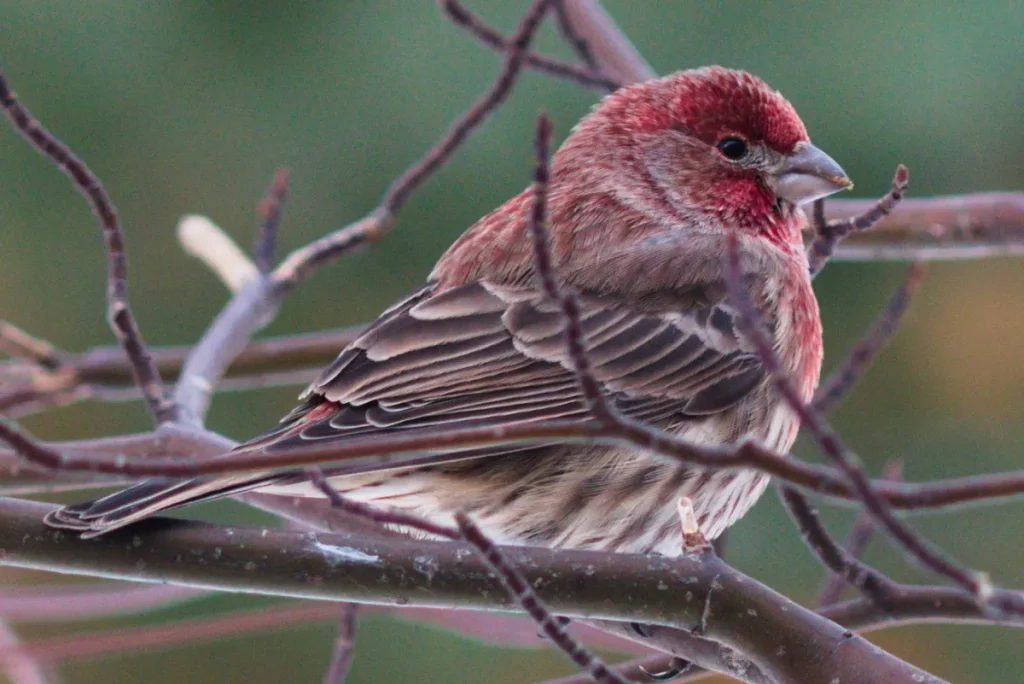
Male House Finch with a rosy head and brown streaking down the sides.
A male House Finch (Haemorhous mexicanus) often has red around the face and upper chest. Look below the red for brown streaks along the belly and flanks. The small seed-cracking bill and shallow notch in the tail can help when the color looks washed out in a photo.
Male coloration varies from yellowish to bright red. If the red extends across the back and the sides show little or no brown streaking, compare your bird with a male Purple Finch too.
3. Red-headed Woodpecker
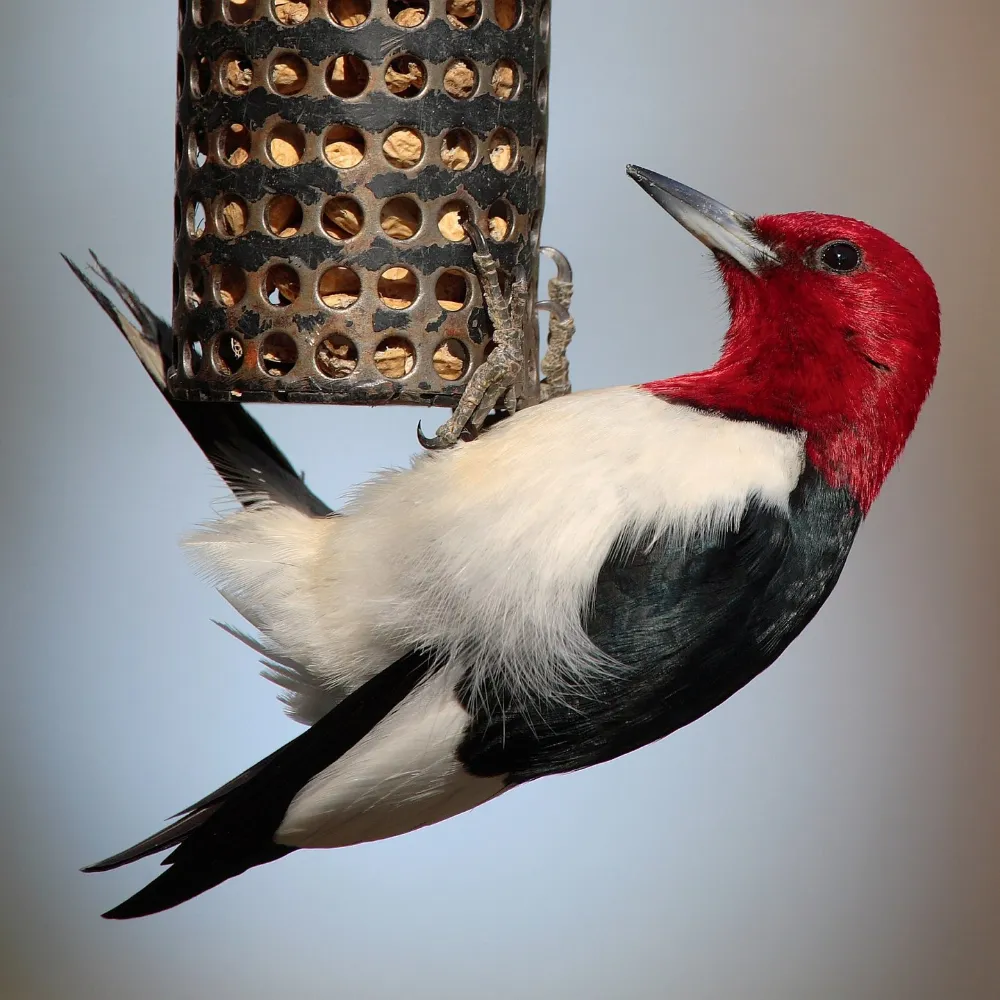
Adult Red-headed Woodpecker with an entirely red head, a white belly and large white patches on the wings.
An adult Red-headed Woodpecker (Melanerpes erythrocephalus) has a red head and throat above a sharply patterned black-and-white body. If it flies off, watch for broad white patches flashing in the wings.
A Red-bellied Woodpecker often causes confusion. Its red is concentrated on the crown or nape, and its back is covered in narrow black-and-white bars. Young Red-headed Woodpeckers can have brown heads, so check the wings if you suspect you saw an immature bird.
UK and Europe
4. European Goldfinch
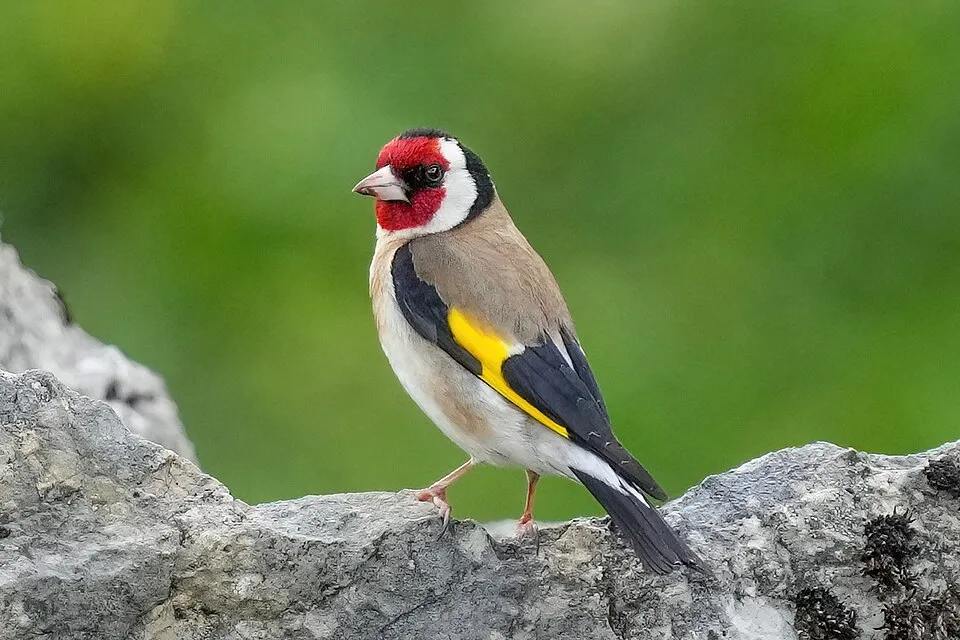
Adult European Goldfinch with a red face and a broad yellow wing bar.
On a European Goldfinch (Carduelis carduelis), the red surrounds the bill and covers the front of the face. White cheeks and a black crown frame it. If the bird turns away, look for the yellow band across its black wing. That band is usually easier to see at a distance than the face.
Young goldfinches have streaky brown heads and already show the yellow wing marking. This can explain why two birds feeding together look different around the face.
5. Great Spotted Woodpecker

Male Great Spotted Woodpecker with a small red patch on the back of its head.
An adult male Great Spotted Woodpecker (Dendrocopos major) has a small red patch on its nape, the back of the head just above the neck. Look for large white shoulder patches and a separate red area under the tail.
An adult female has no red nape patch. A juvenile can show red across the top of the head, so a photo of the crown and the shoulders is especially useful for this species.
Australia
6. Australian King-Parrot
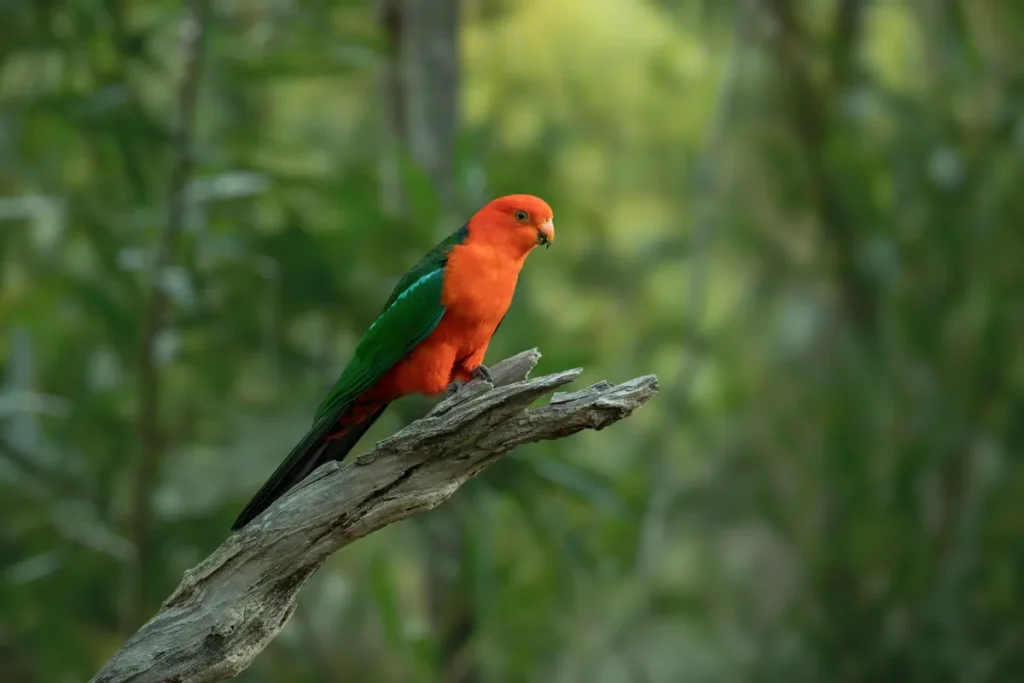
Male Australian King-Parrot with a red head and chest, green wings and a long tail.
In eastern Australia, a long-tailed parrot with a red head and chest and solid green wings is a good match for a male Australian King-Parrot (Alisterus scapularis). Its red face extends across the cheek, which is useful when you’re comparing it with a Crimson Rosella.
Female King-Parrots have green heads and chests with red on the belly. A green-headed bird beside a red-headed male may be the same species.
7. Crimson Rosella
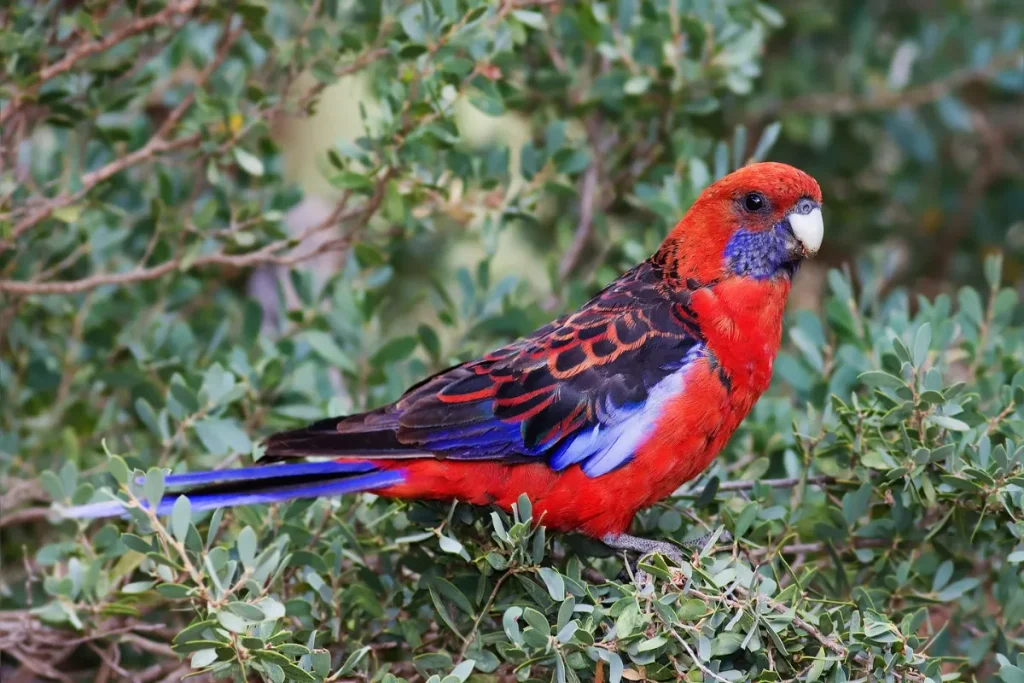
Crimson Rosella showing the blue cheek patch and blue wing feathers that help identify it.
On a red Crimson Rosella (Platycercus elegans), the first place to look is just below and behind the eye. The bright blue cheek patch stands out against the red head. Blue flight feathers and a dark back with red-edged feathers give you two more features to check.
Some populations are yellow or orange, and many young birds are largely green. If the body color looks different from the photo, compare the cheek and wing patterns.
South and Southeast Asia
8. Coppersmith Barbet

Adult Coppersmith Barbet with a red forehead, yellow throat and streaked green underparts.
The Coppersmith Barbet (Psilopogon haemacephalus) has a small red patch on the forehead and a second patch on the upper chest. Look for the yellow throat between the red patches and the dark streaks down its pale greenish belly.
You may hear its repeated metallic tuk before you spot it in the canopy. If all you catch is a glimpse of green, try watching the same branch for a view of the forehead and throat.
What to record if you only get a quick look
Write down where you saw the bird, where the red was, and one other marking. “Southern Ontario, rosy forehead, brown streaks down the sides” is enough to start comparing finches. “Sydney, red head, blue cheeks” points you toward a different set of birds. If you can take one photo, try to get a side view that shows both the head and the folded wing.
Related guide
If what caught your attention was a flock moving as one near sunset, see Why Do Starlings Murmurate at Dusk?
Sources
- Cornell Lab of Ornithology. Northern Cardinal, House Finch, Purple Finch, Red-headed Woodpecker and Red-bellied Woodpecker. allaboutbirds.org
- RSPB. Goldfinch and Great Spotted Woodpecker. Carduelis Carduelis
- Australian Museum. Australian King-Parrot and Crimson Rosella. The Australian Museum
- Singapore National Parks Board. Coppersmith Barbet.


