Starlings murmurate at dusk because that’s when they return to a shared place to spend the night. Before landing, hundreds or thousands may gather into a flock that turns and changes shape. Flying together can make it harder for a predator, such as a peregrine falcon, to single out one bird.
The swirling flight is called a murmuration. The roost is the place where the birds settle afterward. If you’re watching a flock and want to know where it’s headed, keep an eye on the place it circles back to.
Why Do Starlings Gather Just Before Dark?
Starlings can spend the day feeding in smaller groups spread across different areas. As daylight fades, groups arrive at the same roost from several directions. They may circle over a reedbed, a patch of trees, or a structure such as a pier before dropping out of sight.

Researchers studying more than 3,000 murmurations found that displays tended to be larger and last longer when birds of prey were nearby. That supports the idea that flocking helps protect starlings. A flock can still swirl when there’s no predator you can see, so a sudden turn alone is a poor sign that a hawk is attacking.
How Do Starlings Turn Together?
Each bird adjusts to nearby birds. Researchers who reconstructed starling flocks in three dimensions estimated that a bird’s movements were linked to those of about six or seven neighbors on average in the flocks they studied. As one group changes direction, the turn can spread rapidly through the flock.
If you film a murmuration, watch the clip at half speed. Focus on one edge of the flock and see where the turn starts and how it passes through the birds. From a distance, that quick sequence can look like one simultaneous movement.

Do Starlings Only Murmurate in Winter?
In the UK, November through February is a good period to look. Resident starlings are joined by birds from elsewhere in Europe, and the larger gatherings make displays easier to spot. Starlings also gather in parts of North America and Australia, where the best time to look depends on local roosts and seasonal conditions.
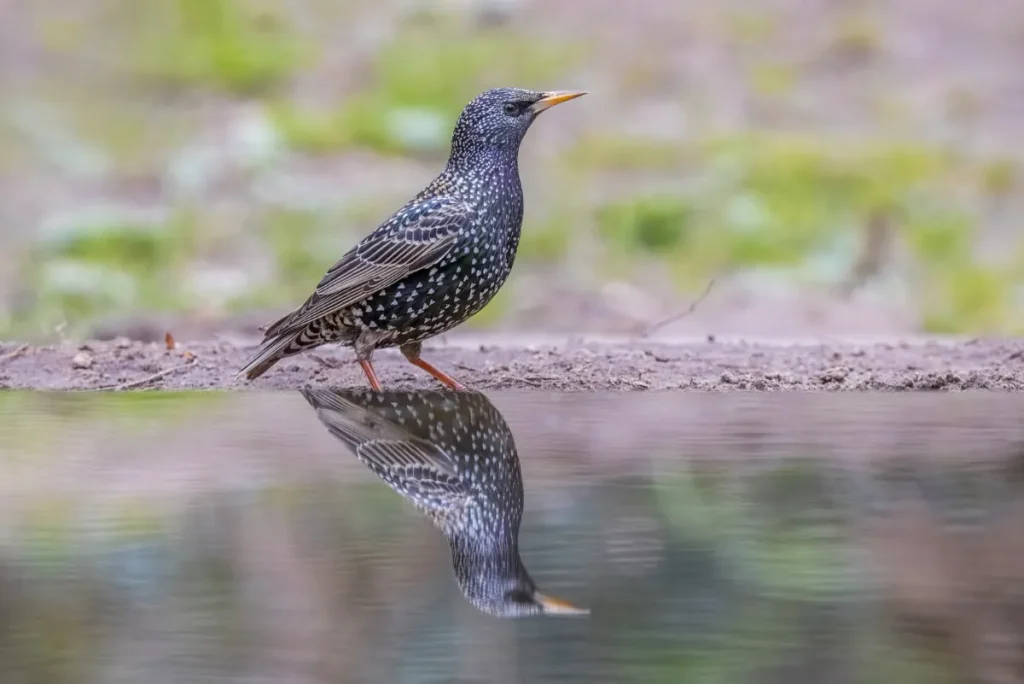
If you get a closer look when the birds are perched, a common starling (Sturnus vulgaris) has a short tail and a pointed bill. In nonbreeding plumage, pale spots stand out against its dark feathers.
What Should You Watch for Around Sunset?
Start with a place that has recent roost reports and check the local sunset time. Arriving about 30–60 minutes before sunset gives you time to see the first groups come in. Some sites, such as RSPB Ham Wall, can see activity about an hour before sunset.
| What you see | What to watch for next |
|---|---|
| Small groups fly in from several directions | See whether they join up over the same area. |
| A larger flock keeps returning to one patch of sky | Look below it for reeds, trees, or a structure where the birds might settle. |
| Birds stream down into cover and disappear | You’re seeing the transition from the aerial display to the night roost. |

If you record a sighting, note the time, how long the display lasted, where the birds landed, and whether you saw a bird of prey. Those are the kinds of observations researchers use to compare murmurations. University of Gloucestershire Starling Murmuration Survey
See how to tell a bird nest from a squirrel nest when you’re looking up into a tree.
Sources
- RSPB — Why and when starlings murmurate
- RSPB Ham Wall — Viewing the starling roost
- PLOS ONE — What more than 3,000 observations reveal about murmurations
- PNAS — How individual starlings interact with nearby birds
- Cornell Lab of Ornithology — European starling identification
- Australian Museum — Common starlings and dusk roosting