Imagine walking through a desert filled with towering saguaro cacti, rocky hills, and sunbaked sand. The landscape may seem quiet during the hottest part of the day, but a surprising variety of wildlife lives among the cactus forests and desert shrubs.
A Gila monster may shelter beneath a rock, a roadrunner might dash between bushes, and a tiny elf owl could be sleeping inside an old woodpecker cavity.
When the sun sets, kangaroo rats emerge from their burrows, bats visit night-blooming flowers, and other desert animals begin searching for food.
Gila monsters, Sonoran desert tortoises, javelinas, greater roadrunners, cactus wrens, and lesser long-nosed bats are among the many remarkable animals that live in the Sonoran Desert.
Here are 12 fascinating Sonoran Desert animals, including their habitats, diets, identifying features, and special adaptations for surviving one of North America’s most distinctive desert ecosystems.
12 Sonoran Desert Animals: Quick Comparison
| Animal | Scientific Name | Main Habitat | Key Adaptation |
|---|---|---|---|
| Gila Monster | Heloderma suspectum | Desert scrub and rocky slopes | Underground shelter and fat storage |
| Sonoran Desert Tortoise | Gopherus morafkai | Rocky hillsides and desert scrub | Sheltering in rock crevices and burrows |
| Collared Peccary (Javelina) | Pecari tajacu | Cactus scrub and desert washes | Flexible diet and group living |
| Greater Roadrunner | Geococcyx californianus | Open desert scrub | Fast running and opportunistic hunting |
| Cactus Wren | Campylorhynchus brunneicapillus | Cactus stands and thorny scrub | Protected nests in spiny vegetation |
| Gila Woodpecker | Melanerpes uropygialis | Saguaro cactus forests and desert woodlands | Excavating nesting cavities |
| Elf Owl | Micrathene whitneyi | Saguaro habitats and desert woodlands | Nocturnal hunting and cavity nesting |
| Harris’s Hawk | Parabuteo unicinctus | Desert scrub and open woodland | Cooperative hunting |
| Merriam’s Kangaroo Rat | Dipodomys merriami | Sandy and gravelly desert habitats | Water conservation and seed storage |
| Western Diamondback Rattlesnake | Crotalus atrox | Desert scrub and rocky terrain | Heat-sensitive prey detection |
| Desert Cottontail | Sylvilagus audubonii | Desert scrub and brushy areas | Using dense cover to escape heat |
| Lesser Long-nosed Bat | Leptonycteris yerbabuenae | Desert scrub and cactus-flowering habitats | Long tongue for nectar feeding |
These animals use different parts of the desert. Some spend most of their active time aboveground, while others depend heavily on underground shelters or become active after dark.
1. Gila Monster

ALT: Gila monster in southeastern Arizona showing pink and black patterned skin and a thick tail.
Photo: Josh Olander | Source: Wikimedia Commons | License: CC BY 4.0 | Changes: None if the original image is used unchanged.
Scientific name: Heloderma suspectum
Habitat: Rocky foothills, desert scrub, washes, and sheltered areas of the Sonoran Desert.
Diet: Bird eggs, reptile eggs, young mammals, and other small vertebrates.
The Gila monster is one of the most distinctive reptiles found in the American Southwest.
It has a heavy body, short powerful legs, and a thick tail. Its skin is covered with beadlike scales, often arranged in dramatic patterns of black, pink, orange, or yellowish colors.
Unlike many lizards that rely on speed to escape danger, Gila monsters usually move slowly and spend substantial periods hidden in protected shelters.
They are also among the few venomous lizard species in the world.
Gila monsters use their strong jaws and specialized teeth to deliver venom when biting.
Despite their intimidating appearance, they generally avoid people and are not naturally aggressive toward humans.
Much of their time is spent underground or in sheltered spaces, where they can avoid extreme heat and conserve energy.
Their thick tails can store fat, providing an important energy reserve when food is scarce.
How to recognize it: Look for a stocky lizard with a large head, thick tail, short legs, and striking pink-and-black or orange-and-black beadlike markings.
Interesting fact: Gila monsters can spend most of their lives out of sight, which is why even people who regularly visit the Sonoran Desert may never encounter one.
Safety note: Never touch, pick up, or attempt to move a wild Gila monster. Observe it from a safe distance.
2. Sonoran Desert Tortoise

ALT: Sonoran desert tortoise photographed in Arizona showing its domed shell and strong front legs.
Photo: Arizona Game and Fish Department / mypubliclands | Source: Wikimedia Commons | License: CC BY 2.0 | Changes: None if the original image is used unchanged.
Scientific name: Gopherus morafkai
Habitat: Rocky hillsides, desert foothills, and areas with suitable shelter.
Diet: Grasses, leaves, flowers, and other desert vegetation.
The Sonoran desert tortoise is an impressive example of a reptile adapted to dry environments.
It has a high-domed shell, sturdy legs, and strong claws that help it move across rocky terrain.
Although tortoises are commonly associated with flat desert landscapes, Sonoran desert tortoises frequently inhabit rocky slopes where they can shelter beneath boulders and within natural crevices.
These protected spaces help them avoid excessive heat and unfavorable weather.
Tortoises may become more active during periods when temperature and moisture conditions are suitable, including during the summer monsoon season.
They consume a variety of native desert plants and can obtain moisture from the vegetation they eat.
Their slow growth, relatively long lifespan, and low reproductive rate make healthy adult populations especially important.
How to recognize it: Look for a land-dwelling tortoise with a rounded brownish shell, sturdy front legs, and thick scales.
Interesting fact: Sonoran desert tortoises frequently rely on rocky shelters, while some other desert tortoise populations make more extensive use of excavated burrows in sandy environments.
Desert tortoises are one example of how animals use underground and rocky shelters to survive. Discover more in our guide to 12 animals that live underground.
3. Collared Peccary (Javelina)
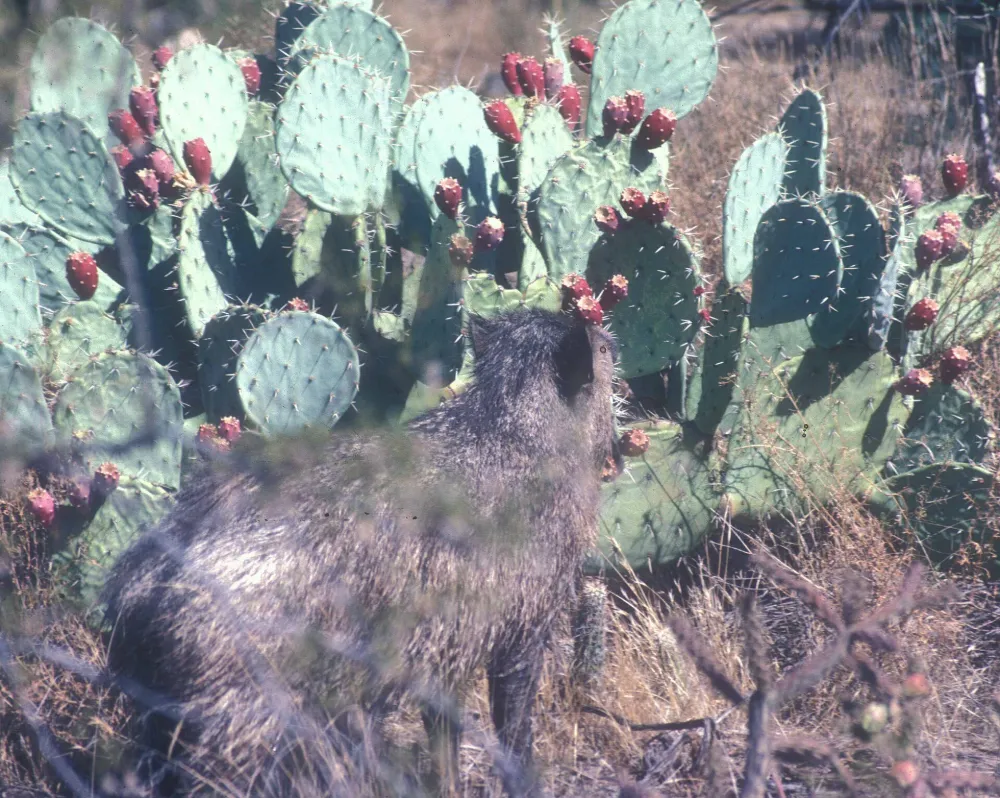
ALT: Collared peccary, also known as a javelina, investigating a prickly pear cactus in Saguaro National Park.
Photo: Saguaro National Park / SaguaroNPS | Source: Wikimedia Commons | License: CC BY 2.0 | Changes: None if the original image is used unchanged.
Scientific name: Pecari tajacu
Habitat: Desert scrub, cactus forests, wooded washes, and other suitable habitats.
Diet: Prickly pear cactus, roots, fruits, seeds, and other plant material, with occasional animal food.
The javelina is a sturdy, piglike mammal commonly found in the Sonoran Desert.
Although it resembles a small wild pig, the javelina belongs to the peccary family rather than the true pig family.
Its body is covered with coarse, dark hair, and many individuals have a lighter band of fur around the neck and shoulders.
This pale band gives the species its name: the collared peccary.
Javelinas frequently travel in social groups.
Group living can help individuals remain aware of danger and maintain contact as they move through dense desert vegetation.
Their strong snouts help them investigate soil and vegetation while searching for food.
Prickly pear cactus is an especially important food source in many desert habitats.
Javelinas can consume cactus pads and fruit despite the plants’ defensive spines.
During hot weather, they may rest beneath shrubs or in shaded areas.
How to recognize it: Look for a dark, stocky, piglike animal with short legs, a broad snout, and a pale collar around its shoulders.
Interesting fact: Javelinas help connect cactus plants with desert food webs by consuming their pads and fruit.
Safety note: Do not feed or approach javelinas. They can defend themselves, particularly when startled or accompanied by young.
4. Greater Roadrunner
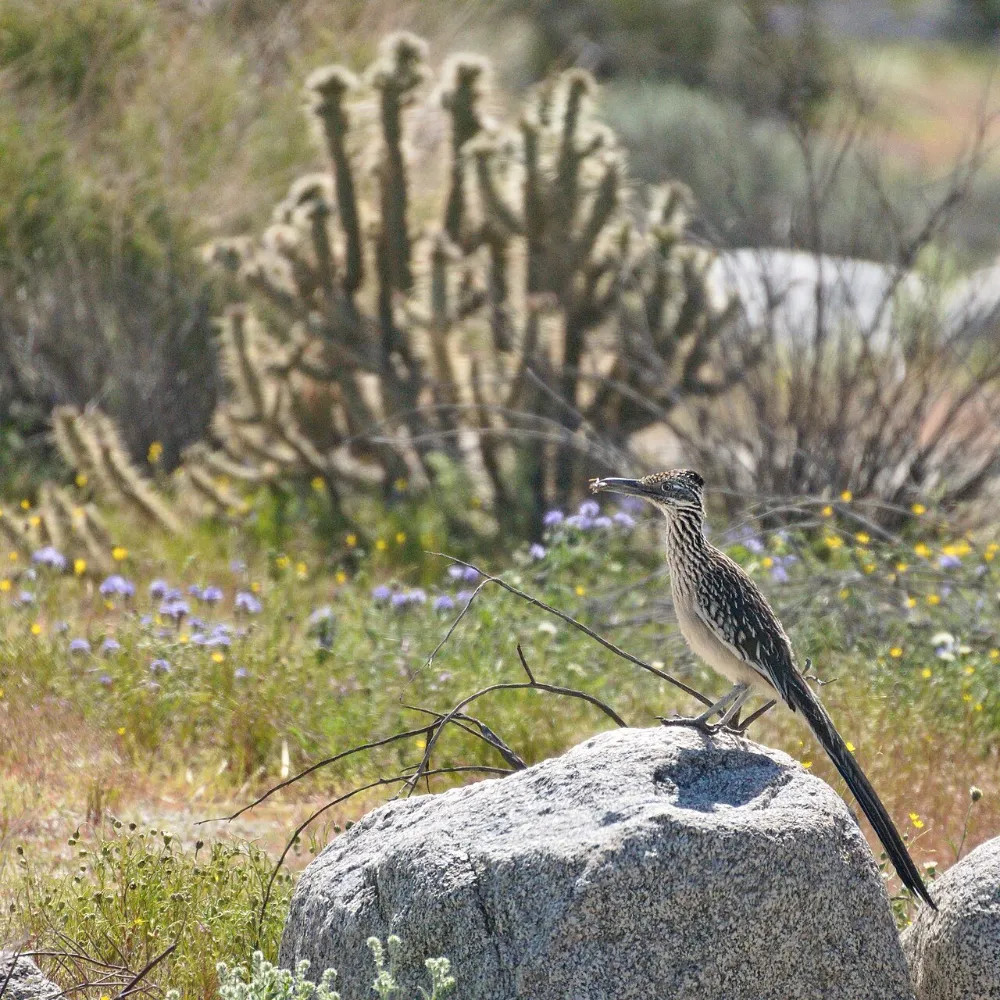
ALT: Greater roadrunner standing among cholla cactus vegetation in a desert habitat.
Photo: Keenanhye | Source: Wikimedia Commons | License: CC BY 4.0 | Changes: None if the original image is used unchanged.
Scientific name: Geococcyx californianus
Habitat: Desert scrub, thorny vegetation, grassland edges, and open woodland.
Diet: Lizards, insects, rodents, small snakes, and other animals.
The greater roadrunner is one of the most recognizable birds of the American Southwest.
It has a long tail, strong legs, a pointed bill, and a shaggy crest that can be raised or flattened.
Although roadrunners are capable of flying, they spend much of their time running across the ground.
Their long legs allow them to move quickly between bushes while searching for prey.
Roadrunners are opportunistic predators.
They hunt insects, lizards, small mammals, and sometimes snakes.
They may also eat fruit or other available food.
During cooler mornings, roadrunners can sometimes be seen facing the sun and exposing darker patches of skin beneath their feathers to help warm their bodies.
Their long tails assist with balance and rapid changes in direction.
How to recognize it: Look for a long-legged bird with a shaggy crest, streaked brown plumage, a long tail, and a habit of running rather than flying away.
Interesting fact: Roadrunners are capable of catching and eating small rattlesnakes, although snakes are only one part of their varied diet.
5. Cactus Wren

ALT: Cactus wren with bold white eyebrow stripes and a heavily spotted breast.
Photo: Vickie J. Anderson | Source: Wikimedia Commons | License: CC BY-SA 4.0 | Changes: None if the original image is used unchanged.
Scientific name: Campylorhynchus brunneicapillus
Habitat: Cactus stands, desert scrub, thorny bushes, and saguaro-rich landscapes.
Diet: Insects, spiders, small fruits, and other available food.
The cactus wren is one of the most characteristic songbirds of the Sonoran Desert.
It is also Arizona’s state bird.
Unlike many tiny wrens, the cactus wren is relatively large and has a bold, conspicuous appearance.
Its plumage is brownish with extensive white spotting and streaking.
A prominent white stripe extends above each eye, making the face particularly distinctive.
Cactus wrens frequently build large, enclosed nests within thorny plants.
Cholla cacti and other spiny vegetation can provide protection by making nests difficult for some predators to approach.
These birds often construct more than one nest, with some used for breeding and others serving as roosting shelters.
They usually search for insects and other small food items among desert vegetation and on the ground.
How to recognize it: Look for a large brown wren with a strong white eyebrow, spotted breast, long tail, and slightly curved bill.
Interesting fact: A cactus wren’s bulky nest is often hidden inside one of the desert’s spiniest plants.
Explore other remarkable animal-built shelters in our guide to animals that build their own homes.
6. Gila Woodpecker

ALT: Male Gila woodpecker photographed in southeastern Arizona showing a barred back and red crown patch.
Photo: Vickie J. Anderson | Source: Wikimedia Commons | License: CC BY-SA 4.0 | Changes: None if the original image is used unchanged.
Scientific name: Melanerpes uropygialis
Habitat: Saguaro cactus forests, desert scrub, and riparian woodlands.
Diet: Insects, fruits, cactus flesh, nectar, and other available foods.
The Gila woodpecker is a fascinating bird closely associated with giant saguaro cacti.
It has a pale tan or grayish head and underparts, with a strongly barred black-and-white back.
Adult males display a red patch on the crown, while females generally lack this marking.
One of the bird’s most important behaviors is excavating nesting cavities.
In saguaro-rich habitats, Gila woodpeckers may carve holes into the living cactus.
The cactus responds by producing a hardened lining around the cavity.
After the cavity becomes suitable, the woodpeckers may use it for nesting.
When the original occupants leave, these cavities can provide homes for other animals.
Elf owls, flycatchers, and certain other birds may use abandoned woodpecker holes.
Gila woodpeckers therefore help create nesting habitat for an entire community of desert wildlife.
How to recognize it: Look for a woodpecker with a pale face, black-and-white barred back, and a red crown patch in adult males.
Interesting fact: A nesting hole excavated by a Gila woodpecker can become a valuable shelter for other desert birds.
For more identification tips, read our guide to 10 birds with red heads in North America.
7. Elf Owl

ALT: Elf owl photographed in Saguaro National Park showing its round head and yellow eyes.
Photo: Saguaro National Park / SaguaroNPS | Source: Wikimedia Commons | License: CC BY 2.0 | Changes: None if the original image is used unchanged.
Scientific name: Micrathene whitneyi
Habitat: Sonoran Desert cactus forests, wooded washes, and suitable desert woodlands.
Diet: Moths, beetles, scorpions, spiders, and other small animals.
The elf owl is one of the world’s smallest owl species.
Despite its tiny size, it is an effective nocturnal hunter.
Elf owls are generally brownish or grayish, with rounded heads, yellow eyes, and no prominent ear tufts.
During daylight hours, they often remain hidden in protected cavities.
At night, they emerge to capture insects and other small animals.
In parts of the Sonoran Desert, elf owls frequently nest in cavities excavated by woodpeckers.
Saguaro cacti are particularly useful because they can contain multiple nesting holes.
Elf owls do not need to carve these spaces themselves.
Instead, they take advantage of structures created by other birds.
This relationship demonstrates the importance of Gila woodpeckers and other cavity-excavating species.
How to recognize it: Look for a very small owl with a rounded head, yellow eyes, brown-and-white plumage, and no obvious ear tufts.
Interesting fact: A single large saguaro cactus can provide nesting places for multiple bird species over time.
8. Harris’s Hawk

ALT: Harris’s hawk perched on a utility wire in Tucson, Arizona.
Photo: Greg Schechter | Source: Wikimedia Commons | License: CC BY 2.0 | Changes: None if the original image is used unchanged.
Scientific name: Parabuteo unicinctus
Habitat: Sonoran Desert scrub, cactus forests, and open woodlands.
Diet: Rabbits, rodents, birds, lizards, and other animals.
Harris’s hawks are among the most unusual birds of prey in North America because of their social behavior.
While many hawks hunt alone, Harris’s hawks may cooperate in groups.
Several birds can work together to pursue or surround prey.
This behavior is especially useful when hunting animals that can escape into thick vegetation.
Harris’s hawks have dark brown plumage, chestnut-colored wing and leg feathers, and a tail with noticeable white markings.
Their broad wings and strong talons make them effective hunters.
They frequently perch on tall cacti, trees, poles, or other elevated structures while watching the surrounding terrain.
In suitable desert habitats, family groups may remain together and cooperate in hunting or other activities.
How to recognize it: Look for a dark brown hawk with rich chestnut patches on the wings and legs and white markings near the tail.
Interesting fact: Harris’s hawks are among the best-known examples of cooperative hunting in birds of prey.
9. Merriam’s Kangaroo Rat

ALT: Merriam’s kangaroo rat showing its large hind feet, long tail, and large eyes.
Photo: Connor Long | Source: Wikimedia Commons | License: CC BY-SA 4.0 | Changes: None if the original image is used unchanged. Photographer requests clearly visible attribution: Connor Long.
Scientific name: Dipodomys merriami
Habitat: Desert scrub, sandy soils, and open dry landscapes.
Diet: Primarily seeds, along with other available plant material.
Merriam’s kangaroo rat is a small desert rodent with extraordinary water-conservation abilities.
Despite its name, it is not closely related to kangaroos.
Its large hind legs allow it to move in powerful jumps, while its long tail helps maintain balance.
Kangaroo rats are primarily nocturnal.
They emerge after dark to collect seeds and other food items, often carrying seeds in external cheek pouches.
Their underground burrows provide shelter from predators and extreme daytime temperatures.
These animals have highly efficient kidneys that help them conserve water.
They can obtain much of their moisture from food and metabolic processes, reducing their dependence on drinking free-standing water.
Kangaroo rats may also store seeds underground for future consumption.
How to recognize it: Look for a small rodent with very large hind feet, large eyes, short front legs, and a long tail.
Interesting fact: Merriam’s kangaroo rats are highly adapted to obtaining and conserving water in environments where surface water may be scarce.
Their underground lifestyle connects them with other fascinating species in our guide to 12 animals that live underground.
10. Western Diamondback Rattlesnake
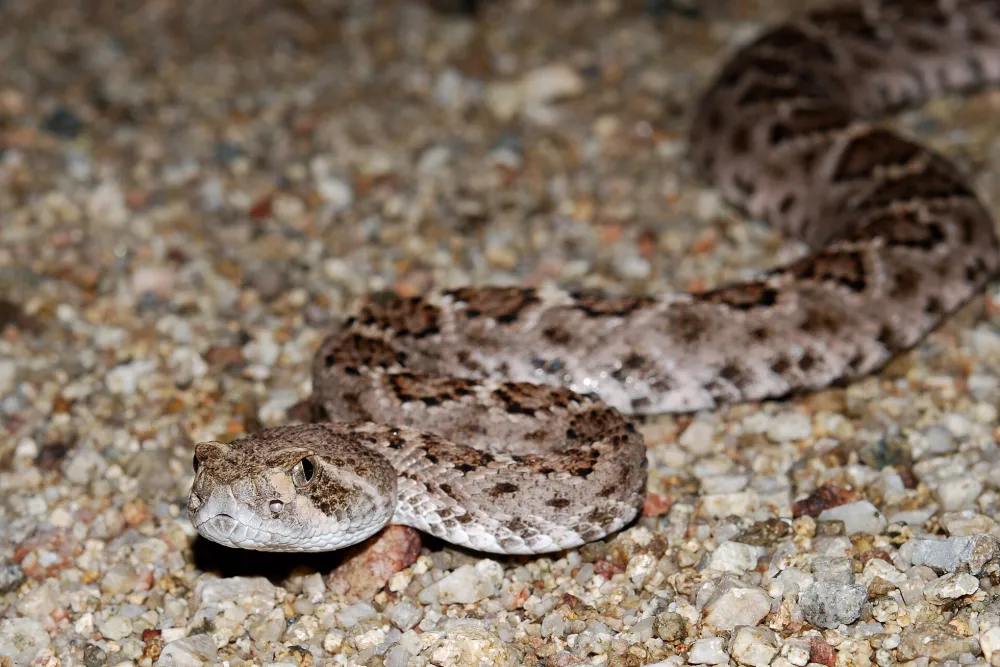
ALT: Western diamondback rattlesnake showing its diamond-shaped back markings and heavy body.
Photo: Geoff Gallice | Source: Wikimedia Commons | License: CC BY 2.0 | Changes: None if the original image is used unchanged.
Scientific name: Crotalus atrox
Habitat: Desert scrub, rocky slopes, grassland edges, and suitable dry habitats.
Diet: Rodents, rabbits, birds, and other small vertebrates.
The western diamondback rattlesnake is one of the largest rattlesnake species found in the American Southwest.
Its body is usually grayish, brownish, or tan, with darker diamond-shaped markings running along the back.
Near the tail, it often displays contrasting black-and-white bands.
A rattle at the tail tip produces a buzzing warning sound when the snake vibrates it.
Like other pit vipers, western diamondbacks possess specialized heat-sensitive organs that help them detect warm-blooded prey.
This ability is particularly useful when hunting in low light.
Western diamondbacks may shelter beneath rocks, vegetation, or in animal burrows to avoid unfavorable temperatures.
They are venomous predators but generally prefer to avoid unnecessary confrontations.
How to recognize it: Look for a heavy-bodied snake with dark diamond-shaped back markings, black-and-white tail bands, and a rattle when present.
Interesting fact: A rattlesnake’s rattle is made of interlocking keratin segments that produce sound when vibrated.
Safety note: Do not approach a rattlesnake for identification. Juveniles and snakes with damaged tails may have very small or missing rattles, so the absence of a visible rattle does not mean a snake is harmless.
11. Desert Cottontail

ALT: Desert cottontail rabbit resting in Tucson, Arizona, with large ears and gray-brown fur.
Photo: Katja Schulz | Source: Wikimedia Commons | License: CC BY 2.0 | Changes: None if the original image is used unchanged.
Scientific name: Sylvilagus audubonii
Habitat: Desert scrub, brushy washes, cactus-rich areas, and open dry habitats.
Diet: Grasses, herbs, leaves, and other available vegetation.
The desert cottontail is a small rabbit commonly found in the Sonoran Desert.
It has large ears, grayish-brown fur, a relatively rounded body, and a short tail with a pale underside.
Unlike some animals that spend much of their lives underground, desert cottontails often rely on dense vegetation for protection.
They rest beneath bushes, within grass clumps, or in other shaded locations.
Their large ears help with hearing and can also contribute to heat exchange.
Desert cottontails are often more active during cooler periods of the day, including early morning and evening.
They feed on grasses and other plants, adjusting their diet according to season and food availability.
Their relatively small size and ability to hide in vegetation help them avoid predators.
How to recognize it: Look for a small gray-brown rabbit with relatively long ears, a rounded body, and a short pale tail.
Interesting fact: Desert cottontails are important prey for coyotes, hawks, owls, snakes, and other desert predators.
12. Lesser Long-nosed Bat

ALT: Lesser long-nosed bat photographed in southern Arizona with its elongated muzzle and nectar-feeding adaptations.
Photo: Sue Carnahan | Source: Wikimedia Commons | License: CC BY 4.0 | Changes: None if the original image is used unchanged.
Scientific name: Leptonycteris yerbabuenae
Habitat: Desert scrub, caves and other roosting sites, and landscapes containing flowering cacti and agaves.
Diet: Nectar, pollen, and fruit from suitable desert plants.
The lesser long-nosed bat is one of the most ecologically important mammals associated with the Sonoran Desert.
Unlike bats that specialize in eating flying insects, this species feeds heavily on nectar and pollen.
Its elongated muzzle and specialized tongue allow it to reach deep into desert flowers.
As the bat visits flowers, pollen can become attached to its fur.
The bat may then carry pollen to other flowers, contributing to plant reproduction.
Lesser long-nosed bats are important pollinators of certain columnar cacti and agaves.
In the Sonoran Desert, they visit flowers of saguaro, organ pipe, and other suitable cacti.
These bats undertake seasonal movements that help them take advantage of flowering plants across large geographical areas.
Their relationship with cactus flowers is an excellent example of how plants and animals depend on one another.
How to recognize it: Look for a medium-sized nectar-feeding bat with an elongated muzzle, relatively large eyes, and brownish fur.
Interesting fact: The seasonal flowering of desert cacti and agaves helps provide food for migrating lesser long-nosed bats.
Where Is the Sonoran Desert Located?
The Sonoran Desert lies in the southwestern United States and northwestern Mexico.
It covers much of southern Arizona, southeastern California, and portions of the Mexican states of Sonora and Baja California.
The desert contains a variety of landscapes, including sandy plains, rocky mountains, cactus forests, desert washes, and dry valleys.
One of its most recognizable plants is the giant saguaro cactus.
Saguaros grow naturally in the Sonoran Desert, but not in every part of it.
The distribution of these cacti depends on temperature, elevation, moisture, and other environmental conditions.
Popular places associated with Sonoran Desert wildlife include Saguaro National Park, Organ Pipe Cactus National Monument, and desert habitats surrounding Tucson and Phoenix.
What Makes the Sonoran Desert Different From Other Deserts?
The Sonoran Desert is especially famous for its rich plant diversity and two main periods of seasonal rainfall in many areas.
Winter rainfall and summer monsoon storms help support different waves of plant growth and animal activity.
This rainfall pattern distinguishes much of the Sonoran Desert from some neighboring desert regions.
It also supports large cacti, shrubs, trees, grasses, and seasonal wildflowers.
| Feature | Sonoran Desert | Mojave Desert |
|---|---|---|
| Location | Southwestern U.S. and northwestern Mexico | Southwestern U.S. |
| Iconic Plant | Saguaro cactus | Joshua tree |
| Rainfall | Winter rain and summer monsoon influence in many areas | Generally receives more winter-dominant precipitation |
| Typical Wildlife | Gila Monster, Javelina, Gila Woodpecker | Desert Tortoises, Kangaroo Rats, Desert Reptiles |
| Vegetation | Diverse cactus and desert scrub communities | Creosote scrub, Joshua tree woodland in suitable areas |
The two deserts share some animal species, so wildlife alone cannot always identify which desert you are visiting.
How Do Sonoran Desert Animals Survive Extreme Heat?
Desert animals face challenges involving heat, limited water, and rapidly changing environmental conditions.
Different species have evolved different survival strategies.
1. Nocturnal Activity
Many Sonoran Desert animals become more active after sunset.
Kangaroo rats emerge at night to search for seeds.
Elf owls hunt insects and other small prey under the cover of darkness.
Lesser long-nosed bats visit flowers during nighttime hours.
Avoiding the hottest part of the day can reduce the risk of overheating and excessive water loss.
2. Underground Shelter
Gila monsters, kangaroo rats, and other desert animals use burrows or protected spaces.
Soil and rock shelters can provide cooler, more stable conditions than exposed desert surfaces.
3. Water Conservation
Merriam’s kangaroo rats have highly efficient kidneys that help reduce water loss.
Other desert animals obtain substantial moisture from food.
Some species also reduce activity during particularly hot or dry periods.
4. Using Shade
Javelinas and desert cottontails often rest beneath bushes or other vegetation during hot weather.
Shaded habitats can be important even when they cover relatively small areas.
5. Specialized Body Structures
The large ears of rabbits can help with heat exchange.
Reptiles use behavioral strategies such as moving between sunlight and shade to regulate body temperature.
6. Seasonal Activity
Some desert animals become more active during cooler seasons or following rain.
Sonoran desert tortoises and Gila monsters may be especially difficult to observe during extreme conditions.
Which Sonoran Desert Animals Are Active at Night?
Many desert animals are nocturnal or crepuscular, meaning they are most active at night or around dawn and dusk.
| Animal | Typical Activity Pattern |
|---|---|
| Gila Monster | Often seasonal, with daytime or nighttime activity depending on conditions |
| Sonoran Desert Tortoise | Usually active during favorable daytime temperatures and conditions |
| Javelina | Daytime, twilight, or nighttime depending on temperature |
| Greater Roadrunner | Mainly daytime |
| Cactus Wren | Mainly daytime |
| Gila Woodpecker | Mainly daytime |
| Elf Owl | Mainly nighttime |
| Harris’s Hawk | Mainly daytime |
| Merriam’s Kangaroo Rat | Mainly nighttime |
| Western Diamondback Rattlesnake | Can be active by day or night depending on season |
| Desert Cottontail | Often dawn, dusk, and nighttime |
| Lesser Long-nosed Bat | Nighttime |
These patterns can change with temperature, weather, season, food availability, and location.
A species described as nocturnal is not necessarily incapable of being active during the day.
How Do Saguaro Cacti Help Desert Animals?
The saguaro cactus is more than an iconic symbol of Arizona.
It provides food, shelter, nesting spaces, and other resources for many desert animals.
Nesting Cavities
Gila woodpeckers excavate holes in saguaros.
After these birds leave, elf owls and other cavity-nesting birds may use the abandoned spaces.
Flowers and Nectar
Saguaro flowers provide nectar and pollen for several kinds of animals.
Lesser long-nosed bats are among the nighttime visitors capable of pollinating these flowers.
Birds and insects also contribute to saguaro pollination.
Fruit and Seeds
Saguaro fruit provides food for numerous desert animals.
Birds, mammals, and other organisms may consume the fruit and help disperse seeds.
Structural Habitat
Large saguaros provide perches, nesting opportunities, and sheltered spaces in otherwise relatively open desert environments.
The importance of saguaros demonstrates how one plant species can support many different animals.
Gila Monster vs. Western Diamondback Rattlesnake
Both of these Sonoran Desert reptiles are venomous, but they are very different animals.
| Feature | Gila Monster | Western Diamondback Rattlesnake |
|---|---|---|
| Animal Group | Lizard | Snake |
| Body Shape | Thick-bodied with four legs | Long and legless |
| Skin | Beadlike scales | Distinct scales with diamond-shaped markings |
| Tail | Thick tail used for fat storage | Tail may end in a rattle |
| Main Diet | Eggs and small vertebrates | Rodents, rabbits, and other vertebrates |
| Hunting | Searches for food and nests | Frequently ambushes prey |
| Main Shelter | Burrows and protected rock spaces | Rocks, vegetation, and animal burrows |
Quick identification tip: A Gila monster is a heavy-bodied lizard with legs and striking pink-and-black patterns. A western diamondback is a snake with no legs and dark diamond-shaped markings.
Do not approach either animal to confirm identification.
Javelina vs. Wild Pig: What’s the Difference?
Javelinas are frequently mistaken for feral pigs because of their similar overall appearance.
However, they belong to different animal families.
| Feature | Javelina | Feral Pig |
|---|---|---|
| Family | Tayassuidae | Suidae |
| Typical Body | Compact, dark, coarse-haired | Highly variable in size and color |
| Tail | Very short | Usually more noticeable |
| Social Behavior | Often travels in groups | Can form groups |
| Sonoran Desert Association | Native animal | Non-native where feral populations occur in North America |
| Main Food | Plant material, especially cactus and other desert plants | Broad omnivorous diet |
Javelinas have a pale collar of fur around the shoulders, although it may be difficult to see in some lighting conditions.
The distinction matters because a javelina is not simply a small pig.
Sonoran Desert Food Chain: Who Eats Whom?
The Sonoran Desert supports complex food webs involving plants, insects, herbivores, and predators.
Some animals feed directly on cacti, seeds, or other plants.
Others hunt insects, reptiles, rodents, or rabbits.
A simplified food chain is:
Desert Seeds → Merriam’s Kangaroo Rat → Western Diamondback Rattlesnake
Another possible feeding relationship is:
Desert Plants → Desert Cottontail → Harris’s Hawk
A third example is:
Saguaro Nectar → Lesser Long-nosed Bat
The third relationship represents nectar feeding and pollination rather than a conventional predator-prey food chain.
Real desert food webs contain many overlapping connections.
The same plant may provide food for insects, birds, and mammals.
A roadrunner may hunt insects in one season and lizards or other small animals in another.
These relationships help maintain the ecological balance of desert habitats.
How to Identify Sonoran Desert Animals
If you are walking through a desert nature reserve or looking at wildlife photographs, the following clues can help identify common animals.
| What You Notice | Possible Animal |
|---|---|
| Heavy pink-and-black lizard with beadlike scales | Gila Monster |
| Brown land tortoise near rocky shelter | Sonoran Desert Tortoise |
| Dark piglike mammal with pale shoulder collar | Javelina |
| Long-legged bird with crest and long tail | Greater Roadrunner |
| Large brown wren with white eyebrow | Cactus Wren |
| Barred woodpecker on a saguaro cactus | Gila Woodpecker |
| Very small owl with round head and yellow eyes | Elf Owl |
| Dark brown hawk with chestnut shoulders | Harris’s Hawk |
| Tiny rodent with long hind legs and tail | Merriam’s Kangaroo Rat |
| Heavy snake with diamond patterns | Western Diamondback Rattlesnake |
| Small gray-brown rabbit with large ears | Desert Cottontail |
| Long-snouted bat visiting cactus flowers | Lesser Long-nosed Bat |
These are helpful identification clues, but they do not replace a complete field guide.
Other desert species can have similar shapes or coloration.
Always consider the animal’s location, behavior, body proportions, and additional physical features.
Where Can You See Sonoran Desert Wildlife?
Several protected areas in Arizona provide opportunities to observe native desert wildlife.
Saguaro National Park
Located near Tucson, Saguaro National Park protects extensive saguaro cactus habitat and other desert ecosystems.
Roadrunners, cactus wrens, Gila woodpeckers, javelinas, lizards, and other animals occur within the park.
Organ Pipe Cactus National Monument
This protected desert landscape near the U.S.–Mexico border contains cactus-rich habitats and important wildlife communities.
Lesser long-nosed bats use suitable flowering resources in the region.
Sonoran Desert National Monument
This monument protects desert mountain ranges, cactus-rich valleys, and other Sonoran Desert habitats.
Animals include reptiles, birds, mammals, and numerous invertebrates.
Arizona-Sonora Desert Museum
Located west of Tucson, this institution combines a zoo, botanical garden, and natural history museum.
It is an excellent place to learn about Sonoran Desert animals, including species that may be difficult to encounter in the wild.
Wildlife observations are never guaranteed. Conditions vary considerably between seasons and locations.
How to Watch Desert Wildlife Safely
The Sonoran Desert is an outstanding place for wildlife observation, but the environment can be dangerous when temperatures are high.
Follow these basic guidelines:
- Carry enough water. Do not assume that water will be available along trails.
- Avoid the hottest hours. Early morning and cooler periods are often more comfortable for walking.
- Watch where you place your hands and feet. Snakes, scorpions, and other animals may shelter near rocks and vegetation.
- Never handle wild reptiles. Venomous snakes and Gila monsters should be observed from a safe distance.
- Do not feed javelinas or other wildlife. Feeding can create dangerous interactions.
- Remain on designated trails. Desert soils and fragile vegetation can be damaged by repeated disturbance.
- Avoid disturbing cactus nests. Saguaros and other plants may contain active bird nesting sites.
- Follow national park guidance. Check official information about trail conditions, closures, heat warnings, and wildlife precautions.
Use binoculars or a zoom lens to obtain photographs without approaching animals.
What Threatens Sonoran Desert Animals?
Although many desert animals are highly adapted to heat and drought, they still face environmental pressures.
Habitat loss: Expanding urban development, roads, and other land uses can reduce or fragment natural desert habitat.
Changing climate: Rising temperatures and shifts in precipitation can affect food availability, animal activity, and plant survival.
Road mortality: Slow-moving reptiles such as tortoises and Gila monsters may be vulnerable when crossing roads.
Loss of nesting structures: Damage to mature saguaros can reduce important nesting and shelter opportunities for birds.
Invasive plants: Some non-native grasses can change fire patterns in desert communities.
Human disturbance: Collecting wildlife, feeding animals, and damaging burrows can affect local populations.
Protecting healthy desert vegetation, connected habitats, and suitable shelter locations can benefit many species at once.
Frequently Asked Questions
What animals live in the Sonoran Desert?
The Sonoran Desert is home to Gila monsters, desert tortoises, javelinas, roadrunners, cactus wrens, Gila woodpeckers, elf owls, Harris’s hawks, kangaroo rats, rattlesnakes, rabbits, bats, and many other animals.
What are the most famous Sonoran Desert animals?
Some of the most recognizable animals are the Gila monster, greater roadrunner, javelina, desert tortoise, and cactus wren.
Their appearance and behavior make them especially associated with the American Southwest.
What mammals live in the Sonoran Desert?
Mammals include javelinas, coyotes, bobcats, kangaroo rats, desert cottontails, bats, and several other rodents and carnivores.
What reptiles live in the Sonoran Desert?
Reptiles include Gila monsters, Sonoran desert tortoises, western diamondback rattlesnakes, chuckwallas, whiptail lizards, and numerous other species.
What birds live in the Sonoran Desert?
Greater roadrunners, cactus wrens, Gila woodpeckers, elf owls, Harris’s hawks, Gambel’s quail, and many other birds occur in suitable habitats.
What animals live inside saguaro cacti?
Gila woodpeckers excavate nesting cavities in saguaros.
Elf owls and various other birds may later use abandoned cavities.
Different animals also visit the flowers and fruit of saguaros.
Do Sonoran Desert animals come out at night?
Many do.
Kangaroo rats, elf owls, and lesser long-nosed bats are examples of animals that are mainly active at night.
Other animals, including roadrunners and cactus wrens, are primarily active during daylight hours.
How do desert animals survive without much water?
Different animals conserve water through efficient kidneys, sheltered resting locations, reduced daytime activity, and obtaining moisture from food.
Not all desert species have the same water requirements.
Are there venomous animals in the Sonoran Desert?
Yes. Gila monsters and several rattlesnake species are venomous.
Scorpions and other venomous invertebrates also occur in the region.
Avoid handling or disturbing unfamiliar wildlife.
Are javelinas pigs?
No. Javelinas are collared peccaries and belong to the family Tayassuidae.
True pigs belong to the family Suidae.
Are Sonoran desert tortoises endangered?
Their conservation status varies by jurisdiction and should be checked against current government assessments.
They face threats including habitat fragmentation, road mortality, and other environmental changes.
What is the difference between the Sonoran Desert and the Mojave Desert?
The Sonoran Desert is especially associated with giant saguaro cacti and a distinctive combination of winter and summer rainfall.
The Mojave Desert is well known for Joshua trees and generally more winter-focused precipitation.
Both contain diverse wildlife, and some species occur in both regions.
Final Thoughts
The Sonoran Desert is far more than a dry landscape filled with cacti.
It is a complex ecosystem where animals have developed remarkable strategies for surviving extreme heat, limited water, and changing seasons.
Gila monsters shelter underground, kangaroo rats conserve water, and desert tortoises use protected rocky spaces.
Roadrunners hunt among bushes, cactus wrens construct nests in spiny vegetation, and Gila woodpeckers create cavities that become homes for other birds.
At night, lesser long-nosed bats visit flowers and contribute to the reproduction of important desert plants.
Together, these animals demonstrate the extraordinary relationships connecting desert plants, wildlife, and the environment.
The next time you see a photograph of a towering saguaro cactus, look beyond the plant itself.
An entire community of fascinating animals may depend on the habitat surrounding it.
Related Articles
- 12 Animals That Live Underground (With Pictures)
- 10 Animals That Live in the Rocky Mountains (With Pictures)
- Animals That Build Their Own Homes
- Animals That Store Food for Winter
- 10 Birds With Red Heads in North America
- 12 Animals That Live in Temperate Deciduous Forests (With Pictures)
References and Further Reading
- National Park Service – Animals of Saguaro National Park
- National Park Service – Sonoran Desert Network Ecosystems
- Arizona-Sonora Desert Museum – Sonoran Desert Animal Fact Sheets
- Arizona Game and Fish Department – Upland Sonoran Desertscrub
- National Park Service – Gila Woodpecker and Saguaro Habitats
- Cornell Lab of Ornithology – Gila Woodpecker
- Cornell Lab of Ornithology – Elf Owl
- Cornell Lab of Ornithology – Harris’s Hawk
- National Park Service – Lesser Long-nosed Bat
- National Park Service – Bats in Saguaro National Park
- National Park Service – Sonoran Desert Tortoise