If you spot a bird with a bright red head in your backyard, you might immediately think of a cardinal. But North America is home to many other birds with red heads, including woodpeckers, finches, tanagers, and flycatchers.
Some have completely red heads, while others display red crowns, crests, foreheads, or patches of feathers. In certain species, only adult males have bright red coloring, making identification even more interesting.
The easiest way to identify a red-headed bird is to look beyond its color. Body shape, bill size, wing markings, habitat, and behavior can reveal which species you are observing.
Here are 10 birds with red heads found in North America, along with pictures, identification tips, habitats, and the differences between males and females.
10 Birds With Red Heads: Quick Identification Guide
| Bird | Red Head Pattern | Other Identification Features | Common Habitat |
|---|---|---|---|
| Northern Cardinal | Entire red head and crest in males | Black face mask and orange-red bill | Gardens and woodland edges |
| Red-headed Woodpecker | Entire head bright red in adults | Black-and-white body | Open woodlands |
| Pileated Woodpecker | Large red crest | Black body and white facial stripes | Mature forests |
| Red-bellied Woodpecker | Red crown and nape | Black-and-white barred back | Woodlands and suburbs |
| House Finch | Red forehead, crown, and upper breast in males | Brown-streaked body | Backyards and towns |
| Purple Finch | Raspberry-red head and breast in males | Thick conical bill | Northern forests |
| Summer Tanager | Entire head and body red in adult males | Plain wings without black patches | Deciduous woodlands |
| Scarlet Tanager | Red head and body during breeding season in males | Contrasting black wings and tail | Eastern forests |
| Vermilion Flycatcher | Brilliant red crown and underparts in males | Dark eye mask and wings | Southwestern open habitats |
| Acorn Woodpecker | Bright red crown | Black-and-white facial pattern | Oak woodlands |
Important: These birds do not all have red heads throughout their lives. Color can vary according to sex, age, season, and individual differences.
1. Northern Cardinal
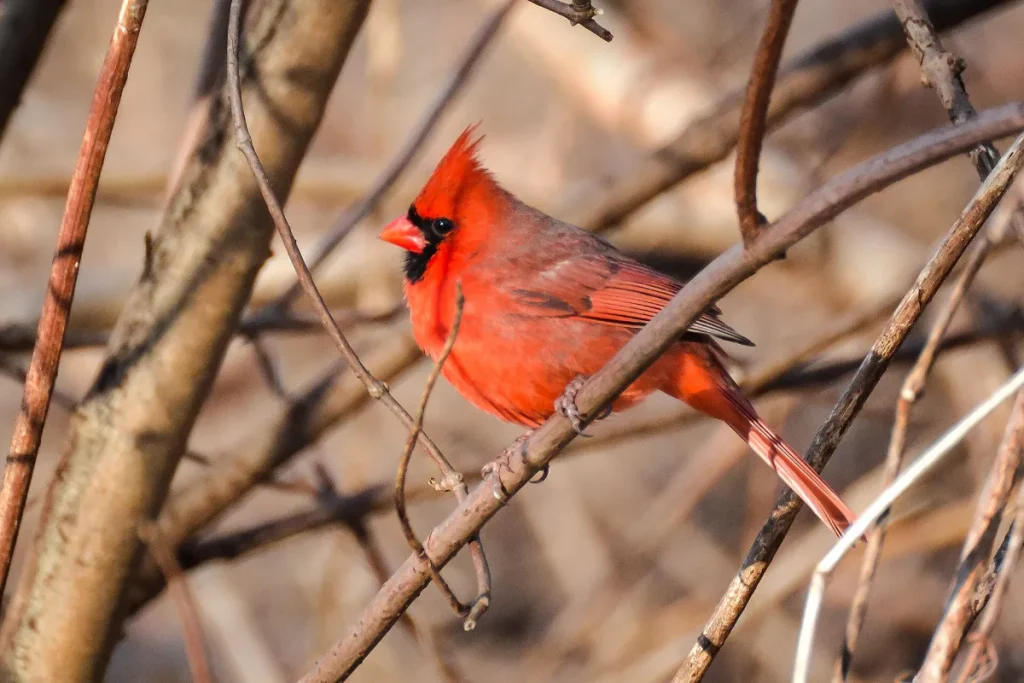
ALT: Male Northern Cardinal with bright red feathers, a pointed crest, and a black facial mask.
Photo: Hari Krishnan | Source: Wikimedia Commons | License: CC BY-SA 4.0 | Changes: None if original used; update this statement if the image is resized, cropped, or converted.
Scientific name: Cardinalis cardinalis
Where to find it: Eastern and central United States, parts of the Southwest, and Mexico.
Habitat: Backyards, gardens, woodland edges, thickets, and parks.
Diet: Seeds, fruits, and insects.
The Northern Cardinal is probably the most recognizable red bird in North America.
Adult males have brilliant red feathers covering almost their entire bodies, including their heads and prominent pointed crests.
A black mask surrounds the face and throat, while the short, thick, orange-red bill is adapted for cracking seeds.
Unlike many migratory songbirds, Northern Cardinals remain in much of their range throughout the year. Their vivid red feathers can look especially striking against winter snow.
Females have a very different appearance. They are mostly warm brown or tan, with reddish highlights on their wings, tails, and crests.
Both sexes have the characteristic crest and stout bill.
How to identify it: Look for a pointed crest, an orange-red bill, and a black mask around the face of an adult male.
Common confusion: Male Summer Tanagers are also red, but they lack the cardinal’s prominent crest and black facial mask.
2. Red-headed Woodpecker
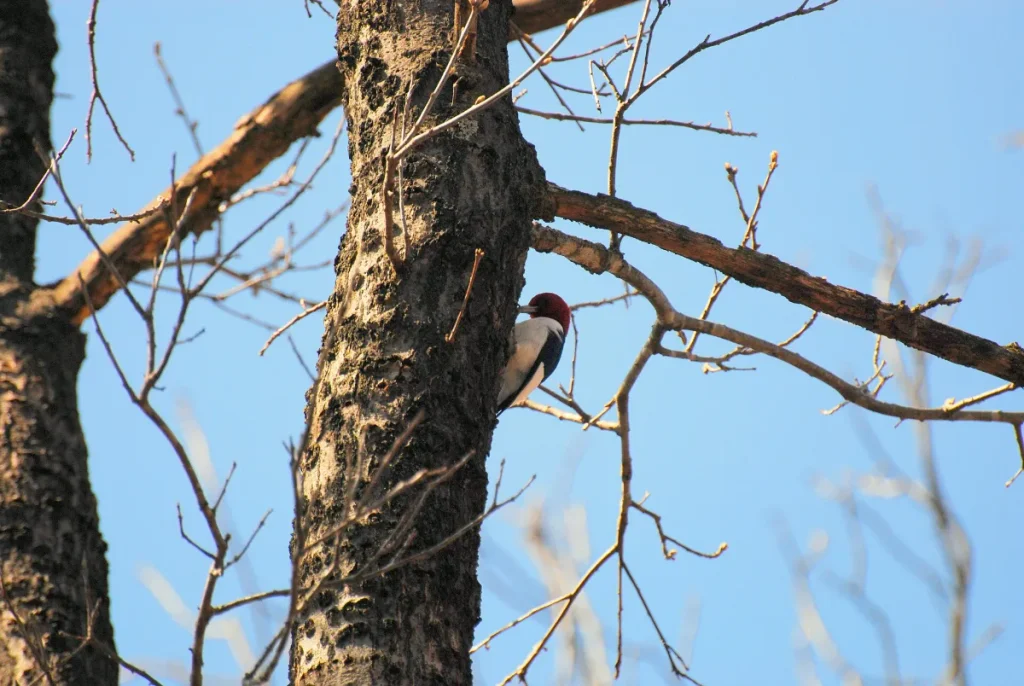
ALT: Adult Red-headed Woodpecker with an entirely red head and black-and-white plumage.
Photo: Wackybadger | Source: Wikimedia Commons | License: CC BY-SA 3.0 | Changes: None if original used; update if modified.
Scientific name: Melanerpes erythrocephalus
Where to find it: Eastern and central North America.
Habitat: Open woodlands, woodland edges, groves, and areas with standing dead trees.
Diet: Insects, nuts, seeds, fruits, and occasionally small animals.
Few birds have a more appropriate name than the Red-headed Woodpecker.
Adults have a completely red head that contrasts sharply with their white underparts and black back, wings, and tail.
Large white patches on the wings become particularly noticeable when the bird is flying.
Unlike many woodpeckers that mainly search for insects beneath bark, Red-headed Woodpeckers also catch flying insects and frequently store food for later use.
They may hide acorns, nuts, and other food items in tree crevices and cavities.
This behavior is one of several fascinating strategies discussed in our guide to animals that store food for winter.
Both adult males and females have red heads. Juveniles, however, have mostly brownish heads that gradually change as they mature.
How to identify it: Look for a completely red head, a mostly white belly, black upperparts, and large white wing patches.
Common confusion: Red-bellied Woodpeckers have red feathers on their crowns and necks, but their faces are mostly pale and their backs are heavily barred.
3. Pileated Woodpecker

ALT: Male Pileated Woodpecker with a large red crest and black-and-white facial markings.
Photo: Amy | Source: Wikimedia Commons | License: CC BY 2.0 | Changes: None if original used; update if modified.
Scientific name: Dryocopus pileatus
Where to find it: Forested regions of eastern North America and parts of the Pacific Northwest.
Habitat: Mature forests, wooded parks, and areas containing large trees.
Diet: Carpenter ants, beetle larvae, other insects, and fruits.
The Pileated Woodpecker is one of the largest woodpeckers in North America.
Its enormous red crest is immediately noticeable, especially when the bird is perched against a dark tree trunk.
The rest of its body is predominantly black, with bold white stripes along its face and neck.
Pileated Woodpeckers are powerful excavators. They use their strong bills to remove wood while searching for insects living inside trees.
Their feeding holes are often large and rectangular rather than small and round.
These birds also excavate nesting cavities in dead or decaying trees. Abandoned cavities may later provide shelter for other wildlife, including small mammals and cavity-nesting birds.
Explore more unusual wildlife construction techniques in our article about animals that build their own homes.
Both male and female Pileated Woodpeckers have red crests.
Males additionally have a red stripe along the lower cheek, sometimes described as a red mustache. This stripe is dark in females.
How to identify it: Look for a very large black woodpecker with a tall red crest, white facial stripes, and a long neck.
Common confusion: Red-headed Woodpeckers are much smaller and have entirely red heads instead of just a prominent red crest.
4. Red-bellied Woodpecker

ALT: Red-bellied Woodpecker showing its red crown and black-and-white barred back.
Photo: DSparrow14 | Source: Wikimedia Commons | License: CC BY-SA 4.0 | Changes: None if original used; update if modified.
Scientific name: Melanerpes carolinus
Where to find it: Eastern and central United States, with populations extending northward into parts of southern Canada.
Habitat: Deciduous forests, wooded suburbs, parks, and gardens.
Diet: Insects, fruits, nuts, seeds, and other small food items.
Despite its name, the Red-bellied Woodpecker is more easily recognized by the red feathers on its head than by the faint reddish coloration on its belly.
Adult males typically have a red stripe extending from the forehead across the crown to the back of the neck.
Females also have red feathers on the back of the head, but the front portion of the crown is generally gray.
The bird’s black-and-white barred back is another important identification feature.
Red-bellied Woodpeckers can often be found climbing tree trunks, searching bark for insects, or visiting backyard feeders.
They may eat peanuts, suet, fruits, and sunflower seeds.
How to identify it: Look for a medium-sized woodpecker with a pale face, red crown or nape, and black-and-white stripes across the back.
Common confusion: Red-headed Woodpeckers have entirely red heads and large solid white wing patches rather than a barred back.
5. House Finch
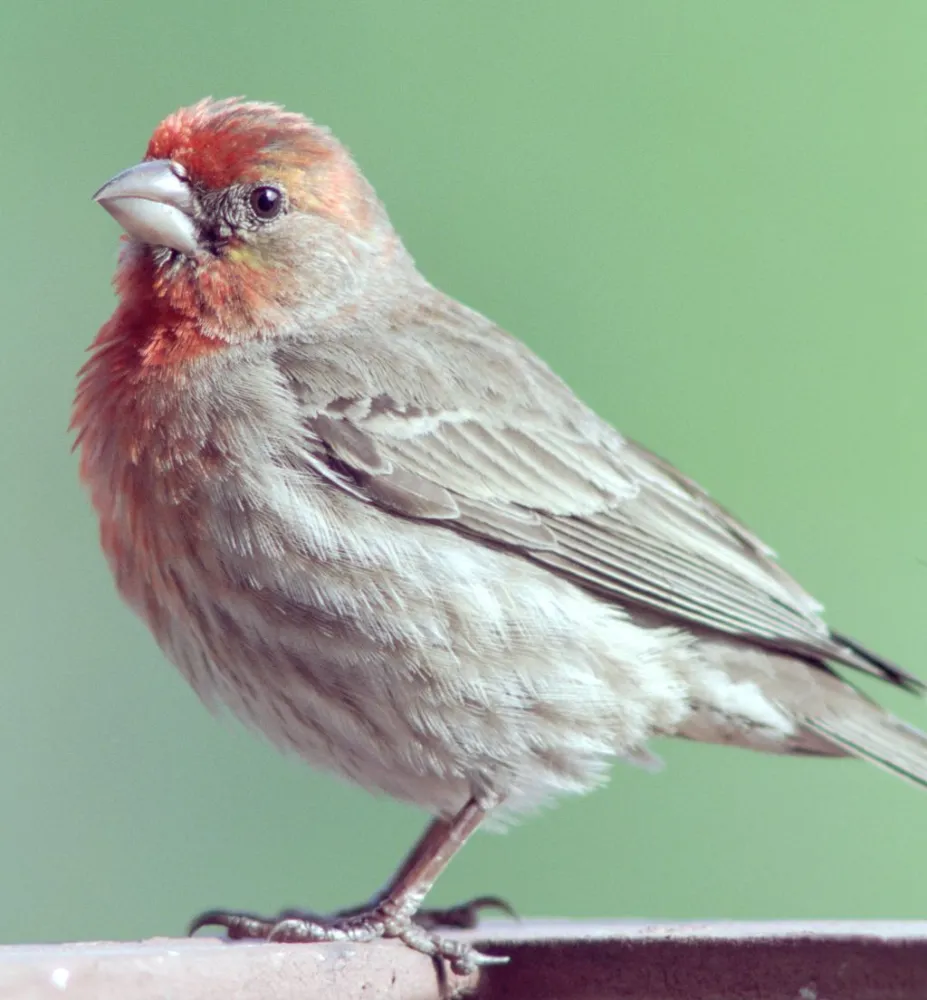
ALT: Male House Finch with a red forehead, face, and upper breast.
Photo: Matthew Hunt | Source: Wikimedia Commons | License: CC BY-SA 2.0 | Changes: None if original used; update if modified.
Scientific name: Haemorhous mexicanus
Where to find it: Widespread across the United States, southern Canada, and Mexico.
Habitat: Backyards, gardens, towns, agricultural areas, and open woodlands.
Diet: Seeds, buds, fruits, and other plant material.
If you have noticed a small brown bird with a red forehead at your backyard feeder, it may be a male House Finch.
Male House Finches typically display red or orange-red coloring on their foreheads, faces, throats, and upper breasts.
However, the rest of the bird is mostly brown, with noticeable streaks along the belly and flanks.
The intensity of the male’s red color can vary. Some males appear bright red, while others are more orange or yellowish.
This variation is partly related to carotenoid pigments obtained from their diet.
Female House Finches generally lack the male’s red coloring and are mostly grayish brown with extensive streaking.
House Finches are highly adaptable birds and are frequently seen around buildings, patios, bird feeders, and other human environments.
How to identify it: Look for a small seed-eating bird with a red forehead and breast, a short conical bill, and brown streaks on its sides.
Common confusion: Purple Finches can look very similar, but adult male Purple Finches typically have more extensive raspberry-colored plumage and less prominent dark streaking on their underparts.
6. Purple Finch
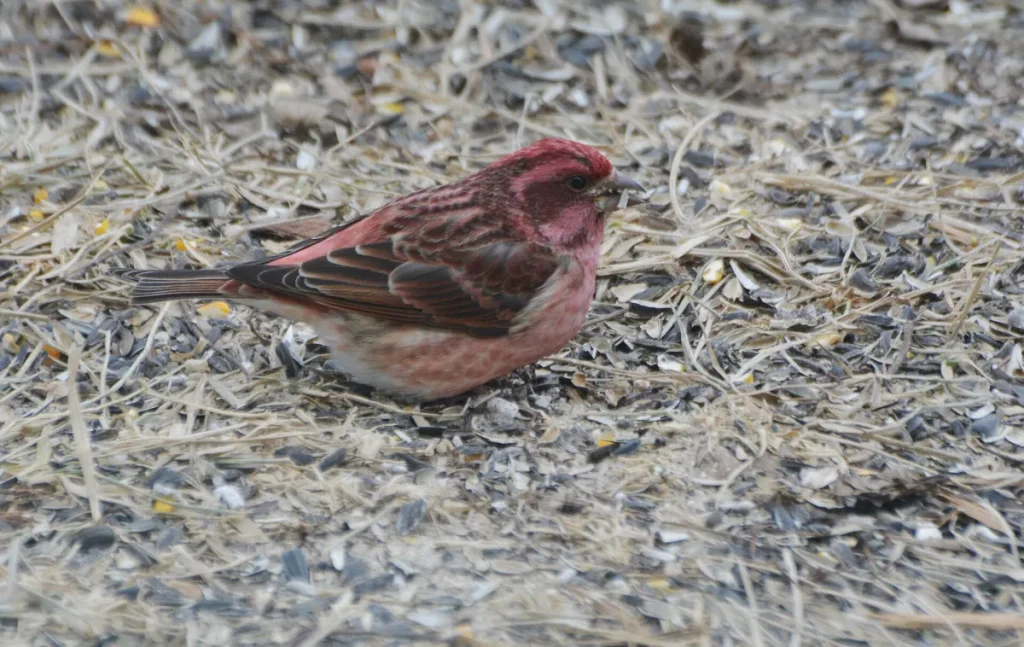
ALT: Male Purple Finch showing raspberry-red feathers on its head and upper body.
Photo: Andy Reago and Chrissy McClarren (Wildreturn) | Source: Wikimedia Commons | License: CC BY 2.0 | Changes: None if original used; update if modified.
Scientific name: Haemorhous purpureus
Where to find it: Forested regions of Canada and the northern United States, with seasonal movements into other areas.
Habitat: Coniferous and mixed forests, woodland edges, and gardens.
Diet: Seeds, buds, berries, and insects.
The Purple Finch has a confusing name because adult males are not actually purple.
Instead, they have a rich raspberry-red or pinkish-red appearance, particularly around the head, throat, and breast.
The red coloration often extends across the back, giving the bird a more uniformly reddish appearance than a typical male House Finch.
Purple Finches are associated with forested habitats but also visit backyard feeders, especially during winter.
Their populations can move southward irregularly depending on food availability.
Female Purple Finches are predominantly brown and white, with strong facial markings and streaked underparts.
How to identify it: Look for a stocky finch with a substantial conical bill, a raspberry-red head, and relatively diffuse breast streaking in adult males.
Common confusion: House Finches usually appear browner overall, with more concentrated red around the forehead and chest and clearer brown streaking along the lower body.
The distinction can be subtle, so comparing several features is more reliable than judging color alone.
7. Summer Tanager
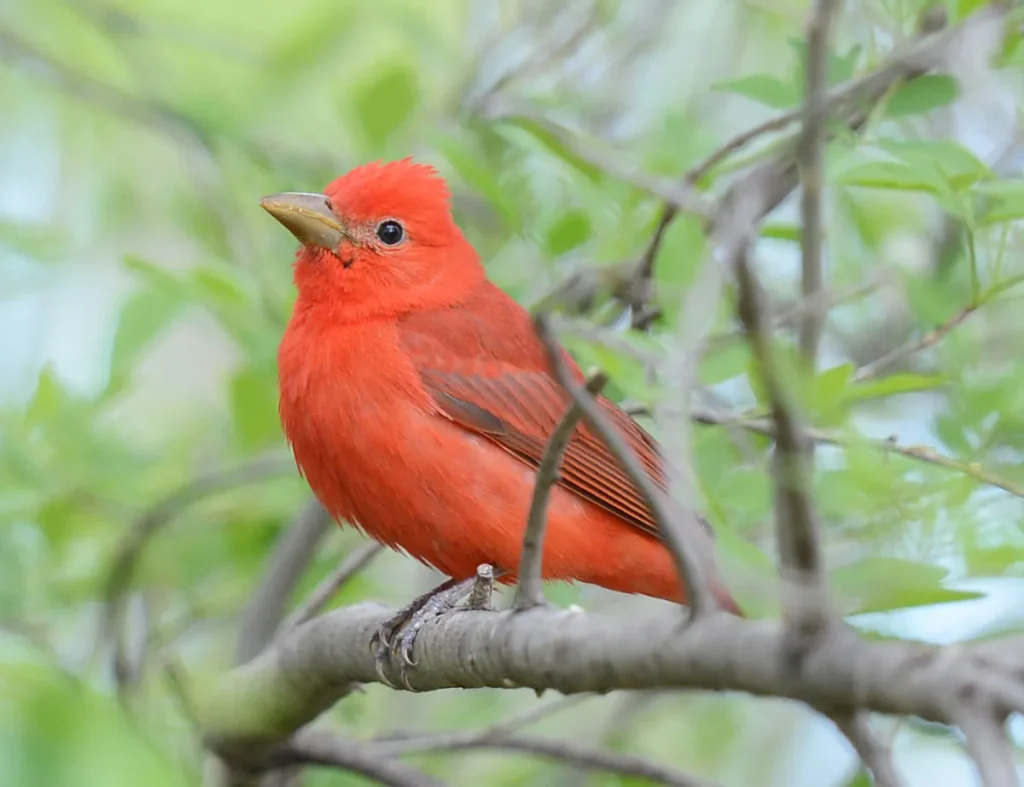
ALT: Adult male Summer Tanager with completely red plumage perched on a branch.
Photo: VJAnderson | Source: Wikimedia Commons | License: CC BY-SA 4.0 | Changes: None if original used; update if modified.
Scientific name: Piranga rubra
Where to find it: Breeds in the southern United States and parts of northern Mexico; migrates farther south outside the breeding season.
Habitat: Open deciduous woodlands, forest edges, and wooded riparian areas.
Diet: Insects, especially bees and wasps, as well as fruits.
The Summer Tanager is a spectacular red songbird with a relatively simple appearance.
Adult males are almost entirely red, from the top of the head to the tail.
Unlike Scarlet Tanagers, they do not have contrasting black wings or tails.
Their stout bills are useful for capturing insects, and they are especially well known for feeding on bees and wasps.
Summer Tanagers may catch insects in flight or search among leaves and branches.
Despite their striking color, they can be surprisingly difficult to spot because they often remain high in the tree canopy.
Female Summer Tanagers look very different. Their plumage is generally yellowish or olive-yellow rather than bright red.
Immature males may show a mixture of red and yellow feathers.
How to identify it: Look for a medium-sized songbird that is almost completely red, with a substantial pale bill and no obvious black wing patches.
Common confusion: Scarlet Tanagers have black wings and tails during the breeding season, while Northern Cardinals have distinctive crests and black facial masks.
8. Scarlet Tanager
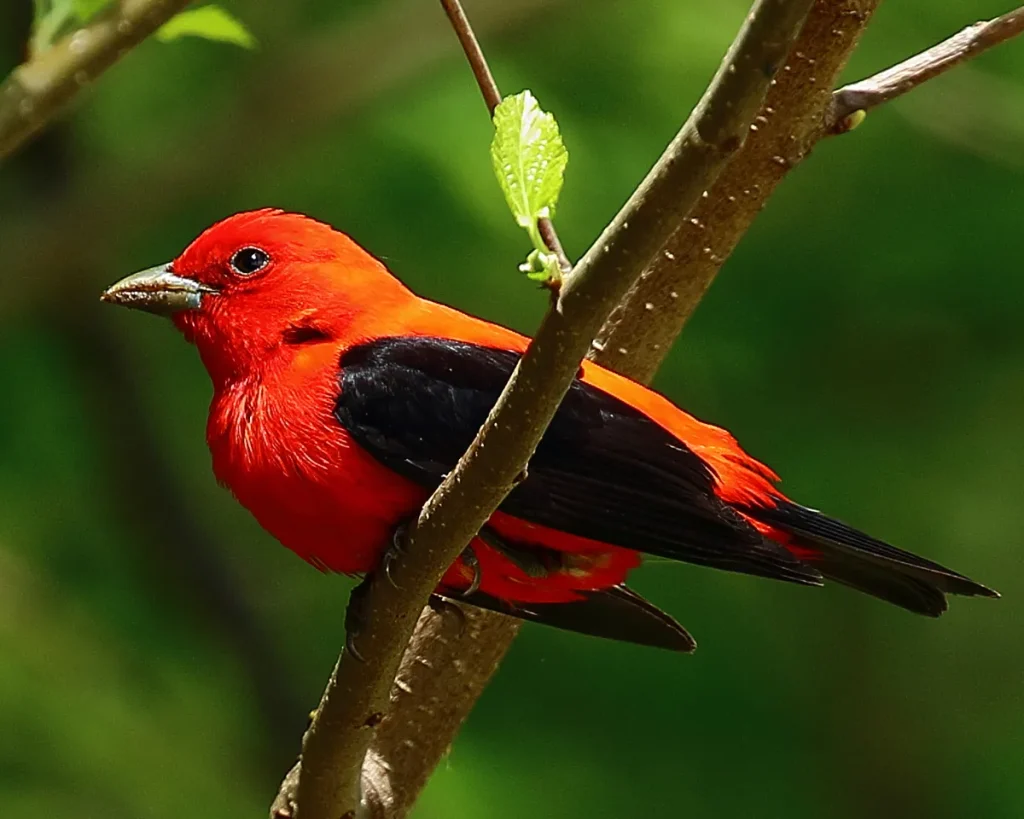
ALT: Male Scarlet Tanager in breeding plumage with a red head and black wings.
Photo: Ryan A. Candee | Source: Wikimedia Commons | License: CC BY-SA 4.0 | Changes: None if original used; update if modified.
Scientific name: Piranga olivacea
Where to find it: Eastern North America during the breeding season; migrates to northwestern South America for the nonbreeding season.
Habitat: Mature deciduous forests, especially wooded areas with extensive tree canopy.
Diet: Insects, spiders, and fruits.
The Scarlet Tanager is among the most brightly colored birds found in eastern North American forests during spring and summer.
Adult breeding males have brilliant scarlet-red heads and bodies, creating a striking contrast with their jet-black wings and tails.
However, these birds are often harder to observe than their coloring might suggest.
Scarlet Tanagers spend considerable time high among forest leaves, where branches and vegetation can conceal them.
Their calls and songs are sometimes easier to detect than the birds themselves.
Female Scarlet Tanagers are typically yellowish green with darker wings.
Males also change their appearance after the breeding season, replacing much of their brilliant red plumage with less conspicuous yellow-green feathers.
This seasonal transformation is an interesting example of how bird coloration can change. You can explore similar adaptations in our guide to animals that change color.
How to identify it: A breeding male has a bright red head and body with clearly contrasting black wings and tail.
Common confusion: Summer Tanagers are also red, but adult males lack the Scarlet Tanager’s black wings and tail.
9. Vermilion Flycatcher

ALT: Male Vermilion Flycatcher with a brilliant red head, dark eye mask, and brown wings.
Photo: Michael L. Baird | Source: Wikimedia Commons | License: CC BY 2.0 | Changes: None if original used; update if modified.
Scientific name: Pyrocephalus obscurus (historically also listed as Pyrocephalus rubinus in some references)
Where to find it: Southwestern United States, Mexico, and parts of Central and South America.
Habitat: Open scrublands, desert streams, wetlands, and other open areas with scattered perches.
Diet: Flying insects.
The male Vermilion Flycatcher is a small bird with extraordinarily bright red plumage.
Its crown, forehead, throat, and underparts are often a vivid orange-red or vermilion color.
A dark stripe extends through the eyes, while the wings, back, and tail are mostly brownish.
This creates one of the most distinctive red-and-dark color combinations among North American flycatchers.
Vermilion Flycatchers often perch on exposed branches, fence posts, or shrubs while watching for flying insects.
When they spot prey, they quickly leave the perch, catch the insect in the air, and frequently return to a nearby lookout point.
Females are much less colorful, usually showing grayish-brown upperparts and pale underparts with varying peach-colored or salmon-colored tones.
How to identify it: Look for a small flycatcher with an intense red crown and breast, dark eye mask, and a habit of catching insects from exposed perches.
Common confusion: A male House Finch is generally browner and streakier, with a thicker seed-eating bill rather than the flycatcher’s insect-catching bill.
10. Acorn Woodpecker

ALT: Acorn Woodpecker holding an acorn in its beak, showing its red crown and black-and-white face.
Photo: Frank Schulenburg | Source: Wikimedia Commons | License: CC BY-SA 4.0 | Changes: None by publisher if original used. The source photograph was previously adjusted by the photographer.
Scientific name: Melanerpes formicivorus
Where to find it: Western North America, including parts of the western United States and Mexico.
Habitat: Oak woodlands, wooded hillsides, and areas containing mature oak trees.
Diet: Acorns, insects, fruits, and other plant material.
The Acorn Woodpecker is a highly social bird with distinctive black, white, and red markings.
Its face contains contrasting black-and-white patches, while the top of its head displays a bright red cap.
Male and female Acorn Woodpeckers both have red feathers on the crown, but the arrangement differs.
In typical North American populations, males have red extending forward to the white forehead. Females have a black band between the white forehead and the red crown.
This species is particularly famous for its unusual food-storage behavior.
Acorn Woodpeckers collect acorns and place them into holes drilled into tree trunks, utility poles, and other wooden structures.
These storage sites are called granaries and may contain thousands of acorns.
Family groups often cooperate in defending their stored food and maintaining their territories.
How to identify it: Look for a medium-sized woodpecker with a bright red cap, bold black-and-white face, and pale eye.
Common confusion: Red-headed Woodpeckers have entirely red heads rather than a red cap surrounded by contrasting facial markings.
How to Identify a Bird With a Red Head
If you see an unfamiliar bird with red feathers on its head, the following details can help narrow down its identity.
1. Check Whether the Entire Head Is Red
A completely red head strongly suggests certain species.
Adult Red-headed Woodpeckers have an entirely red head, while male Northern Cardinals and Summer Tanagers have extensive red plumage covering much of the body.
Other birds may have only a red crown, crest, or forehead.
2. Look at the Wings and Back
Wing patterns provide some of the most useful identification clues.
A Scarlet Tanager has brilliant red breeding plumage with black wings and tail.
A Red-headed Woodpecker has large white wing patches and a mostly black back.
A Red-bellied Woodpecker has a heavily barred black-and-white back.
A House Finch has a brown, streaked body with red concentrated around the head and chest.
3. Examine the Bill
The shape of a bird’s bill often reveals its feeding habits.
Cardinals and finches have short, strong, conical bills for handling seeds.
Woodpeckers have relatively straight, pointed bills adapted for excavating wood and collecting food.
Flycatchers have bills suited to catching insects.
4. Consider the Habitat
Different red-headed birds prefer different environments.
Northern Cardinals and House Finches are common around backyards and residential neighborhoods.
Pileated Woodpeckers are most closely associated with wooded environments containing large trees.
Vermilion Flycatchers favor open areas in warmer regions.
Acorn Woodpeckers are strongly associated with oak woodlands.
5. Remember That Females May Look Different
Many red-headed birds display sexual dimorphism, meaning males and females have noticeably different appearances.
Male House Finches, Purple Finches, Summer Tanagers, and Scarlet Tanagers are substantially redder than females.
However, both male and female adult Red-headed Woodpeckers have red heads.
This distinction is particularly important when identifying birds from photographs.
Red-headed Woodpecker vs. Red-bellied Woodpecker
These two species are frequently confused because both have red feathers on their heads.
However, their appearances differ considerably.
| Feature | Red-headed Woodpecker | Red-bellied Woodpecker |
|---|---|---|
| Head | Entirely red in adults | Red crown or nape, mostly pale face |
| Back | Mostly black | Black-and-white barred |
| Wings | Large white patches | Black-and-white barred |
| Belly | Mostly white | Pale, often with faint reddish wash |
| Male vs. Female | Similar head color | Different red crown patterns |
| Typical Habitat | Open woodland and edges | Forests, parks, and suburbs |
Quick identification tip: If the bird has a completely red head and large white wing patches, think Red-headed Woodpecker. If it has a barred back and a red stripe along the top or back of its head, think Red-bellied Woodpecker.
House Finch vs. Purple Finch: Which Has the Redder Head?
Both species are small songbirds with reddish males and stout bills.
House Finch males usually have red concentrated around the forehead, face, throat, and upper chest. Their lower bodies often show conspicuous brown streaks.
Purple Finch males tend to look more uniformly raspberry-red across the head and upper body.
Their bills, facial markings, and body proportions can also provide identification clues.
Color alone is not always reliable, especially when lighting conditions affect photographs.
For accurate identification, compare several features rather than relying on one characteristic.
Which Red-headed Birds Visit Backyard Feeders?
Some red-headed birds are relatively easy to attract to a suitable backyard habitat.
| Species | Common Backyard Attraction |
|---|---|
| Northern Cardinal | Sunflower seeds, safflower seeds, shrubs |
| House Finch | Sunflower seeds and other small seeds |
| Purple Finch | Sunflower seeds, especially in suitable northern or winter habitats |
| Red-bellied Woodpecker | Suet, peanuts, and suitable trees |
| Pileated Woodpecker | Mature trees, deadwood, and occasionally suet |
| Red-headed Woodpecker | Open wooded habitat and, sometimes, feeders |
Backyard birds also need clean water, native vegetation, shelter, and safe nesting locations.
To reduce collisions, place feeders and nearby windows with bird safety in mind. Keep feeders clean to reduce the spread of disease.
Are Birds With Red Heads Common in Winter?
Some North American birds retain red feathers throughout the year.
Northern Cardinals, Red-bellied Woodpeckers, and House Finches can often be observed during winter in suitable parts of their ranges.
Other red-headed birds are more seasonal.
Scarlet Tanagers and Summer Tanagers generally migrate away from much of their North American breeding range.
Purple Finches may move irregularly depending on food availability.
For this reason, the time of year is an important clue when identifying red-headed birds.
A bright red bird visiting a backyard feeder in January in the eastern United States is more likely to be a Northern Cardinal or House Finch than a Scarlet Tanager.
Frequently Asked Questions
What is the most common bird with a red head in North America?
Northern Cardinals and House Finches are among the most familiar red-headed or red-faced birds around homes and gardens in many parts of North America.
The species you are most likely to see depends on your location and habitat.
What small brown bird has a red head?
A male House Finch is a strong possibility. It has a reddish forehead, face, and upper breast, with a mostly brown and streaked body.
Male Purple Finches can also appear brownish and red, particularly around the head and chest.
What bird has a red head and a black-and-white body?
An adult Red-headed Woodpecker is one possibility. It has a completely red head, black upperparts, white underparts, and large white wing patches.
An Acorn Woodpecker also has bold black-and-white markings but usually only a red cap.
What woodpecker has a red head?
Several North American woodpeckers have red head markings, including Red-headed Woodpeckers, Red-bellied Woodpeckers, Pileated Woodpeckers, and Acorn Woodpeckers.
The size and placement of the red area are important identification clues.
Do female birds have red heads?
Some do. Adult female Red-headed Woodpeckers have red heads much like males. Female Pileated Woodpeckers also have red crests.
In other species, such as House Finches and Northern Cardinals, females are generally much less red than males.
What is the difference between a cardinal and a red-headed woodpecker?
Northern Cardinals have stout conical bills, pointed crests, and bright red bodies in males.
Red-headed Woodpeckers have straight, pointed bills, black-and-white bodies, and entirely red heads in adults.
Their shapes and feeding behaviors are also very different.
Which red bird has black wings?
A male Scarlet Tanager in breeding plumage has a bright red head and body with contrasting black wings and tail.
Are all red-headed birds male?
No. Although males are often more brightly colored, females of certain woodpecker species also have red head markings.
The appearance depends on the species.
Final Thoughts
North America’s red-headed birds come in an impressive variety of shapes, sizes, and colors.
Some, like the Northern Cardinal, display brilliant red feathers across most of the body. Others, such as the Red-bellied Woodpecker and Acorn Woodpecker, have smaller red patches that become essential identification features.
The next time you notice a bird with a red head, pay attention to its bill, wings, body size, and surroundings.
With a little practice, you can learn to recognize many of these remarkable birds without needing to rely on color alone.
Related Articles
- 10 Animals That Store Food for Winter
- 10 Animals That Build Dams, Nests, and Other Remarkable Homes
- Animals That Change Color
- 12 Animals That Live in Caves
References and Further Reading
- Cornell Lab of Ornithology – Northern Cardinal
- Cornell Lab – Red-headed Woodpecker
- Cornell Lab – Red-bellied Woodpecker
- Cornell Lab – Pileated Woodpecker
- Cornell Lab – House Finch
- Cornell Lab – Purple Finch
- Cornell Lab – Summer Tanager
- Cornell Lab – Scarlet Tanager
- Cornell Lab – Vermilion Flycatcher
- Cornell Lab – Acorn Woodpecker