A praying mantis egg case looks like a tan or brown lump of hardened foam attached to a twig, stem, or fence. A round, puffy case can point to a Chinese mantis. A slim case with a pale stripe suggests a Carolina mantis. A longer case with a more even brown color can be a European mantis.
The case is called an ootheca. The individual eggs are tucked inside it. If you’re trying to identify one, start with a side view to see its shape. Then look straight at the surface that faces away from the twig to check the central seam, where the young mantises emerge.

How to Identify 3 Praying Mantis Egg Cases
These clues apply to three mantises found in parts of North America. Use the shape and stripe together, and check which mantises live in your area.
| Mantis | Overall shape | What to look for |
|---|---|---|
| Chinese mantis | Rounded and bulky | A tan, foam-like lump that bulges away from the stem |
| Carolina mantis | Long, narrow, and relatively flat | A pale central band often bordered by darker stripes |
| European mantis | Elongated and usually bulkier than the Carolina case | A more uniform tan or brown surface, often with a less distinct pale band |
1. Chinese Mantis Egg Case
The Chinese mantis (Tenodera sinensis) makes the puffy case shown in the cover photo. From the side, it can look like a small toasted marshmallow stuck to a branch. The main clue is its bulk. It projects from the stem, with a rounded outline and a textured surface.
Check bare shrub branches and sturdy plant stems in fall and winter. Once the leaves drop, the case is easier to see.
2. Carolina Mantis Egg Case
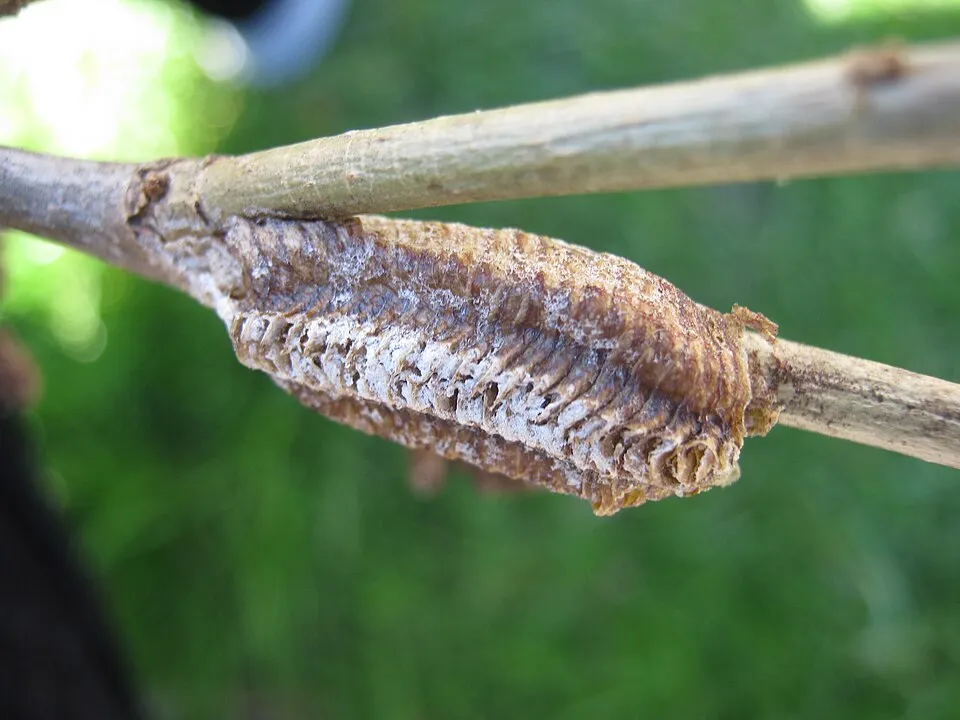
The Carolina mantis (Stagmomantis carolina) makes a flatter case that often runs lengthwise along a twig. In the photo below, notice the pale, ribbed band down the middle and the darker areas beside it.
A side view helps here. A case can look broad in a close-up, while a second photo from the side shows how closely it sits against the twig.
3. European Mantis Egg Case
The European mantis (Mantis religiosa) also makes an elongated case. Compared with a typical Carolina mantis case, it usually looks fuller and more evenly tan or brown. Its pale center stripe, if visible, tends to be less distinct.
The case below was photographed in Ontario. It has a long outline like a Carolina mantis case, but its rounded profile and more even color give you two extra clues.

How to Tell If a Praying Mantis Egg Case Has Hatched
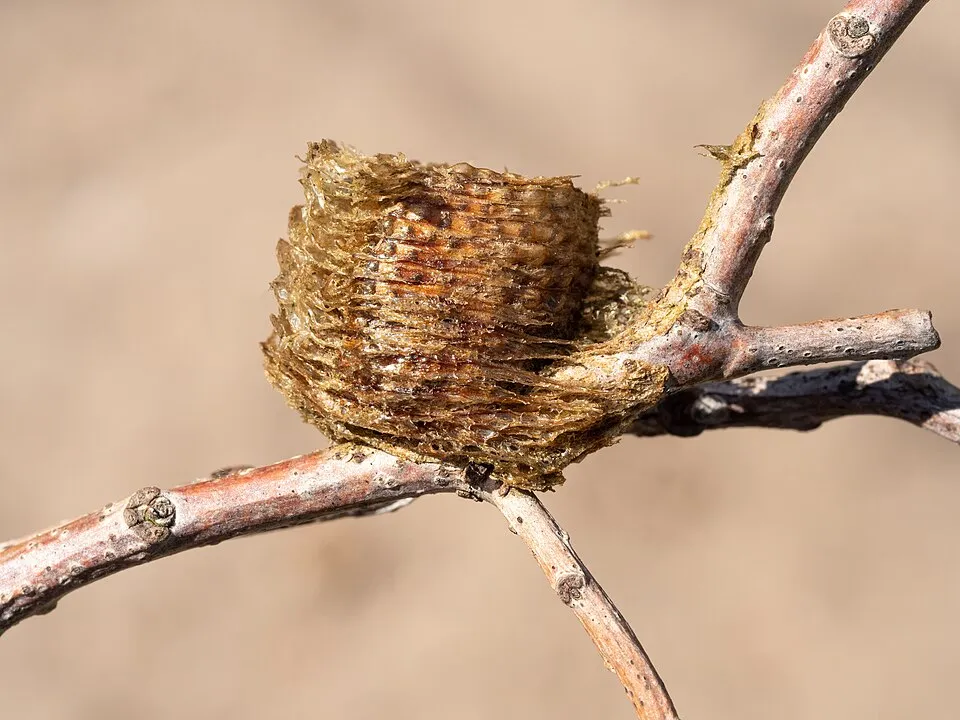
Look along the central seam. After young mantises emerge, that area can look ragged or open, with a series of gaps where the surface has lifted. A closed, smooth-looking seam may indicate an unhatched case, although appearance alone can’t tell you whether the eggs inside are viable.
A few isolated round holes elsewhere on the case are harder to interpret. Tiny wasps that develop on mantis eggs can chew their own exit holes. If you see scattered holes, check the seam before deciding what happened.
When Do Praying Mantis Eggs Hatch?
In temperate parts of North America, these mantises usually lay their eggs in late summer or fall. The eggs spend the winter inside the case, and the young typically emerge as temperatures warm in spring. The timing varies with local weather.
An egg case on an evergreen branch can hatch earlier if the branch is brought into a warm house. If you find a case outside and want to watch for hatching, take a close-up in place and use it to compare the seam when you check again in spring.
See how other animals get through the cold months in our guide to where frogs go in winter.
Sources
- Illinois Extension — How to identify Carolina, Chinese, and European mantises
- Illinois Extension — Where to find mantis egg cases and when they hatch
- University of Maryland Extension — What a hatched egg-case seam looks like
- Journal of Animal Ecology — How parasitic wasps emerge from mantis egg cases