Have you ever watched a crow pull food from a narrow hole with a stick or seen a sea otter smash a shell against a rock?
These animals are doing something once thought to be uniquely human: using tools to solve practical problems.
Tool use occurs in a surprising variety of animals, including mammals, birds, fish, and even octopuses. Some animals modify objects before using them. Others select stones, carry protective materials, or take advantage of hard surfaces to open food.
Here are 12 remarkable animals that use tools, with real examples of how their behavior helps them survive.
What Counts as Tool Use in Animals?
Scientists generally describe animal tool use as the purposeful manipulation of an external object to achieve a particular outcome.
For example, using a stick to retrieve insects or a rock to crack a hard shell are clear examples.
However, researchers sometimes disagree about borderline cases. A fish striking a shell against a fixed rock, for instance, is not quite the same as a monkey picking up and swinging a stone hammer.
Tool use also varies within species. Not every individual uses the same techniques, and some behaviors are found only in particular populations.
12 Tool-Using Animals at a Glance
| Animal | Tool | Purpose |
|---|---|---|
| 1. New Caledonian Crow | Hooked sticks | Extracting hidden insects |
| 2. Chimpanzee | Sticks and stones | Gathering insects and cracking nuts |
| 3. Sea Otter | Rocks and hard objects | Opening shellfish |
| 4. Bottlenose Dolphin | Marine sponges | Protecting its snout while foraging |
| 5. Bearded Capuchin | Stone hammers | Cracking nuts and accessing food |
| 6. Orangutan | Modified sticks | Extracting seeds and insects |
| 7. Egyptian Vulture | Stones | Breaking large eggs |
| 8. Woodpecker Finch | Twigs and cactus spines | Removing insect larvae |
| 9. Green Heron | Small bait objects | Attracting fish |
| 10. Veined Octopus | Coconut shells | Building portable shelter |
| 11. Graphic Tuskfish | Rocks and coral anvils | Breaking shellfish |
| 12. Asian Elephant | Branches | Swatting away flies |
1. New Caledonian Crow — A Bird That Makes Its Own Tools
Scientific name: Corvus moneduloides
Where found: New Caledonia, South Pacific
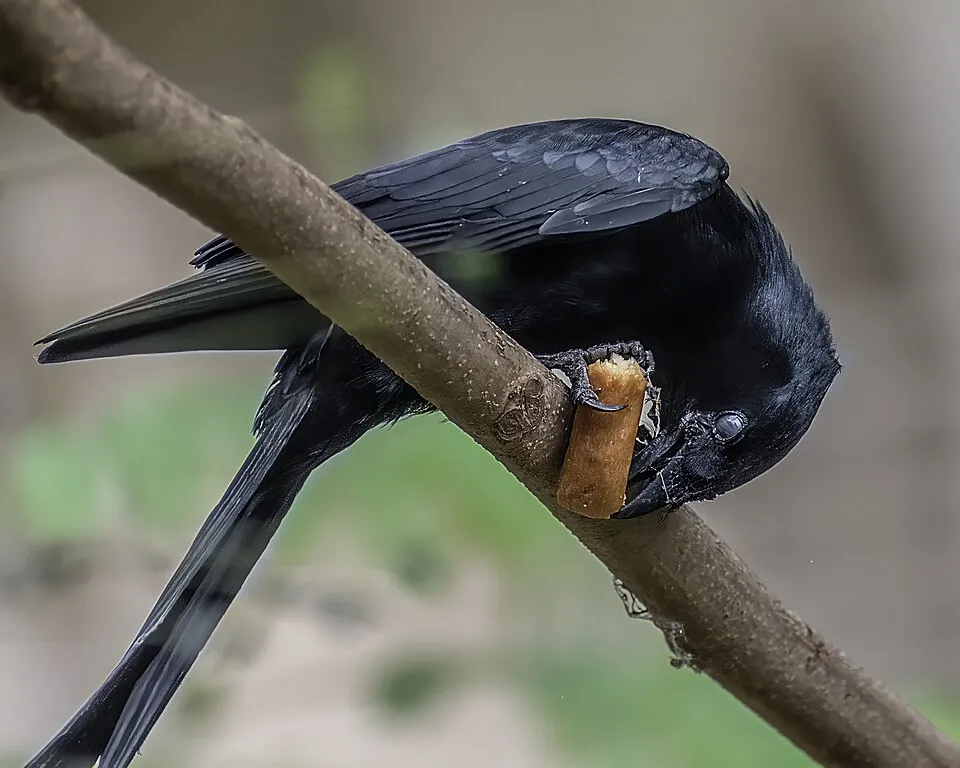
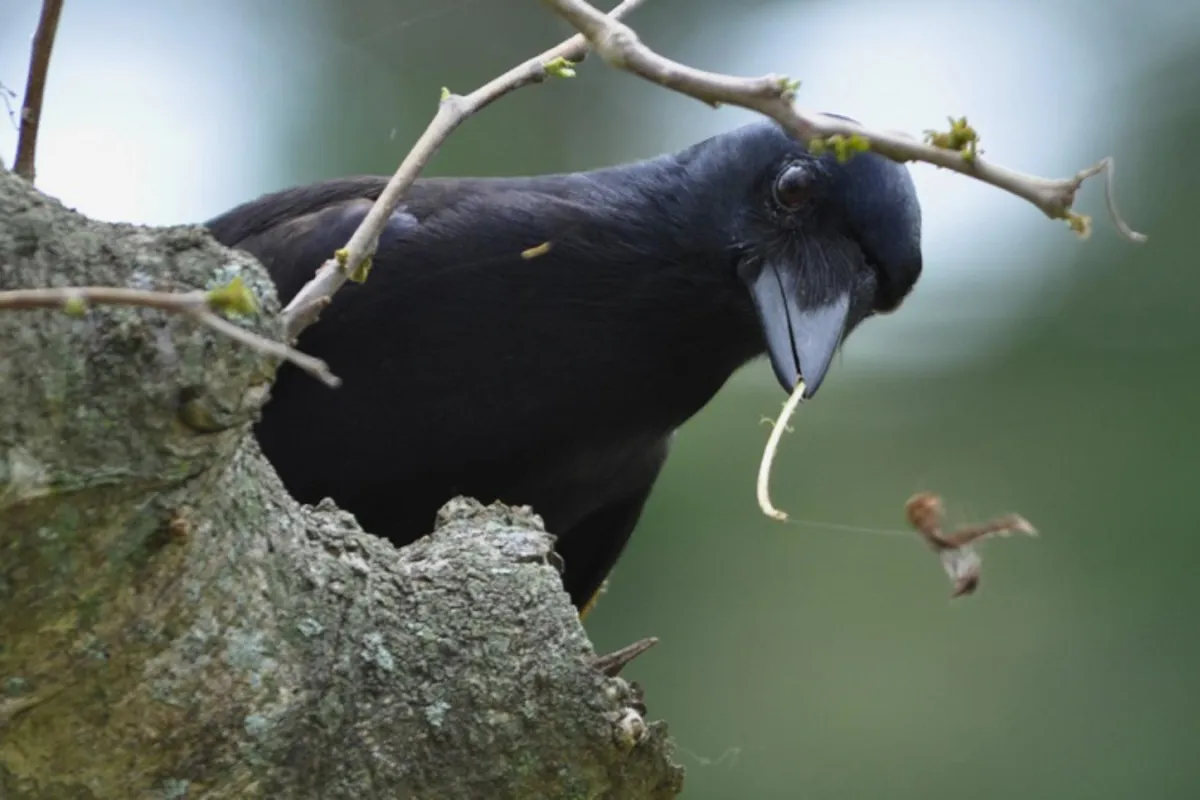
Suggested alt text: New Caledonian crow holding a slender stick tool while searching for insects in wood.
The New Caledonian crow is one of the most remarkable tool-using birds in the world.
In the forests of New Caledonia, these crows use sticks and plant materials to extract insects and other small prey from narrow spaces.
What makes their behavior especially impressive is that they do not always use objects exactly as they find them.
Some crows manufacture hooked tools by modifying twigs. The hook helps them catch and pull food from places that would otherwise be difficult to reach.
Researchers have also documented tools made from pandanus leaves.
The crow’s relatively straight bill and unusually broad binocular visual field help it hold and guide tools precisely.
This is more than a bird accidentally poking at something with a twig. In studied populations, tool use is a specialized feeding behavior.
Why it is extraordinary: New Caledonian crows can manufacture tools adapted to extracting hidden prey.
2. Chimpanzee — A Skilled User of Sticks and Stones
Scientific name: Pan troglodytes
Where found: Equatorial Africa

Suggested alt text: Wild chimpanzee using a thin stick to gather termites from a nest.
Chimpanzees are among the best-known animal tool users.
In some wild populations, chimpanzees prepare slender sticks or plant stems and insert them into termite nests.
When termites cling to the tool, the chimpanzee withdraws it and eats the insects.
Other chimpanzee populations use stones or wooden clubs to crack hard nuts on suitable anvils.
Some even use different tools in sequence, selecting one object to open access to a food source and another to collect the food.
Young chimpanzees often spend years watching older group members and gradually improving their techniques.
However, the exact tool traditions differ across communities. A technique common in one population may be absent from another.
Why it is extraordinary: Chimpanzees use a diverse toolkit, and some techniques are learned socially over many years.
3. Sea Otter — Cracking Shellfish With Rocks
Scientific name: Enhydra lutris
Where found: North Pacific coastal waters
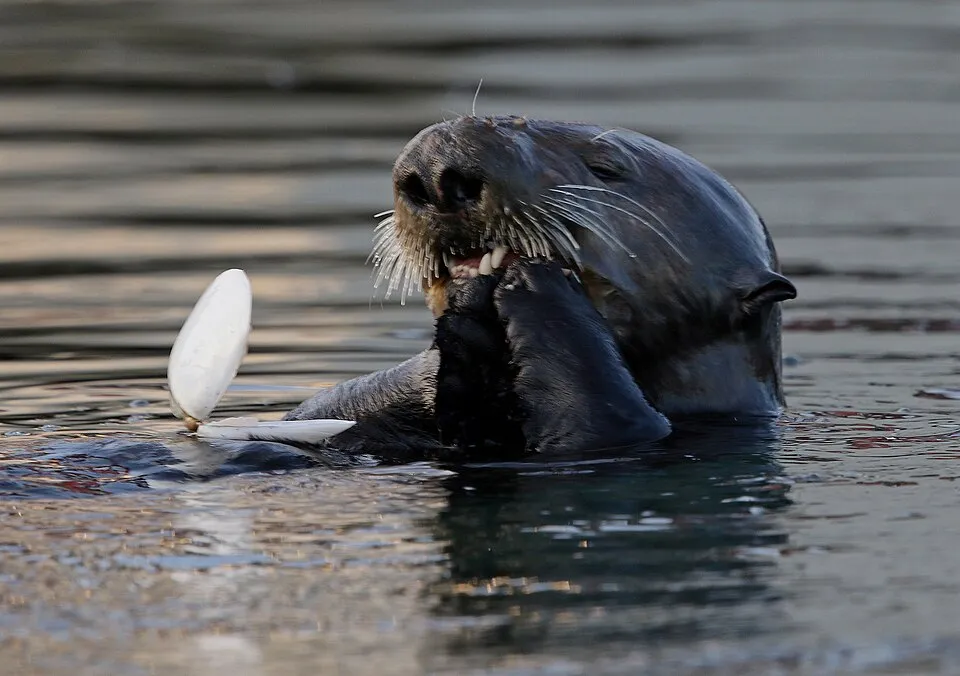
Suggested alt text: Sea otter floating on its back while using a rock to open a shellfish.
Sea otters spend much of their lives swimming and feeding in coastal waters.
Their diet includes marine invertebrates such as clams, mussels, crabs, and snails. Some of these animals have shells that are difficult to break open.
Rather than relying entirely on their teeth, sea otters sometimes use rocks or other hard objects.
An otter may float on its back, position a stone against its chest, and repeatedly strike a shellfish against it.
Other individuals use a hard object as a hammer.
A 2024 study of southern sea otters found that tool use helped individuals access harder prey while reducing damage to their teeth.
Not every sea otter uses tools with the same frequency. Tool use varies among individuals and populations.
Why it is extraordinary: Sea otters can use rocks as portable anvils or hammers to access food protected by hard shells.
4. Bottlenose Dolphin — Using Sea Sponges as Protective Tools
Scientific name: Tursiops aduncus
Where found: Indo-Pacific coastal waters; documented tool use in Shark Bay, Australia

Suggested alt text: Indo-Pacific bottlenose dolphin swimming near the seabed in Shark Bay, Australia.
Dolphins are famous for their intelligence and social behavior, but some have developed a particularly unusual feeding technique.
In Shark Bay, Western Australia, certain Indo-Pacific bottlenose dolphins use marine sponges as tools.
The dolphin removes a sponge from the seabed and carries it over the tip of its snout, also called the rostrum.
The sponge provides protection as the dolphin searches through the seafloor for hidden prey.
Researchers call this behavior sponging.
It is not practiced by every dolphin in Shark Bay, and it is not a universal behavior of the species.
Evidence suggests that young dolphins learn this technique through their mothers, making it an important example of socially transmitted foraging behavior.
Why it is extraordinary: Some dolphins use living marine sponges as protective equipment while hunting along the seabed.
5. Bearded Capuchin Monkey — Choosing Stones to Crack Nuts
Scientific name: Sapajus libidinosus
Where found: Brazil
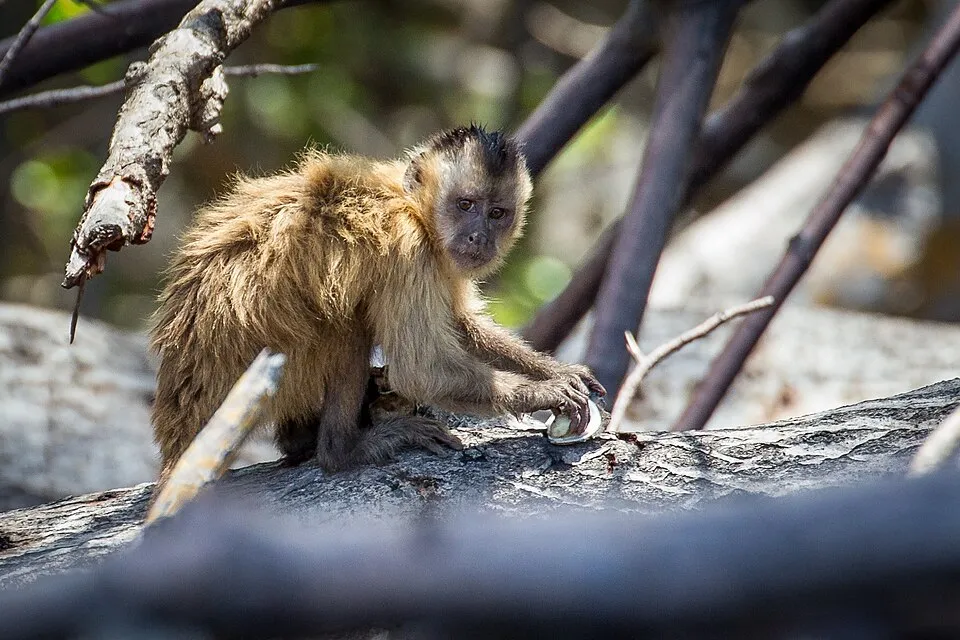
Suggested alt text: Bearded capuchin monkey holding a stone near nuts on a rocky surface in Brazil.
Bearded capuchin monkeys are small primates with surprisingly sophisticated stone-tool behavior.
In parts of Brazil, wild capuchins use stones to open hard nuts and other foods.
A monkey places a nut on a suitable surface and strikes it with a stone until the shell breaks.
The choice of stone matters.
Researchers have found that capuchins can select tools with different properties depending on the food they are processing.
Some populations have an even more varied toolkit.
Scientists studying wild capuchins have documented the use of stones for digging and sticks for probing underground food sources.
These behaviors are not identical across every population, which makes capuchins particularly interesting for studying how tool traditions develop.
Why it is extraordinary: Bearded capuchins select and use stone tools for specific tasks, sometimes combining different tools to obtain food.
6. Orangutan — Using Sticks to Reach Difficult Food
Scientific name: Pongo abelii
Where found: Sumatra, Indonesia

Suggested alt text: Sumatran orangutan in a tropical rainforest holding a slender branch.
Orangutans spend much of their lives in trees, where their long arms and strong hands help them move through the forest.
But some foods are difficult to access even with excellent climbing abilities.
In certain wild Sumatran orangutan populations, individuals use modified sticks to extract insects or reach food hidden inside plant structures.
One especially interesting example involves fruits from Neesia trees.
These fruits contain nutritious seeds but also have protective structures that make handling them challenging.
Some orangutans use sticks to help remove or access the seeds more safely.
Orangutans have also been observed using leaves as absorbent materials to collect water.
These examples show that tools can help animals overcome physical obstacles without needing to possess specialized claws or teeth for every task.
Why it is extraordinary: Some orangutans use modified plant materials to reach food and water that would otherwise be difficult to obtain.
7. Egyptian Vulture — Breaking Eggs With Stones
Scientific name: Neophron percnopterus
Where found: Parts of Africa, southern Europe, the Middle East, and Asia

Suggested alt text: Egyptian vulture standing on rocky ground with its pale body and distinctive yellow face.
The Egyptian vulture is a striking bird with pale plumage, dark flight feathers, and a yellow face.
It is also known for a remarkable form of tool use.
When attempting to open a large, hard-shelled egg, such as an ostrich egg, an Egyptian vulture may pick up a stone in its beak.
It then throws or pounds the stone against the egg.
Repeated impacts can crack the shell, allowing the bird to access the nutritious contents.
This behavior was documented in scientific observations decades ago and remains a classic example of tool use among birds.
The bird does not need to manufacture an elaborate device. It simply selects an external object and uses it to accomplish something its beak alone may struggle to do.
Why it is extraordinary: Egyptian vultures can use stones as impact tools to break eggs too tough to open easily with their beaks.
8. Woodpecker Finch — Fishing for Insects With Twigs
Scientific name: Camarhynchus pallidus
Where found: Galápagos Islands, Ecuador

Suggested alt text: Woodpecker finch perched on a tree branch in the Galápagos Islands.
The woodpecker finch is one of Darwin’s famous Galápagos finches.
Unlike a woodpecker, it does not have a specialized drilling beak capable of reaching every insect hidden beneath bark.
Instead, this small bird can use tools.
Woodpecker finches have been observed picking up twigs or cactus spines and inserting them into cracks and holes in wood.
The tool helps dislodge insect larvae and other prey.
Some individuals modify the tool to make it more useful.
This feeding technique becomes especially valuable when insects are hidden and difficult to reach directly with the beak.
Woodpecker finches are an excellent example of how animals can use simple external objects to extend their physical abilities.
Why it is extraordinary: A small finch can use a twig or cactus spine as a probe to reach prey hidden inside wood.
9. Green Heron — Using Bait to Catch Fish
Scientific name: Butorides virescens
Where found: North and Central America and parts of the Caribbean
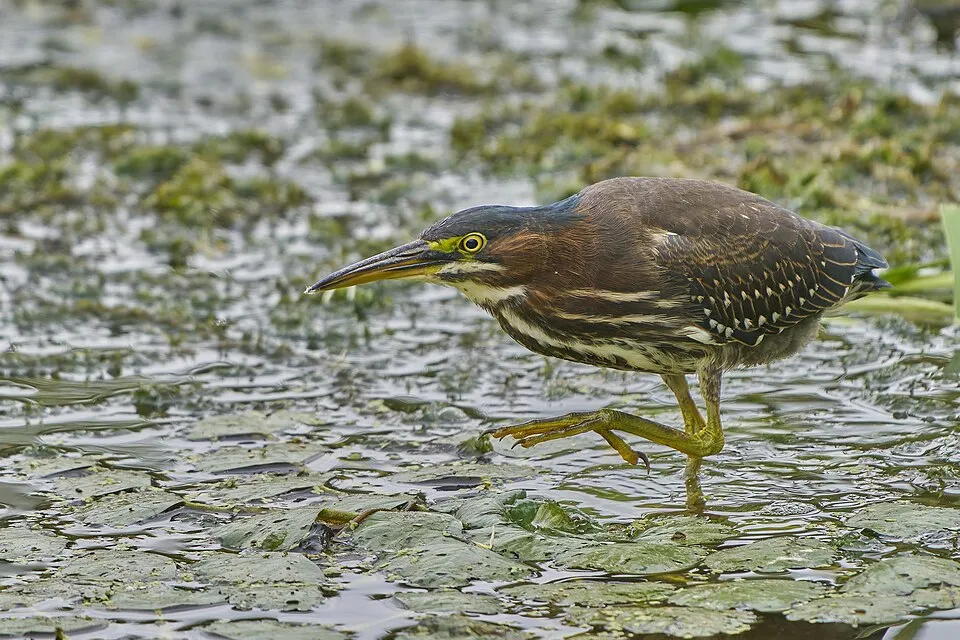
Suggested alt text: Green heron standing at the edge of a pond while watching fish near the water surface.
The green heron is a small, patient fishing bird often seen near ponds, marshes, and wooded waterways.
Most herons catch fish by waiting quietly and striking when prey moves within reach.
Some green herons take this strategy a step further.
They place small objects on the water’s surface to attract fish.
Researchers and birdwatchers have observed green herons using items such as insects, feathers, twigs, and even discarded bread as bait.
When curious fish approach the object, the heron attempts to catch them.
This behavior is especially fascinating because the bird is not using the object to grab prey directly.
Instead, it changes the behavior of another animal.
Why it is extraordinary: Green herons can use small objects as fishing lures, bringing prey within striking distance.
10. Veined Octopus — Carrying a Portable Shelter
Scientific name: Amphioctopus marginatus
Where found: Tropical Indo-Pacific waters
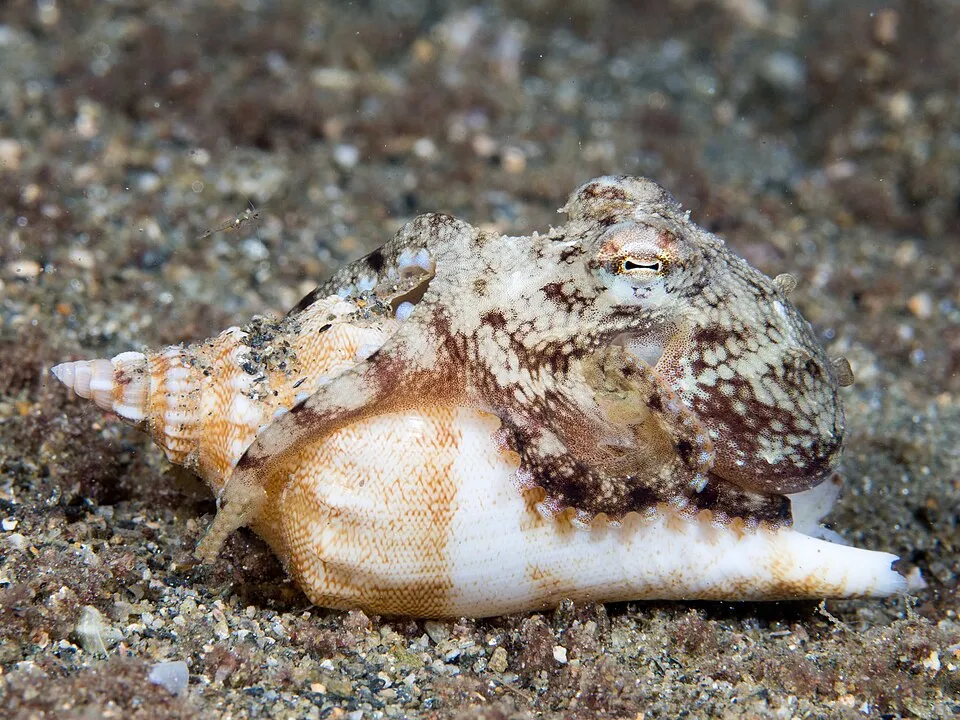
Suggested alt text: Veined octopus moving across the sandy seabed near a coconut shell.
The veined octopus, sometimes called the coconut octopus, provides one of the most unusual examples of tool use in the ocean.
Scientists have observed these octopuses collecting discarded coconut shell halves from the seafloor.
Instead of immediately hiding inside the shell, the octopus may carry it across an exposed area.
The animal sometimes moves awkwardly while transporting the shell, using its arms to hold the object.
When protection is needed, the octopus can arrange the shell halves to form a temporary shelter.
This behavior attracted scientific attention because the animal carries an object for a possible future use.
The shell is not simply part of its natural body covering. It is an external object that the octopus deliberately collects and later deploys.
Why it is extraordinary: A veined octopus can transport coconut shells and assemble them into a temporary protective refuge.
11. Graphic Tuskfish — Using Rocks as Underwater Anvils
Scientific name: Choerodon graphicus
Where found: Indo-Pacific reefs, including New Caledonia

Suggested alt text: Graphic tuskfish swimming above a rocky coral reef in tropical water.
The graphic tuskfish is a reef fish with powerful jaws and an unusual method of handling hard-shelled prey.
Researchers in New Caledonia documented these fish carrying molluscs to rocks and coral structures.
The fish repeatedly struck the shellfish against a hard surface until the shell broke.
In one documented sequence, a tuskfish used more than one anvil while attempting to open a bivalve.
Unlike a sea otter, which can hold a rock in its paws, the fish uses a stationary surface.
Whether fixed anvils should be classified in exactly the same way as handheld tools is a subject of discussion in animal behavior research.
Nevertheless, the fish’s deliberate transport and repeated striking of prey demonstrate flexible problem-solving behavior.
Why it is extraordinary: Graphic tuskfish can use hard reef surfaces as anvils to break open food they cannot easily crush directly.
12. Asian Elephant — Using Branches as Flyswatters
Scientific name: Elephas maximus
Where found: South and Southeast Asia

Suggested alt text: Asian elephant standing in a forest habitat holding a leafy branch with its trunk.
An elephant’s trunk is already an extraordinary natural tool.
It can grasp objects, collect food, spray water, and perform surprisingly delicate movements.
But elephants also use external objects to solve problems.
Researchers have documented Asian elephants using branches to swat away flies.
Some elephants select a branch and hold it in their trunks while brushing or striking areas of their bodies.
In a study that included both wild and captive elephants in India, researchers observed branch use among wild individuals and branch modification among captive individuals.
Some elephants shortened branches or removed parts that made them difficult to use effectively.
This is a useful example of tool behavior serving a purpose other than feeding.
Why it is extraordinary: Asian elephants can use branches as flyswatters, and some individuals modify those branches to make them more effective.
Why Do Animals Use Tools?
Animals use tools for different reasons, depending on the challenges they face.
1. Getting Food
Crows, chimpanzees, capuchins, finches, and tuskfish use tools or external surfaces to obtain food that would otherwise be difficult to reach.
2. Protection
Dolphins use marine sponges to protect their snouts while foraging, while veined octopuses can transport shells for shelter.
3. Processing Hard Materials
Sea otters and Egyptian vultures use hard objects to break into food protected by tough shells.
4. Changing Their Surroundings
Green herons manipulate small objects to attract prey, while elephants use branches to remove irritating insects.
These examples show that tool use is not one single behavior. Different animals have developed different solutions to their own ecological challenges.
Does Tool Use Mean an Animal Is Intelligent?
Tool use can involve learning, planning, memory, and the ability to recognize useful objects.
However, scientists do not judge animal intelligence simply by counting the number of tools a species uses.
Some animals perform specialized tool-use behaviors with relatively little flexibility. Others can choose among different objects, modify tools, or develop new solutions.
Researchers also distinguish between behaviors that are largely inherited and those that depend heavily on learning or social experience.
Chimpanzees and New Caledonian crows provide important examples of flexible tool behavior, but many other species demonstrate that practical problem-solving is widespread in the animal kingdom.
Frequently Asked Questions
Which animals use tools besides humans?
Chimpanzees, New Caledonian crows, sea otters, dolphins, orangutans, capuchin monkeys, certain birds, octopuses, and some fish have all been documented using tools or tool-like methods.
Do all chimpanzees use tools?
No. Tool-use traditions vary across chimpanzee populations. Different communities may use different objects and techniques depending on local conditions and learned behaviors.
Can birds make tools?
Yes. New Caledonian crows manufacture hooked stick tools, while woodpecker finches can use and sometimes modify twigs or cactus spines to extract prey.
Do dolphins really use sponges as tools?
Yes. Some Indo-Pacific bottlenose dolphins in Shark Bay, Australia, carry marine sponges over their snouts while searching for food on the seafloor. This behavior is not universal among dolphins.
Can fish use tools?
Certain fish have been observed using rocks and coral surfaces as anvils to break hard-shelled prey. Researchers continue to study how these behaviors fit different definitions of tool use.
Final Thoughts
Tool use is one of the most fascinating examples of animal behavior.
From crows making hooked sticks to sea otters cracking shells and octopuses carrying portable shelters, animals have developed remarkable ways to interact with their environments.
What makes these examples particularly interesting is their diversity.
Some animals use tools to obtain food. Others use them for protection, shelter, or body care.
Together, they remind us that the natural world contains countless forms of ingenuity worth studying.
Explore more amazing animal adaptations:
15 Animals That Live Underground — Discover how animals survive in hidden underground environments.
Scientific References & Further Reading
- Rutz, C., & St Clair, J. J. H. (2012). The evolutionary origins and ecological context of tool use in New Caledonian crows.
- McGrew, W. C. (2013). Is primate tool use special? Chimpanzee and New Caledonian crow compared.
- University of California, Santa Cruz (2024). Sea otters use tools when feeding to survive a changing world.
- NOAA Ocean Today. Dolphins Use Tools.
- Wild capuchin monkeys use stones and sticks to access underground food. Scientific Reports, 2024.
- Smithsonian’s National Zoo. Orangutan — Behavior and Tool Use.
- van Lawick-Goodall, J., & van Lawick-Goodall, H. (1966). Use of Tools by the Egyptian Vulture.
- Charles Darwin Foundation. Woodpecker Finch — Camarhynchus pallidus.
- Cornell Lab of Ornithology. Green Heron — Identification and Behavior.
- Finn, J. K., Tregenza, T., & Norman, M. D. (2009). Defensive tool use in a coconut-carrying octopus.
- Pryor, K. J., & Milton, A. M. (2019). Tool use by the graphic tuskfish Choerodon graphicus.
- Hart, B. L., et al. (2001). Cognitive behaviour in Asian elephants: use and modification of branches for fly switching.