The Eurasian Eagle-Owl (Bubo bubo) gives a deep hoot that often sounds like two joined syllables, oo-hoo. Listen for the pause after each hoot. The bird may repeat that same short phrase several times from a perch.
What does a Eurasian Eagle-Owl sound like?
In the first clip, listen for the rounded start of each hoot and the softer ending. The recording captures a male calling three times, with several seconds between calls.
A male Eurasian Eagle-Owl hoots in Varese, Italy.
The second clip was recorded in Sweden. You can hear the same short shape to the hoot, with longer gaps between calls in this excerpt. If you hear a single low note in the field, listen a little longer so you can compare the sound and spacing across several calls.
A Eurasian Eagle-Owl sings near Norrköping, Sweden.

A Eurasian Eagle-Owl in Rosas, Madrid, Spain.
When do eagle-owls call, and why?
In a year-long field study in Spain, calling peaked around sunset and sunrise. The researchers also heard more duets before eggs were laid. Calls can serve both as a territorial announcement and as a way for mates to communicate. When a pair calls back and forth, the female’s voice is generally higher than the male’s.

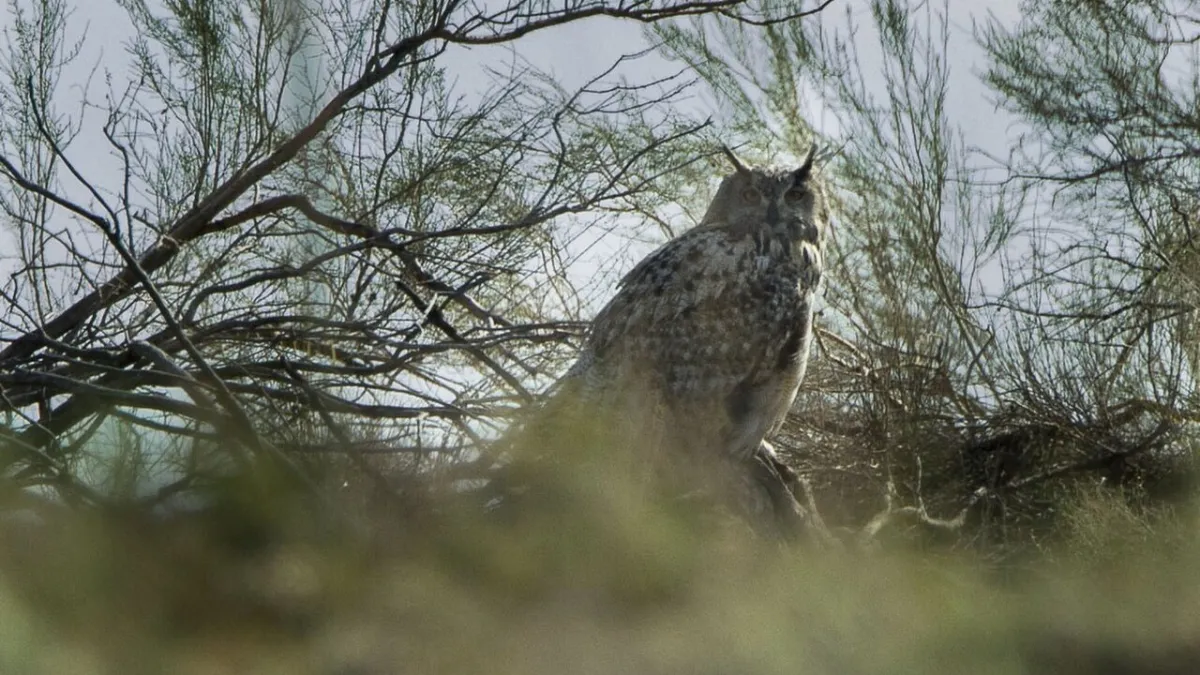
A Eurasian Eagle-Owl blends into the rocks in Ladakh, India.
Watch for the white throat patch
As the owl hoots, its throat expands and exposes a patch of white feathers. The patch appears and recedes with successive calls. In a field experiment, researchers found that this patch stood out most clearly against its surroundings around the time the owls called at dusk. An eagle-owl facing another bird can send a visible signal along with its hoot.
For more examples of how rhythm and spacing can help identify a call, see Owl Sounds at Night.
Sources
- British Trust for Ornithology. Eurasian Eagle-Owl. BTO
- Delgado, M. M., and Penteriani, V. Vocal Behaviour and Neighbour Spatial Arrangement During Vocal Displays in Eagle Owls. Journal of Zoology. vincenzopenteriani.org
- Penteriani, V., and Delgado, M. M. (2009). The Dusk Chorus from an Owl Perspective. PLOS ONE.