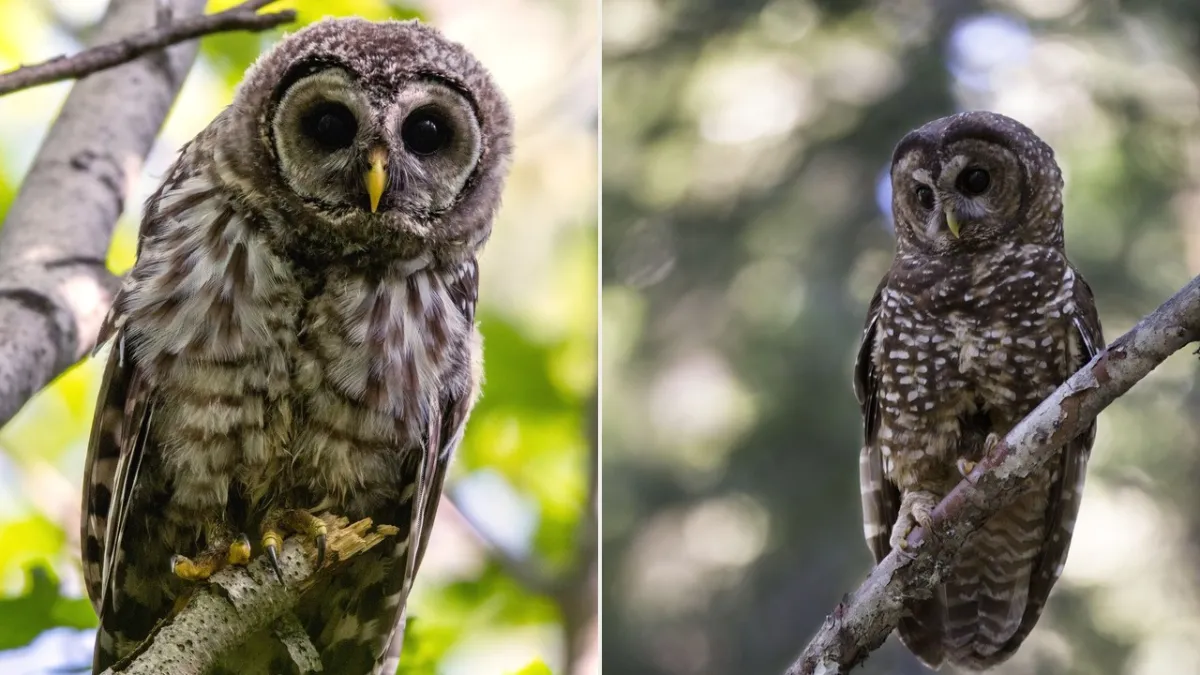
To tell a barred owl from a spotted owl, start with the chest and belly. A barred owl has brown bars across the upper chest and long, dark streaks down a pale belly. A spotted owl has pale oval spots on a darker brown chest and belly. Both have dark eyes and rounded heads, which is why the body pattern is often the clearest clue. allaboutbirds.org
| Field mark | Barred owl | Spotted owl |
|---|---|---|
| Upper chest | Brown bars running across the chest | Pale oval spots |
| Belly | Long brown streaks on a pale background | Pale spots on a darker brown background |
| Face | Usually paler gray-brown | Usually darker, with pale marks between the eyes |
| Familiar call | “Who cooks for you?” series of hoots | Short four-note hoot in the northern subspecies |
1. Look for two directions of markings on a barred owl
On an adult barred owl, the markings change direction below the chest. The upper bars run side to side. Lower down, the brown streaks run toward the feet. If a branch hides part of the bird, look for the lower streaks through the gaps. allaboutbirds.org

A barred owl in Acadia National Park, Maine. Look for the horizontal upper-chest bars and darker streaks below.
2. Look for pale spots across a spotted owl’s underside
A spotted owl’s pale spots stand out against its darker brown chest and belly. From a distance, the spots can look like rows of small white dashes. Check the front of the bird when you can. Both species have pale markings on their backs, so a rear view gives you fewer clues. allaboutbirds.org

A female spotted owl at Mount Rainier National Park. Pale spots stand out against the dark chest and belly.
3. Check the face when the body is hidden
A spotted owl often has a darker facial disc and pale feathers that form an X between the eyes. A barred owl usually has a paler face. Facial color varies, especially among spotted owl subspecies, so use it alongside the chest pattern if you can see both. The two species overlap in size. allaboutbirds.org
4. Listen through a full call
A barred owl’s familiar hoots sound like “Who cooks for you? Who cooks for you-all?” The northern spotted owl commonly gives a much shorter four-note hoot. Both species make other calls, so hearing a full phrase gives you more to work with than a single hoot. www.allaboutbirds.org
5. Use the forest and location as supporting clues
Spotted owls are associated with mature forests in western North America. Northern spotted owls often use dense conifer forests with large trees. Barred owls also use mature woodland, including forests near streams and swamps. Their ranges overlap in parts of the Pacific Northwest, where a clear view of the belly or a recognizable call can help settle the identification. allaboutbirds.org
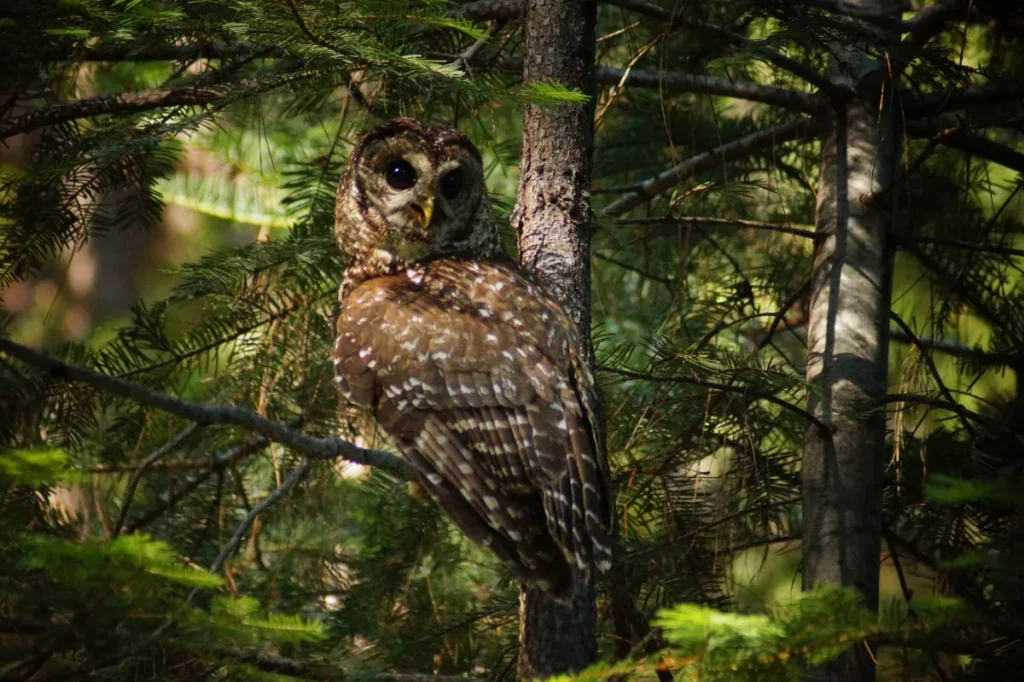
A California spotted owl perched in a conifer.
Related reading · Barn Owl vs. Barred Owl
Sources
- Cornell Lab of Ornithology. Barred Owl Identification and Spotted Owl Identification
- Cornell Lab of Ornithology. Barred Owl Life History and Spotted Owl Life History
- U.S. Forest Service. Spotted Owl Biology and Vocalizations
- Wiens, Anthony, and Forsman, 2014. Northern Spotted Owls and Barred Owls in Western Oregon


