A barred owl’s best-known sound is a series of deep hoots that sounds like “Who cooks for you? Who cooks for you-all?” Listen for two groups of notes and a longer finish. A pair calling together can sound very different, with hoots, cackles, and gurgling notes mixed together. allaboutbirds.org
Barred owl hoot recorded in Nova Scotia, Canada. Recording by Doug Hynes, excerpted and converted to MP3. Original recording · CC BY-SA 4.0
How to recognize the “Who cooks for you?” hoot
The familiar call usually has eight or nine notes. On the first listen, focus on the pause between the two groups. Play it again and listen to how the last note draws out. That rhythm is easier to recognize in the woods than the exact pitch, especially when the owl is calling from a distance. allaboutbirds.org

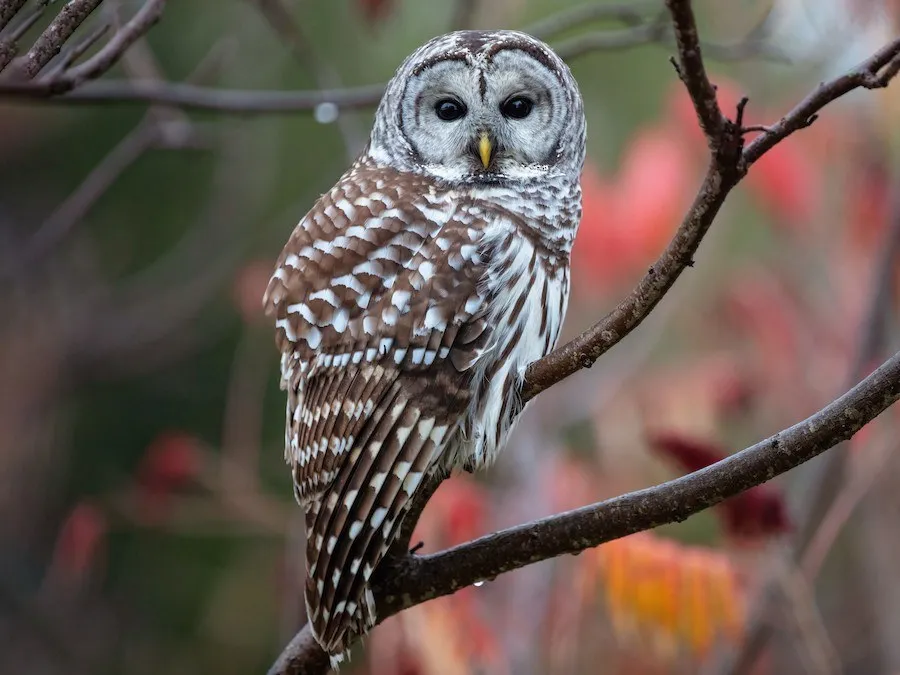
An adult barred owl perched at Conestee, South Carolina.
What does a barred owl duet sound like?
When a pair calls back and forth, the sound can build quickly. Listen for bursts of cackling and gurgling between the deeper hoots. Cornell describes these lively duets in courtship, and the overlapping notes help explain why two barred owls can sound like several animals calling at once. allaboutbirds.org
Two barred owls calling in Chapel Hill, North Carolina. Recording by steve, converted to MP3. Original recording · CC BY-SA 4.0
What does a young barred owl sound like?
A young barred owl begging for food can make a high, rising shriek. On Cornell’s sound page, choose Juvenile calls to hear the recording from New York, then replay the adult hoot above to hear how different the sounds are. allaboutbirds.org
Listen to the juvenile recording on Cornell’s sound page

A young barred owl perched in St. Louis, Missouri.
Do barred owls call during the day?
Yes. A field study documented 13 distinct adult vocalizations and heard barred owls during daytime as well as at night. Calling was more frequent at night in that study, with peaks in the early evening and before dawn. Woods near a stream or swamp are good places to listen for them. academic.oup.com
Sources
- Cornell Lab of Ornithology. Barred Owl Sounds
- Cornell Lab of Ornithology. Barred Owl Life History
- Odom and Mennill, 2010. A Quantitative Description of the Vocalizations and Vocal Activity of the Barred Owl