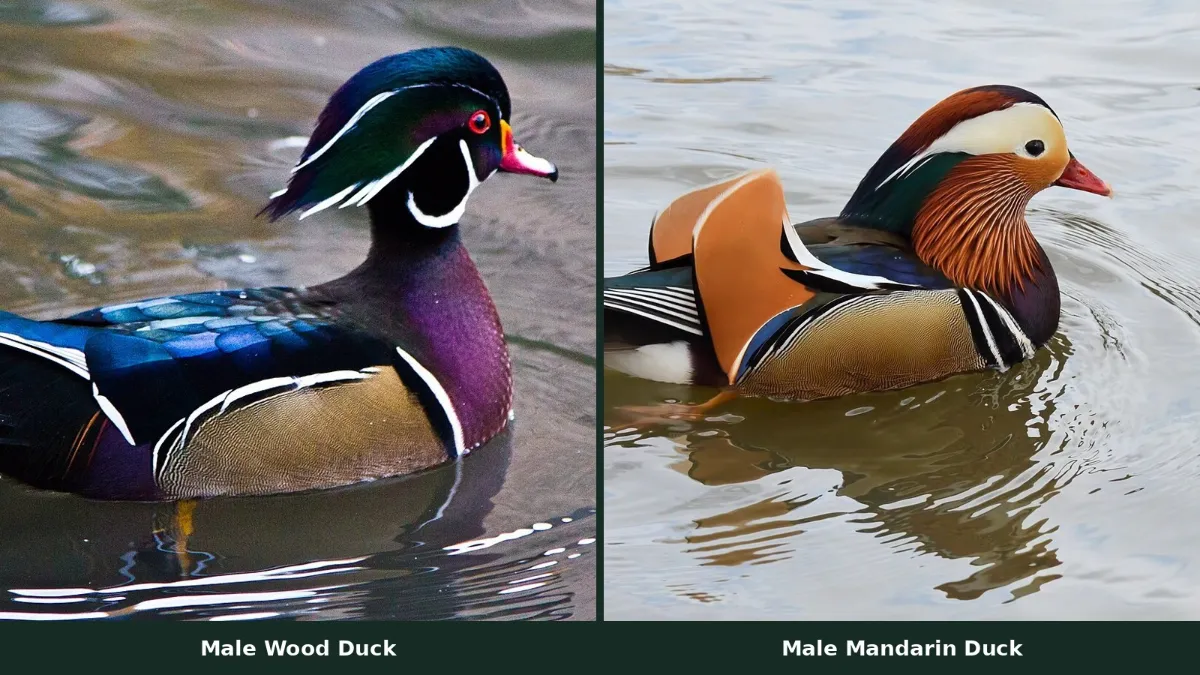
The easiest way to tell a Wood Duck from a Mandarin Duck depends on which bird you’re looking at. For colorful males, look for orange sails on the back. For brown females, zoom in on the white marking around the eye. A Wood Duck usually has a broader white patch, while a Mandarin Duck tends to have a thinner ring with a fine stripe trailing behind it.
1. Look for orange sails on a colorful male
A male Mandarin Duck in breeding plumage has two large orange feathers that stand up above its folded wings. It also has a pale area around the eye and a fan of orange feathers along the cheek.
A male Wood Duck has a glossy crest, a bright red eye, and crisp white lines across its face and neck. In the cover photo, the white lines on the Wood Duck are easy to see even though parts of its head look almost black. The Mandarin Duck’s orange sails are visible behind its shoulders.
2. Compare the white markings around a female’s eye
Look at the width of the white marking just behind the eye. On a female Wood Duck, it usually spreads into a broad, white teardrop. On a female Mandarin Duck, the white area is generally narrower and continues backward as a fine stripe.
The shape can vary from bird to bird. If the marking looks unusually narrow on a possible Wood Duck, use the bill tip as a second clue.

Female Wood Duck on the left and female Mandarin Duck on the right. Compare where the white marking widens or narrows behind each eye.
3. Zoom in on the very tip of the bill
Look for the nail, the small, hard cap at the bill’s tip. It is usually dark on a female Wood Duck and pale on a female Mandarin Duck. Check the cap itself, since the rest of the bill can look gray or dark on both birds.
This clue is easiest to use in a sharp side-on photo. A wet bill can catch the light, so check the eye marking and the bill tip together.

Head close-ups showing the broader eye patch and dark bill tip of the Wood Duck, and the finer eye stripe and pale bill tip of the Mandarin Duck.
4. Use the location to support your identification
Wood Ducks are native to North America, where they often use wooded ponds and swamps. Mandarin Ducks are native to East Asia, and introduced populations are established in Britain. At a wooded pond in England, a Mandarin Duck is the likelier starting point. Ornamental ducks can turn up outside their usual ranges, so use the plumage to confirm what you saw.
Both species can use tree cavities for nesting. Seeing one perched on a branch gives you a good chance to look at its face and bill from the side. See how Wood Ducks and other animals use tree hollows.
Sources
- Cornell Lab of Ornithology · Wood Duck identification and plumage and habitat and nesting. allaboutbirds.org
- RSPB · Mandarin Duck identification, including the male’s sails and the female’s eye stripe. Aix Galericulata
- British Waterfowl Association and British Birds · Female eye-marking comparison and field marks in female-type plumage. British Waterfowl Association
- British Trust for Ornithology and U.S. Fish & Wildlife Service · Mandarin Duck distribution in Britain and Wood Duck range and habitat.


