Snowy Owls have a dense coat that reaches all the way to their toes, pale feathers that help them blend into snow, and a way of hunting that suits open ground. They can also breed in different parts of the Arctic from year to year, depending on where they find enough prey to feed their young.
1. A dense coat covers even the toes
A Snowy Owl has soft down beneath its outer feathers. The down traps a layer of air close to the body, slowing heat loss. Feathers extend down the legs and over the toes, covering areas that would otherwise lose heat to the cold air.
In an experiment with four female Snowy Owls, biologist James Gessaman measured unusually low rates of heat loss. The owls used more oxygen when exposed to wind, showing that windy conditions can still raise the energy cost of staying warm.
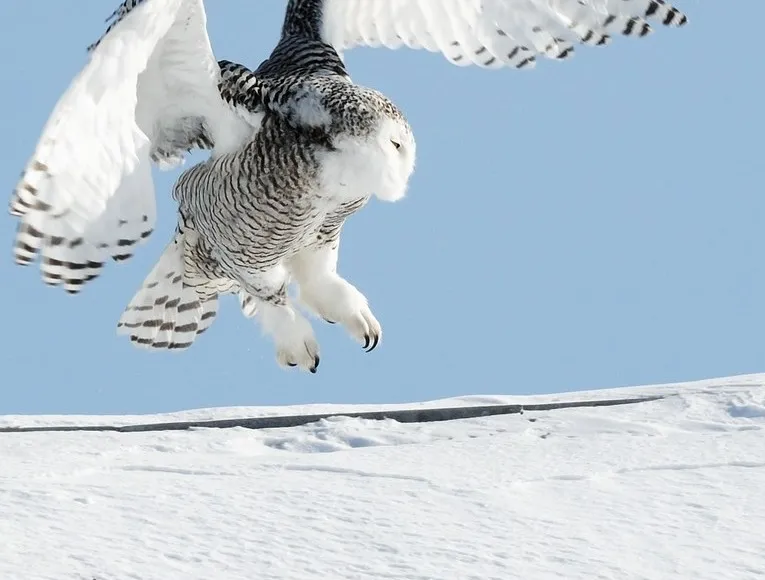
White feathers cover the feet of a Snowy Owl as it comes in to land.
2. Pale feathers blend into snowy ground
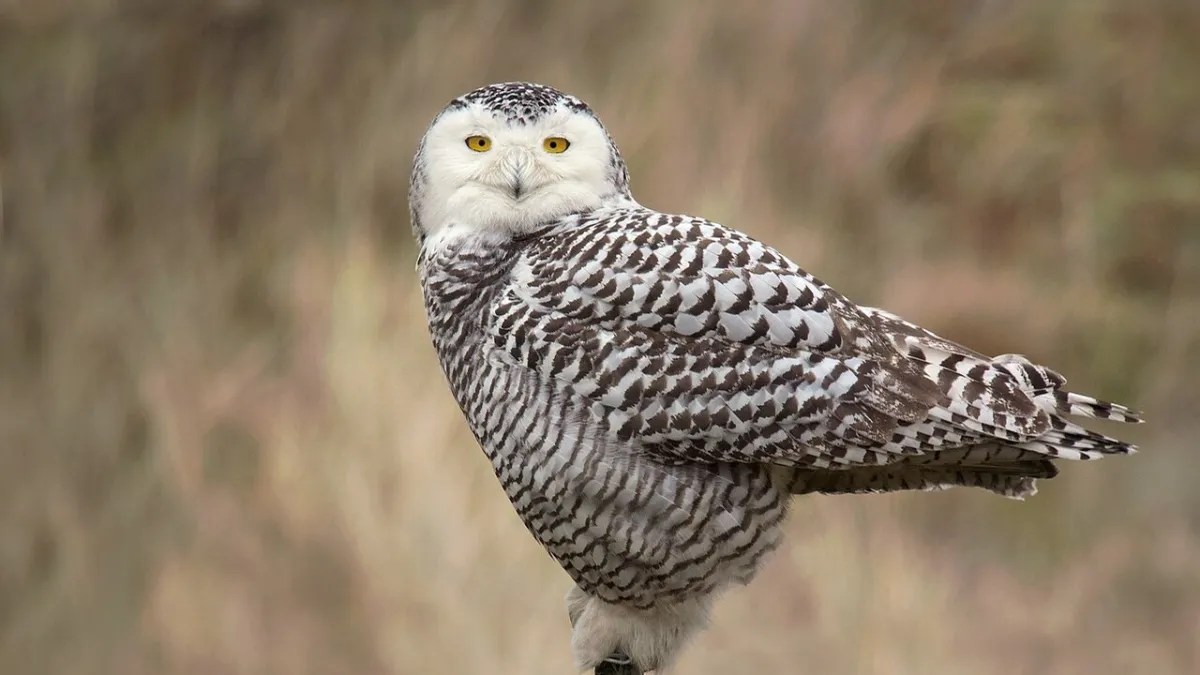
A Snowy Owl sitting low in a white field can be surprisingly hard to pick out. Its pale plumage helps it blend into the snow, and the effect is easiest to see when the bird is viewed against the ground. Some adult males are nearly all white, while females and young birds often show more dark markings. Compare their plumage in Snowy Owl Male vs. Female.

A young Snowy Owl sits low in a snow-covered field in Quebec, Canada.
3. Sight and hearing help it hunt from low perches
The open tundra gives a Snowy Owl long sightlines, and a low rise or rock can be enough for a lookout. From a perch, it can watch for movement or listen for prey before flying out to strike. That hunting style works in open winter habitats, too, where a fence post or a piece of driftwood can serve the same purpose.
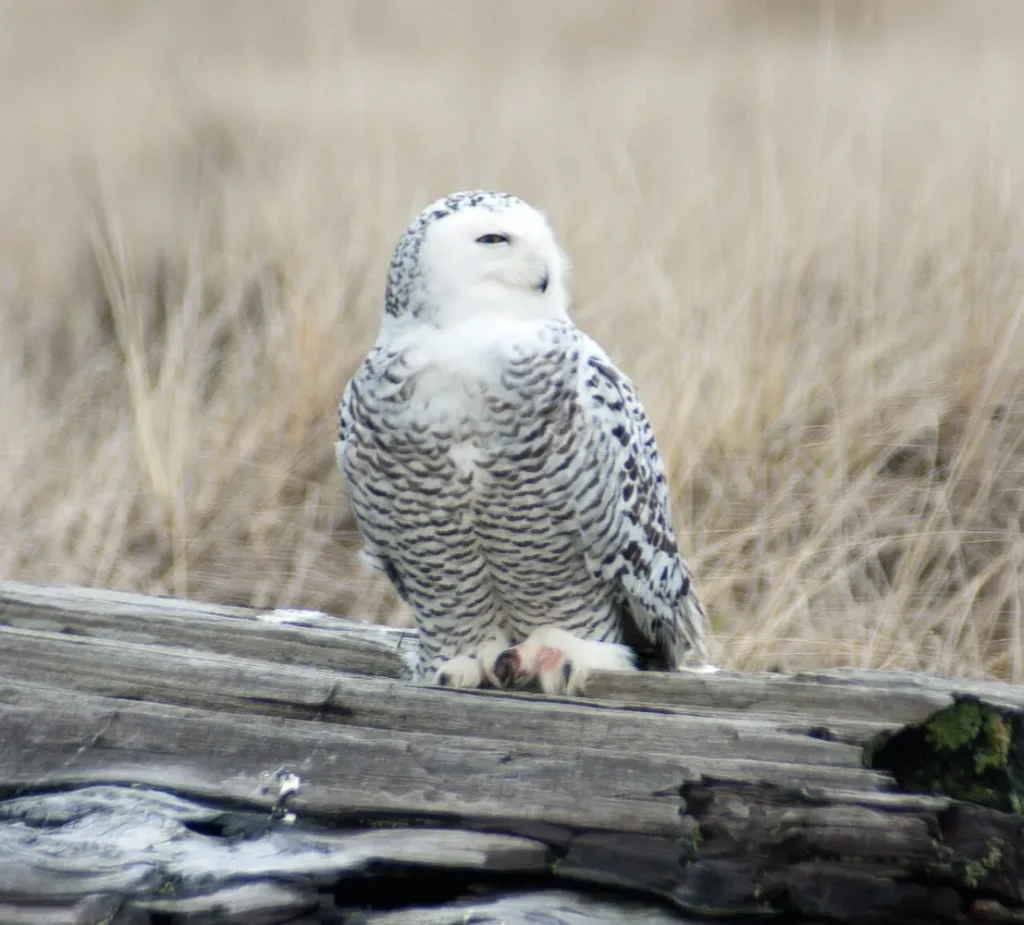
A Snowy Owl perches on driftwood at Damon Point in Washington State.
4. It can change breeding grounds as lemming numbers shift
Lemming populations can rise and fall sharply, and the best place to raise chicks can change from one summer to the next. Snowy Owls may explore widely in spring before settling where prey is abundant.
One satellite-tracked female bred on Bylot Island in 2007, Baffin Island in 2008, and in northern Greenland in 2009. In 2010 she returned to Bylot Island and nested about 1.1 km (0.7 miles) from her 2007 nest. That record shows how widely an individual can shift breeding sites across successive years. For more on the prey behind those movements, see What Do Snowy Owls Eat?

A Snowy Owl stands on open tundra in Alaska’s Arctic National Wildlife Refuge.
Sources
- Gessaman, J. A. (1972). Bioenergetics of the Snowy Owl. Arctic and Alpine Research, 4(3), 223–238. tandfonline.com
- Hinterland Who’s Who. Snowy Owl. Hinterland Who’s Who
- National Audubon Society. Snowy Owl Field Guide. Audubon Field Guide
- Therrien, J.-F., Gauthier, G., Pinaud, D., and Bêty, J. (2014). Irruptive Movements and Breeding Dispersal of Snowy Owls. Journal of Avian Biology, 45, 536–544.