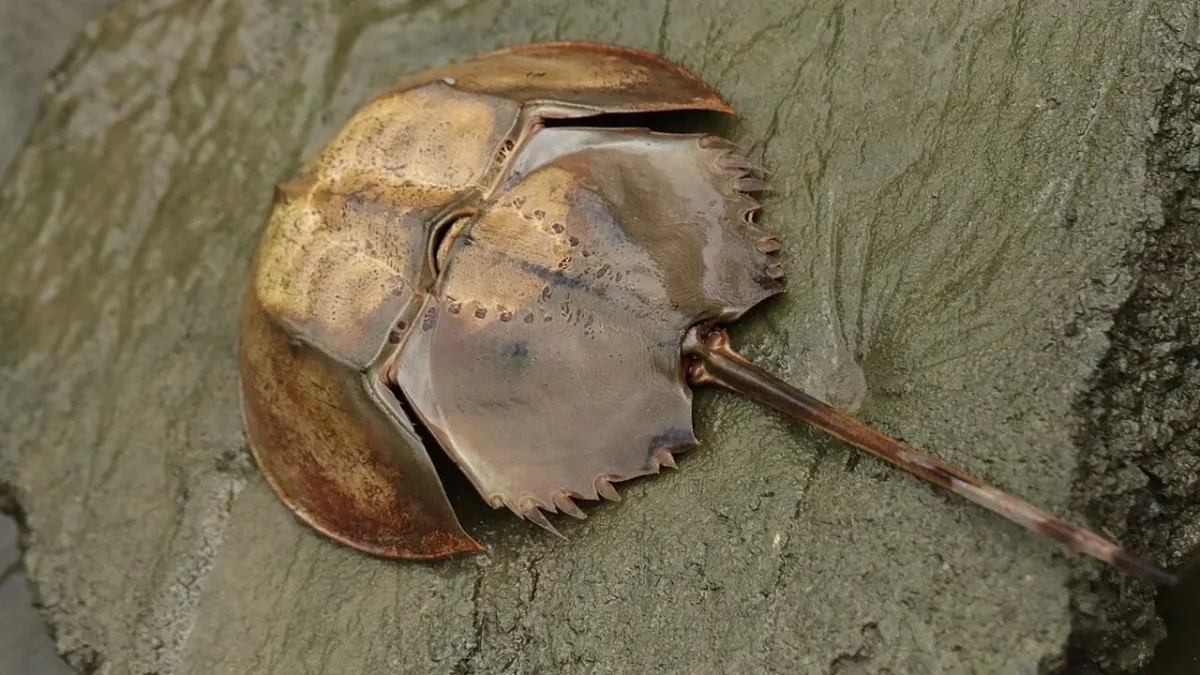
The mangrove horseshoe crab (Carcinoscorpius rotundicauda) is a brown, dome-shelled animal found on muddy shores and in mangrove waterways across parts of Asia. Its best identification clue is the long tail, which is round in cross-section. That feature also gives it another common name, the roundtail horseshoe crab.
1. The round tail helps identify it
From above, look for a broad front shield, a smaller rear section edged with short spines, and a long tail that tapers to a point. The tail is roughly circular across its width, like a thin rod. In Singapore, the similar coastal horseshoe crab (Tachypleus gigas) has a tail that is triangular in cross-section near the base, with a serrated edge.
The mangrove species also tends to be smaller. Singapore’s National Parks Board gives about 15 cm (6 in) as a reference for shell diameter. That measurement is across the shell. The tail adds to the animal’s overall length.

Seen from above, the broad front shield, smaller rear section and long tail are easy to distinguish.
2. The tail helps it turn over
The tail is called a telson. If a horseshoe crab ends up on its back, it can press the telson against the ground and use it as a lever to roll upright. It has no venomous sting. A clear photo from the side can show where the tail joins the shell, so there’s no need to pick the animal up to inspect it.
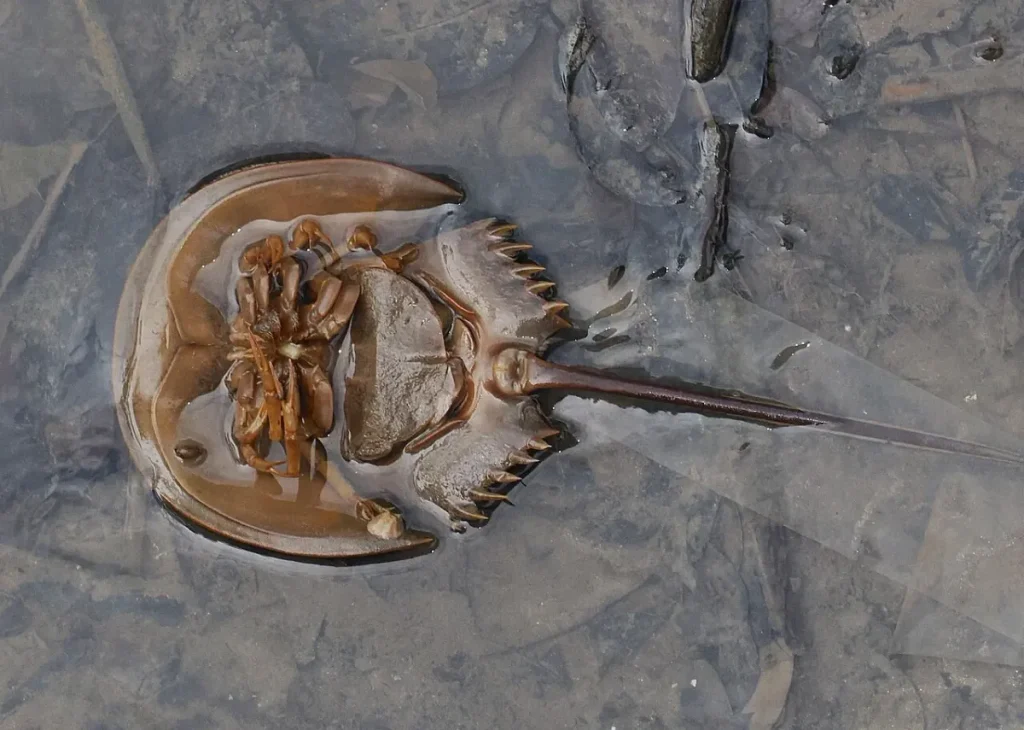
An underside view shows the walking legs beneath the shell and the long telson extending behind them.
3. Mangrove creeks and mudflats are breeding habitat
Mangrove horseshoe crabs live along muddy coasts and estuaries in places including Malaysia, Singapore and southern China. Females may lay their eggs in muddy areas higher up in the mangroves. Juveniles also use intertidal mudflats, where the tide regularly covers and exposes the sediment.
During breeding, the smaller male may clasp the back of the larger female and travel with her. If you see two horseshoe crabs moving together in shallow water, look for that smaller animal at the rear.
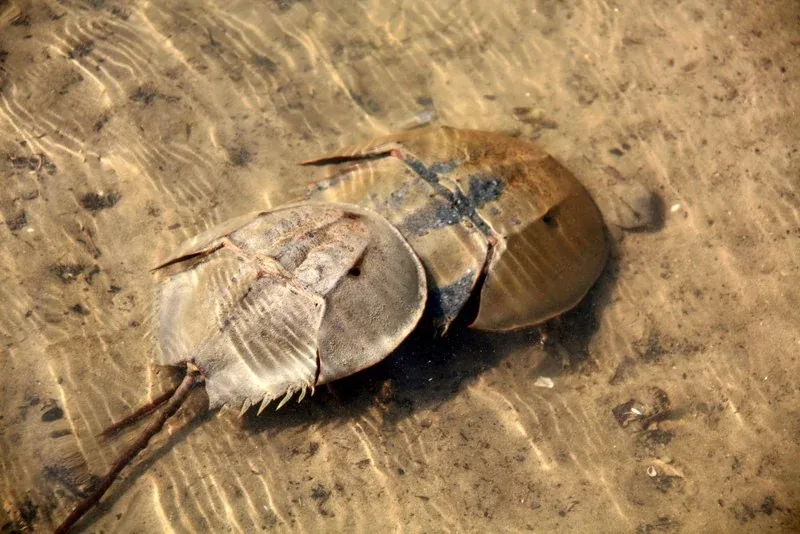
A mating pair in a tidal stream in Deep Bay, Hong Kong. The larger female is in front.
4. A mud crab has a different body plan
Horseshoe crabs belong to the chelicerates, the group that also includes spiders and scorpions. True crabs, including mangrove mud crabs, are crustaceans. Both can live on the same muddy shore, so the easiest way to tell which you’re seeing is to look at the body.
| What to look for | Mangrove horseshoe crab | True mud crab |
|---|---|---|
| Front view | Broad, rounded shield with most legs tucked beneath it | Large claws project in front and the legs are visible at the sides |
| Rear view | Long, pointed telson extends behind the shell | Short abdomen folds beneath the body |
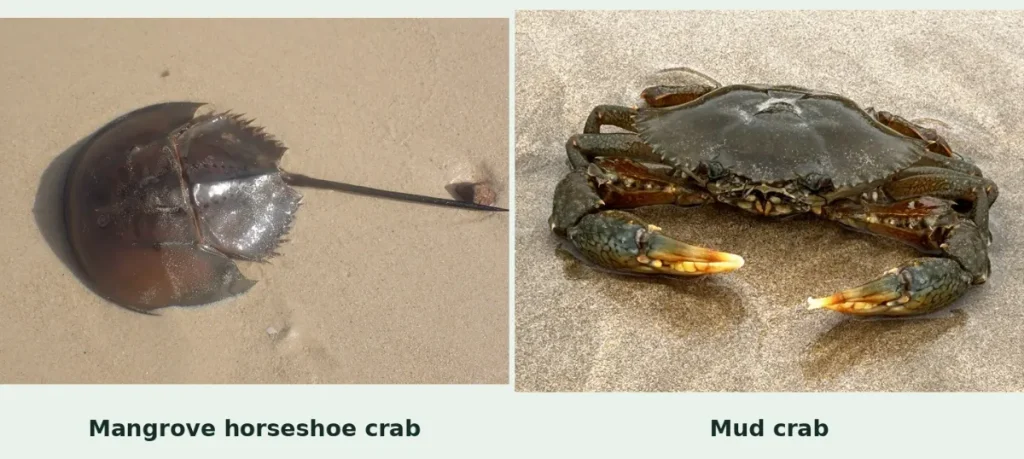
A mangrove horseshoe crab, left, and a true mud crab, right. Compare the long tail with the mud crab’s prominent front claws. The photos are shown at different scales.
5. Protecting the species means protecting its shoreline
A mangrove forest can contain several habitats the species uses at different stages of life, from muddy areas where females lay eggs to intertidal flats where juveniles are found. Coastal development and pollution can affect those areas even when some mangrove trees remain. For more animals that share this habitat, see our guide to mangrove crabs.
Is the mangrove horseshoe crab poisonous?
Its eggs can contain tetrodotoxin, a toxin that has caused serious food poisoning in people who ate them. The risk is from eating the eggs. If you find a mangrove horseshoe crab on the shore, observe it where it is and leave it there.
Sources
- Singapore National Parks Board — Mangrove horseshoe crab and Coastal horseshoe crab. nparks.gov.sg
- Smithsonian’s National Zoo — Horseshoe crab anatomy and tail function. nationalzoo.si.edu
- Marine Environmental Research — Mangrove horseshoe crab habitat and conservation. sciencedirect.com
- Clinical case series — Tetrodotoxin poisoning after eating mangrove horseshoe crab eggs.


