To tell a male wild turkey from a female, start with the head and breast. An adult male, called a tom or gobbler, usually has a larger, mostly bare head and darker breast feathers. An adult female, called a hen, usually has a smaller, muted gray-blue head and browner breast feathers. During a display, a tom’s head and neck can show bright red, white, and blue.
If you only have one photo of a wild turkey (Meleagris gallopavo), look for two clues together. A chest beard is common in males, but some hens grow one too. Body size also changes with posture, so a clear look at the head and chest can tell you more than the bird’s silhouette alone.

Male wild turkey, foreground. Look for the colorful bare head, thick neck, and dark body plumage.

Female wild turkey. Compare the smaller head and the lighter brown feathers on the body.
Male vs. female wild turkey at a glance
| Feature | Adult male (tom) | Adult female (hen) |
|---|---|---|
| Head and neck | Mostly bare, often brighter during a display | Usually muted gray-blue, with fine feathers extending farther up |
| Breast feathers | Dark tips that can give the chest a black or glossy appearance | Buff-colored tips that give the breast a browner look |
| Beard | Usually visible as a dark tuft projecting from the chest | Usually absent, though some hens grow one |
| Leg spurs | Often pointed and visible on the backs of the lower legs | Usually absent |
| Tail display | Often struts with the tail spread and wings lowered | Can fan the tail on occasion |
1. Look at the head and neck
The head is often the first feature you can see when tall grass hides the rest of the bird. A tom has a mostly bare head and upper neck. The folds of skin can look red, bluish, or pale, especially while he is displaying.
A hen’s head usually looks more subdued, with small feathers reaching farther up the neck and onto the head. In shade or outside the breeding season, color can be harder to judge. Zoom in on how far the feathers extend as well as how bright the skin looks.
2. Compare the breast feathers
A tom’s breast generally looks dark, and direct sunlight can bring out a bronze or green sheen. A hen’s breast usually looks browner or lighter. In a sharp photo, look at the tips of the individual breast feathers. Mature males generally have black tips, while hens have lighter, buff-colored tips.
The breast is the part to compare. Both sexes have barred feathers on other parts of the body, and the same bird can look considerably darker when it moves into shade.
3. Check for a beard on the chest

A thin, bristly beard hangs from the chest of this turkey at Fort Worth Zoo.
A turkey’s beard is a tuft of stiff, modified feathers that grows from the center of the chest. In a side view, it can look like a dark brush hanging away from the body. A young male, called a jake, may have a much shorter beard than a mature tom.
Some hens also grow beards. If the bird has a beard but the head is gray and the breast feathers have pale tips, keep a bearded hen in mind.
4. Look behind the lower legs for spurs

On the raised leg at right, the small upper projection is the spur. The backward-pointing toe is lower down.
A spur is a pointed projection on the back of the lower leg. On a mature tom, it may stand out in a side view as the bird lifts a foot. A jake’s spur can be short and rounded, while most hens lack visible spurs.
Grass, shadows, and the angle of the leg can hide a spur. Use this feature when the photo shows it clearly, alongside the head and breast markings.
5. Watch the whole display
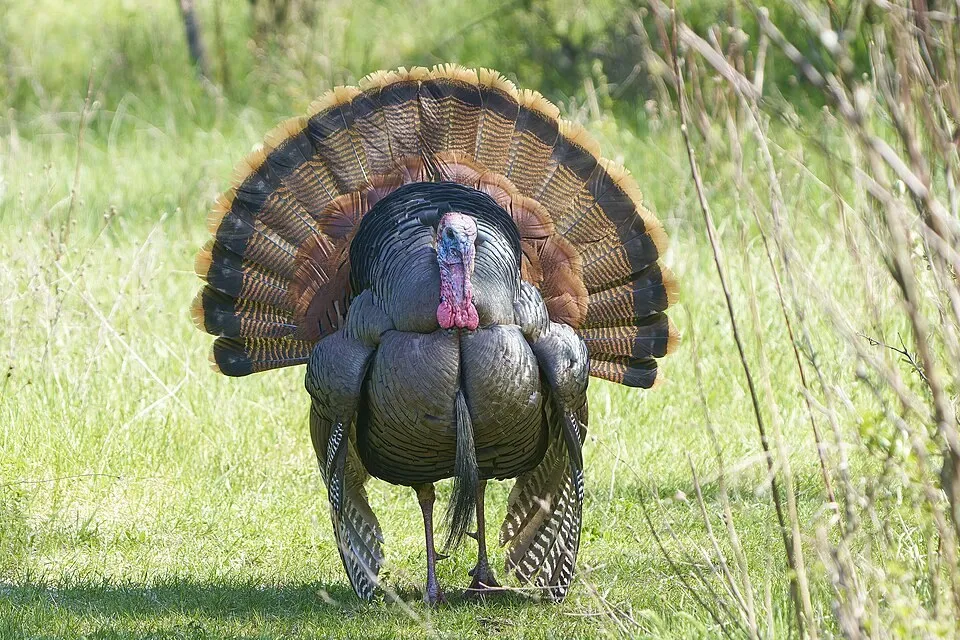
A tom faces forward with its tail fully spread during a display.
A tom often fans his tail, puffs up his body feathers, and lowers his wings as he struts. Look for that combination of movements, especially if you can watch the bird for a few seconds. A hen can also fan her tail, so a single frame showing a spread tail leaves room for doubt.
The shape of the fan can help you judge the age of a bird you’ve already identified as male. A jake often has longer feathers in the center, giving the fan a stepped outline. A mature tom’s fan usually forms a smoother arc.
What to photograph if you only get one chance
Take a side photo that includes the head, full breast, and lower legs. If the bird moves, a second frame as it raises a foot may reveal a spur. For a flock, a wider photo of birds standing at a similar distance can also help you compare their size and plumage. If the only visible clue is a beard or an open tail, wait for another angle before deciding.
Related guide
Compare birds by where the red appears, from a full red head to a small patch at the back of the neck. 8 Birds With Red Heads
Sources
- Cornell Lab of Ornithology. Wild Turkey Identification. allaboutbirds.org
- Massachusetts Division of Fisheries and Wildlife. Identifying female and male turkeys. Mass.gov
- Government of New Brunswick. Wild Turkey Identification: Adult Birds. Adult Birds
- Illinois Natural History Survey. Wild Turkeys & Their Sign.


