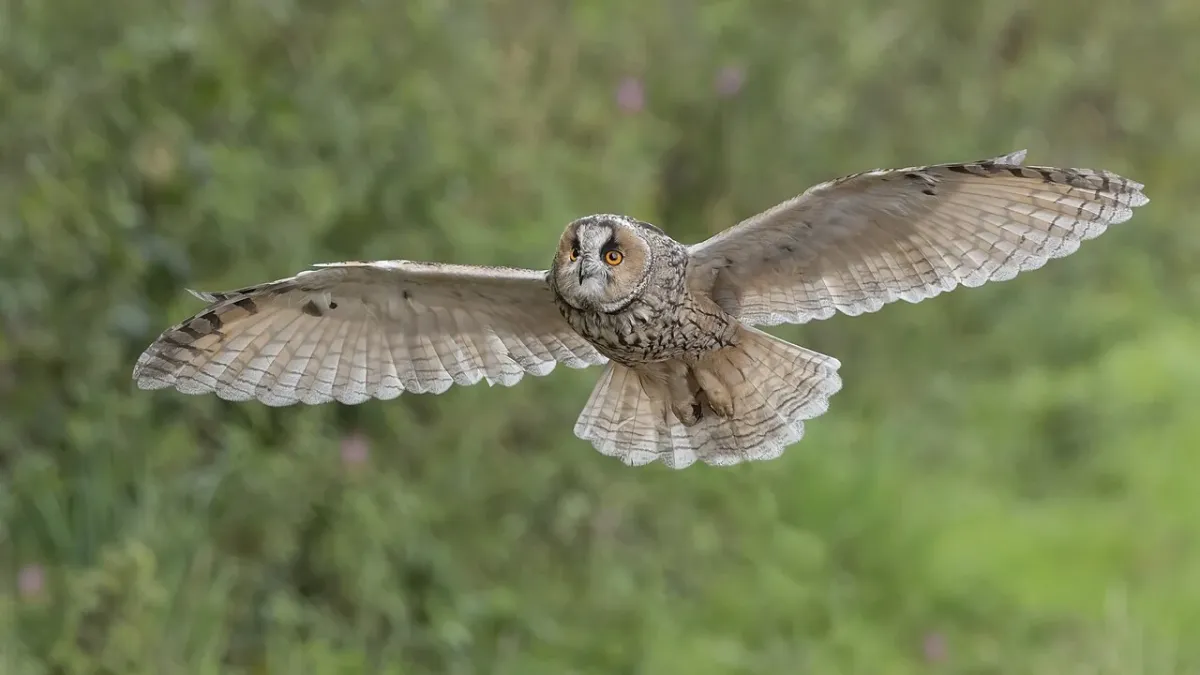
If a brown owl flies past and you can’t see its ear tufts, look at the lower belly first. A short-eared owl often has a streaked chest above a paler, less marked lower belly. A long-eared owl usually carries dark markings farther down. If the bird banks and shows the top of a wing, look for the short-eared owl’s pale outer-wing panel next to a dark tip.
1. When it banks, look for a pale panel beside the dark wingtip
On a short-eared owl (Asio flammeus), the upperwing can show three contrasting areas in a row. Look for a dark patch near the bend, a broad pale panel farther out, and a dark tip. The pale panel is easiest to see when the owl turns and the top of the wing faces you. On a long-eared owl (Asio otus), the upperwing usually looks more evenly patterned.

A banking short-eared owl shows the pale outer-wing panel next to the dark tip.
2. Check the trailing edge of the wing
The trailing edge is the back edge of the wing, where the flight feathers end. A short-eared owl can show a thin, pale line along this edge. Look for it when the wings are spread. On a long-eared owl, that line is generally less distinct. In glare or a blurry photo, move on to the belly pattern.

The pale trailing edge runs along the back of the wing. The dark wrist mark sits farther forward.
3. Treat the dark wrist mark as a shared clue
The wrist mark is the dark patch on the underside near the bend of the wing. Both owls can show it. If you see a dark mark on an otherwise pale underwing, also check how abruptly the wingtip darkens and whether the lower belly looks pale. The wrist mark is easy to spot, which makes it easy to give it too much weight.
4. Follow the streaks from the chest to the lower belly
Both species can have a heavily streaked chest. On a short-eared owl, the streaks usually thin out toward the lower belly, leaving a visibly paler area. On a long-eared owl, dark streaks and crossbars usually continue farther down. If you take several photos of a fly-by, pick the frame that shows the underside of the body most clearly. A sharp wingtip photo may give you less to work with.

The long-eared owl on the left has dark markings extending down its underside. The short-eared owl on the right has a paler lower belly.
5. Check the face if the bird turns towards you
A short-eared owl typically has sooty patches around its eyes, set against a paler facial disc. A long-eared owl often has a warmer, rustier face with a pale strip beside the bill. Eye colour can help in Britain, where long-eared owls typically have orange eyes and short-eared owls have yellow eyes. North American long-eared owls can also have yellow eyes, so look at the feathers around the eyes as well.
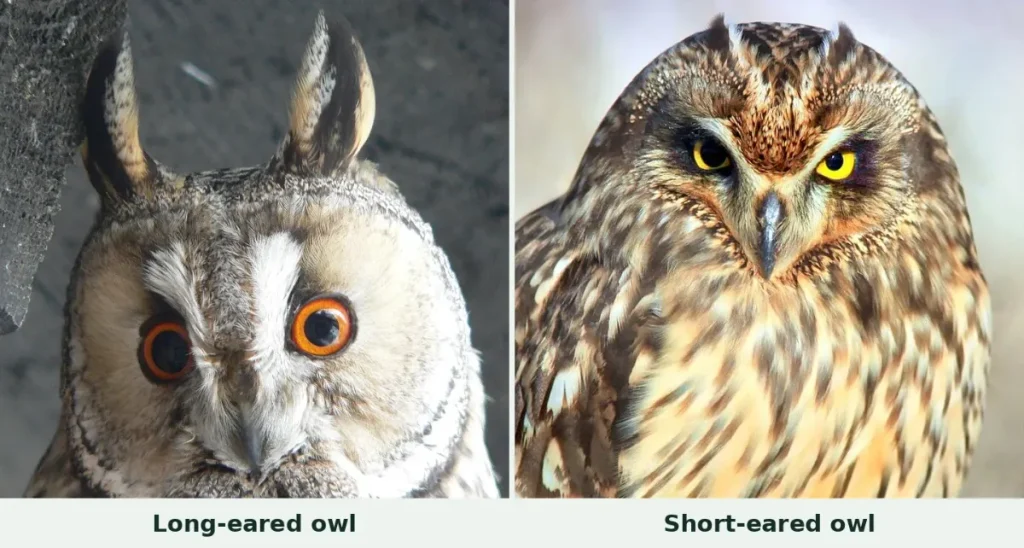
A long-eared owl at Cologne Zoo, left, and a short-eared owl at Boundary Bay, British Columbia, right. Compare the feathers surrounding their eyes.
Does the habitat help?
An owl repeatedly quartering low over rough grassland, a marsh or a moor in daylight is more likely to be a short-eared owl. Long-eared owls usually roost in dense cover and often hunt after dark over nearby open ground. Both can cross an open field, so use the habitat alongside the wing and belly patterns. If your bird lands, see our long-eared owl identification guide for examples of how its silhouette changes when it raises or lowers its tufts.


