
A long-eared owl is easiest to recognize when it sits upright with its long feather tufts raised. When those tufts lie flat, check the rest of the bird. A slim body, a tall rusty face, and dark markings that continue down the belly make a stronger identification than any one clue on its own. In flight, the belly pattern is particularly useful because the tufts can be hard to see. Missouri Department of Conservation
1. Look for a Slim Outline and Closely Spaced Tufts
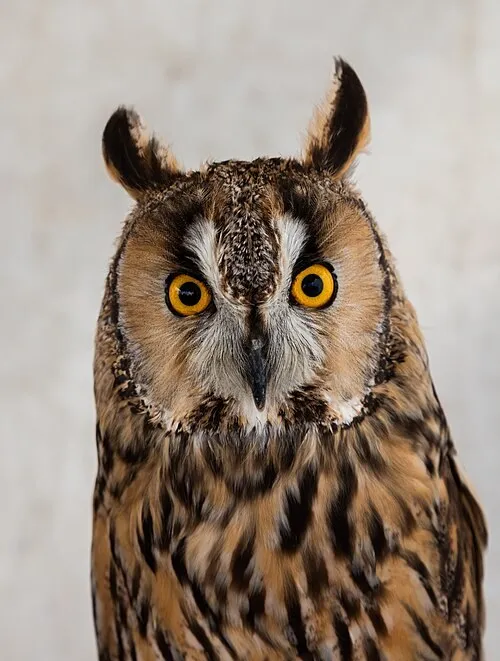
A long-eared owl photographed in Cádiz, Spain, showing its tall feather tufts and warm-toned facial disc.
A perched long-eared owl (Asio otus) often looks tall and narrow. Its two feather tufts sit fairly close together and can rise almost straight up when the bird is alert. Together, the upright posture and tufts give the owl a distinctive outline. Missouri Department of Conservation

A long-eared owl perched in Kecskemét, Hungary, with its tufts held low.
The owl can lower those tufts. When the top of the head looks rounded, shift your attention to the face and chest. The two photos show how much the outline can change with posture. Asio Otus
2. Check the Face Before You Judge the Eye Color
Look for a tall facial disc with warm, rusty tones around the eyes and pale markings near the bill. The facial disc is the ring of feathers around the face. On a long-eared owl, it gives the face a narrow, elongated look. Missouri Department of Conservation
Eye color varies geographically. North American field guides describe yellow eyes, while British guides describe deep orange eyes. Use the shape and color of the facial disc along with the eye color, particularly when the photo’s location is unknown. The Raptor Center
3. Follow the Dark Markings Down the Belly
A long-eared owl’s chest is streaked, and the dark pattern continues onto the lower belly. From a good front view, you may see short crossbars mixed in with longer streaks. This combination can make the lower body look densely patterned. Missouri Department of Conservation
The short-eared owl can also have a heavily streaked chest. Look farther down on that bird and the belly usually appears paler, with less marking than on the chest. That difference is useful when you have a front or underside view of a bird whose head feathers are hard to see. allaboutbirds.org
4. In Flight, Check the Body Along With the Wings

A long-eared owl flying in Scotland, with its underparts and the underside of one raised wing visible.
A long-eared owl has long, rounded wings. From below, you may see a dark mark near the bend of the wing, sometimes called the wrist. Short-eared owls can show a similar dark mark. If your photo shows both the wings and the body, check how far the dark streaks and bars extend down the underside. Missouri Department of Conservation
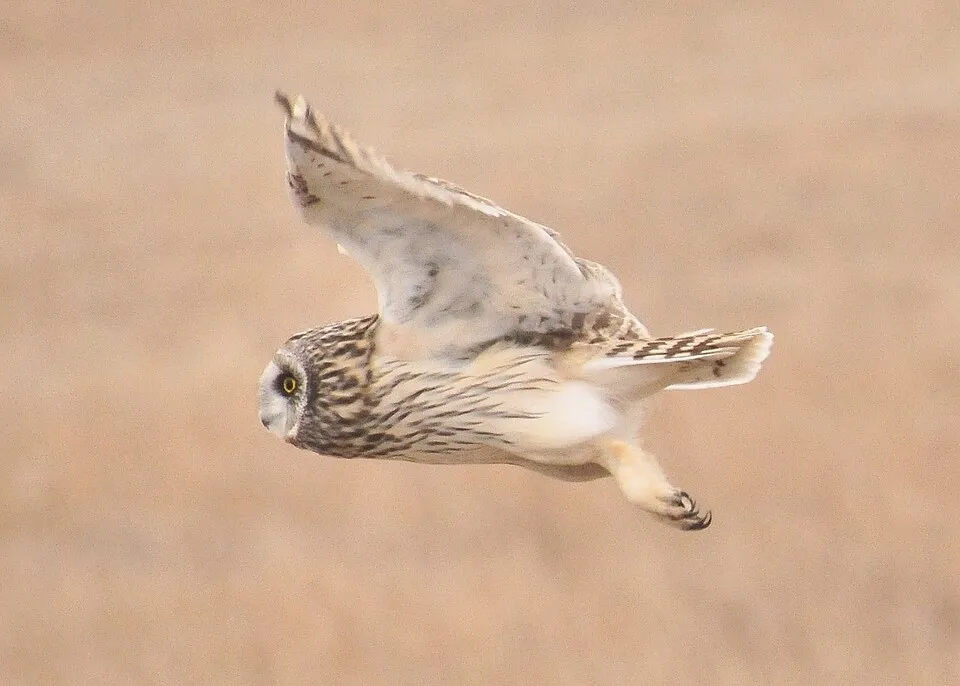
A short-eared owl in flight at Lacreek National Wildlife Refuge, with a pale lower belly.
A flying owl can pass too quickly for several markings to register. In a burst of photos, the frame with the clearest view of the chest and belly may tell you more than the sharpest view of the wingtips.
5. Use the Roost or Hunting Site as a Supporting Clue
Long-eared owls often spend the day tucked into dense vegetation, sometimes close to a tree trunk where their plumage blends in. After dark, they can leave that cover and hunt small mammals over nearby grassland or scrub. A bird seen over an open field could therefore have been roosting in the trees beside it. allaboutbirds.org
Short-eared owls also hunt over open ground and are more likely to be seen flying in daylight. The time and place of a sighting can support the identification once you’ve checked the face and belly. allaboutbirds.org
Long-Eared Owl vs. Similar Owls
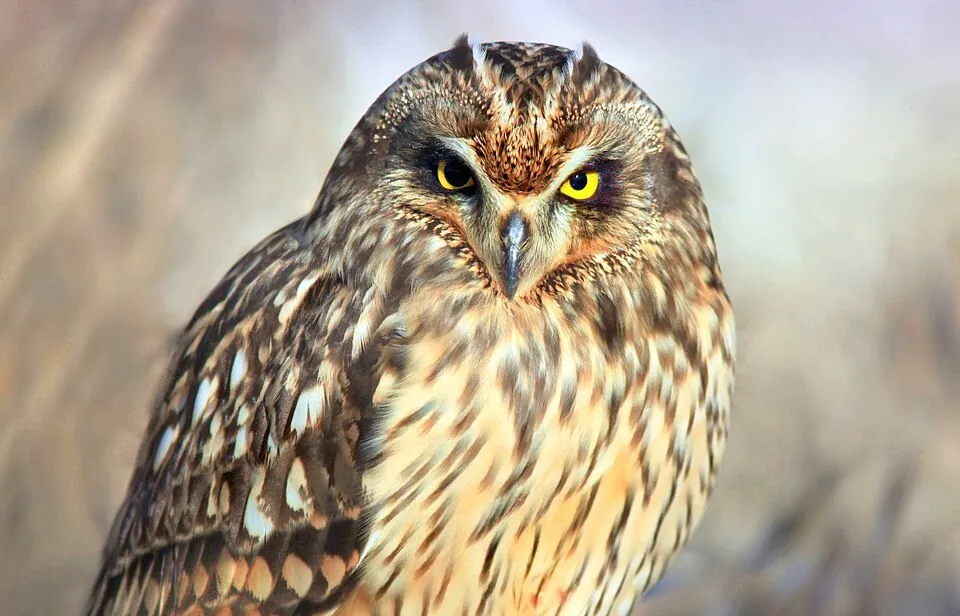
A short-eared owl at Boundary Bay, British Columbia, with dark patches around its yellow eyes.
| Owl | Head and face | Body clue |
|---|---|---|
| Long-eared owl | Tall, closely spaced tufts when raised and a narrow, rusty facial disc | Slim build and dark markings extending down the belly |
| Short-eared owl | Tiny tufts, a rounded outline, and dark patches around the eyes | Streaked chest with a paler lower belly |
| Great horned owl | Broader head and more widely spaced tufts | Bulkier build, often with a noticeable white throat patch |
Sources for comparison. Missouri Department of Conservation
Sources
- Cornell Lab of Ornithology — Long-Eared Owl Identification, Life History, and Similar Species
- Cornell Lab of Ornithology — Short-Eared Owl Identification
- Missouri Department of Conservation — Long-Eared Owl Field Guide
- University of Minnesota Raptor Center — Long-Eared Owl
- RSPB — Long-Eared Owl


