
If all you can see is a seal’s head above the water, look at the line from its forehead to the tip of its nose. A harbor seal usually has a rounded forehead and a short muzzle. A gray seal has a longer muzzle and a straighter or gently arched profile. If it turns toward you, the nostrils give you a second clue.
Harbor seals (Phoca vitulina) are also called common seals or harbour seals. In British English, the gray seal (Halichoerus grypus) is written grey seal.
1. Head shape — look from the side
On a harbor seal, the forehead rises above the eyes, then the profile dips before reaching the short muzzle. On a gray seal, the muzzle projects farther forward. The line from the top of the head toward the nose is often fairly straight in females and more noticeably arched in adult males.
What to look for in the water: Wait for the seal to turn sideways. Even when the rest of its body is underwater, you may be able to see where the forehead meets the muzzle.

The harbor seal on the left has a rounded forehead and short muzzle. The gray seal in the foreground on the right has a longer profile.
2. Nostrils — check when it faces you
A harbor seal’s nostrils angle inward toward the bottom, making a V. A gray seal’s nostrils are generally more upright and nearly parallel. Use binoculars or camera zoom if the nose is hard to see. An angled head or a splash of water can hide the shape, so wait for a clearer view.
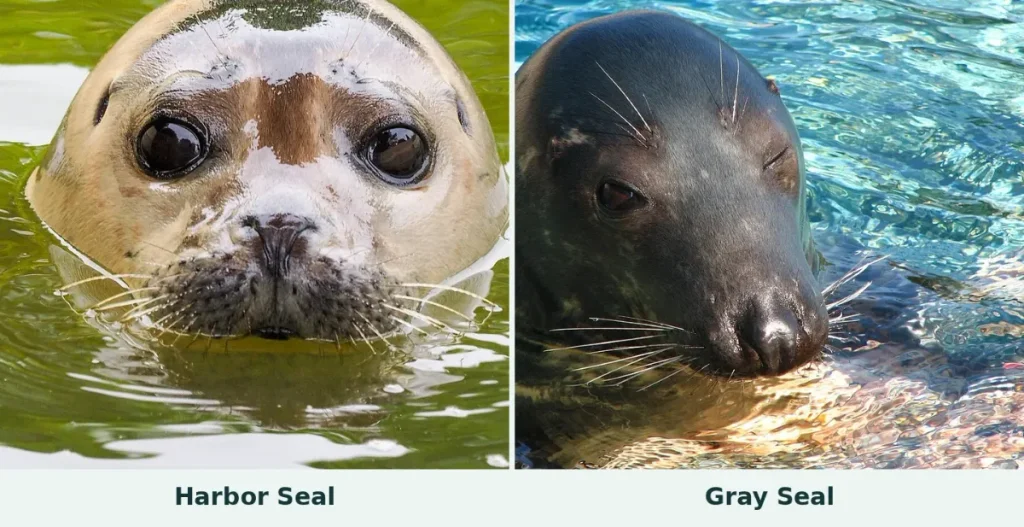
Compare the angle of the nostrils near the tip of each seal’s muzzle.
3. Body size — compare adults when you can
Adult harbor seals are generally about 5–6 feet (1.5–1.8 m) long. Adult female gray seals are about 7.5 feet (2.3 m) long, and large adult males can reach 10 feet (3 m). A large gray seal can be conspicuous among adult harbor seals, but a young gray seal can look small. If you see one animal alone, the head shape is more useful than a size estimate.
4. Coat markings — look at the pattern
Harbor seals often have many small spots. Gray seals frequently have larger, irregular blotches, especially visible on lighter-coated females. Both species can be spotted and vary from pale to dark. Use the markings to support what you see in the face, especially if the seal is wet or backlit. A gray coat alone tells you very little.
5. Pups — check the texture as well as the color
Newborn gray seal pups typically have a fluffy white or cream coat. They shed it as they grow, so older pups can look quite different. Most harbor seal pups are born with a short, adult-like coat, often already spotted, and can swim soon after birth. When comparing pups, look for the long, fluffy fur as well as the color.
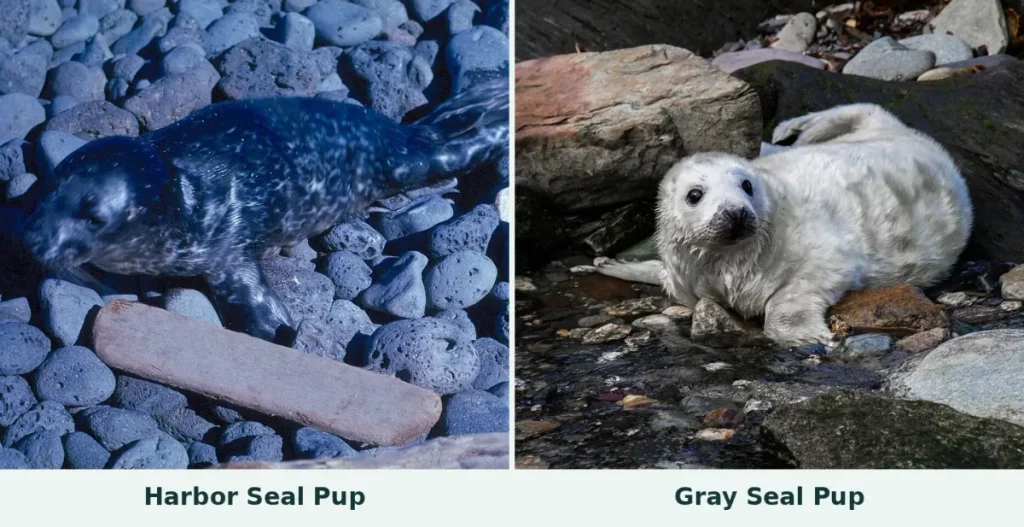
A spotted harbor seal pup on the left and a white-coated gray seal pup on the right. The photos are shown at different scales.
Can you use the location to tell them apart?
Both species occur around the UK and parts of eastern North America, where they can share resting sites. A seal on a sandbank in those areas could be either species. On the Pacific coast of North America, harbor seals are native, while the gray seal’s natural range is in the North Atlantic.
If a seal is resting on shore, watch from a distance and let it turn on its own. In the US, NOAA Fisheries recommends staying at least 50 yards away. In the UK, the RSPCA advises at least 100 metres. Follow any stricter guidance posted at the site.
If the animal has visible ear flaps, check our seal vs. sea lion identification guide.
Sources
- Natural History Museum — Grey seals and harbour seals in the UK and Dorset Wildlife Trust — Seal identification guide. Natural History Museum
- NOAA Fisheries — Harbor Seal and Gray Seal. NOAA Fisheries
- Seal-watching guidance from NOAA Fisheries and the RSPCA.


