If you’re trying to tell fox tracks from dog tracks in snow, look at several steps before deciding. A red fox often leaves compact, narrow prints in a nearly single-file trail. A dog may leave broader prints and a trail that wanders from side to side. Both animals can leave four toe impressions and claw marks, and a small dog can make prints about the same size as a fox’s.
Start with the clearest pawprint, then look at the next few steps. A narrow print repeated along a steady, direct trail gives you more to work with than one isolated mark.

Red fox print in snow. The snow softens the edges of the toe pads.

Domestic dog print in snow, showing four toe pads and claw marks. The two photos were taken at different scales.
Fox vs. dog tracks at a glance
| What to check | Red fox | Domestic dog |
|---|---|---|
| Toe layout | Often compact, with the middle toes set forward | The toes may spread farther apart, depending on the dog and the surface |
| Print shape | Often narrow or diamond-shaped | Often rounder, with considerable variation |
| Claw marks | May show as fine points or disappear in soft snow | May be visible, depending on the surface |
| Trail pattern | Often narrow and nearly single file at a steady pace | Can wander or spread out, especially when the dog is exploring |
| Surroundings | A repeated trail across a quiet field or along an edge can support a fox ID | A trail that repeatedly runs beside fresh shoeprints can support a dog ID |
1. Look at how the toes are arranged
Find a print where the toes and the large pad behind them are clearly separated. In many red fox (Vulpes vulpes) prints, the two middle toes sit close together and project farther forward. The outer toes sit back and give the front of the track a pointed, compact shape.
Some field guides use the X test. Imagine drawing two diagonal lines through the gaps between the toes and the main pad. A clear X can support a fox identification. Some dogs and other canids can leave a similar gap, so check the outline and the trail as well.
2. Compare the shape and measure the print

A red fox footprint photographed with a measuring tape. A scale in the frame lets you check the actual size.
A red fox print is often longer than it is wide. British field guides give an approximate length of 5 cm (2 inches). This is a reference point, since a small dog can leave a similar-sized impression.
Pick a print with a clean edge. Set a ruler beside it and photograph straight down. Record the length from the front of the toe pads to the back of the main pad, leaving out any claw tips. Then measure the widest part. A second print can help you check whether the first one spread as the snow softened.
3. Use claws as a supporting clue
Fine points just ahead of the toes can be claw marks. Both foxes and dogs may leave them. How clearly they show depends on the snow and how the animal placed its foot. A print can show clear toes on one stretch of trail and very little detail a few steps farther on.
Foxes have furry feet, which can soften the outline in snow. If a print has rounded, crumbling edges, look for a sharper impression where the trail crosses firmer snow or a patch of mud.
4. Step back and read the trail

A narrow line of red fox prints crossing open snow.
A red fox moving at a steady pace often places a hind foot close to or into the print left by the front foot. This can leave a narrow line of impressions. Trackers call it direct registration when the hind foot lands in the front print.
Look across several steps. A trail that repeatedly widens, loops, or turns toward things along the way can fit a dog out exploring. A purposeful dog can also travel in a straight line, and a fox can turn or wander while searching for food. In parts of North America, coyote trails can also look narrow and direct.
5. Check what else crossed the snow
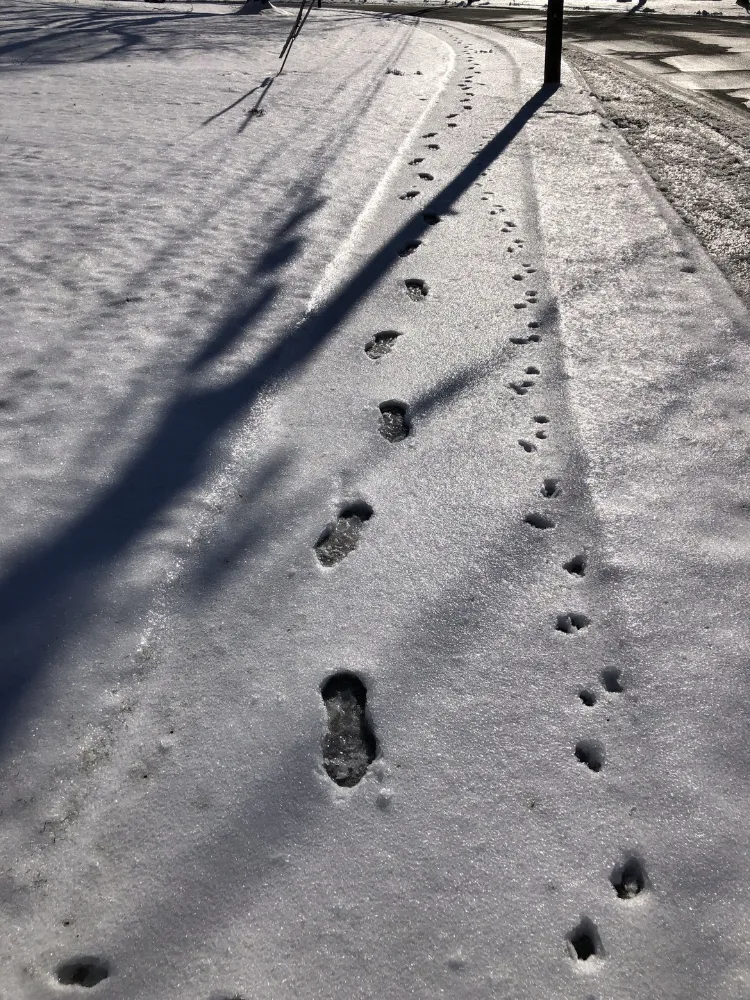
Dog pawprints run beside human shoeprints on a snow-covered sidewalk.
On a snowy sidewalk, dog prints may run beside shoeprints at a consistent distance, then move away and return. Look for that relationship along a stretch of the trail. A single crossing could be a coincidence.
Foxes also travel through gardens, parks, and residential areas. The strongest fox identification comes when compact prints, a narrow route, and the surrounding clues all point in the same direction. If you have only one soft four-toed print, “unidentified canine track” is a reasonable field note.
The two photos to take
- Take one close-up with a scale. Include the whole print, from the frontmost toes to the back of the main pad.
- Take one wider photo of the trail. Show several steps and any shoeprints beside them. Keep the direction of travel consistent between the two photos if you can.
Related guide
For another way foxes adapt to snow, see how the Arctic fox changes its coat across the seasons. 15 Animals That Change Color
Sources
- Woodland Trust and The Mammal Society. Animal tracks in snow · Red fox Woodland Trust
- Mass Audubon and University of Michigan BioKIDS. Wildlife tracking in winter · Four-toed mammal tracks massaudubon.org
- Salt Lake City Public Lands and the Internet Center for Wildlife Damage Management. Identifying animal tracks in snow · Comparing animal tracks


