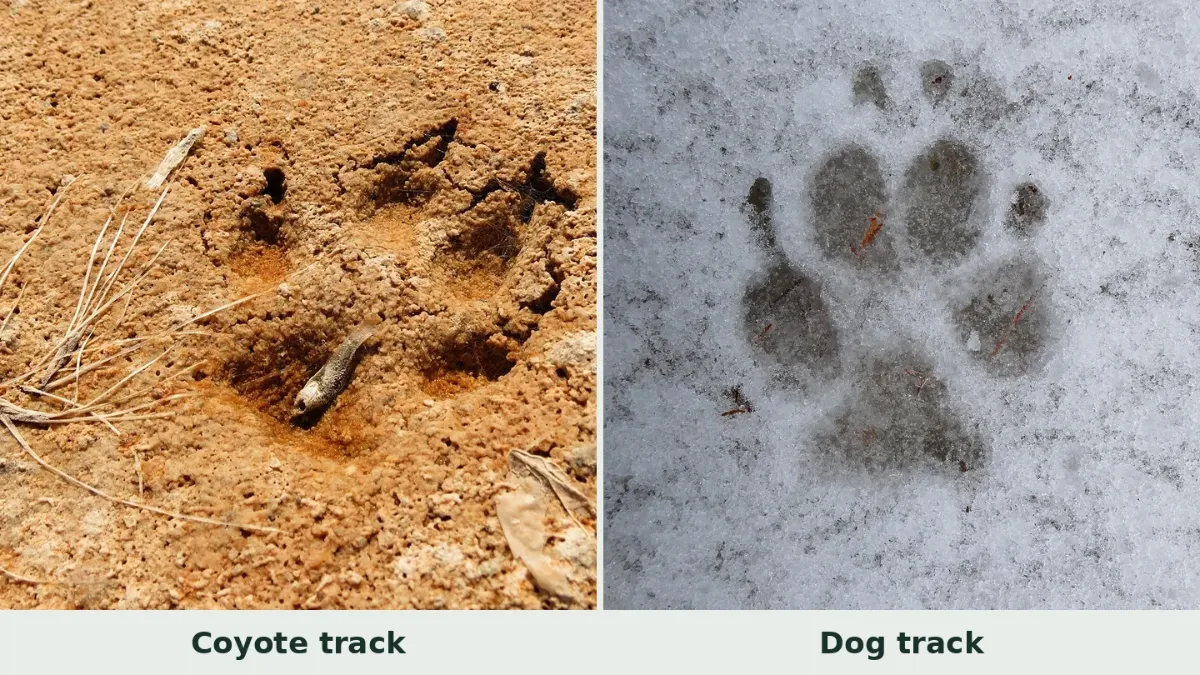
A coyote track often looks narrow and oval, with four toes held close together. A dog track often looks rounder, with toes that spread outward. The two can look nearly identical, especially in soft snow. If you find one clear print, photograph it, then look for the next few. The way the prints line up can tell you more than a single paw print.
1. Check the outline and toe spacing
Start with the clearest print you can find. In a typical coyote track, the two middle toes point forward and the outer toes sit close to them, giving the print a compact outline. A domestic dog may leave a broader print with wider gaps between the toes. Some dogs leave tight, oval prints too, and a coyote’s front print is often rounder than its hind print. Compare several before deciding.
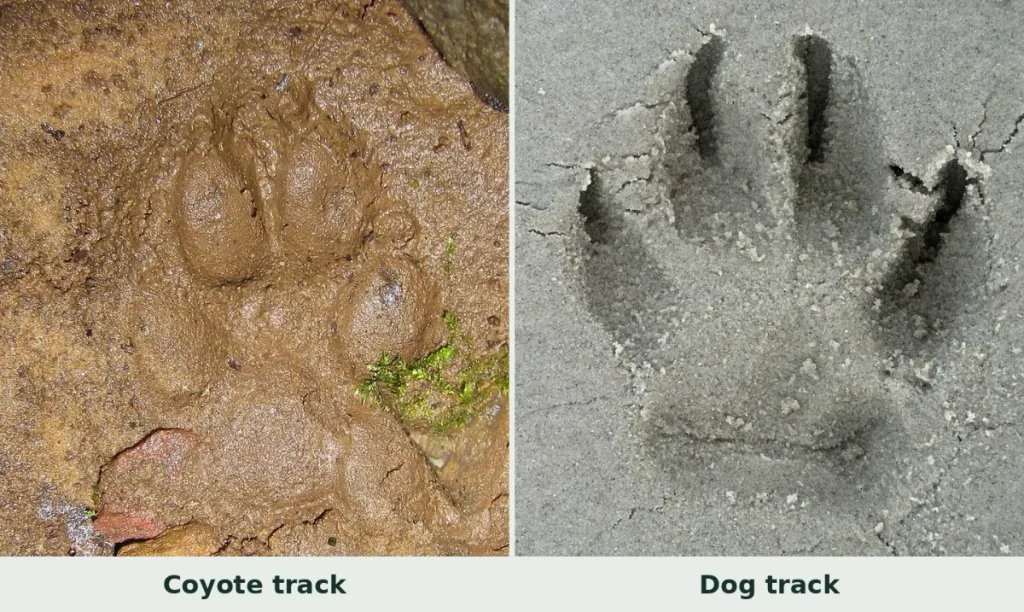
A coyote print in mud, left, and a Labrador print in sand, right. Compare the toe spacing and overall shape. The photos are at different scales.
2. Look at where the claws land
In a crisp coyote print, the two middle claws may leave small marks close together, pointing forward or slightly inward. The outer claws may leave only faint marks. Dog claw marks are often more prominent and can point outward with the toes. Both animals can leave prints with four visible claw marks, and on firm ground some claws may leave no mark at all.
3. Measure a fresh print
Place a ruler flat beside the print and take a photo from directly above. Measure from the front edge of the farthest-forward toe pad to the back edge of the large pad, leaving out the claw marks. Then record the width at the widest point.
New Mexico State University Extension gives 2¼–2¾ inches (about 5.7–7 cm) as a reference range for coyote front tracks in soft mud. Some coyotes leave larger prints, and plenty of dogs fall within that range. Use the measurement alongside the toe shape and trail. In snow, look for a fresh print with sharp edges. As the snow melts, the same print can widen and lose its original shape.
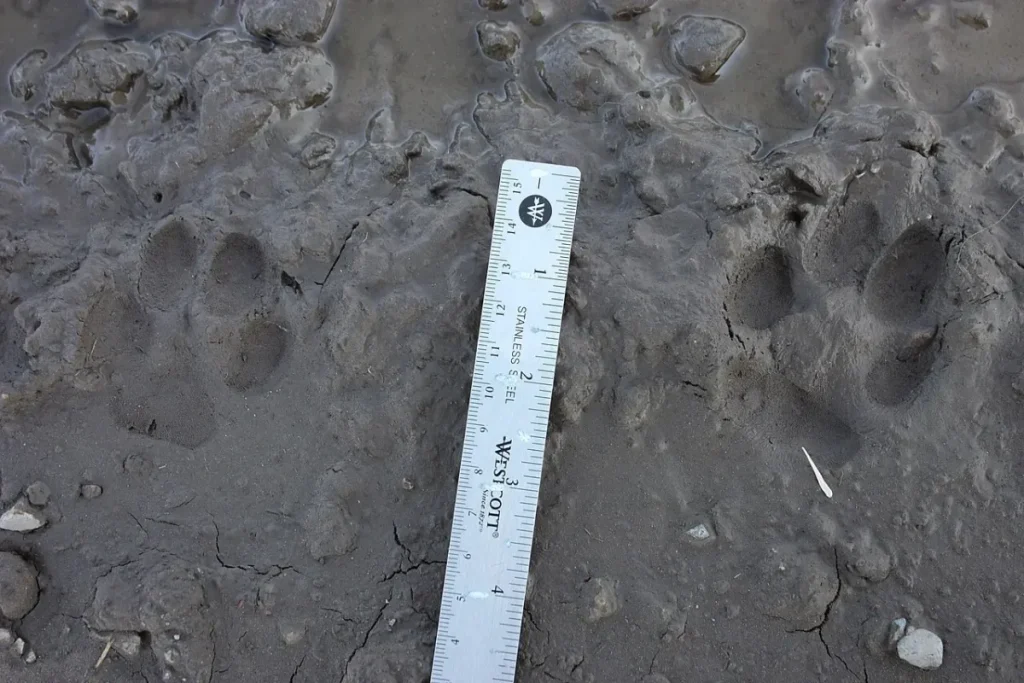
Coyote tracks beside a ruler in Jackson Hole, Wyoming. Place the ruler next to the print so the scale appears in the same photo.
4. Follow the trail for several steps
A traveling coyote often leaves a narrow, fairly straight line of evenly spaced tracks. Its hind paw may land in or close to the print left by the front paw on the same side. When the two overlap closely, trackers call it direct registration. Look for that overlap in several places along the same trail.
A free-moving dog may weave, stop or change pace. Dogs can also walk in a straight line, especially along a sidewalk or path. Check how the feet land as well as where the trail goes.

A coyote trail crossing elk tracks in snow at Mount Rainier National Park.
5. Check what else is on the ground
Boot prints running alongside paw prints for several steps make a walked dog more plausible. A single boot print crossing the trail could belong to someone who passed at a different time. Coyotes use paths too, and a loose dog can leave a trail without any human footprints nearby.
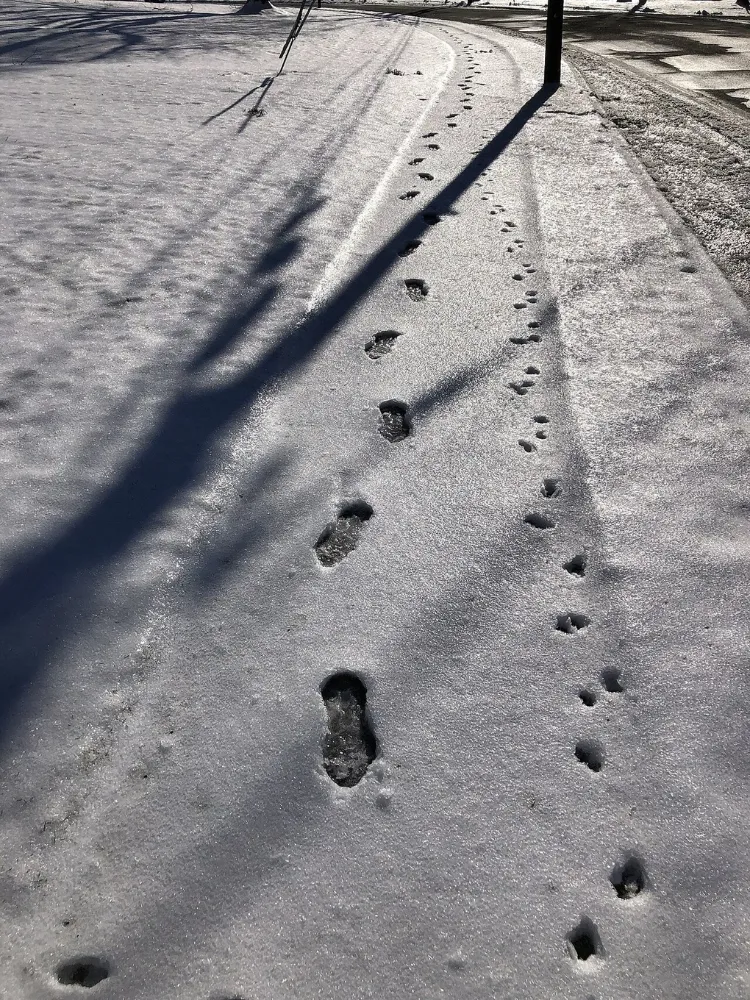
Dog and human footprints run beside each other on a snowy sidewalk in New Jersey.
What if you only find one print?
If you can see four toes and a central pad but the shape and spacing are unclear, “unidentified canid track” is a reasonable call. If you return while the tracks are still fresh, take one close photo with a ruler and a second photo showing the trail. A compact print, close-set claws and repeated overlap along a narrow trail together make a stronger case for coyote.
If the prints are smaller and you’re also considering a fox, see Fox vs. Dog Tracks in Snow.
Sources
- New Mexico State University Extension — Identifying and Preserving Wildlife Tracks. BE BOLD. Shape the Future.
- Virginia Cooperative Extension — Managing Human-Wildlife Interactions: Coyote. pubs.ext.vt.edu
- Iowa Department of Natural Resources — Canid Identification: Wolves, Coyotes, and Dogs. iowadnr.gov
- Wildlife Illinois — Coyote Tracks.


