A blue bird with an orange chest could be an Eastern Bluebird on a fence in North America, a Common Kingfisher beside a British canal, or an Azure Kingfisher above an Australian creek. Start with where you saw it, then look at the bill. A long, straight bill near water points toward a kingfisher. A short bill on an upright bird in an open field points you toward a different group.
Next, check where the orange starts and stops. On a male Eastern Bluebird, the rusty color reaches the throat. On a male Western Bluebird, the throat stays blue above the rusty chest. If you remember an orange belly, check the lower underside too. Some birds on this list have an orange breast and a white belly.
Blue and orange bird identification at a glance
| Where you saw it | Bird to compare | What to look for |
|---|---|---|
| Eastern North America, in an open field or yard | Eastern Bluebird, male | Rusty throat and chest, blue back, white lower belly |
| Western North America, in open woodland or on a fence | Western Bluebird, male | Blue throat above a rusty chest |
| Western North America, on a shrub or fence | Lazuli Bunting, breeding male | Short, triangular bill, white wing bars, cinnamon chest |
| UK, much of Europe or parts of Asia, near water | Common Kingfisher | Orange cheek, blue back, long pointed bill |
| Northern or eastern Australia, near a shady creek or river | Azure Kingfisher | Deep blue head and back, long black bill, orange belly |
| Sub-Saharan Africa, beside reeds or water | Malachite Kingfisher, adult | Red bill, blue-and-black barred crown, white throat |
| Himalayan region, in wooded undergrowth | Rufous-bellied Niltava, male | Dark face, bright blue crown, orange underside |
North America
1. Eastern Bluebird

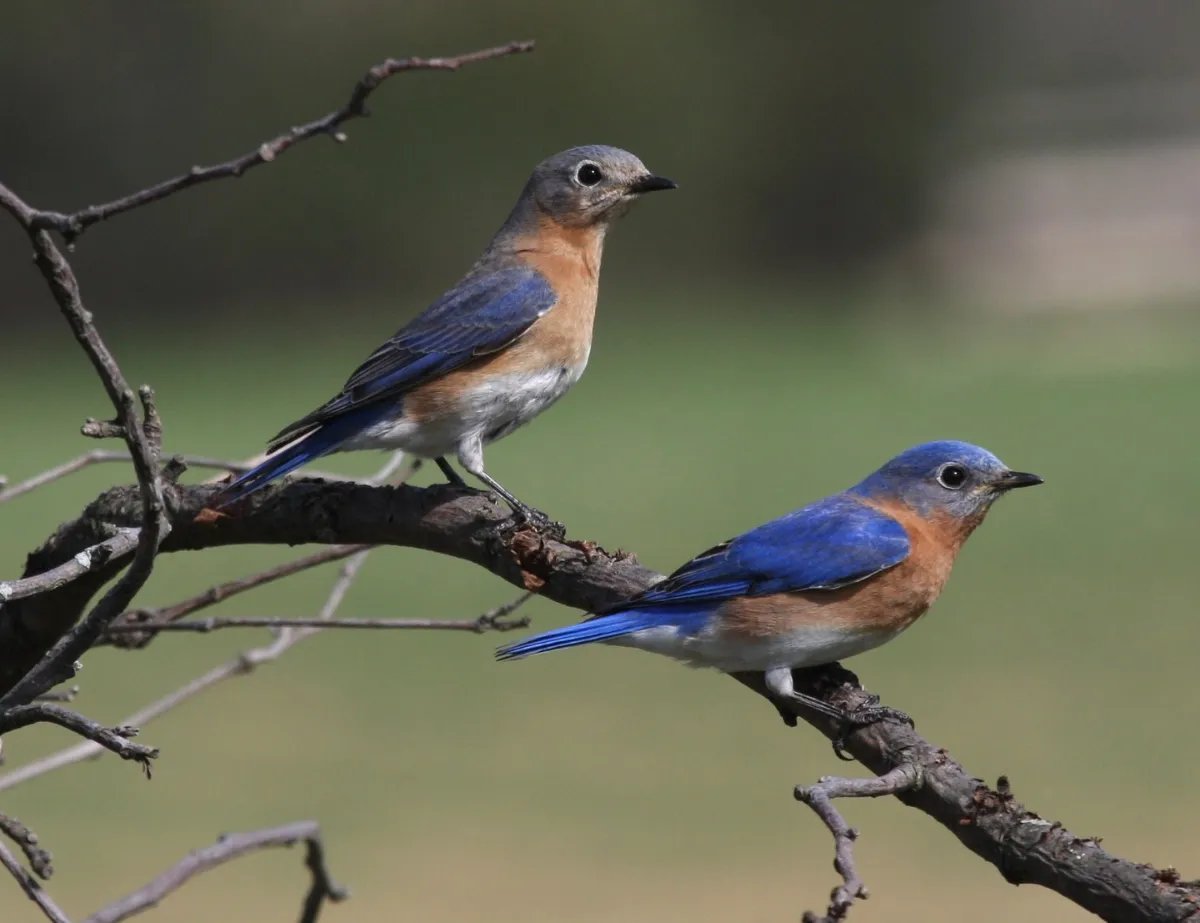
Eastern Bluebird pair. The brighter male at lower right shows the rusty throat and breast.
A male Eastern Bluebird (Sialia sialis) has a blue head, back and wings. The rusty color reaches from the chest up to the throat and sides of the neck. Below the rusty breast, the lower belly is white.
Watch for a round-headed bird sitting upright on a fence post or low branch overlooking short grass. Females are duller, with blue most noticeable on the wings and tail and a softer wash of rust across the chest.
2. Western Bluebird

Male Western Bluebird with a blue throat above a rusty chest.
To tell a male Western Bluebird (Sialia mexicana) from a male Eastern Bluebird, zoom in just below the bill. The Western has a blue throat, with rust beginning lower on the chest. In some males, the rust also extends onto the shoulders and upper back.
The throat is easiest to check in a front or side view. Females are less vividly colored, so compare your location and the whole bird with a regional guide if the throat color is hard to see.
3. Lazuli Bunting
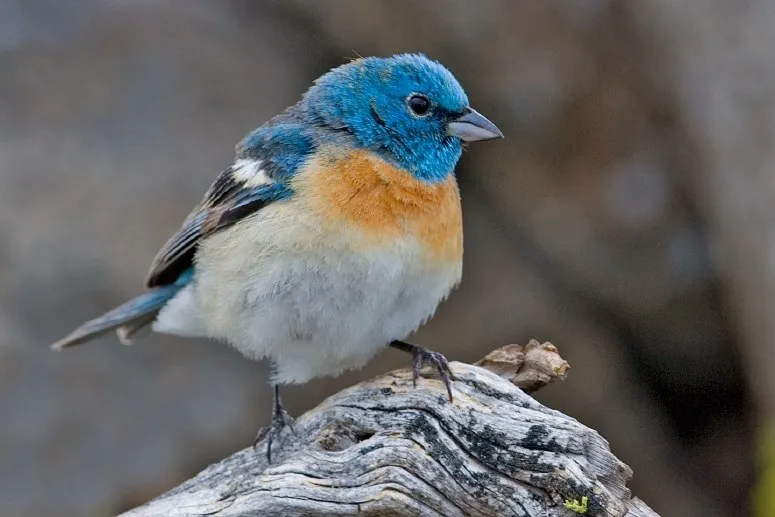
Breeding male Lazuli Bunting with a cinnamon chest, white belly and pale wing bars.
A breeding male Lazuli Bunting (Passerina amoena) wears a turquoise-blue head above a cinnamon chest and white belly. The quickest check in a side view is the pair of white wing bars. The bill is also short and triangular, giving the bird a different profile from a bluebird.
In western North America, look for it singing from a shrub or feeding near brushy edges during the breeding season. Females and nonbreeding males are less vivid, so the bright blue-and-orange pattern is most useful for identifying breeding males.
Three blue and orange kingfishers
4. Common Kingfisher

Common Kingfisher with a bright blue back, orange cheek and long, pointed bill.
If you saw a small blue-and-orange bird flash low over a British river or canal, compare it with the Common Kingfisher (Alcedo atthis). Check for a long, straight bill, an orange cheek patch and white on the side of the neck. The back can look especially bright blue when the bird turns toward the light.
A perched bird gives you a chance to check the bill. An adult male’s bill is black, while an adult female usually shows orange on the lower half.
5. Azure Kingfisher
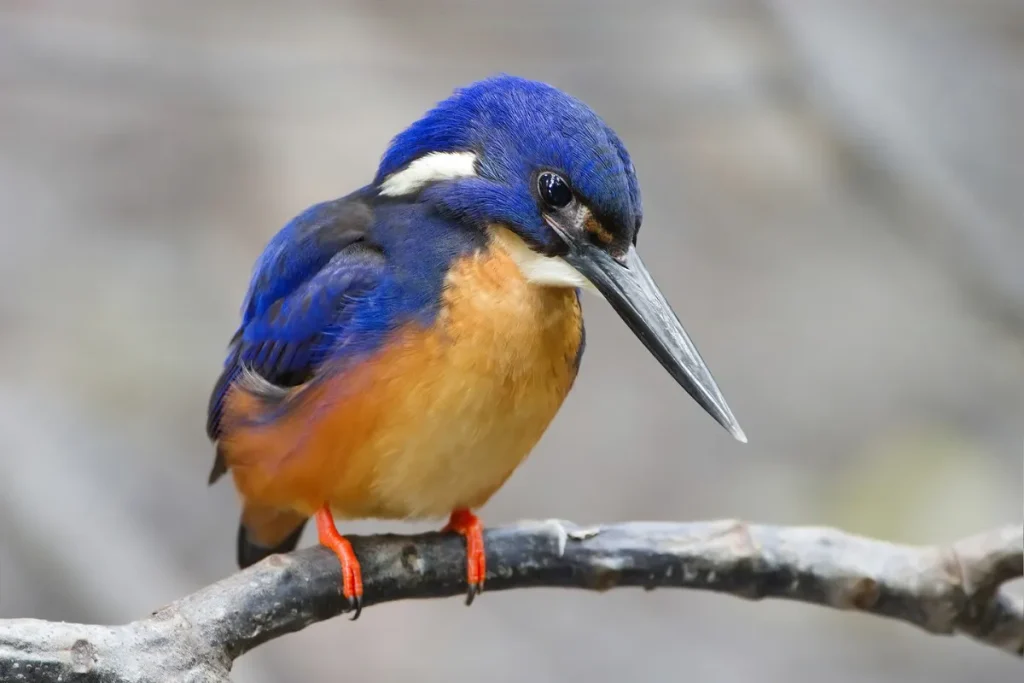
Azure Kingfisher with deep blue upperparts, a long dark bill and an orange belly.
The Azure Kingfisher (Ceyx azureus) is a small waterside bird found across northern and eastern Australia, including Tasmania. Look for deep blue upperparts with a violet sheen, a long black bill and warm orange underparts. The sides of the chest can look bluish-purple where they meet the orange.
You’re most likely to get a clear view while it sits on a low branch over the water. A side view shows the long bill, short tail and pale neck marking together.
6. Malachite Kingfisher
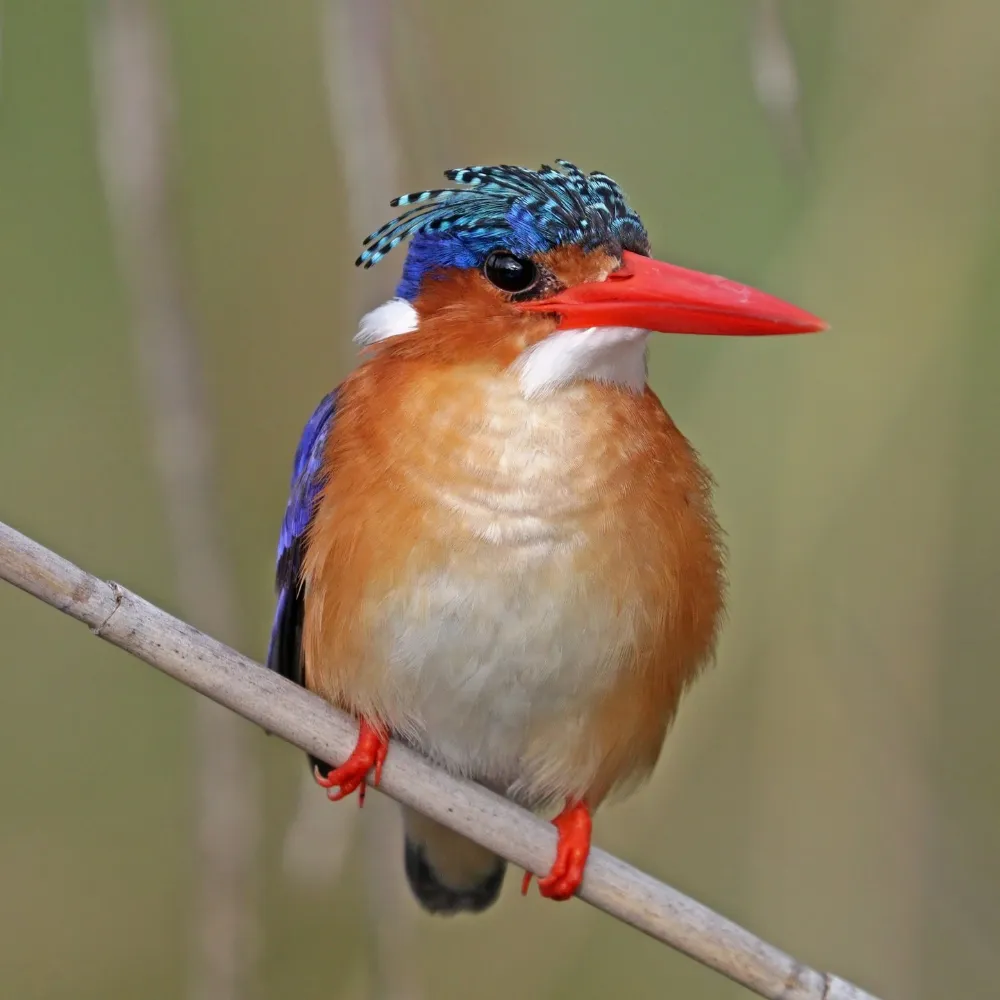
Adult Malachite Kingfisher showing its red bill, white throat and barred crown.
In sub-Saharan Africa, a small blue-and-orange bird perched on a reed may be a Malachite Kingfisher (Corythornis cristatus). Look for the adult’s red bill and fine dark bars across its turquoise crown. A white throat sits between the orange cheek and chest.
Young birds can have dark bills. If the bill is hard to see, check the crown pattern and note whether the bird was perching low beside water.
Himalayan forests
7. Rufous-bellied Niltava

Male Rufous-bellied Niltava with a dark face, bright blue crown and orange underparts.
A male Rufous-bellied Niltava (Niltava sundara) has rich blue upperparts, a dark face and orange across much of the underside. In a front view, the brighter blue crown stands out above the dark face. A side view may also show a bright blue patch on the neck.
In the Himalayan region, look for it in dense undergrowth in broad-leaved or mixed forest. Its short bill and the forest setting help distinguish it from a blue-and-orange kingfisher.
The easiest detail to photograph
Try to get a side view that includes the throat, the whole bill and the folded wing. The throat separates the two male bluebirds, the wing bars help pick out a Lazuli Bunting, and the bill helps narrow down the kingfishers. Save the location with the photo so you can compare it with a regional field guide.
Related guide
Bluebirds sometimes raise their young in old tree cavities. See what else lives inside them. Animals That Live in Tree Hollows
Sources
- Cornell Lab of Ornithology. Eastern Bluebird and Western Bluebird. allaboutbirds.org
- National Audubon Society. Lazuli Bunting. Audubon Field Guide
- RSPB. Common Kingfisher. Alcedo Atthis
- Australian Museum. Azure Kingfisher. The Australian Museum
- Vorstman’s Guide to the Birds of Southern Africa. Malachite Kingfisher. vorstman.com
- India’s Directorate of Forest Education. Chidiya: The Flight of Colours, p. 52.


