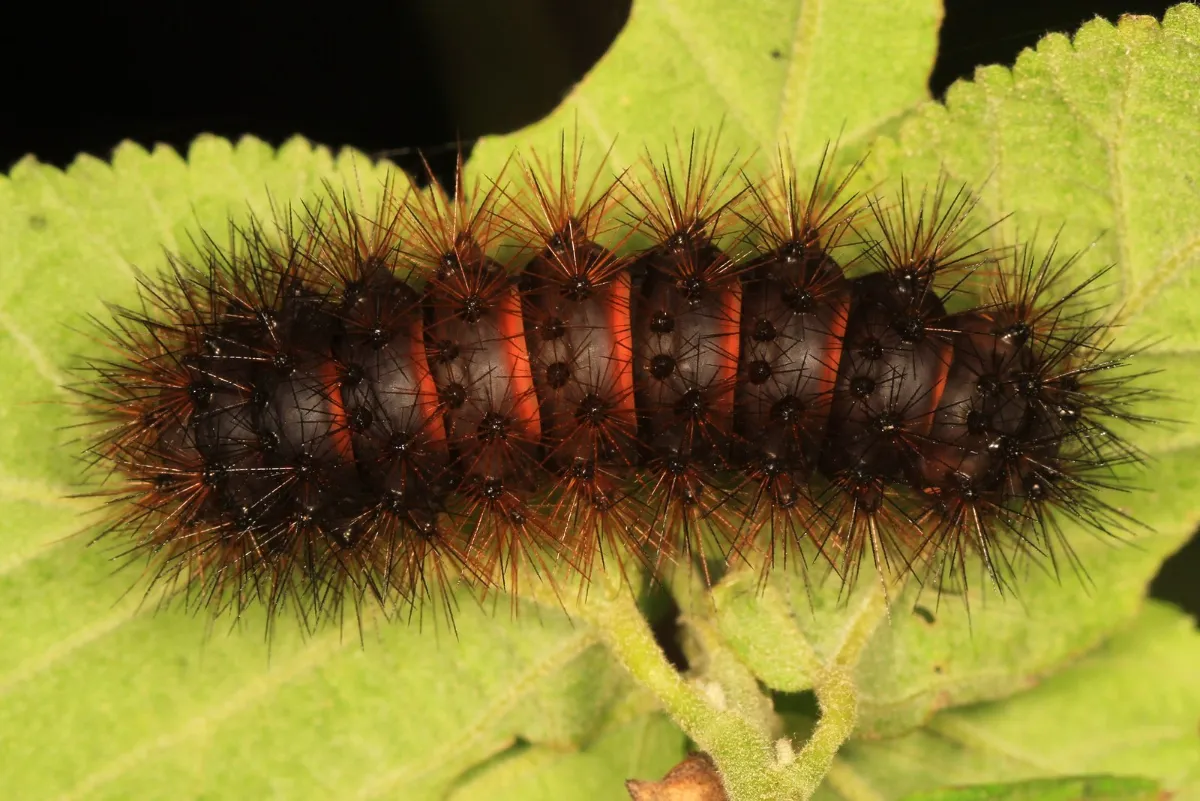
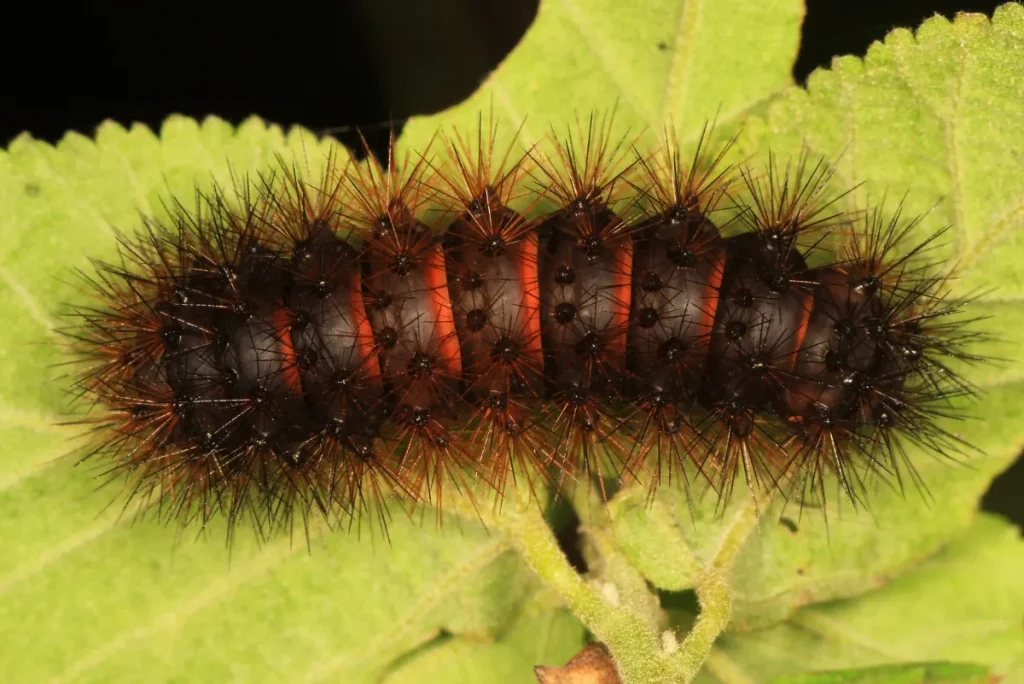
If you find a black fuzzy caterpillar with thin red bands in eastern North America, it may be a giant leopard moth caterpillar (Hypercompe scribonia). Look for narrow rings of red skin between the clumps of black bristles. The rings are often easiest to see when the caterpillar curls up.
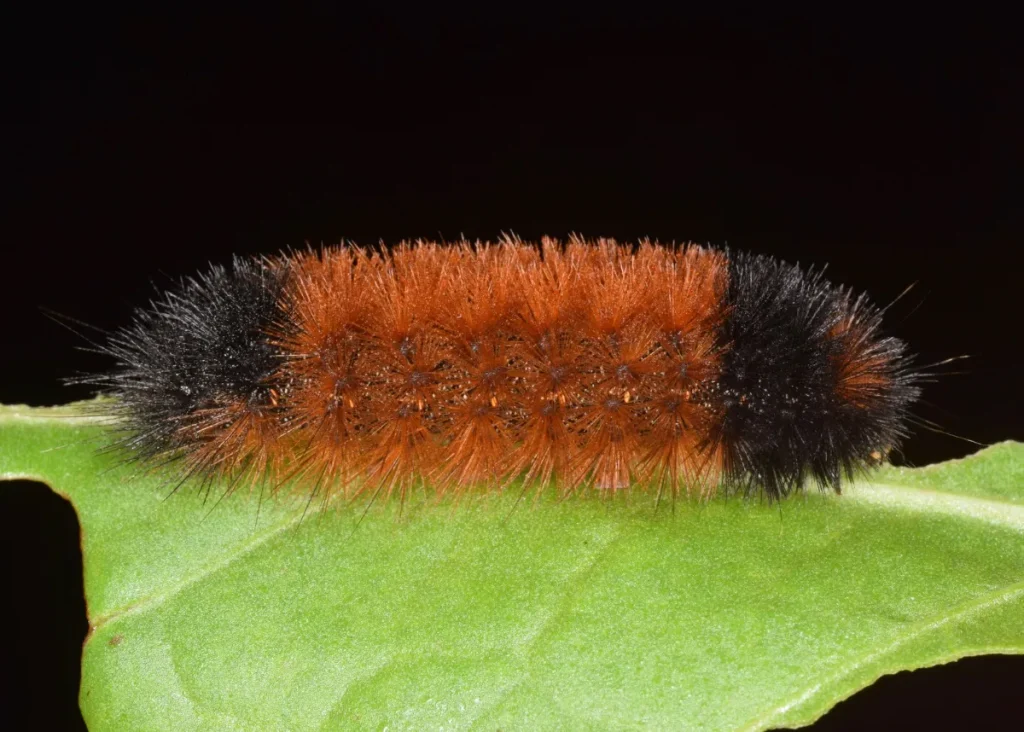
A banded woolly bear, the caterpillar of the Isabella tiger moth, usually has a broad rusty-orange middle with black hairs at both ends. To tell them apart, zoom in on the colored part of your photo and check whether you’re looking at skin or hair.
| What you see | Likely identification |
|---|---|
| Black bristles with narrow red lines between body segments | Giant leopard moth caterpillar |
| A broad band of rusty-orange hairs with black ends | Banded woolly bear caterpillar |
| Black bristles with no clear view of the skin | Look for a side view or wait for the caterpillar to change position. |
Look Between the Black Bristles for Red Rings
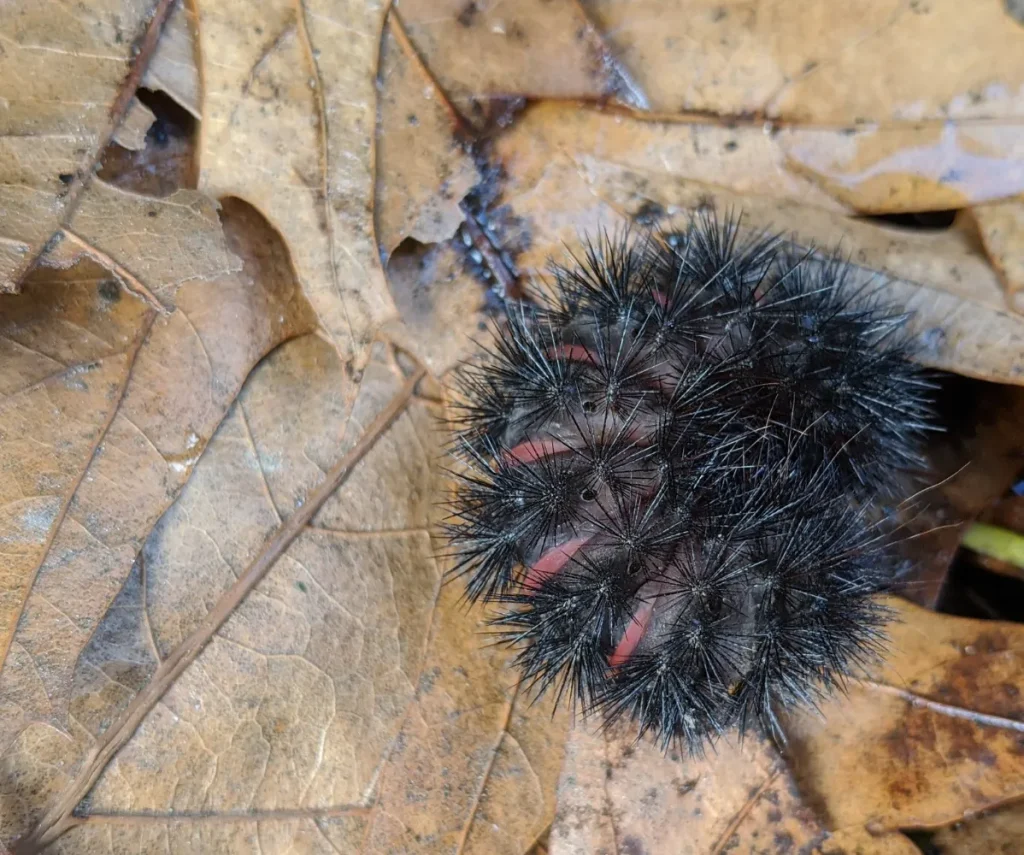
A mature giant leopard moth caterpillar has stiff black bristles along its body. When it’s stretched out, the bristles can make it look almost entirely black. When it curls, the skin between the body segments is easier to see. That’s where the red rings appear.
In the photo below, follow the curved edge of the caterpillar. Several narrow red lines show through the black bristles. If the caterpillar you found is still moving, wait for it to turn and take a side photo. You can often see more by zooming in on the picture.
Giant Leopard Moth Caterpillar vs. Banded Woolly Bear
In the next photo, the rusty color belongs to the hairs themselves. It forms one broad patch across several segments, with dark hairs toward the ends. That’s the typical pattern of a banded woolly bear (Pyrrharctia isabella).
The width of that rusty patch varies. A banded woolly bear can look much darker than the one in the photo, so pay more attention to where the color sits than to how much orange you see. The giant leopard moth caterpillar is also called the giant woolly bear, which is one reason the names get confused.
Do Giant Leopard Moth Caterpillars Sting?
Giant leopard moth caterpillars lack stinging spines. If you’re still working out what you found, photograph it in place. Other hairy caterpillars can irritate skin, and a photo that shows the bands and bristles will help you identify yours.
Why Do They Show Up on Paths in the Fall?
Giant leopard moth caterpillars often spend winter as larvae. In fall, you may see one crossing a path or driveway while it looks for shelter. Some turn up under fallen leaves or in woodpiles, tucked away from exposed ground.
What Does the Adult Giant Leopard Moth Look Like?
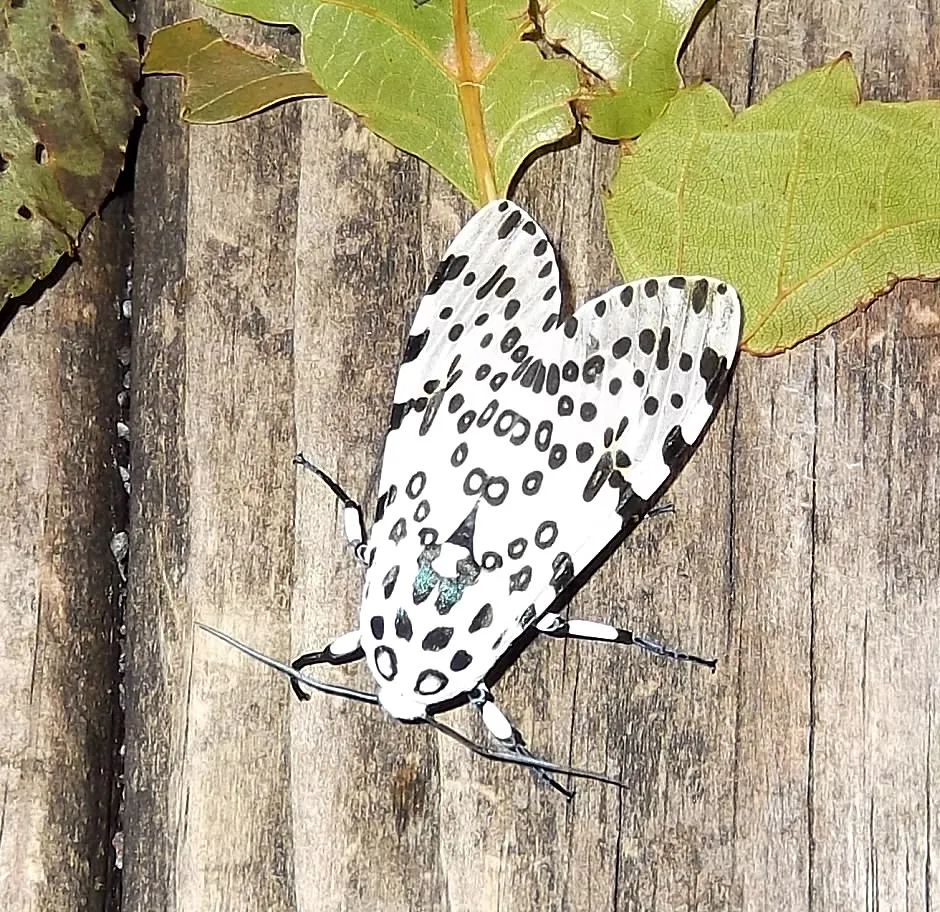
The adult has white wings covered in black spots and rings. Some of the spots have white centers, which gives the moth its leopard-like pattern. The black, bristly caterpillar and the white moth in the photo below are two stages of the same species.
Read how to identify a praying mantis egg case on a branch or fence.
Sources
- University of Florida IFAS Extension — Giant leopard moth identification, life cycle, and defenses
- USA National Phenology Network — Banded woolly bear identification
- Florida Museum of Natural History — Giant leopard moth caterpillar and adult
- Missouri Department of Conservation — Giant leopard moth field guide


