If you saw an upright black-and-white bird on a rocky ledge, you may have been looking at an auk. Common Murres, Razorbills, and Atlantic Puffins all have the dark backs and white bellies that can make them look like penguins from a distance. They also dive for food. Living penguins use their wings as flippers underwater, while these auks can take to the air, often with rapid wingbeats just above the sea.
For a bird you saw perched or swimming, start with the bill. A thin, pointed bill fits a murre. A deep black bill with a narrow white line suggests a Razorbill. In Australia or New Zealand, a black-and-white bird with a long neck and hooked bill is worth comparing with a Pied Cormorant.
Penguin look-alikes at a glance
| What you saw | Bird to compare | Where to start |
|---|---|---|
| Upright stance, white belly, thin pointed bill | Common Murre, also called Common Guillemot | North Atlantic and North Pacific |
| Deep black bill with a thin white line | Razorbill | North Atlantic |
| Broad, colorful bill and orange feet | Atlantic Puffin | North Atlantic |
| Very small, round-bodied bird with a stubby black bill | Little Auk, also called Dovekie | Arctic and North Atlantic |
| Mostly black body with a white wing patch and red feet | Black Guillemot in breeding plumage | Arctic and North Atlantic rocky coasts |
| Long neck, white chest, and hooked gray bill | Pied Cormorant, also called Pied Shag | Australia and New Zealand |
1. Common Murre
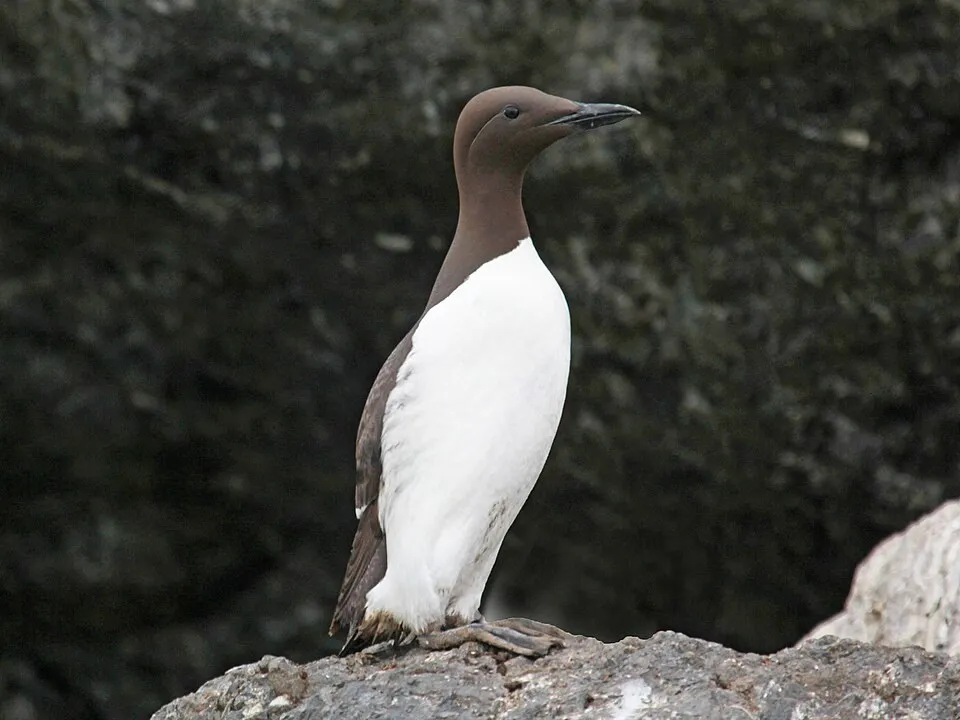
Common Murre standing upright on a ledge in Alaska. Look for the slim, pointed bill.
The Common Murre (Uria aalge) is called the Common Guillemot in Britain. It can look remarkably penguin-like on a crowded cliff ledge. The legs sit well back on the body, and the dark head and back frame a white belly.
Look for a long, pointed bill. That narrow profile is one of the easiest ways to tell it from a Razorbill. In winter, Common Murres often show more white on the face and throat, so the bill can be more useful than the amount of white on the head.
2. Razorbill
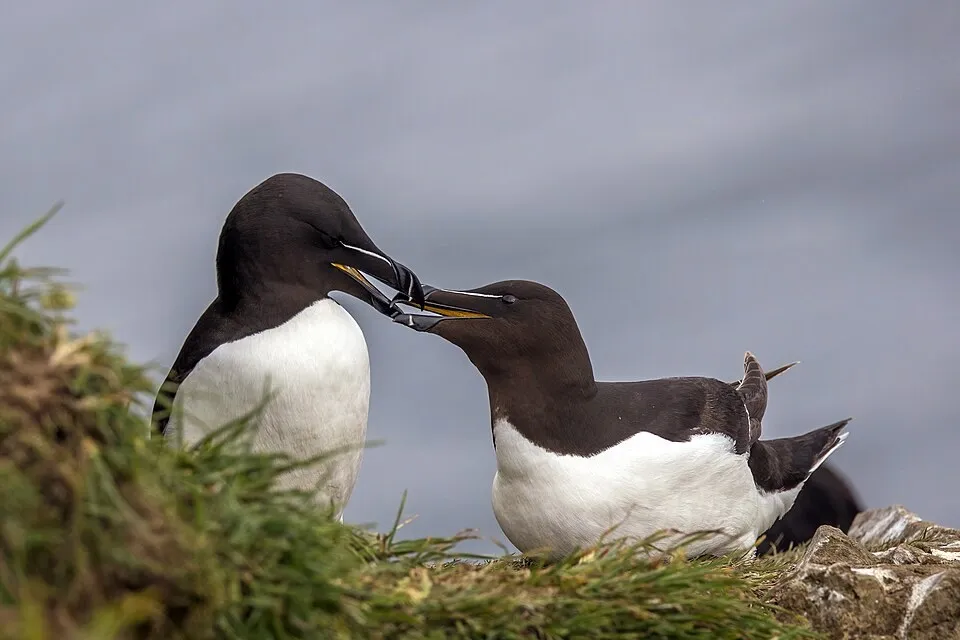
Two Razorbills on Skomer Island, Wales. Look for the deep bills and fine white markings.
The Razorbill (Alca torda) has a black back, white underparts, and a deep, blunt bill. In a sharp side view of a breeding adult, look for a thin white line across the bill and another fine line running toward the eye.
Razorbills and murres sometimes share the same rocky ledges. When several black-and-white birds are standing together, compare their bill profiles. A murre’s bill tapers to a narrow point, while a Razorbill’s looks deeper all the way to the tip.
3. Atlantic Puffin
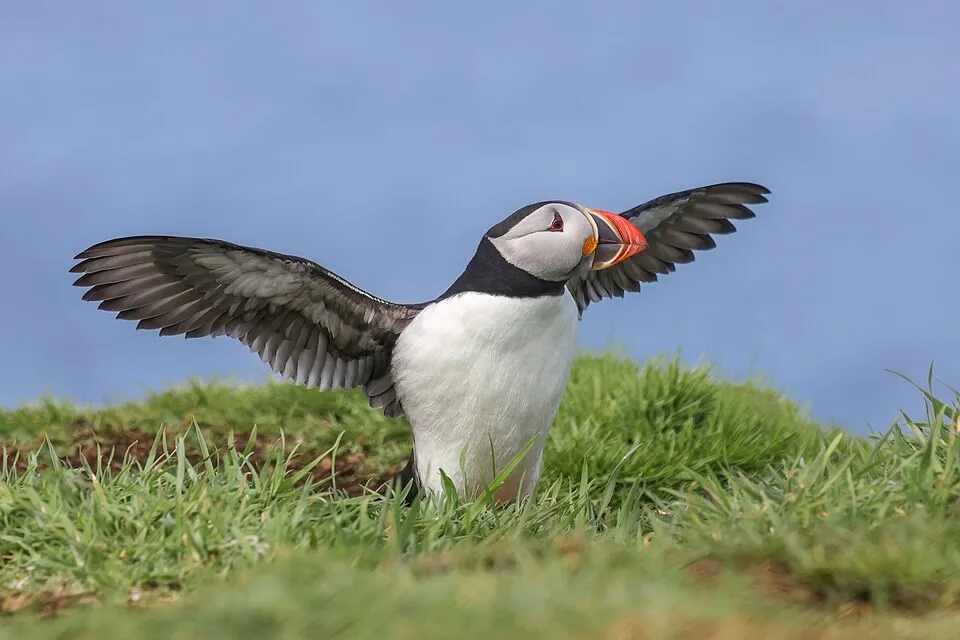
Atlantic Puffin with wings spread and its colorful breeding-season bill visible.
An Atlantic Puffin (Fratercula arctica) has a compact body, pale cheeks, and bright orange feet in breeding plumage. Its broad, colorful bill is usually the easiest detail to recognize when it stands on a grassy slope or cliff edge.
In winter, the bill gets smaller and duller as the bird sheds its colorful outer plates. If you see one offshore, pay attention to the short neck and the shape of the bill as well as its color.
4. Little Auk
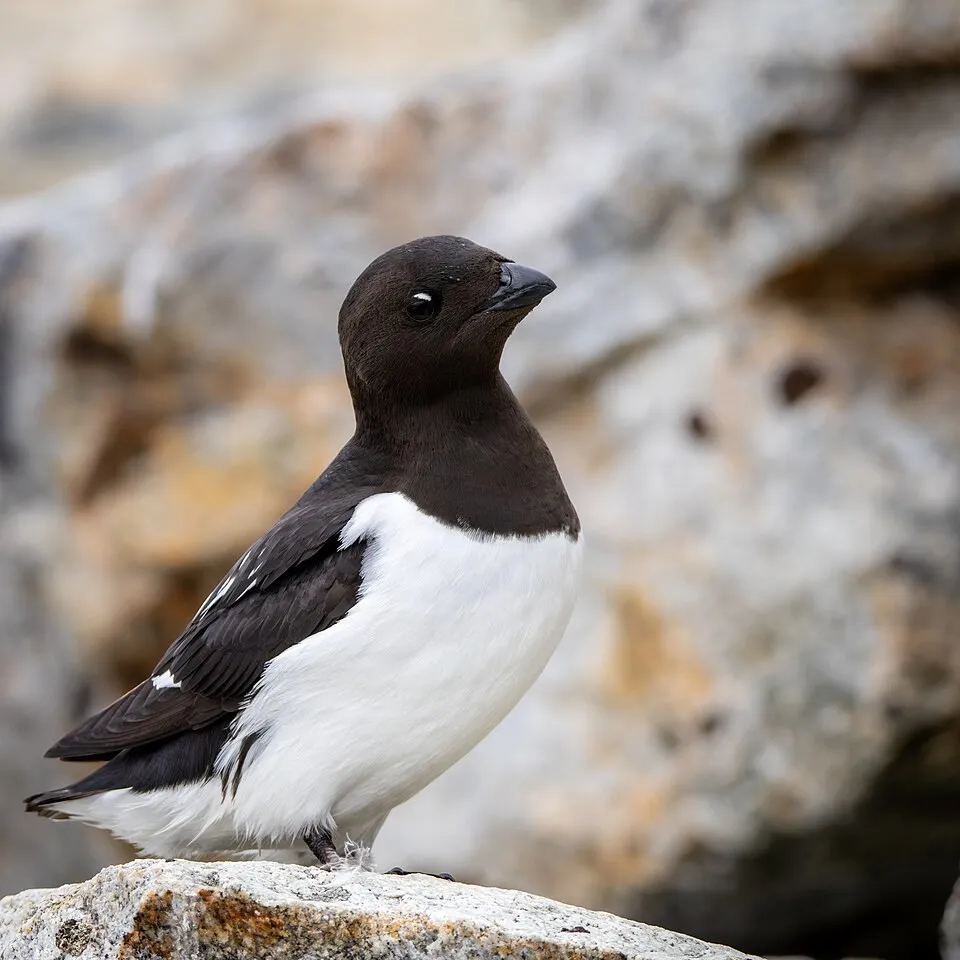
Little Auk in breeding plumage in Svalbard. Notice the short neck and small black bill.
The Little Auk (Alle alle), called the Dovekie in North America, is about the size of a starling. It has a round body, a short neck, and a stubby black bill. In breeding plumage, the dark throat meets the white belly in a sharp boundary.
Look for a very small seabird flying low over the water with fast, whirring wingbeats. It breeds in the Arctic and spends winter in the North Atlantic, when more white is visible around the throat and face.
5. Black Guillemot
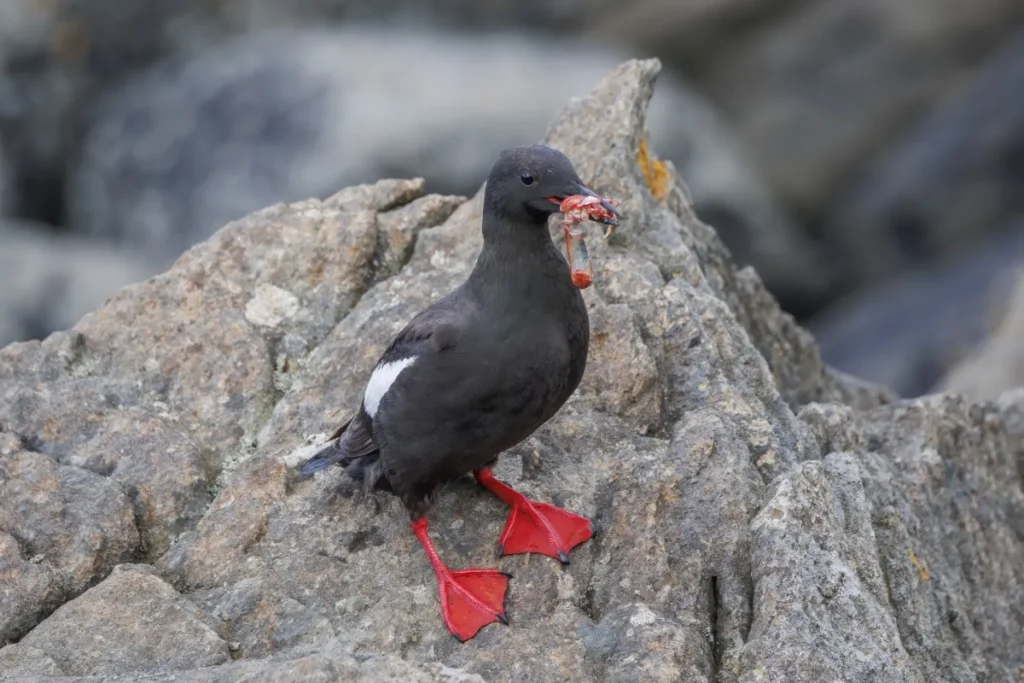
Black Guillemot on a rock with bright red feet and a white patch on the folded wing.
In breeding plumage, the Black Guillemot (Cepphus grylle) looks mostly black until it turns sideways and shows the white patch on its folded wing. Its bright red feet are easy to spot when it stands on a low rock.
In winter, the body becomes much paler, so a winter bird can look quite different from the one pictured. Around Scotland, rocky shores and sea lochs are good places to compare this species with other auks.
6. Pied Cormorant
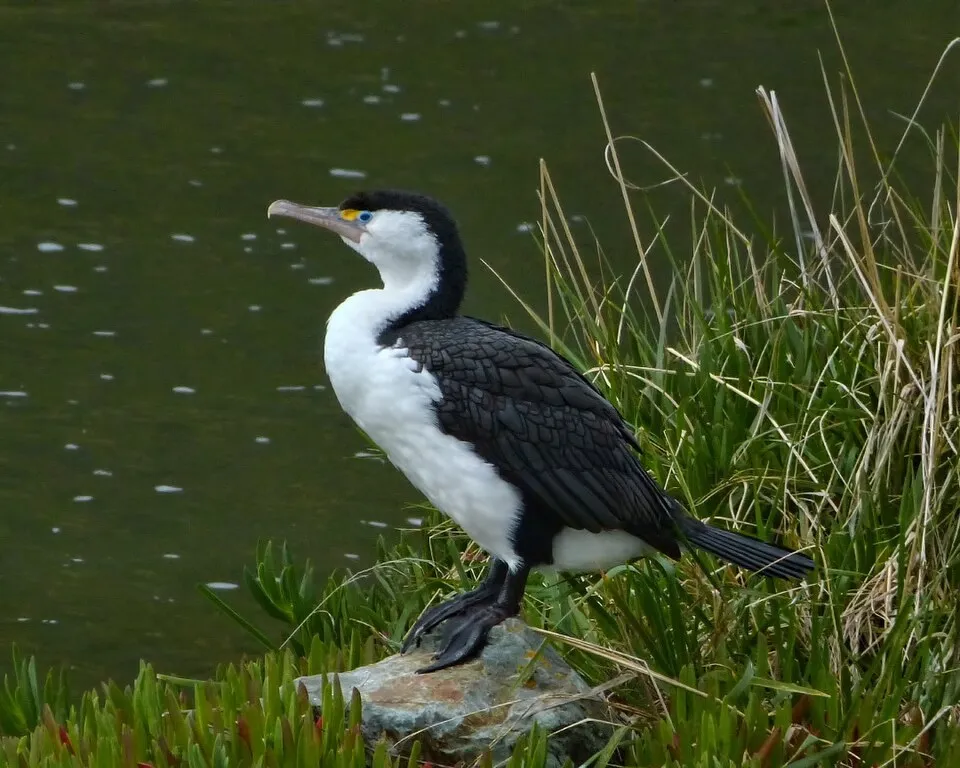
Pied Shag in New Zealand, showing its long neck, white chest, and hooked bill.
The Pied Cormorant (Phalacrocorax varius), known as the Pied Shag in New Zealand, can look like a tall, black-and-white penguin while standing near the water. Look for a long neck and a long gray bill with a hooked tip. On a breeding adult, yellow skin in front of the eye can provide another clue.
You may see it perched on rocks, on a structure beside the water, or in a tree near a harbor. If it flies past, look for the neck held out in front and the long tail trailing behind.
What if you see it fly?

An Atlantic Puffin flying in to land on the Icelandic coast.
Flight above the water is a quick way to narrow the identification. All six birds in this guide can fly. Once you’ve seen that, use location and shape to work out which group you’re looking at. A compact bird with rapid wingbeats off Britain could be an auk. A longer-necked bird flying past an Australian or New Zealand harbor could be a cormorant.
If you’re looking at a historical illustration, there’s one other bird worth knowing. The Great Auk was a flightless North Atlantic seabird with an upright stance and dark-and-white plumage. It went extinct in the nineteenth century. The Razorbill is one of its living relatives.
Related guide
If you also spotted a marine mammal on the shore, here are the features to look for in a photo. Seal vs. Sea Lion: How to Tell From a Photo
Sources
- British Trust for Ornithology and the Australian Antarctic Program. Auks · Penguins. BTO
- Cornell Lab of Ornithology. Common Murre Identification. allaboutbirds.org
- RSPB. Razorbill · Puffin · Little Auk · Black Guillemot. Alca Torda
- BirdLife Australia and New Zealand Birds Online. Pied Cormorant · Pied Shag. BirdLife Australia
- Natural History Museum and Audubon. The Great Auk · Razorbill field guide.


