
Saw a beach bird with a long beak? Start with the direction of the curve. A long bill that curves down points toward a curlew. A bill that tilts slightly upward, often with a pink base and dark tip, is a clue to a godwit. A straight orange-red bill on a black-and-white bird points toward an oystercatcher.
Then check where you saw it. A brown bird with a long, downcurved bill on a California beach could be a Long-billed Curlew. A similar bird on a British estuary is more likely to be a Eurasian Curlew. Use the table to match the bill with your location and one other visible feature.
Long-beaked beach birds at a glance
| What you see | Bird to compare | Where to start |
|---|---|---|
| Very long, downcurved bill on a warm brown bird | Long-billed Curlew | Western North American coasts, especially outside the breeding season |
| Downcurved bill, streaky brown body and long legs | Eurasian Curlew | UK and European coasts and estuaries |
| Slightly upturned, two-tone bill and warm buff body | Marbled Godwit | North American beaches and tidal flats |
| Slightly upturned bill, pale underside and a barred tail | Bar-tailed Godwit | UK, Australian and New Zealand tidal flats in the nonbreeding season |
| Straight red-orange bill, black head and yellow eye | American Oystercatcher | Atlantic and Gulf coasts of the United States |
| Straight orange-red bill, red eye and black-and-white body | Australian Pied Oystercatcher | Australian coasts, including Tasmania |
| Orange-and-black bill with the lower half projecting past the upper half | Black Skimmer | Coastal bays and beaches in the Americas |
1. Long-billed Curlew
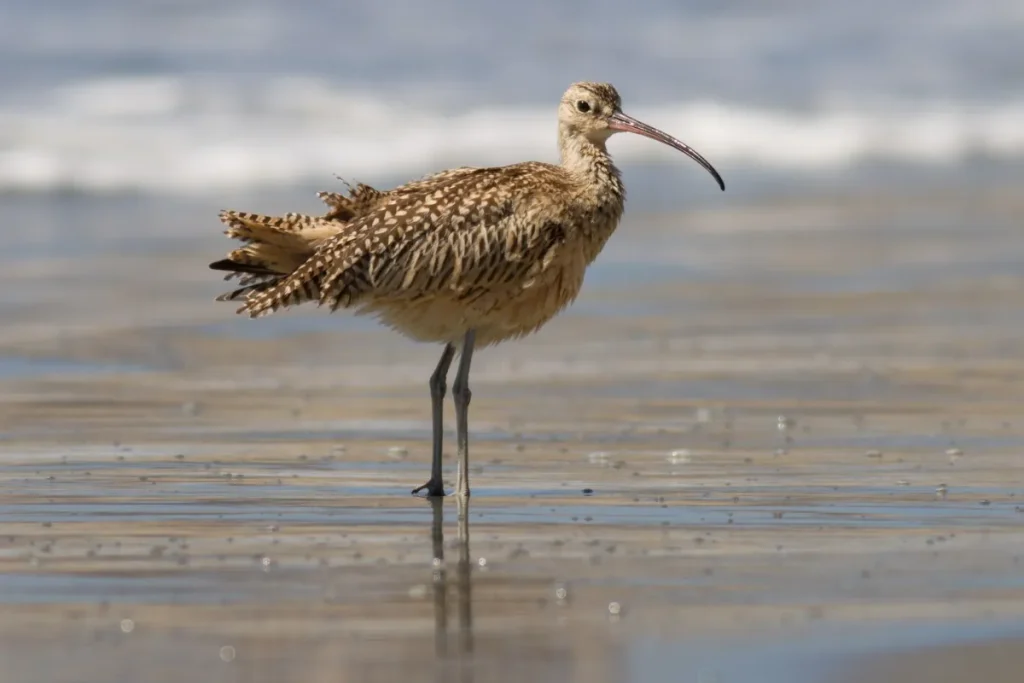
A young Long-billed Curlew with a long, downcurved bill at Drakes Beach, California.
The Long-billed Curlew (Numenius americanus) is a large, sandy-brown shorebird with a bill that curves down well beyond the head. It probes wet sand and mud for prey and can often be seen on beaches, estuaries, and tidal flats outside the breeding season.
If the bill seems shorter than expected, check the head. Young birds and males can have shorter bills than adult females. A Hudsonian Whimbrel also has a curved bill, but its bold head stripes are a useful extra clue.
2. Eurasian Curlew

Eurasian Curlew showing streaked brown plumage and a long, downcurved bill.
The Eurasian Curlew (Numenius arquata) is a good match for a tall, streaky brown wader with a long, downward-curving bill on a British estuary. Watch how it probes into exposed mud as the tide falls. You may hear its bubbling call before you get a close enough view to see the bill clearly.
A side view is especially helpful. It shows the curve while keeping the length of the bill in perspective. From straight ahead, the bill can look much shorter.
3. Marbled Godwit
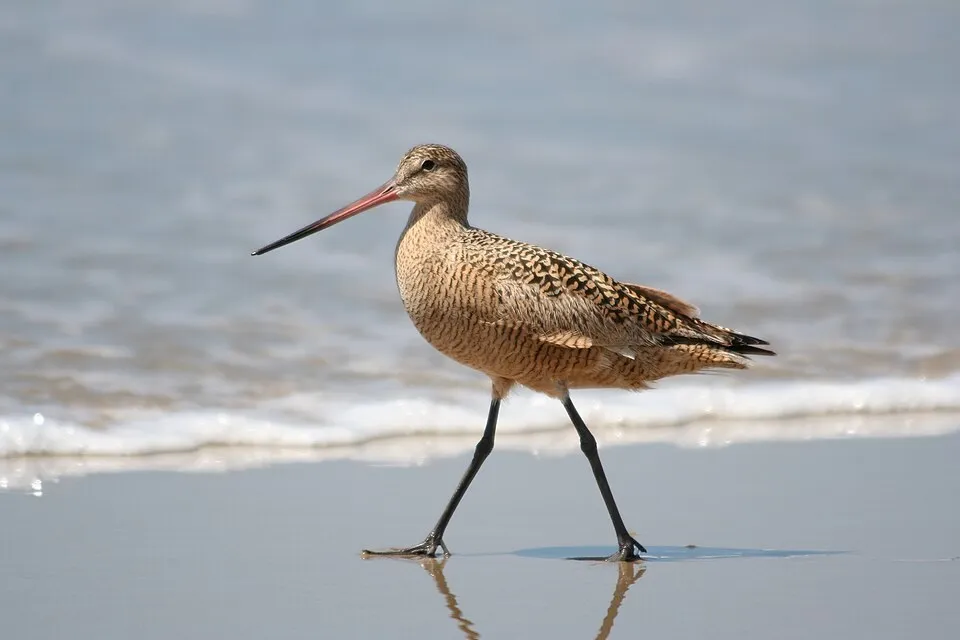
Marbled Godwit walking along a beach. Its long pink-and-dark bill turns slightly upward.
The Marbled Godwit (Limosa fedoa) has a warm, cinnamon-buff body and a two-tone bill. The pink base leads into a dark tip that tilts slightly up. In a distant photo, that pink can fade into the background, so follow the outline of the bill first.
This is a useful comparison on the North American coast, where a Marbled Godwit and a Long-billed Curlew can feed on the same stretch of shore. The godwit’s bill tips up and the curlew’s bends down.
4. Bar-tailed Godwit

Bar-tailed Godwit in New South Wales. The bill is pink at the base, dark toward the tip and slightly upturned.
A Bar-tailed Godwit (Limosa lapponica) in nonbreeding plumage is usually brownish above and pale below. It has a long, tapered bill with a subtle upward curve. Look for it on estuaries and tidal flats, including in Britain, Australia, and New Zealand.
If the bird takes off, check the tail for narrow bars. In Britain, this can help separate it from a Black-tailed Godwit, which has a straighter bill and shows a prominent white wing stripe and a black tail contrasting with the white rump in flight.
5. American Oystercatcher
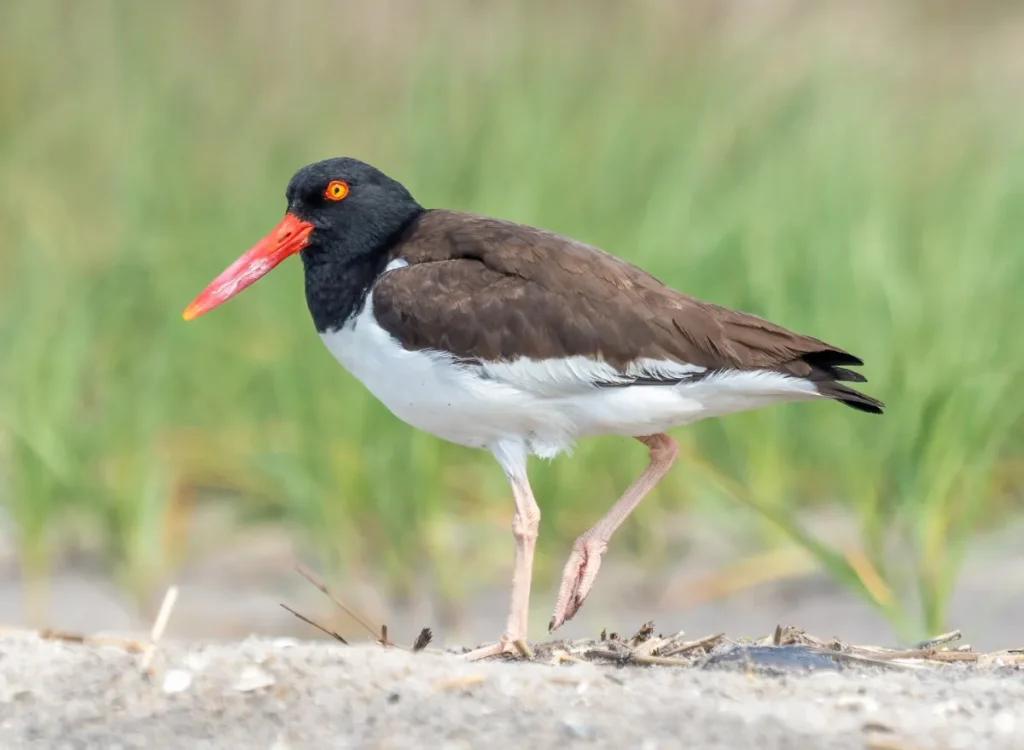
American Oystercatcher with a straight red-orange bill and a yellow eye.
The American Oystercatcher (Haematopus palliatus) has a thick, straight red-orange bill, a black head, and a white belly. In a sharp photo, the yellow iris inside a reddish eye ring gives you another feature to check. Its back often looks dark brown.
Look for it on the Atlantic and Gulf coasts of the United States, where it feeds on shellfish along beaches, mudflats, and other tidal shores.
6. Australian Pied Oystercatcher
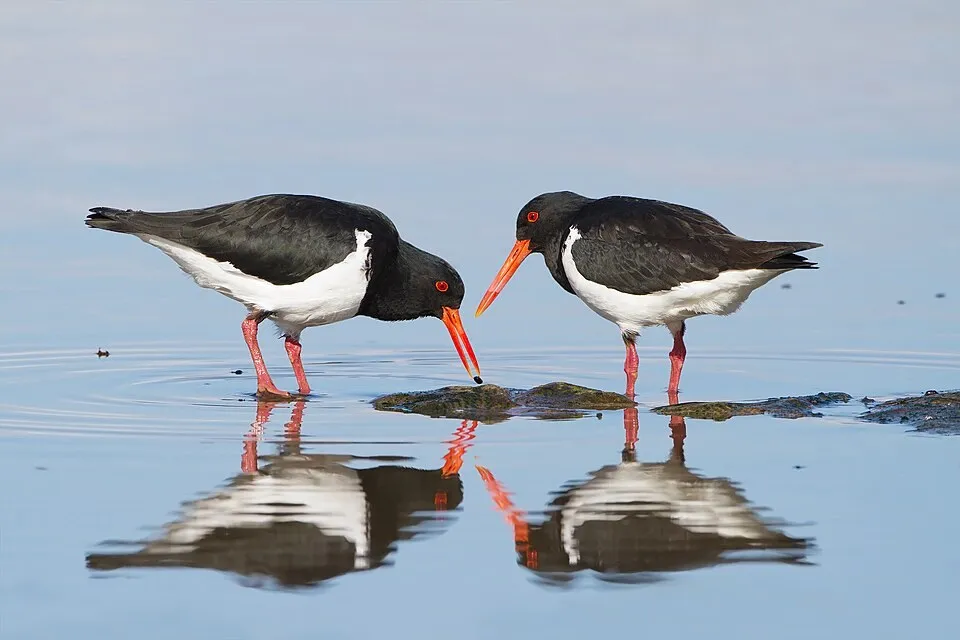
Two Australian Pied Oystercatchers probing in shallow water in Tasmania.
The Australian Pied Oystercatcher (Haematopus longirostris) has a long orange-red bill, pinkish legs, and sharply divided black-and-white plumage. Look for it along sandy beaches and tidal flats around Australia. If the bird is dark all over, compare it with the Sooty Oystercatcher, another orange-billed bird found on Australian shores.
A black-and-white bird with an orange bill on a British beach is also worth comparing with the Eurasian Oystercatcher. These birds share a similar outline, so the location is especially useful.
7. Black Skimmer
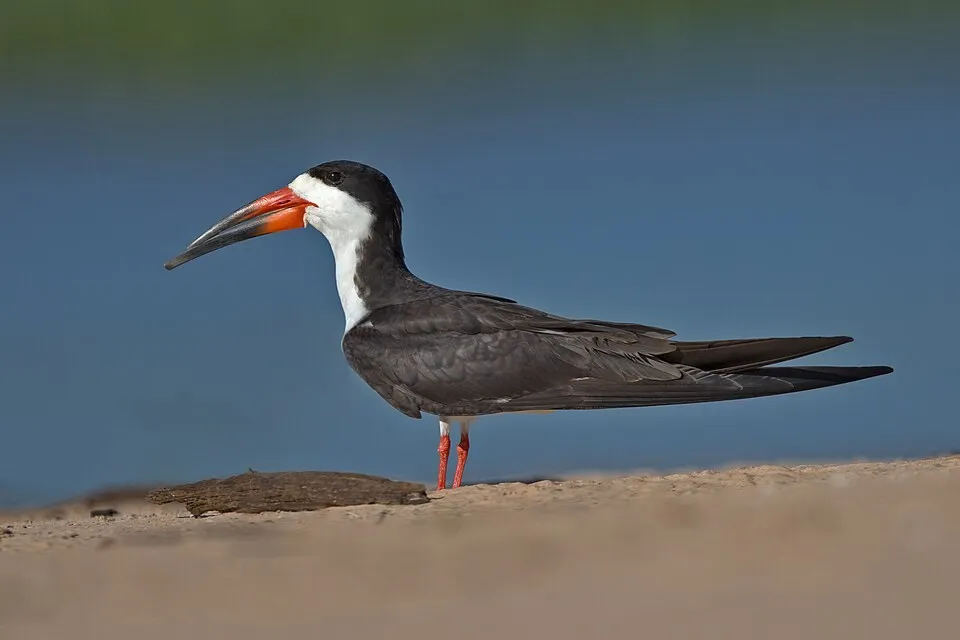
Black Skimmer with an orange-red bill base and a lower bill that extends beyond the upper half.
The Black Skimmer (Rynchops niger) has a bill that is orange-red at the base and black toward the tip. Look closely at the side profile. The lower half extends farther forward than the upper half. That feature stands out even when the bird is resting.
If you see it feeding, watch it fly low over calm water with the lower part of its bill touching the surface. The long wings and low, level flight can help you recognize it from much farther away.
What to photograph for an identification
Take a side-on photo that includes the entire bill, plus a wider photo that shows where the bird was feeding. A side view captures the curve and any color change from base to tip. The wider view adds context, such as an exposed mudflat, a surf line, or calm water over which the bird was flying.
Related guide
If you’re exploring a rocky shore on the same walk, see what you can find in the pools left by the falling tide. 10 Pacific Coast Tide Pool Animals
Sources
- Cornell Lab of Ornithology. Long-billed Curlew · Marbled Godwit · American Oystercatcher · Black Skimmer. allaboutbirds.org
- RSPB. Curlew · Bar-tailed Godwit · Oystercatcher. Numenius Arquata
- New Zealand Birds Online. Bar-tailed Godwit / Kuaka. New Zealand Birds Online
- BirdLife Australia and the Australian Museum. Australian Pied Oystercatcher · Pied Oystercatcher.


