
The quickest way to tell a barred owl from a great horned owl is to look at the eyes and head. A barred owl has dark eyes and a rounded head. A great horned owl has yellow eyes and two prominent feather tufts. If you only hear the bird, listen through one complete phrase and compare it with the recordings below. allaboutbirds.org
| Field mark | Barred owl | Great horned owl |
|---|---|---|
| Eyes | Dark brown, often nearly black | Yellow |
| Head | Smooth, rounded outline | Two prominent feather tufts |
| Belly | Long brown streaks running down a pale belly | Fine bars running across the belly |
| Typical body length | 16.9–19.7 in (43–50 cm) | 18.1–24.8 in (46–63 cm) |
| Familiar call | “Who cooks for you?” rhythm | Deep hoots with a quick pair of notes near the start |
1. Check the eyes when the owl faces you
In a clear photo, look at the colored ring around the pupil. A great horned owl’s yellow iris can be easy to see even when its body blends into the tree. A barred owl’s iris is so dark that it often blends into the pupil at a distance. In deep shade, move on to the head shape or breast markings. allaboutbirds.org

A barred owl with dark eyes, a rounded head, and long brown belly streaks.
2. Look at the outline of the head
The great horned owl’s “horns” are tufts of feathers. When they stand upright, they give the head two pointed corners. A perched barred owl has a smoothly rounded outline. This clue is particularly useful when you can see a silhouette but the eye color is hidden. allaboutbirds.org
3. Follow the direction of the belly markings
On a barred owl, the markings change direction below the chest. The upper chest has horizontal bars, and the lower streaks run down toward the feet. A great horned owl has fine crosswise barring on the belly and often shows a white patch high on the throat. If the owl is looking away, those markings can still give you a clue. www.allaboutbirds.org
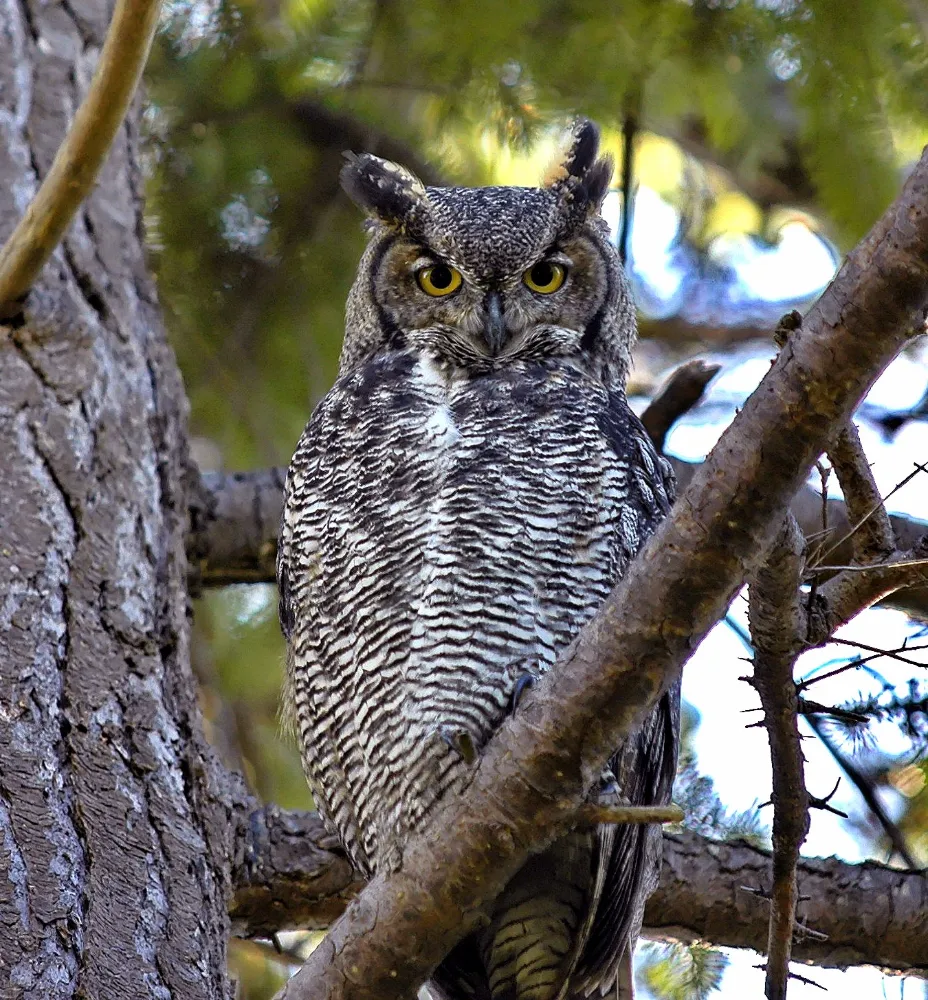
A great horned owl with yellow eyes, raised ear tufts, and fine barring across its belly in Delta, British Columbia.
4. Use size as a supporting clue
Great horned owls are generally heavier and bulkier. The body lengths in the table overlap, though, and a bird perched closer to you can look larger. Use the eyes, head, or belly pattern to confirm an identification based on size. allaboutbirds.org
5. Listen to the rhythm after dark
A barred owl’s familiar call breaks into two phrases that sound like “Who cooks for you? Who cooks for you-all?” A great horned owl’s territorial hoot has a more compact rhythm, with a quick pair of notes near the start. Play both recordings and listen to the spacing as well as the pitch. www.allaboutbirds.org
Barred owl in Nova Scotia, Canada. Recorded by Doug Hynes. Excerpted and converted to MP3. Original recording · CC BY-SA 4.0
Great horned owl in Anderson Township, Ohio. Recorded by Michael & Katie LaTour. Excerpted, amplified, and converted to MP3. Original recording · CC BY-SA 4.0
Related reading · Owl Sounds at Night · Barred Owl Sounds · Great Horned Owl Sounds
Sources
- Cornell Lab of Ornithology. Barred Owl Identification and Great Horned Owl Identification
- Cornell Lab of Ornithology. Barred Owl Sounds and Great Horned Owl Sounds


