A spider monkey can hang from a branch by its tail. A harvest mouse can wrap its tail around a blade of grass. A seahorse uses its tail to hold on underwater.
All three have a prehensile tail, meaning a tail that can grasp and hold something. The grip serves different purposes. It can support an animal’s weight, steady it while it reaches for food, or keep it from drifting in a current.
10 Animals With Prehensile Tails at a Glance
| Animal | What its tail grips | How it uses the grip |
|---|---|---|
| Geoffroy’s Spider Monkey | Branches | Hangs, climbs, and reaches for food |
| Red Howler Monkey | Branches and woody vines | Maintains a hold while crossing gaps |
| Kinkajou | Branches | Anchors itself while reaching for fruit |
| Binturong | Branches | Steadies itself while climbing |
| Prehensile-tailed Porcupine | Branches | Holds on while feeding with its front feet |
| Virginia Opossum | Branches and nesting material | Steadies itself and carries leaves |
| Harvest Mouse | Grass and reed stems | Holds on while climbing among thin stalks |
| Panther Chameleon | Twigs and branches | Keeps a grip while moving its feet |
| Solomon Islands Skink | Branches | Secures its position while climbing and browsing |
| Lined Seahorse | Seaweed and other submerged supports | Anchors itself in moving water |
1. Geoffroy’s Spider Monkey — A Tail That Can Hold Its Whole Body

Geoffroy’s spider monkey (Ateles geoffroyi) can hang with all four limbs free. The underside of its tail tip has a bare patch that provides a firm grip on branches.
Watch what happens when the monkey reaches beyond a branch for food. Its tail stays wrapped around a support while its arms reach into the surrounding foliage. The same grip lets the monkey shift its weight as it moves through the canopy.
2. Red Howler Monkey — Holding On While Crossing a Gap

A red howler monkey (Alouatta seniculus) often crosses gaps by stretching between supports. It can keep a foot, a hand, or its tail on one branch while reaching for the next.
This movement is called bridging. A long, grasping tail helps the monkey maintain contact with the tree while it shifts its weight across the gap. The important part of the movement is the secure hold it keeps during the crossing.
3. Kinkajou — Reaching for Fruit Below a Branch
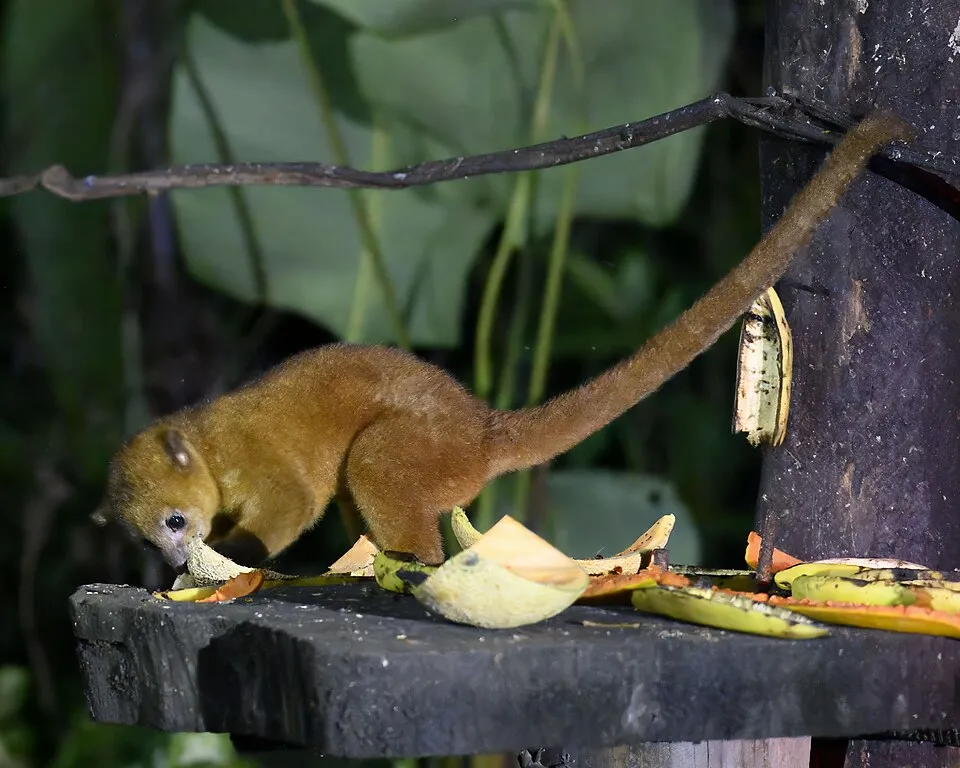
A kinkajou (Potos flavus) can wrap its tail around a branch and hang down to reach fruit. Its paws can then handle the food while its tail keeps it attached to the branch above.
Kinkajous are nocturnal relatives of raccoons. Their grasping tails help them move through overlapping branches and feed among the outer leaves, where their footing can be less secure.
4. Binturong — An Extra Grip for a Slow Climber

The binturong (Arctictis binturong) is a shaggy Asian mammal that moves carefully through trees. The outer third of its tail can curl around a branch, and a leathery patch near the tip helps it grip.
Young binturongs have been observed hanging by their tails alone. Adults are heavier and typically use their feet for extra support when hanging. The tail is especially useful as another point of contact while the animal repositions its paws.
5. Prehensile-tailed Porcupine — Holding On With Both Front Feet Free
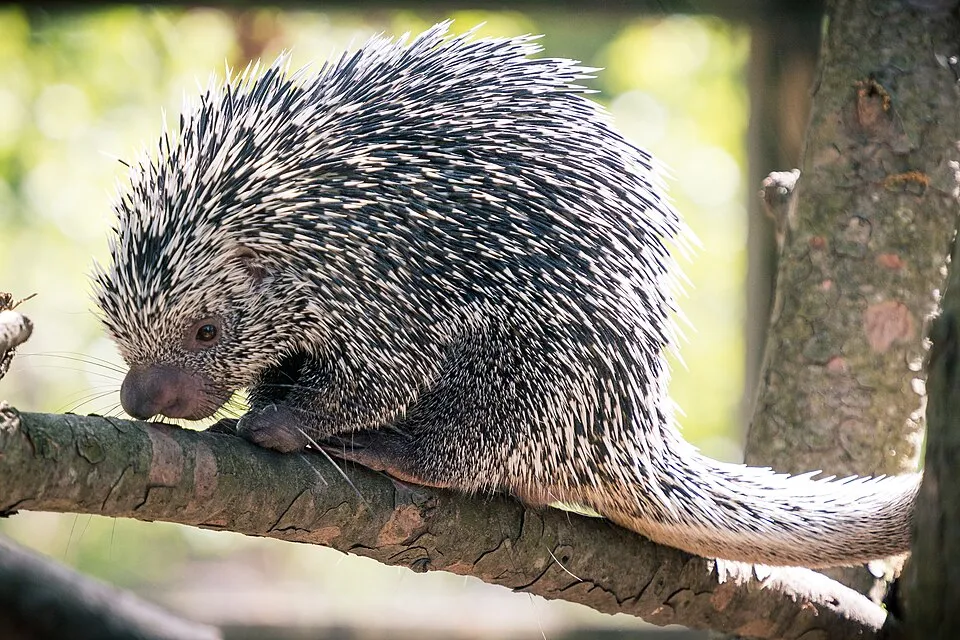
The prehensile-tailed porcupine (Coendou prehensilis) climbs in the forests of South America. The underside of its tail lacks quills where it needs to grip, so it can press that surface against a branch.
A feeding porcupine can anchor itself by the tail while using both front feet to handle food. The bare gripping surface is easiest to notice in a photo that shows the tail wrapped around a perch.
6. Virginia Opossum — Carrying Leaves to a Nest
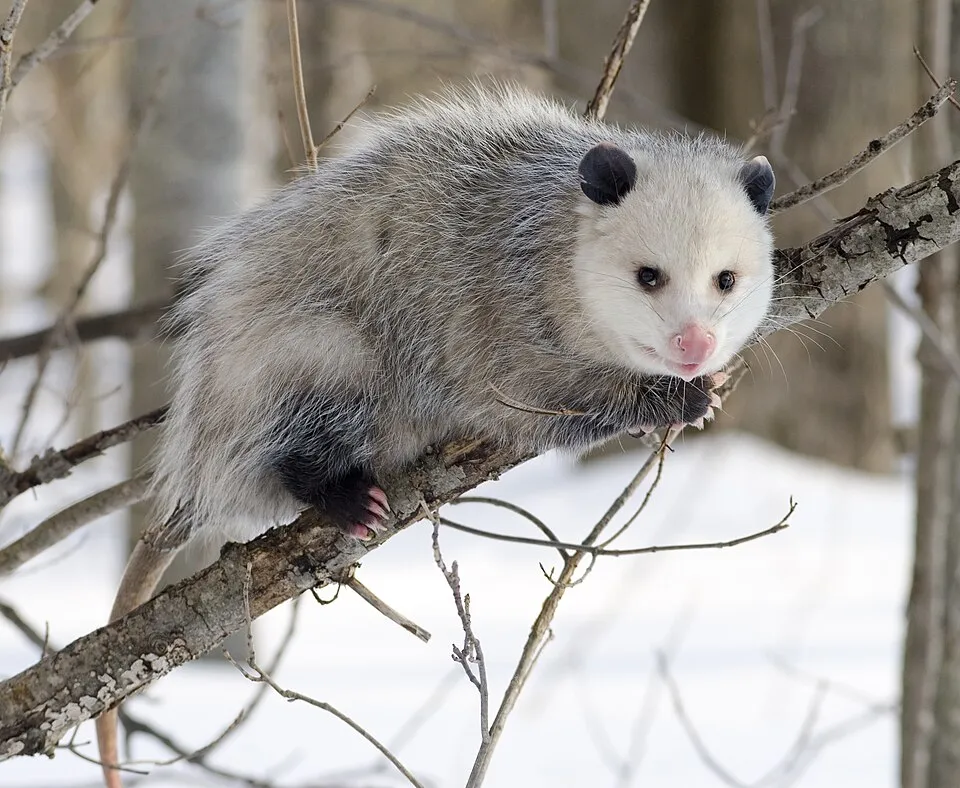
A Virginia opossum (Didelphis virginiana) uses its long, nearly hairless tail to grasp branches and carry nesting material. It can curl the tail around a bundle of leaves and take them to a sheltered nest site.
Its tail is suited to grasping and balancing, while an adult’s weight limits how long it can hang by the tail alone. Carrying leaves is a better example of the tail at work than the familiar cartoon pose of an opossum sleeping upside down.
7. Harvest Mouse — Gripping a Single Grass Stem

A harvest mouse (Micromys minutus) climbs through tall grasses and reeds. Its slender tail can wrap around a stalk, giving it another point of support while its feet move between stems.
This grip is useful in a habitat where the supports bend and sway. Harvest mice also build rounded nests from woven grass leaves, often above the ground among the same stems they climb.
8. Panther Chameleon — Keeping a Hold While Its Feet Move

The panther chameleon (Furcifer pardalis) has grasping feet and a tail that can coil around a branch. The tail gives it another point of contact while it transfers a foot to a new perch.
A tight spiral in the air and a tail wrapped around a twig can look similar in a photograph. To see the grip in action, look for the twig passing through the coil. The tail’s contact with the branch is what provides support.
9. Solomon Islands Skink — A Branch Grip for Life in the Canopy

The Solomon Islands skink (Corucia zebrata), also called the monkey-tailed skink, spends much of its time among rainforest branches. It uses its claws to climb and coils its tail around a branch to steady itself.
The skink feeds mainly on plant material. Its tail helps it stay secure as it moves through the canopy and reaches foliage on nearby branches.
10. Lined Seahorse — An Anchor in Moving Water

The lined seahorse (Hippocampus erectus) can curl its tail around seaweed or another submerged support. Holding on lets it stay in one spot while water moves around it.
From that position, the seahorse can wait for small prey to come within reach of its snout. Its dorsal fin moves it through the water when it swims. Its tail does a different job by securing it to its surroundings.
Frequently Asked Questions
Does a curled tail count as a prehensile tail?
A tail is prehensile if it can grasp and hold something. An animal can carry its tail in a curl without using it to grip. A chameleon wrapped around a branch or a seahorse attached to seaweed shows what the term means in practice.
Can every animal with a prehensile tail hang by it?
The strength and purpose of the grip vary. A spider monkey can support its full weight by its tail. A harvest mouse uses its tail to steady itself on thin stems, and a seahorse uses its tail as an anchor underwater.
Which animal uses its tail to carry leaves?
The Virginia opossum can curl its tail around leaves and other nesting material. It also uses the same tail to grasp branches.
Sources and Further Reading
- Los Angeles Zoo — Geoffroy’s Spider Monkey.
- Wisconsin National Primate Research Center — Red Howler Monkey.
- San Diego Zoo Wildlife Alliance — Kinkajou and Binturong.
- Smithsonian’s National Zoo — Prehensile-tailed Porcupine.
- U.S. National Park Service — Virginia Opossum. Connecticut Department of Energy and Environmental Protection — Opossum tail and climbing behavior.
- Mammal Society — Harvest Mouse.
- University of Florida IFAS Extension — Panther chameleons and other introduced chameleons.
- Marwell Zoo — Solomon Islands Prehensile-tailed Skink.
- Florida Museum — Lined Seahorse. Animal Diversity Web — How lined seahorses use their tails.