Some animals have eyes that seem almost impossible. A fish can look through its own transparent head. A scallop can have up to 200 tiny eyes. A chameleon can look in two directions at once, while a goat’s unusual pupils help it watch for danger across the landscape.
These remarkable eyes are not just unusual in appearance. Their shapes, positions, and internal structures are adaptations that help animals find food, avoid predators, and survive in very different environments.
Here are 12 animals with extraordinary eyes—and the science behind how they see the world.
12 Animals With Extraordinary Eyes at a Glance
| Animal | Extraordinary eye feature |
|---|---|
| 1. Philippine Tarsier | Enormous eyes that barely move in their sockets |
| 2. Barn Owl | Tube-shaped eyes adapted to low light |
| 3. Goat | Horizontal pupils that remain aligned with the ground |
| 4. Panther Chameleon | Eyes that can move independently |
| 5. Gecko | Pupils that can narrow into tiny openings |
| 6. Common Cuttlefish | Distinctive W-shaped pupils |
| 7. Mantis Shrimp | Complex compound eyes that detect polarized light |
| 8. Scallop | Numerous small eyes containing microscopic mirrors |
| 9. Four-Eyed Fish | Split eyes for seeing above and below water |
| 10. Barreleye Fish | Rotating eyes inside a transparent head |
| 11. Dragonfly | Huge compound eyes providing an almost panoramic view |
| 12. American Alligator | Reflective eyes and protective third eyelids |
1. Philippine Tarsier — Enormous Eyes for Night Vision
Scientific name: Carlito syrichta
Where found: Philippines
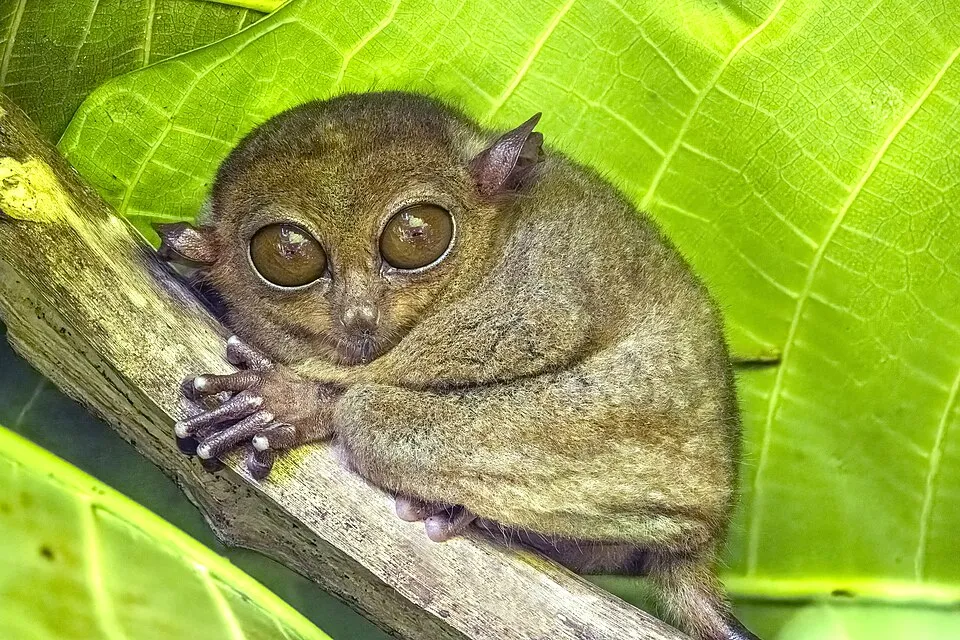
Suggested alt text: Philippine tarsier with enormous round eyes gripping a tree branch in a tropical forest.
The Philippine tarsier is a tiny nocturnal primate with eyes that look almost too large for its head. Its enormous eyes are among the most striking adaptations found in any mammal.
Tarsiers depend heavily on vision to locate insects and other small prey at night. Their large eyes collect light efficiently, helping them detect movement in the dim forest.
But there is a surprising disadvantage to having eyes this large: a tarsier cannot move its eyeballs freely within their sockets.
Instead, it turns its head to look in different directions. Its unusually flexible neck helps compensate for the limited movement of its eyes.
Unlike many nocturnal mammals, tarsiers lack the reflective layer behind the retina that produces the familiar nighttime eye shine of cats and other animals.
What makes its eyes extraordinary?
A tarsier combines exceptionally large eyes with a flexible neck, creating a remarkable visual system for hunting after dark.
2. Barn Owl — Eyes Shaped Like Tubes
Scientific name: Tyto alba
Where found: Widely distributed around the world
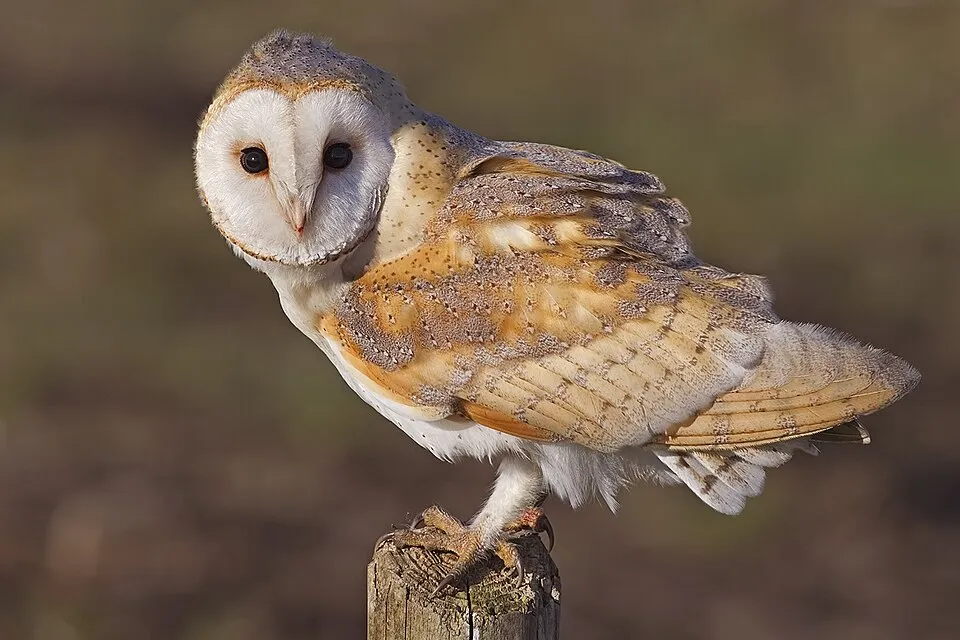
Suggested alt text: Close-up of a barn owl’s heart-shaped face and large forward-facing dark eyes.
Owls are famous for staring intensely at their surroundings, but their eyes work differently from human eyes.
A barn owl’s eyes are elongated rather than nearly spherical. They are held inside rigid structures that greatly restrict eye movement.
This shape helps the eyes collect light, an important advantage when searching for prey in darkness.
However, an owl cannot simply roll its eyes toward something interesting.
Instead, it moves its head. Owls have remarkably flexible necks that allow them to turn their heads through a large arc without moving their entire bodies.
Their forward-facing eyes also provide overlapping visual fields, helping them judge the position of nearby objects.
Barn owls additionally rely on exceptional hearing to locate prey, including small mammals moving through vegetation.
What makes its eyes extraordinary?
Their tubular shape and limited movement make the owl’s entire head an essential part of its visual system.
3. Goat — Horizontal Pupils That Stay Level
Scientific name: Capra hircus
Where found: Worldwide as a domesticated animal

Suggested alt text: Close-up of a goat’s eye showing its elongated horizontal rectangular pupil.
Look closely into a goat’s eye and you will notice something unusual: its pupil is a horizontal slit rather than a round opening.
This pupil shape helps grazing animals maintain a broad view of their surroundings.
For animals that spend much of their time feeding with their heads lowered, watching for approaching predators is especially important.
Researchers have found that goats and certain other grazing animals rotate their eyes as they lower or raise their heads. This helps keep their elongated pupils aligned with the ground.
The horizontal arrangement supports a panoramic view of the landscape while helping the animal monitor activity around it.
It is a useful reminder that unusual pupils are often connected to an animal’s role as predator or prey.
What makes its eyes extraordinary?
A goat’s horizontal pupils and eye rotation help it maintain awareness of the surrounding landscape even while grazing.
4. Panther Chameleon — Two Eyes Looking in Different Directions
Scientific name: Furcifer pardalis
Where found: Madagascar

Suggested alt text: Panther chameleon on a branch with its raised eyes pointing in different directions.
The panther chameleon is well known for its colorful skin, but its eyes are just as extraordinary.
Each eye sits inside a raised, cone-shaped structure. Much of the eye is covered by specialized eyelids, leaving a small opening for the pupil.
Chameleons can move their eyes partly independently, allowing them to inspect different areas of their surroundings.
This ability is particularly useful when searching for small insects while remaining relatively still among branches.
When a chameleon notices prey, its visual behavior changes. The eyes can coordinate to help the animal track the target and prepare its precisely directed tongue strike.
Independent eye movement does not mean that the two eyes always operate separately. Their movements change according to what the animal is doing.
What makes its eyes extraordinary?
The chameleon’s flexible visual system combines broad environmental scanning with coordinated prey tracking.
5. Gecko — Pupils That Can Become Tiny Pinholes
Scientific group: Several nocturnal gecko species
Where found: Warm regions worldwide
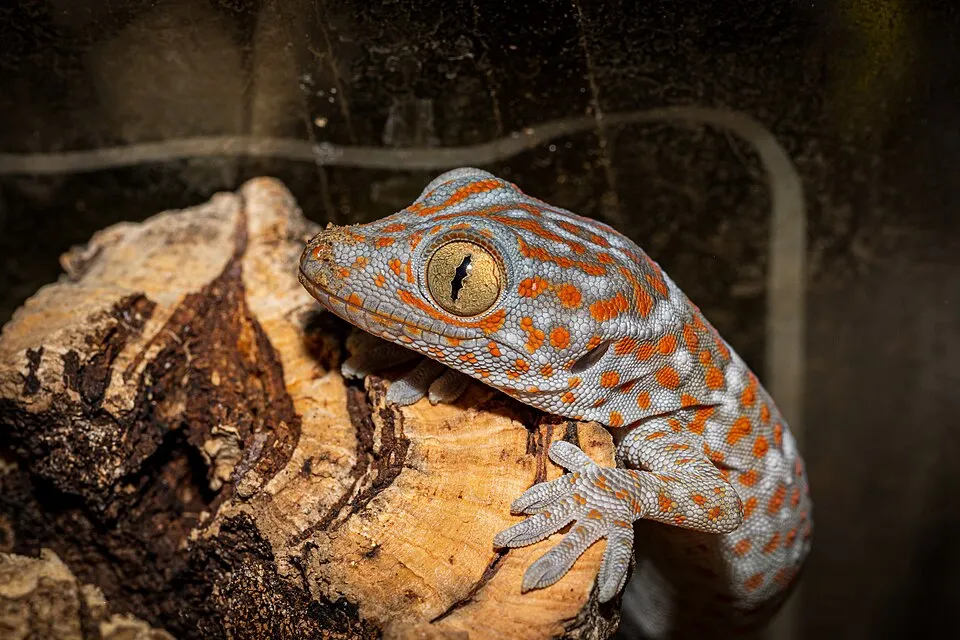
Suggested alt text: Macro photograph of a nocturnal gecko eye with a narrow vertical pupil.
Many nocturnal geckos have large eyes adapted to environments with little light.
At night, their pupils can open widely, allowing more light to enter the eye.
Under bright conditions, however, some species can reduce their pupils to a narrow vertical shape containing several tiny openings.
These openings are sometimes described as pinholes.
The unusual pupil design allows the animal to greatly reduce the amount of light entering its eyes during the day while maintaining useful visual information.
Not every gecko species has the same pupil structure. Day-active geckos and night-active geckos can have significantly different eye shapes.
The variety of gecko eyes illustrates how closely vision is connected to an animal’s daily activity patterns.
What makes its eyes extraordinary?
Some nocturnal geckos can change from a wide nighttime pupil to several tiny daytime apertures.
6. Common Cuttlefish — Strange W-Shaped Pupils
Scientific name: Sepia officinalis
Where found: Eastern Atlantic Ocean and Mediterranean Sea

Suggested alt text: Close-up of a common cuttlefish underwater showing the distinctive W-shaped pupil.
The common cuttlefish has one of the most unusual pupil shapes in the ocean.
Under bright conditions, its pupil forms a distinctive W-like shape. In darkness, the opening becomes more rounded.
This design influences how light enters the eye.
Researchers studying the common cuttlefish found that the W-shaped pupil helps balance illumination across the animal’s visual field, especially in underwater environments where light often comes predominantly from above.
The shape can improve image contrast in parts of the visual field where illumination is weaker.
Cuttlefish also possess remarkable visual systems used for navigating, detecting prey, and interpreting their surroundings.
Although cuttlefish can produce spectacular body colors and patterns, their color vision is not equivalent to the familiar three-cone system of humans.
What makes its eyes extraordinary?
Its W-shaped pupils are a specialized adaptation for managing underwater light.
7. Mantis Shrimp — One of Nature’s Most Complex Eyes
Scientific group: Stomatopoda
Where found: Tropical and subtropical marine environments

Suggested alt text: Close-up of a colorful mantis shrimp showing its two independently movable stalked compound eyes.
Mantis shrimps have some of the most complex eyes found among animals.
Their compound eyes sit on movable stalks, allowing them to examine their surroundings from different angles.
Depending on the species, mantis shrimps possess approximately 12 to 16 types of photoreceptors. Humans normally use three cone types for color vision.
Some mantis shrimps can also detect ultraviolet light and different forms of polarized light, properties of light that humans cannot normally perceive without equipment.
However, having more photoreceptor types does not automatically mean they can distinguish every color more precisely than humans.
Research suggests that mantis shrimp visual processing differs substantially from our own.
Their eyes provide specialized information suited to their underwater environment, including the detection of visual signals and potential prey.
What makes its eyes extraordinary?
Mantis shrimps combine sophisticated compound eyes, independently moving eye stalks, and sensitivity to light properties invisible to humans.
8. Scallop — Up to 200 Eyes With Tiny Mirrors
Scientific family: Pectinidae
Where found: Marine habitats around the world

Suggested alt text: Close-up of an open living scallop showing rows of tiny bright eyes along the mantle edge.
A scallop may look like an ordinary shellfish, but many species have dozens of small eyes along the fleshy edge of their mantle.
Some scallops possess as many as 200 eyes.
Even more remarkably, their eyes contain microscopic reflective structures.
Unlike a typical human eye, which primarily uses a lens to focus light, a scallop eye uses a curved mirror to form an image.
These mirrors contain highly organized layers of tiny crystals.
Scientists have studied this unusual structure because it resembles certain features of reflecting telescope technology.
Scallop eyes help the animal respond to changes in its surroundings, including movement and potential threats.
The individual eyes are small, and their visual capabilities are not equivalent to those of a human eye. Nevertheless, together they provide an extraordinary sensory system.
What makes its eyes extraordinary?
A scallop may have up to 200 miniature eyes, each using a biological mirror to direct light toward its retinas.
9. Four-Eyed Fish — Seeing Above and Below Water
Scientific name: Anableps anableps
Where found: Coastal and estuarine waters of northern South America

Suggested alt text: Four-eyed fish swimming at the water surface with its raised eyes positioned across the waterline.
Despite its name, the four-eyed fish does not actually have four separate eyes.
It has two highly specialized eyes, each divided into upper and lower portions.
The upper part is adapted for looking through air, while the lower part is used for seeing underwater.
When the fish swims close to the surface, it can observe both environments at the same time.
Each eye contains two pupil regions and specialized retinal areas that handle visual information from the two different environments.
This is an important adaptation because light behaves differently in water and air.
A fish that lives along the water’s surface must detect threats and food both above and below it.
What makes its eyes extraordinary?
Its divided eyes give the fish two different views of the world simultaneously, without requiring four separate eyeballs.
10. Barreleye Fish — Eyes Inside a Transparent Head
Scientific name: Macropinna microstoma
Where found: North Pacific Ocean

Suggested alt text: Deep-sea barreleye fish showing its transparent head and visible green tubular eyes.
The barreleye fish looks like a creature from science fiction.
The upper part of its head is covered by a transparent, fluid-filled shield. Beneath that shield are large tubular eyes with greenish lenses.
The fish lives in the dim ocean twilight zone, where detecting small amounts of light can be essential for locating food.
Its eyes often point upward, helping it detect the silhouettes of prey against the faint light filtering down from the surface.
For many years, scientists believed these unusual eyes remained fixed in place.
Underwater observations revealed something surprising: the eyes can rotate within the transparent shield.
When the fish approaches food, its eyes can turn forward, allowing it to keep the target in view.
The small dark spots visible on the front of its face are not additional eyes. They are structures associated with its sense of smell.
What makes its eyes extraordinary?
The barreleye combines a transparent head, highly light-sensitive tubular eyes, and the ability to rotate those eyes while feeding.
11. Dragonfly — An Almost Panoramic View
Scientific group: Anisoptera
Where found: Freshwater habitats and nearby terrestrial environments worldwide
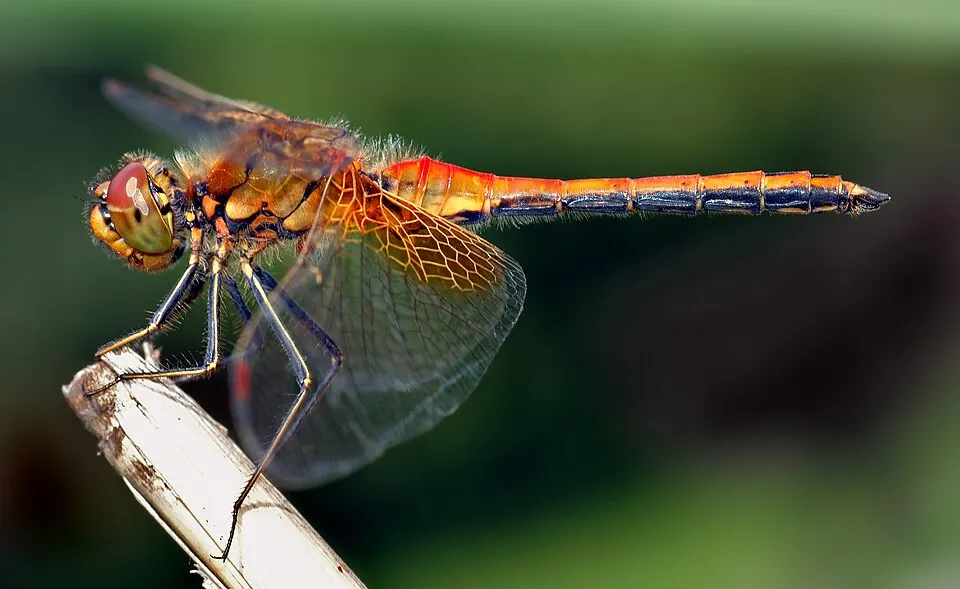
Suggested alt text: Macro photograph of a dragonfly head showing its two enormous compound eyes.
A dragonfly’s head is dominated by a pair of enormous compound eyes.
Each eye is made of thousands of tiny visual units called ommatidia.
In some dragonflies, an individual eye may contain as many as 30,000 of these units.
The combined visual system gives dragonflies an extremely broad field of view, approaching a full panorama of their surroundings.
This is especially useful for an insect that catches other insects in flight.
Dragonflies must detect moving targets, calculate their direction, and adjust their flight rapidly.
Their compound eyes are highly suited to detecting movement and monitoring a large portion of the environment.
Unlike human eyes, dragonfly eyes do not produce an image through one single lens. Instead, the many individual visual units contribute information that the animal’s nervous system processes.
What makes its eyes extraordinary?
Dragonflies use enormous compound eyes to detect movement across an exceptionally wide field of view.
12. American Alligator — A Protective Third Eyelid
Scientific name: Alligator mississippiensis
Where found: Southeastern United States
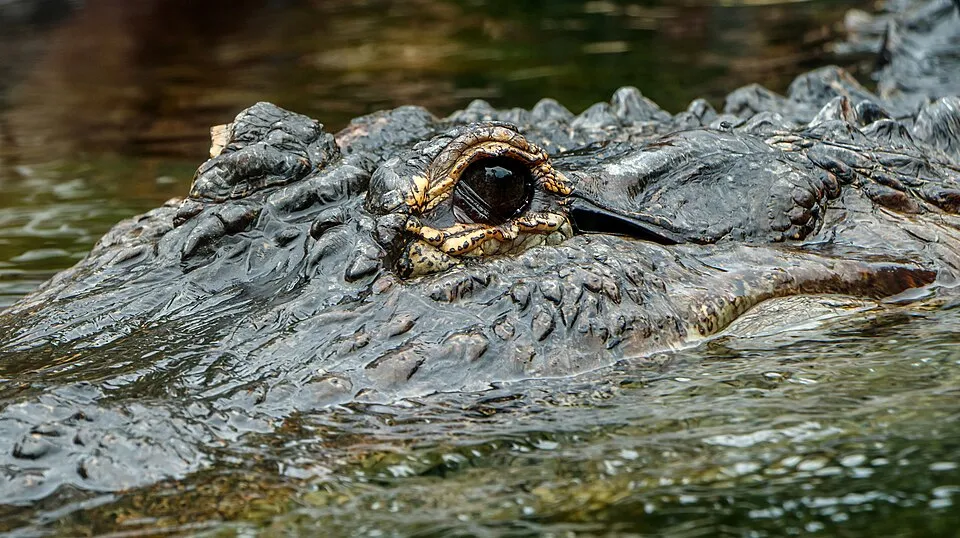
Suggested alt text: Close-up of an American alligator’s eye above the surface of dark swamp water.
American alligators are well adapted to hunting in and around water.
Their eyes are positioned high on the head, allowing them to watch their surroundings while much of the body remains submerged.
One of their most useful eye adaptations is a protective third eyelid called the nictitating membrane.
This translucent membrane moves over the eye to provide protection when the animal is underwater.
It is sometimes compared to a pair of underwater goggles, although an alligator’s underwater vision is not necessarily as clear as its vision in air.
Alligators also possess a reflective layer associated with their visual system that helps them use available light in dark conditions.
This contributes to their noticeable eye shine when illuminated at night.
What makes its eyes extraordinary?
An alligator’s eyes combine protective membranes, low-light adaptations, and a position on the head that supports stealthy observation.
Why Do Animals Have Such Different Eyes?
Animal eyes have evolved in response to different environments and survival challenges.
For some animals, seeing in dim light is essential. For others, detecting movement across a wide field of view is more important.
A predator searching for prey at night faces different visual challenges from a grazing animal watching for approaching danger.
Underwater species encounter additional difficulties because water absorbs and scatters light differently from air.
The remarkable variety of animal eyes can be grouped into four broad adaptations:
Low-light vision: Tarsiers, owls, and some geckos have visual adaptations that help them function in darkness.
Wide-field vision: Goats, dragonflies, and chameleons use specialized eye arrangements to monitor their surroundings.
Unusual optical systems: Scallops, four-eyed fish, and barreleye fish have eye structures that differ dramatically from familiar human eyes.
Specialized light detection: Mantis shrimps and cuttlefish process visual information using systems adapted to their underwater environments.
None of these eyes is universally the best. Each design reflects the particular challenges its animal faces.
Frequently Asked Questions
Which animal has the most unusual eyes?
There is no single scientific winner. Barreleye fish have rotating eyes inside transparent heads, scallops possess numerous mirror-based eyes, and mantis shrimps have unusually complex compound eyes. Each is extraordinary for a different reason.
Which animals can move their eyes independently?
Chameleons are well known for partly independent eye movements. Mantis shrimps can also move their stalked eyes independently. These abilities help the animals scan their surroundings and respond to potential targets.
What animal has the largest eyes relative to its body?
Tarsiers are famous for having exceptionally large eyes relative to their body size, especially among mammals. Their eye size supports vision in low-light environments.
Do any animals have more than two eyes?
Yes. Scallops can have dozens or even hundreds of individual eyes, and many insects possess additional simple eyes alongside their large compound eyes. However, the four-eyed fish actually has only two eyes, each divided into specialized regions.
Can animals see colors humans cannot?
Some animals detect ultraviolet light or polarization patterns that humans cannot normally see. Mantis shrimps are especially well known for their complex light-detection systems. But differences in photoreceptor numbers do not necessarily translate into more precise color discrimination.
Final Thoughts
From the enormous eyes of a tarsier to the mirror-filled eyes of a scallop, the animal kingdom demonstrates that vision can evolve in extraordinary ways.
Some eyes help their owners hunt in darkness. Others provide a wide view of approaching danger, while certain marine creatures use optical systems unlike anything found in human eyes.
These adaptations reveal that an animal’s appearance is often closely connected to how it survives.
The next time you look into an animal’s eyes, remember that it may be experiencing a visual world very different from your own.
Explore more animal adaptations:
15 Animals That Live Underground — Discover how animals adapt to hidden environments beneath the ground.
Scientific References & Further Reading
- Natural History Museum, London. Amazing Eyes: Vision Champions.
- British Trust for Ornithology. Owl Vision.
- University of California, Berkeley. Pupil Shape Linked to Animals’ Place in Ecological Web.
- Ott, M. (2001). Chameleons Have Independent Eye Movements but Synchronise Both Eyes During Saccadic Prey Tracking.
- Mäthger, L. M., et al. (2013). The W-Shaped Pupil in Cuttlefish.
- Natural History Museum, London. Mantis Shrimps.
- Palmer, B. A., et al. (2017). The Image-Forming Mirror in the Eye of the Scallop.
- Monterey Bay Aquarium Research Institute. Barreleye Fish.
- Natural History Museum, London. Dragonflies: The Ultimate Hunters.
- National Park Service. American Alligator.
- New England Primate Conservancy. Philippine Tarsier.
- Banks, M. S., et al. (2015). Why Do Animal Eyes Have Pupils of Different Shapes?.


