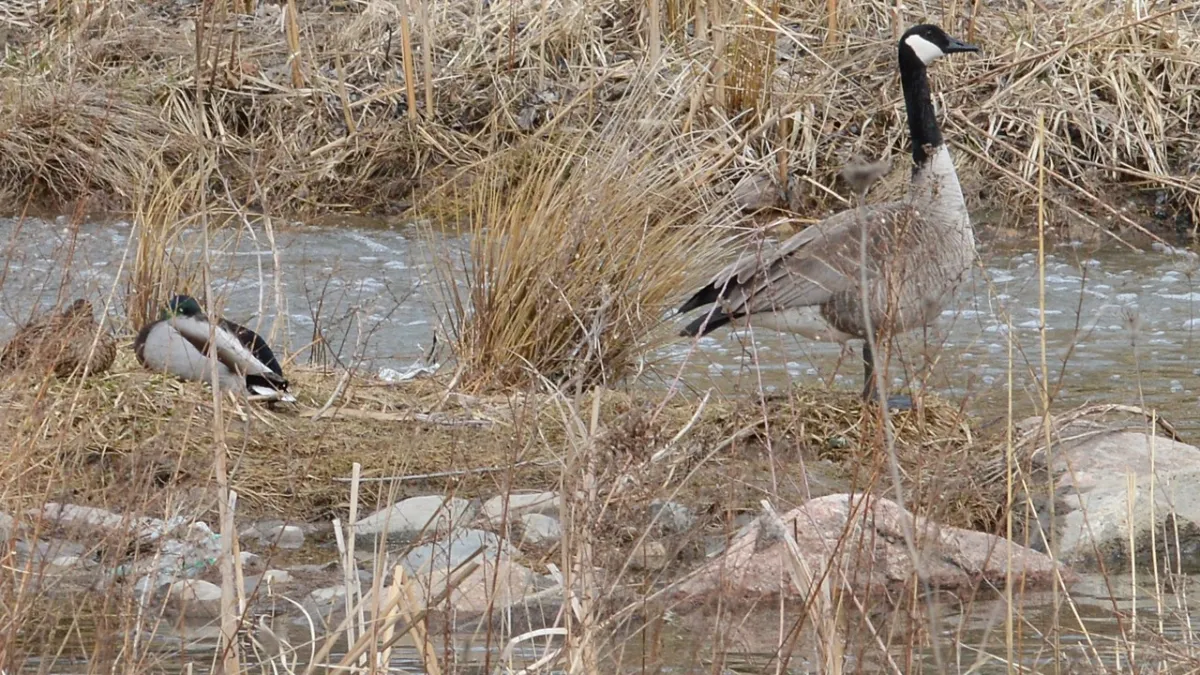
If you’re looking at a Mallard and a Canada Goose, check the cheek and neck first. A Canada Goose has a bold white cheek patch on a black head, above a long black neck. A Mallard is lower and more compact, with a broad bill. The trickier view is a bird resting with its neck tucked in. That’s when a side-on look at its face and bill helps most.
1. Check the cheek
A Canada Goose has a white patch that runs from the cheek under the chin. Birders call it a chinstrap. Both sexes have it. A male Mallard in breeding plumage usually has a green head and a thin white ring lower down on the neck. A female Mallard has a mottled brown face with a dark line through the eye.
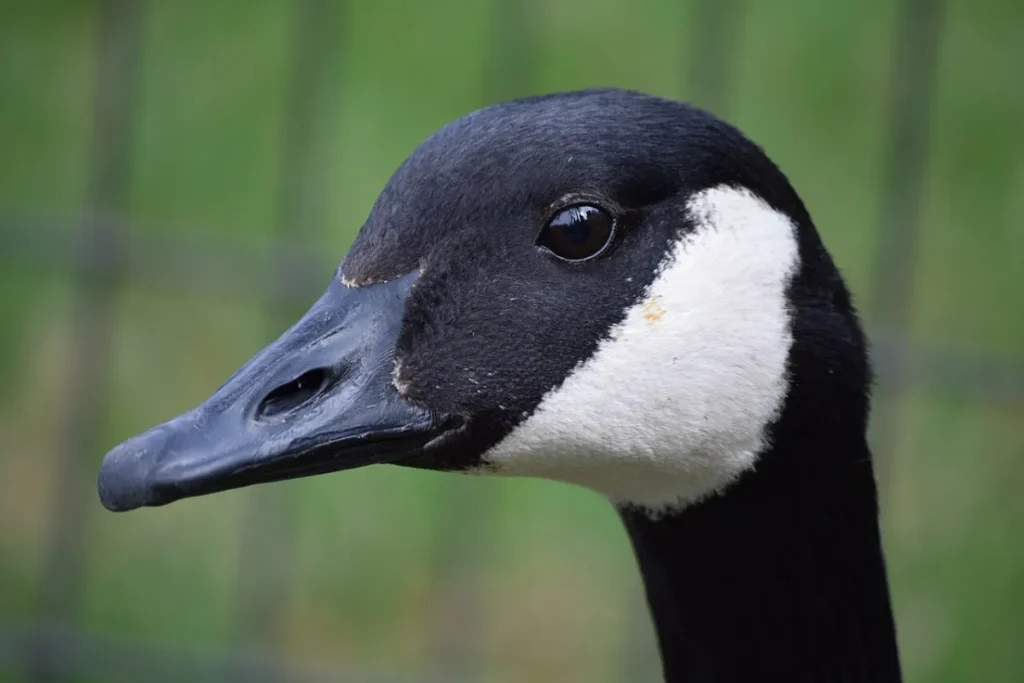
The white cheek patch of a Canada Goose curves below the chin.
2. Compare the neck and body
A Canada Goose stands taller on the bank and carries its head well above its shoulders when alert. A Mallard has a shorter neck and usually sits lower on the water. In the cover photo, the goose’s head rises well above the reeds beside the ducks.
Size helps when the birds are at a similar distance. A Canada Goose is typically 30–43 inches (76–110 cm) long. A Mallard is about 20–26 inches (50–65 cm) long. If one bird is much closer to you, wait for a side view and compare its proportions instead.
3. Look closely at the bill
A Canada Goose has a dark bill that tapers toward the tip. A Mallard’s bill looks broader toward the front, with a rounded tip. The breeding male’s bill is usually yellow. The female’s often shows orange around darker markings.
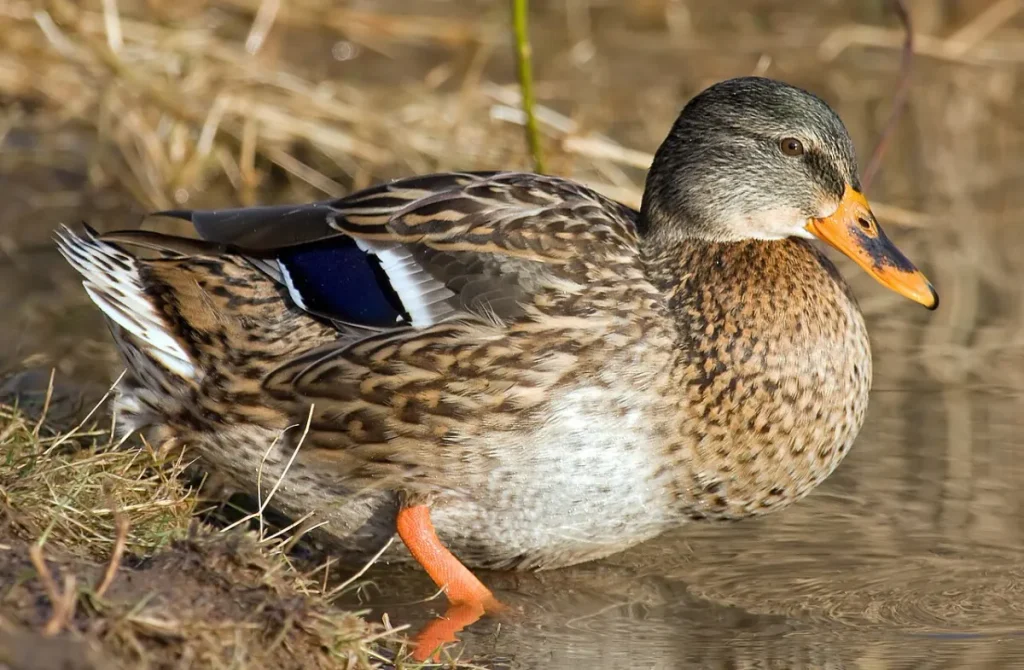
A female Mallard with an orange-and-dark bill and mottled brown feathers.
4. Watch where it feeds
Canada Geese often graze on short grass beside a pond, walking and plucking as they go. Mallards often feed in shallow water by tipping forward, leaving their tails above the surface. Geese can also dabble, so use feeding behavior to back up what you saw on the head and bill.

A female Mallard tips forward to feed below the water’s surface.
5. Listen for a honk or a quack
Canada Geese commonly give loud honks. The familiar series of quacks comes from a female Mallard. A male Mallard usually gives a shorter, softer, raspier call. In a mixed flock, watch which bird opens its bill before matching a sound to it.
One look-alike to know: A Cackling Goose can have a white chinstrap much like a Canada Goose’s. It may be closer to a large duck in size, with a compact body and a short bill. If you see a small bird with that black-and-white face, get a side-on photo that shows the bill and head shape.
Related reading · Why Do Ducks Have Webbed Feet?
Sources
- Cornell Lab of Ornithology · Canada Goose identification and Mallard identification. allaboutbirds.org
- Cornell Lab of Ornithology · Canada Goose calls and Mallard calls. allaboutbirds.org
- Cornell Lab of Ornithology · Canada Goose feeding behavior and Cackling Goose identification.


