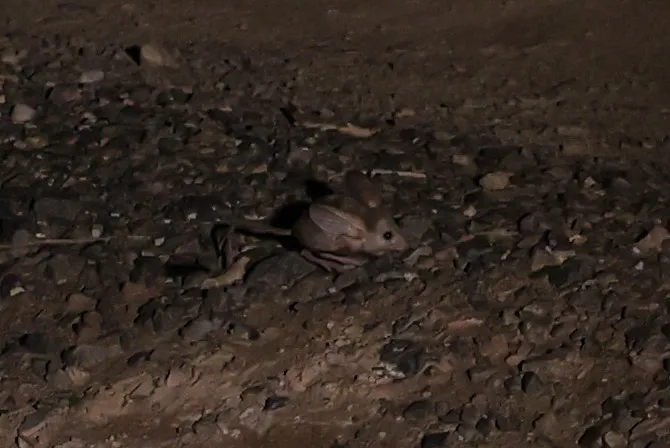
A long-eared jerboa (Euchoreutes naso) is a small rodent from the deserts of Mongolia and China. It has ears longer than its head, hind legs built for hopping, and a tail that can be about twice as long as its head and body combined. After dark, it uses its hearing and jumping ability together to catch insects. Long-eared Jerboa
1. Its ears are longer than its head
The long-eared jerboa’s ears rise well above the top of its head. Its excellent hearing helps it locate flying insects after dark. The ears can also help release body heat, a useful trait in a desert animal. Animal Diversity Web
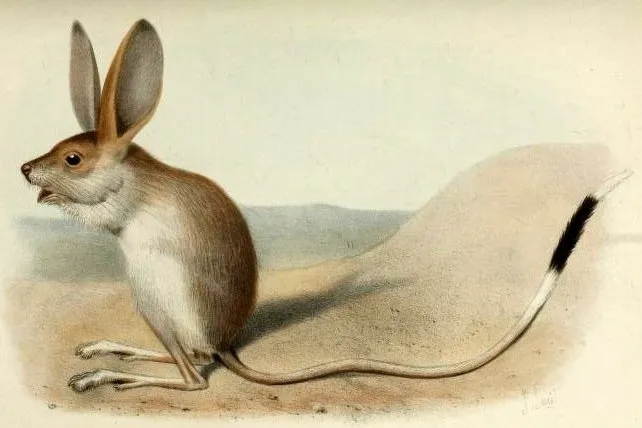
A historical illustration showing the long-eared jerboa’s tall ears and small forefeet.
2. Most of its length is tail
From nose to rump, a long-eared jerboa measures about 7–9 cm (2.8–3.5 inches). Its tail measures roughly 15–16 cm (5.9–6.3 inches) and ends in a black-and-white tuft. Add the tail and the animal can measure around 25 cm (10 inches) from tip to tip. That explains how a rodent with a body short enough to fit in your palm can look surprisingly long in a full-body photo. Animal Diversity Web

A partial skeleton of a long-eared jerboa in the Smithsonian collection. The long row of small bones at the top is the tail.
3. It can jump to catch flying insects
Watch a jerboa on the move and you’ll see how much work its hind legs do. The long-eared jerboa can listen for a flying insect, then spring up to catch it. The same long hind legs that carry it across the desert floor give it the lift it needs to grab prey in the air. Animal Diversity Web

A long-eared jerboa photographed after dark with its tail trailing behind it.
4. It lives in sandy valleys with low shrubs
The species occurs in southern Mongolia and parts of China, including the Gobi region. Researchers have collected specimens in sandy valleys dotted with low bushes. Its range also includes cold, high-elevation desert, so the landscape it lives in can look quite different from one part of its range to another. Long-eared Jerboa
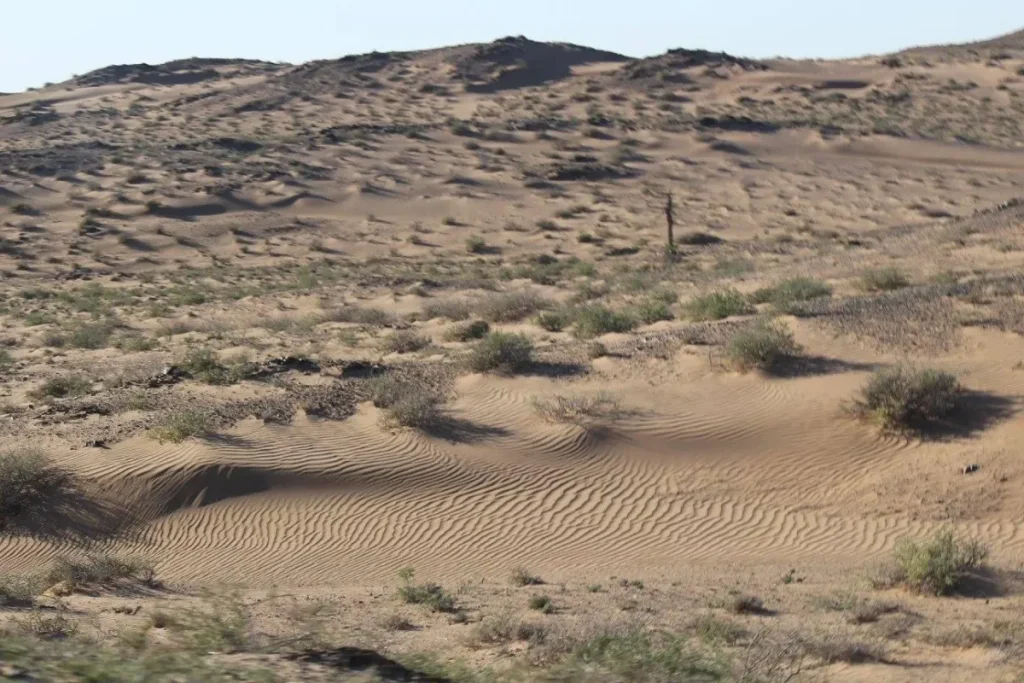
Low shrubs dot the sandy ground in Mongolia’s Gobi Desert.
5. Its nighttime habits make it easy to miss
The long-eared jerboa is thought to be mainly active after dark. In 2007, a Zoological Society of London expedition filmed the species in the wild in Mongolia’s Gobi Desert. The footage makes its proportions easier to appreciate than a still image does. Watch how low it holds its tiny forefeet as it moves on its hind legs. Animal Diversity Web


