
If you saw something hover in front of a flower like a tiny hummingbird, look for two antennae and a thin feeding tube. Those features point to a moth. The tube is called a proboscis. The moth extends it to sip nectar, then coils it up between feeds.
The likely species depends on where you saw it. In Britain, a gray-brown moth flashing orange hindwings is a good match for a hummingbird hawk-moth. In North America, see whether you can look through the center of the wings. If you can, start with the two clearwings below. If the wings have bold pale stripes, compare it with the white-lined sphinx.
Which hummingbird moth did you see?
| What you noticed | Moth to compare | Where to start |
|---|---|---|
| Orange hindwings and a black-and-white tail tuft | Hummingbird hawk-moth | UK and continental Europe |
| Clear wings, pale legs and an olive back | Hummingbird clearwing | North America |
| Clear wings, black legs and a yellow-and-black body | Snowberry clearwing | North America |
| Long pale stripes across brown front wings | White-lined sphinx | North America |
| Two pale bands across a dark abdomen | Nessus sphinx | Eastern North America |
1. Hummingbird hawk-moth

Hummingbird hawk-moth hovering at a flower, with orange hindwings visible beneath the gray-brown front wings.
The hummingbird hawk-moth (Macroglossum stellatarum) often visits sunny gardens in Britain. A side view shows the long proboscis reaching into the flower while the body stays suspended in the air. Watch for a flash of orange beneath the gray-brown front wings and a black-and-white tuft at the end of the abdomen.
If the wings are a blur in your photo, zoom in on the rear of the body. The black-and-white markings can still be visible there. This species is widespread across parts of Europe, Asia and Africa.
2. Hummingbird clearwing

Hummingbird clearwing with transparent wing panels, an olive back and a burgundy abdomen.
The hummingbird clearwing (Hemaris thysbe) has transparent panels bordered by reddish-brown scales. From above, the body often looks olive near the head and burgundy farther back. It hovers at flowers in daylight and is found across much of eastern North America.
If you can see the legs, look for pale cream or yellowish coloring. That is a better clue than the color of the wing border when you’re comparing it with a snowberry clearwing.
3. Snowberry clearwing
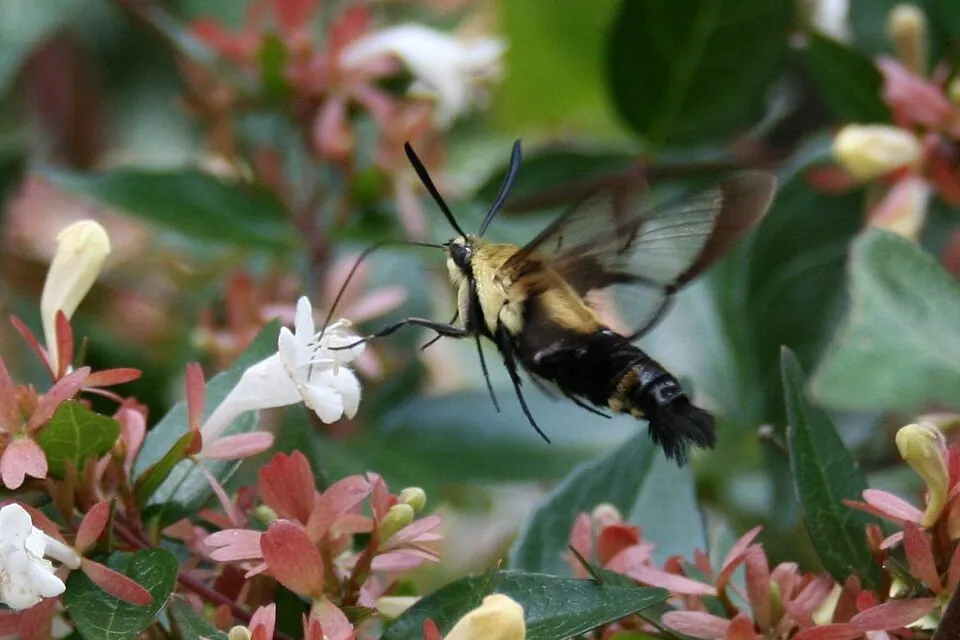
Snowberry clearwing feeding in flight. Look for the yellow-and-black body and dark legs.
From a distance, the snowberry clearwing (Hemaris diffinis) can look like a large bumblebee. It has transparent wing panels and a fuzzy yellow-and-black body. In a sharp side view, look for a dark stripe through the eye that continues along the side of the body.
The black legs help distinguish it from the pale-legged hummingbird clearwing. Both can visit the same kinds of garden flowers, so the flower alone gives you little to go on.
4. White-lined sphinx

White-lined sphinx at rest. Broad pale stripes run toward the tips of the front wings, with finer pale lines along the veins.
The white-lined sphinx (Hyles lineata) has a long pale stripe on each front wing, crossed by finer pale markings along the veins. In flight, you may also catch a flash of pink from the hindwings.
It can hover and feed like a hummingbird, and you may see it around flowers at dusk or in daylight. If it lands, use the long stripes on the front wings as your first check. They are easier to see than the pink hindwings on a resting moth.
5. Nessus sphinx

Nessus sphinx showing two pale bands across its dark abdomen.
The Nessus sphinx (Amphion floridensis) has dark brown front wings and a fuzzy tuft at the end of its abdomen. Its most useful feature is the pair of pale yellow or cream bands across the dark abdomen, just ahead of the tuft.
If you got a photo from behind as it hovered at a flower, check the body before the wings. The bands can be easier to pick out than the orange markings on the moving hindwings.
What to photograph if it comes back
Take a short video from the side and pause it as the moth moves between flowers. Look for a frame showing the wing pattern, legs and abdomen together. Even if the wings stay blurred, pale or black legs can narrow down a clearwing, and two pale abdominal bands can point to a Nessus sphinx. Keep the date and location with the clip so you can compare it with local records.
Related guide
If your insect settles and you can see the tips of its antennae, use this photo comparison to check whether it’s a moth or a butterfly. Moth vs. Butterfly: How to Tell From a Photo
Sources
- The Wildlife Trusts. Hummingbird hawk-moth. The Wildlife Trusts
- Butterflies and Moths of North America. I saw a moth that looks like a hummingbird. What is it? and Hummingbird hawk-moth range. collecting and sharing data about Lepidoptera
- Missouri Department of Conservation. Hummingbird Clearwing, Snowberry Clearwing, White-Lined Sphinx and Nessus Sphinx.


