
Found a jellyfish on a UK beach? Look at the bell, the rounded part of its body. Four rings inside a clear bell point to a moon jellyfish. Brown markings that radiate outwards suggest a compass jellyfish. A thick, pale dome with a violet rim and frilly arms is more likely to be a barrel jellyfish.
Check the markings before relying on colour. Blue jellyfish can be pale, and a jellyfish washed ashore may have lost some of its tentacles. Observe it where it lies. Even dead jellyfish and detached tentacles can still sting.
UK jellyfish identification chart
| What you can see | Jellyfish to check |
|---|---|
| Four pale rings or horseshoe shapes inside a clear bell | Moon jellyfish |
| Brown V-shaped markings radiating across a pale bell | Compass jellyfish |
| Thick, pale dome with a coloured rim and frilly arms underneath | Barrel jellyfish |
| Blue or violet bell with fine lines radiating through it | Blue jellyfish |
| Reddish-brown bell with a mass of long, hairlike tentacles | Lion’s mane jellyfish |
| Small bell dotted with raised pink or purple bumps | Mauve stinger |
1. Moon jellyfish (Aurelia aurita)
A moon jellyfish can look like a clear disc on wet sand. Look through the bell for four pale rings or horseshoe shapes, often tinged pink or purple. These are its reproductive organs. The tentacles around the rim are short and fine, so the rings are often the easiest feature to see. Moon jellyfish are among the most familiar jellyfish on UK shores.
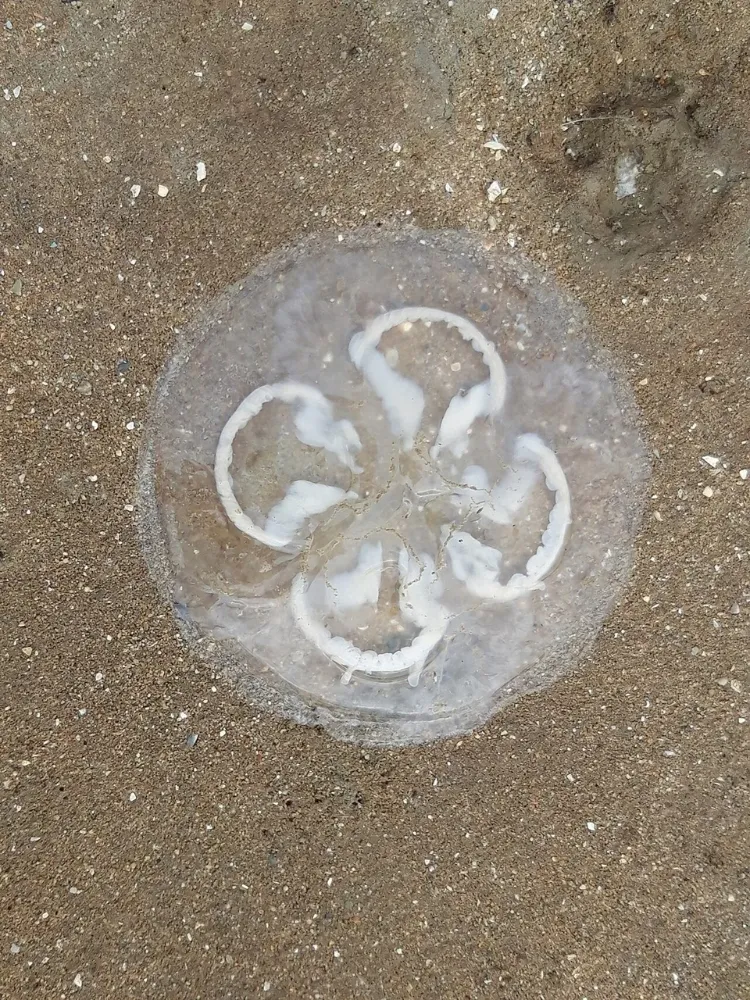
Four horseshoe-shaped marks are visible through the clear bell of this stranded moon jellyfish.
2. Compass jellyfish (Chrysaora hysoscella)
Look for brown V-shaped marks radiating from the centre of a pale bell. In the water, long, thin tentacles trail from the rim and thicker, frilly arms hang from underneath. On the sand, the tentacles may be hard to see, but the pattern on the bell can still identify it. Compass jellyfish can give a painful sting.
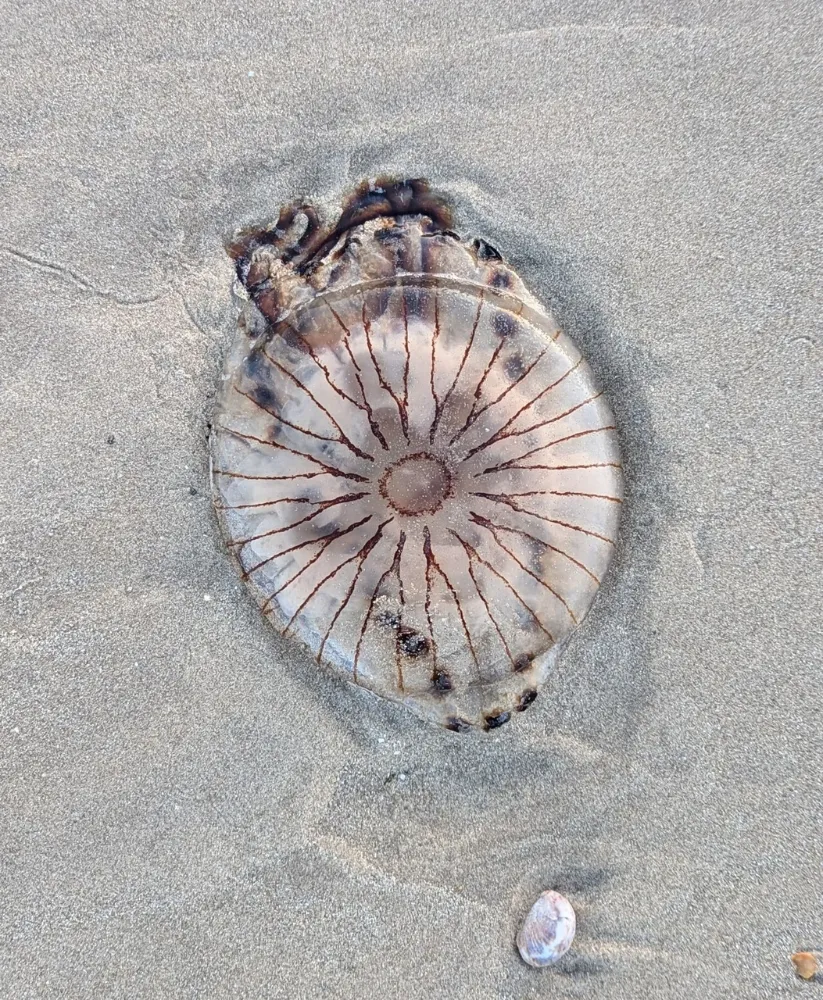
A compass jellyfish washed up at Minnis Bay in Kent. The brown markings are visible from above.
3. Barrel jellyfish (Rhizostoma spp.)
A barrel jellyfish has a thick, mushroom-shaped bell with a rim that is often violet or blue. Underneath are eight thick, frilly feeding arms. These hang from the centre, while the outer rim lacks the long, trailing tentacles seen on a compass jellyfish. If you find a large, pale jellyfish on wet sand, look at its outline from the side without moving it.
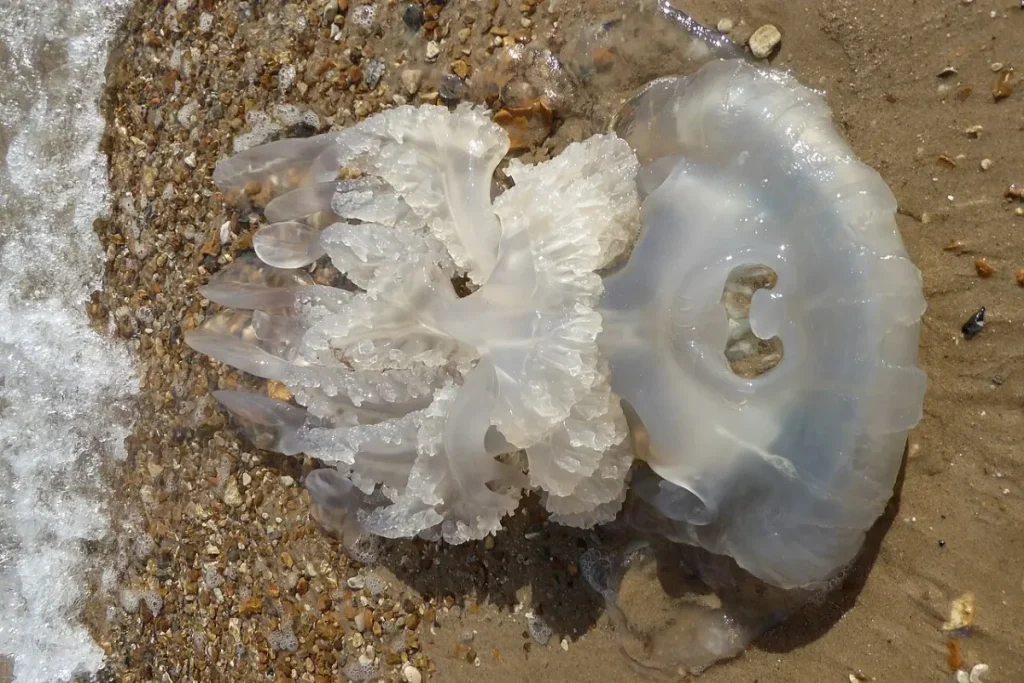
A barrel jellyfish on Bournemouth Beach, with its thick bell and frilly feeding arms visible.
4. Blue jellyfish (Cyanea lamarckii)
A stranded blue jellyfish can look like a blue or violet disc with fine lines running from the centre towards the edge. Some individuals are pale or yellowish, so colour alone is a poor guide. It is generally smaller than a lion’s mane jellyfish, though size can overlap. A small, pale specimen with an obscured bell may be difficult to identify from a single photo.

A blue jellyfish on the beach in Pembrokeshire, Wales. Fine radial lines show through its bell.
5. Lion’s mane jellyfish (Cyanea capillata)
Look for a reddish-brown bell and a mass of fine tentacles that stream behind it like hair. Thick, folded feeding arms sit under the bell. This jellyfish is more often seen in cooler waters around northern Britain. If you can only see the bell, compare the colour and shape with the blue jellyfish, and leave the identification open if the features overlap.

A lion’s mane jellyfish off the Northumberland coast, with long tentacles trailing through the water.
6. Mauve stinger (Pelagia noctiluca)
A mauve stinger is relatively small, with a rounded bell that can reach about 10 cm across. Look for raised pink, purple or brownish spots on the bell and thin tentacles trailing from its edge. The bumps help separate it from a smooth-belled moon jellyfish and from the flat, radiating marks of a compass jellyfish. It is less often encountered in UK waters and can give a painful sting.
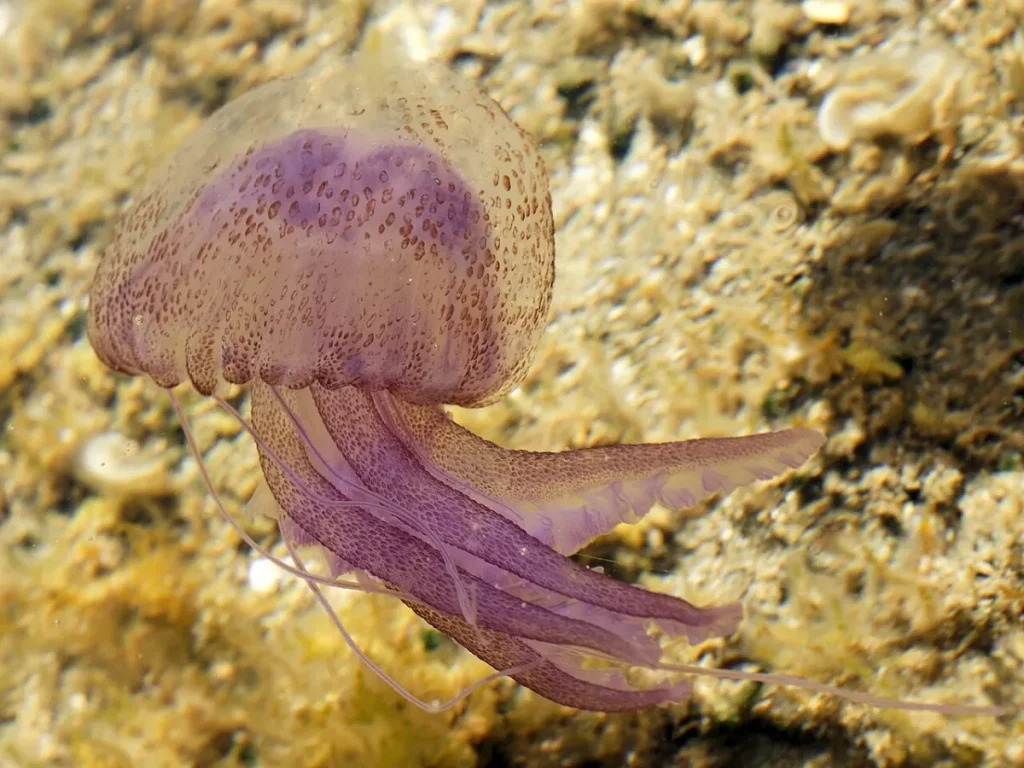
A mauve stinger in a Sardinian rockpool, showing the dotted bell and purple feeding arms.
What if the markings are missing?
Take one photo from above and another from the side, without touching or turning the animal. Note the beach, date and approximate bell width if you can judge it from where you are. If it has an upright sail, a blue or purple float, or looks like a line of clear jelly beads, compare it with our guide to jellyfish look-alikes on the beach.
If you’re stung while swimming, get out of the water and ask a lifeguard for help if one is on duty. Follow the NHS guidance on jellyfish and other sea creature stings.


