
The name tundra wolf usually refers to gray wolves of northern Eurasia historically classified as Canis lupus albus. It also appears in the name Alaskan tundra wolf, which has been used for gray wolves in northern Alaska. Both names describe wolves associated with cold, open country. Where they live matters more than how white their coats look. frontiersin.org
1. The name “tundra wolf” has more than one meaning
Older classifications gave several northern wolf populations their own subspecies names. Researchers have questioned some of those boundaries, especially where wolves from nearby regions overlap in appearance. Here’s what the three names usually mean. frontiersin.org
| Name | Where the name is used |
|---|---|
| Eurasian tundra wolf | A historical name for northern Russian gray wolves classified as Canis lupus albus in some references. |
| Alaskan tundra wolf | A name used in older classifications for northern Alaska gray wolves, including those in the Arctic National Wildlife Refuge and northeastern Brooks Range. |
| Arctic wolf | A name commonly used for High Arctic wolves, including those on Canada’s Ellesmere Island. They are often called Canis lupus arctos. |
2. Wolves live on both sides of the treeline
In northern Russia, wolves occur on open tundra and in the forest-tundra, the transition where scattered trees give way to treeless ground. Alaska’s gray wolves use habitats from the coastal rainforests of the southeast to the Arctic tundra along the Beaufort Sea. Where a wolf lives influences which prey it encounters and how far it may need to travel. environmentandsociety.org

A Nenets camp on the open tundra of southwestern Yamal, Russia.
3. What tundra wolves eat depends on where they live
Reindeer are important prey for wolves in parts of northern Russia. In much of mainland Alaska, caribou and moose are major prey. Farther north on Ellesmere Island, muskoxen and Arctic hares can both be important to local packs. Even within the Arctic, a wolf’s diet reflects what lives nearby. rcin.org.pl
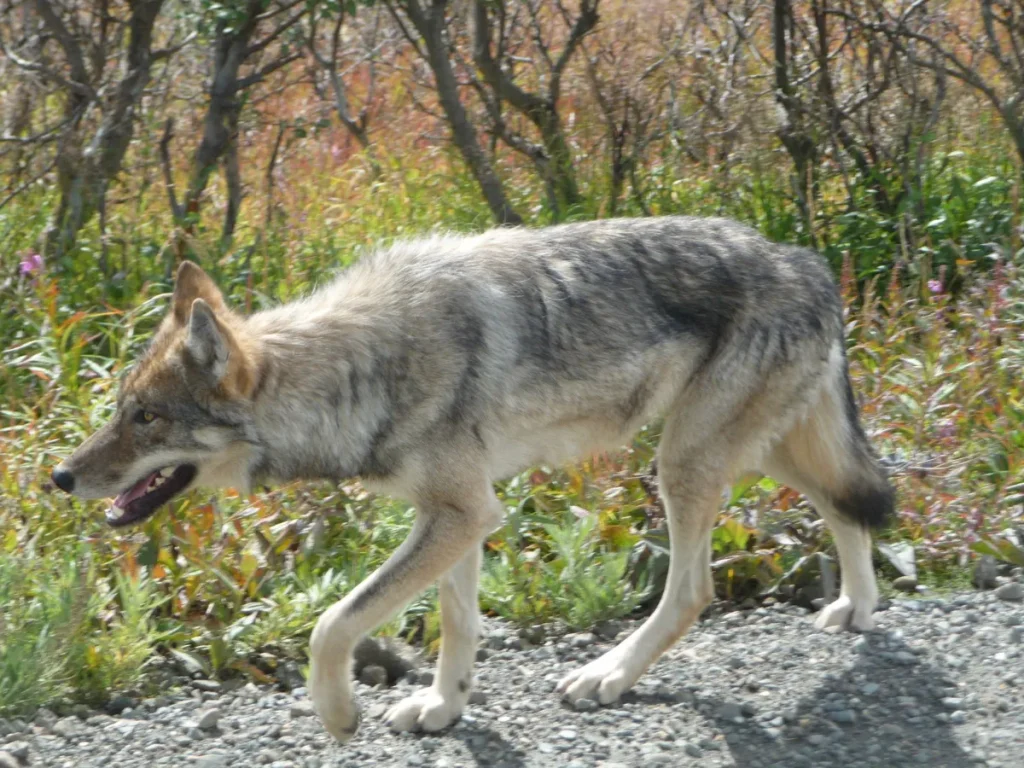
A gray wolf in Denali National Park, Alaska, with a mottled gray and tan coat.
4. Some packs follow caribou for hundreds of miles
Researchers fitted 23 wolves from 19 packs in the central Canadian Arctic with satellite collars. The wolves began spending more time around their tundra dens by late April. In late October, they left their summer ranges and followed caribou toward wintering grounds. oup.silverchair-cdn.com
In the first winter of the study, the straight-line distance from a den to a wolf’s farthest recorded winter location averaged 508 km (316 miles). The second winter’s average was 265 km (165 miles). The difference shows how much the same seasonal routine can vary from year to year. oup.silverchair-cdn.com
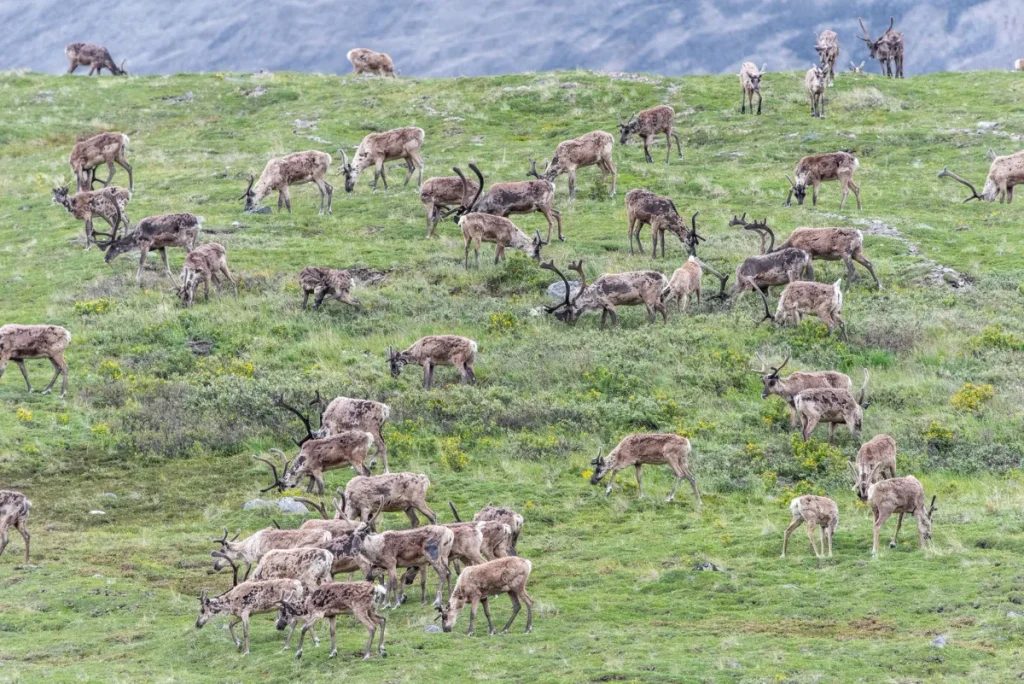
Caribou graze during their northward migration in Alaska’s Arctic National Wildlife Refuge.
5. A warm winter coat can come in many colors
The gray wolf’s soft, dense undercoat helps it retain heat beneath a layer of longer guard hairs. In Alaska, wolves can be nearly white, tan, gray, or black. High Arctic wolves such as those on Ellesmere Island are often white year-round. If you’re trying to identify a wolf from a photograph, the location is a better starting point than the coat color. wolf.org
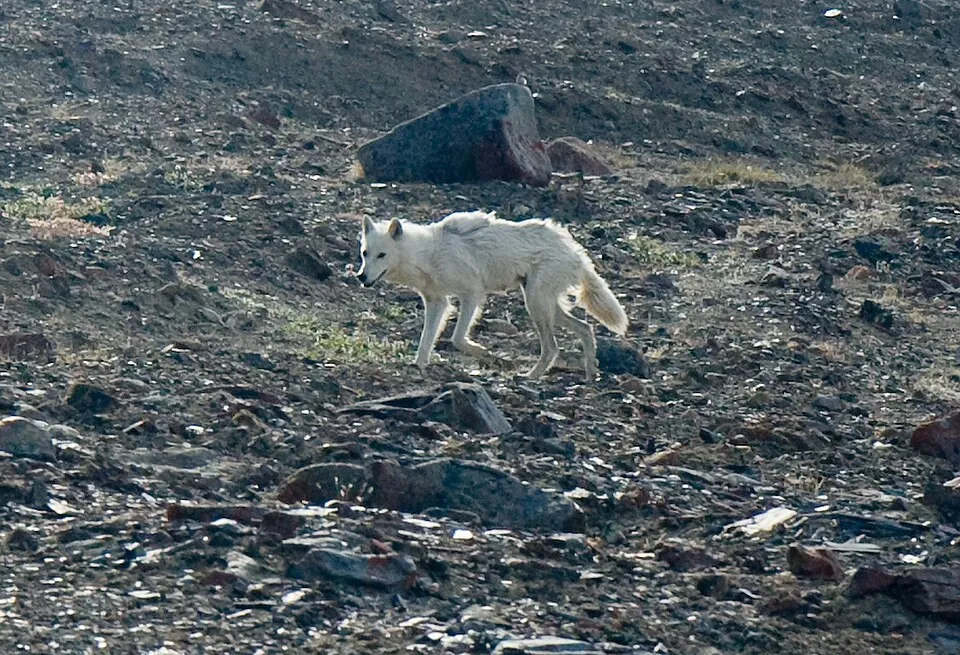
A white Arctic wolf crossing rocky ground on Ellesmere Island, Canada.
Sources
- Werhahn et al. — A Review of Available Data on Asian Wolves
- Alaska Department of Fish and Game — Wolf Species Profile
- Alaska Department of Fish and Game — Wolves of the Arctic National Wildlife Refuge
- Walton et al. — Movement Patterns of Barren-Ground Wolves in the Central Canadian Arctic
- L. David Mech — Arctic Wolves and Their Prey
- International Wolf Center — Winter Coat and Cold-Weather Adaptations


