
An eastern screech-owl and a western screech-owl can look almost identical in a quick photograph. If you hear one, listen for the rhythm. The eastern screech-owl often gives a steady trill, while the western screech-owl’s signature hoots come closer together toward the end. In a sharp photo, the bill offers another clue.
| What to check | Eastern Screech-Owl | Western Screech-Owl |
|---|---|---|
| Signature sound | A steady trill or a descending whinny | A short string of hoots that speeds up |
| Bill | Usually paler where the ranges meet | Usually dark gray to black |
| Plumage | Gray, brown, or rusty red | Often gray or brownish, with regional variation |
| Range | Mainly eastern and central North America | Mainly western North America |
1. Listen for the pace of the hoots
The eastern screech-owl’s trill can sound like one continuous vibration. It holds roughly the same pitch for several seconds. The bird also has a shorter, downward-sliding call that sounds a little like a horse’s whinny.
An eastern screech-owl trills in Minneapolis, Minnesota.
The western screech-owl’s best-known song starts with separated hoots. The gaps get shorter, like the last few bounces of a dropped ping-pong ball. Listen for that change in spacing. Female western screech-owls can also whinny, so a whinny by itself can leave the identification open.
A western screech-owl gives a short series of accelerating hoots in Baja California Sur, Mexico.
Hear more examples in the Eastern Screech-Owl Sounds guide and the Western Screech-Owl Sounds guide.
2. Zoom in on the bill
In areas where both species occur, an eastern screech-owl generally has a lighter bill. The western screech-owl’s bill is typically dark gray or black. Look at the exposed tip between the facial feathers. Shadows can make a pale bill look darker, so a well-lit photo gives you a better view.
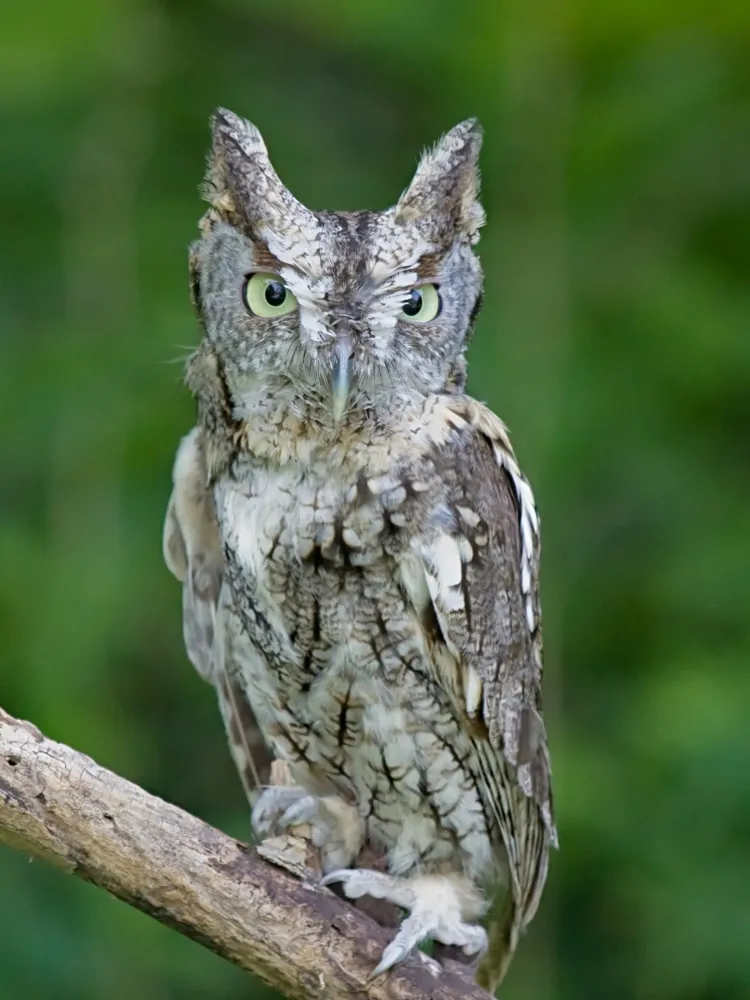
A gray eastern screech-owl with a pale bill.
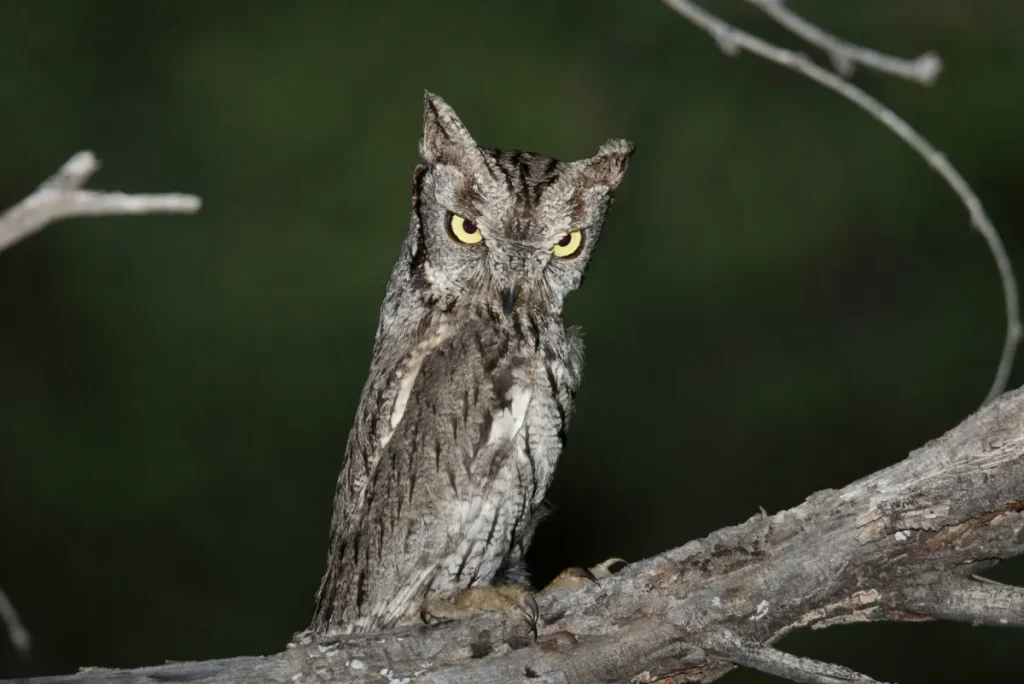
A western screech-owl with a dark bill framed by pale facial feathers.
3. Use plumage and location together
A bird with a rich rusty-red body is a strong clue for eastern screech-owl. A gray bird is harder to place. Both species can have yellow eyes, pointed ear tufts, and finely patterned feathers that blend into bark.
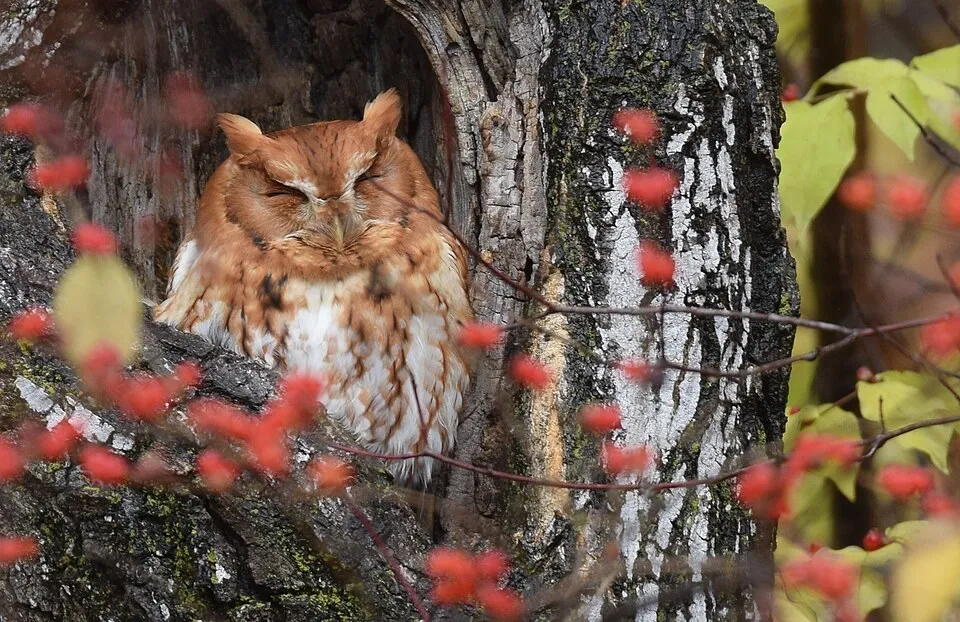
A rusty-red eastern screech-owl rests in a tree cavity.
Most of the two species’ ranges are separate, so the location of a sighting can narrow the choices before you compare feathers. Where the ranges come close, try to capture a full calling sequence. The rhythm gives you something to compare even if the owl stays hidden.
Sources
- Cornell Lab of Ornithology. Eastern Screech-Owl Sounds. allaboutbirds.org
- Cornell Lab of Ornithology. Western Screech-Owl Sounds. allaboutbirds.org
- Cornell Lab of Ornithology. Eastern Screech-Owl Identification and Similar Species. allaboutbirds.org
- American Bird Conservancy. Eastern Screech-Owl.


