
A bluebottle jellyfish on the beach often looks like a small, glassy bubble with a blue thread trailing across the sand. The bubble is a gas-filled float, and the thread is a tentacle that can still sting after it washes ashore. If you find several bluebottles along the same stretch of beach, wind and surface currents may have carried them in together. The Australian Museum
1. Look for the inflated float
Start with the part that looks like a tiny bottle or balloon. A bluebottle’s float is translucent and often pale blue, with a raised crest along the top. The crest sometimes has a pink or purplish edge. On wet sand, the float can partly collapse, leaving a clear, wrinkled pouch beside a tangle of deeper blue tissue. The Australian Museum

A stranded Australian bluebottle with a translucent float and dark blue tentacles.
2. Follow the blue thread with your eyes
A fishing tentacle can extend well beyond the float, so the bluebottle may take up more space on the sand than the little bubble suggests. The tentacle can lie straight, coil near the float, or break away. A loose strand can still sting, even when there’s no float nearby. Western Australian Museum
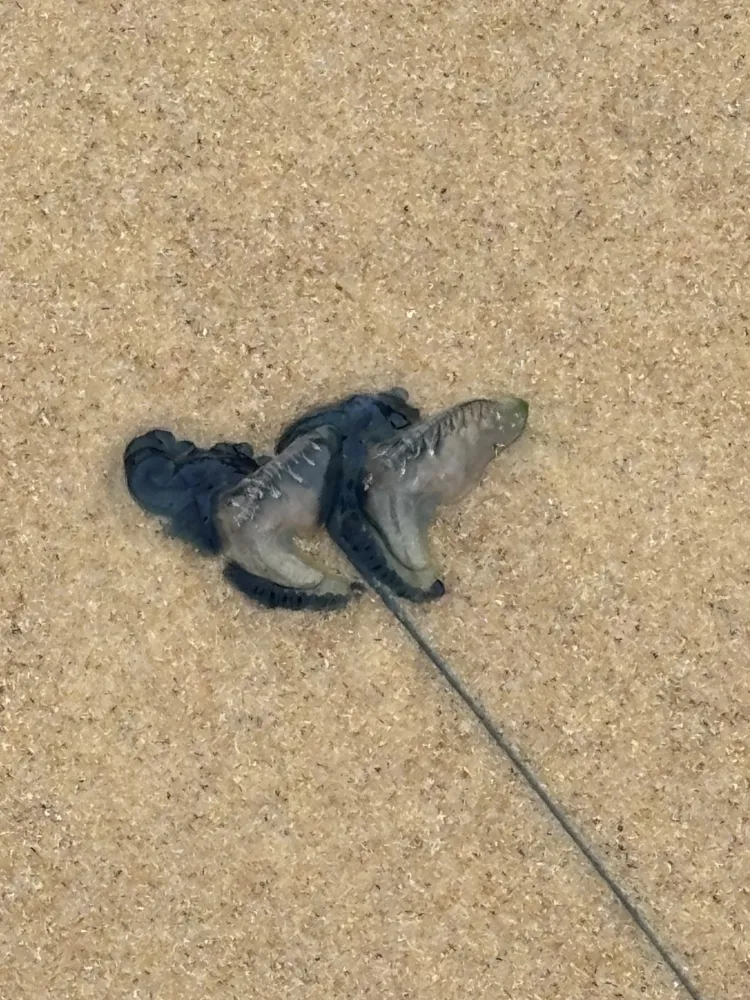
A long bluebottle tentacle trails across the wet sand at Coogee Beach, Australia.
3. A bluebottle is a colony
The animal commonly called a bluebottle jellyfish is a siphonophore. Its colony is made up of connected units called zooids. Some catch prey, others digest food, and others handle reproduction. The gas-filled float holds the colony at the surface while the fishing tentacle hangs below. The Australian Museum
The familiar Australian bluebottle is known as Physalia utriculus. The Atlantic Portuguese man-of-war, Physalia physalis, is a close relative. A 2025 genetic study helped clarify the distinction, which is why older guides may use P. physalis more broadly. unsw.edu.au
4. Wind can bring many bluebottles ashore at once
A bluebottle drifts at the surface, where the wind pushes against its raised crest and currents carry it along. When those forces move floating colonies toward land, many can wash up on the same beach. The Australian Museum
There’s a twist. Some bluebottles have a sail angled to the left, while others have one angled to the right. Under the same wind, the two forms can drift in different directions. The direction of the wind matters, and so does the angle of the sail. unsw.edu.au

Bluebottles stranded together at Maroubra Beach in Sydney, Australia.
5. Compare the shape with two blue look-alikes
Blue is the first thing you notice. Shape is the better clue. Look for an inflated pouch, a flat oval with a sail, or a round disc with a fringe. The Australian Museum
| What you found | What to look for |
|---|---|
| Bluebottle (Physalia) | A raised, balloon-like float. A long blue strand may trail away from it. |
| By-the-wind sailor (Velella velella) | A flat oval disc with a thin, upright sail. From the side, the sail looks like a clear fin. |
| Blue button (Porpita porpita) | A round central disc with a fringe spreading outward, easiest to see from above. |

A by-the-wind sailor has a flat oval disc and a thin, upright sail.
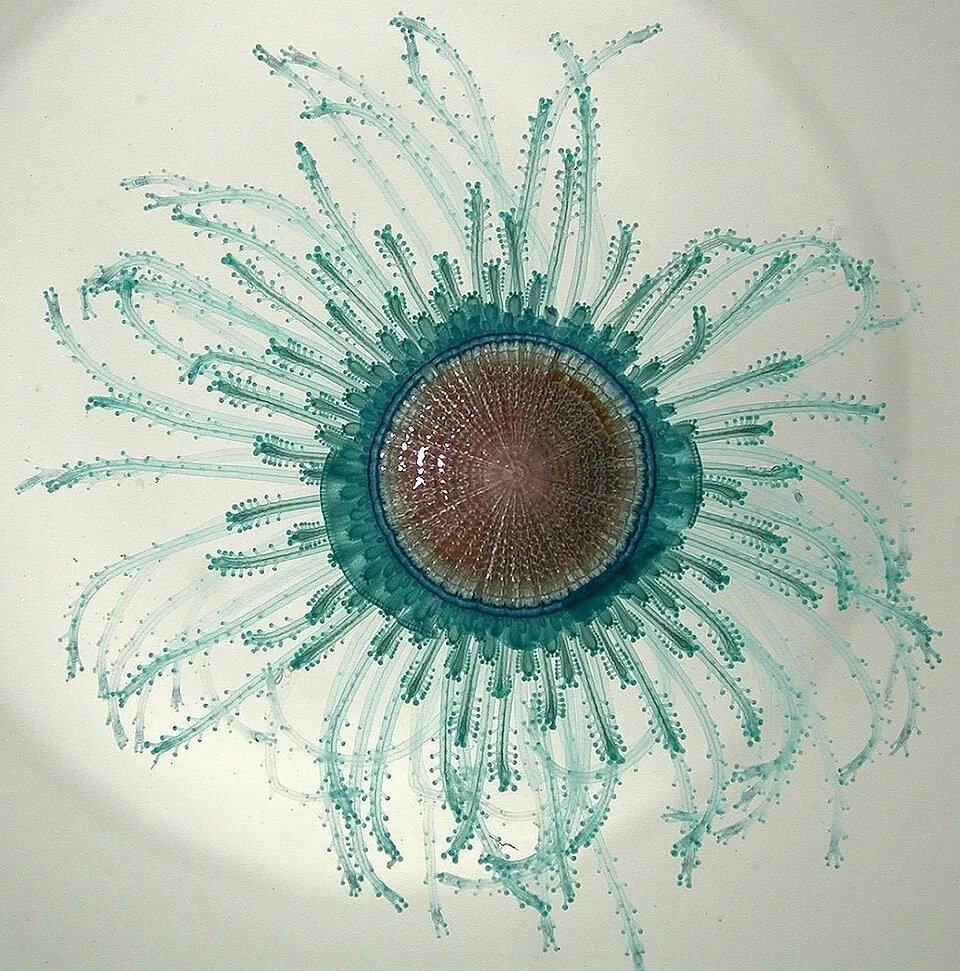
Viewed from above, a blue button has a round center with branches radiating from the edge.
Sources
- Australian Museum — Bluebottle
- Western Australian Museum — Bluebottles
- UNSW Sydney — BluebottleWatch
- Church et al. (2025) — Population genomics of a sailing siphonophore
- National Parks and Wildlife Service South Australia — Five Mistaken Marine Identities
- Texas A&M University at Galveston — Blue Button


